What the drawing asked for
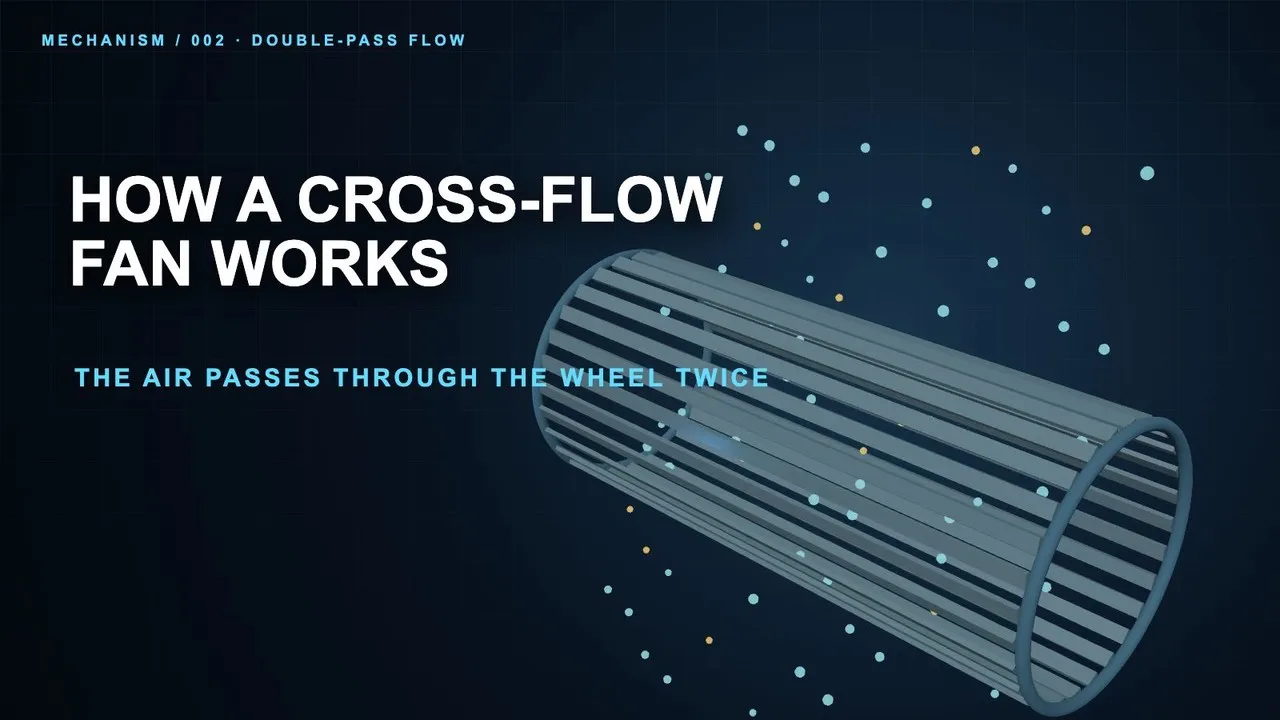
A Southeast Asian HVAC OEM sent a drawing for a cross-flow impeller going into a new mini-split air conditioner, impeller material included.
It looked like a straightforward build-to-print job with one size change: 101.5mm diameter over a 567mm length at 1500 RPM. However, the impeller material did not fit that duty.
What the drawing specified
The impeller material on their drawing was SAN with 20% glass fiber. Their shaft bore was 6.0mm, and their end product is a bedroom appliance, so noise mattered without being stated as a number.
Nothing about that was unreasonable. Even so, one detail sat awkwardly against the operating speed.
Why we proposed a different impeller material
A direct copy was the easy option. Certainly we considered it, then proposed something else.
What the material has to survive
At 1500 RPM over 567mm of span, two failure modes matter and neither shows up in a first article inspection.
First comes blade flutter. Blades that lack stiffness oscillate at speed, which makes noise and eventually fatigue. Second comes creep. Plastic under sustained load deforms slowly, so the profile drifts over years. Consequently airflow falls while noise rises.
What we changed
Instead we proposed an impeller material of AS with 30% glass fiber.
AS is stiffer and harder at the surface than SAN. Meanwhile raising glass content from 20% to 30% adds tensile strength and dimensional stability. Together they address flutter at speed and resist creep over the product life.
Consequently the aerodynamic profile stays as designed rather than slowly changing, which matters for a unit that sits in a bedroom for a decade.
How the blades are joined
Notably the blades join the end rings by ultrasonic welding rather than fastening or bonding.
That adds no mass and no imbalance, which is exactly what a tight balancing figure needs. By contrast screws and adhesives add local weight, and both can loosen or degrade.
The balance figure
Our internal standard is residual unbalance at or below 0.3g measured at 1200 RPM.
That is tighter than typical for this class, and it exists because of what people notice. A homeowner does not hear blade passing frequency. Rather, they hear a low-frequency hum from residual imbalance, and that is the complaint reaching the OEM.
What it cost
A slightly higher material price. Glass content and a stiffer base resin both cost more than the original specification.
It is a small increase against a warranty claim on a bedroom appliance, and we said so rather than quietly quoting the cheaper build. The customer accepted the change.
Technical Specifications
Here the material row below is not the one the customer originally sent. That change is the subject of this case.
| Parameter | Value | Unit |
|---|---|---|
| Part Number | LWPI-Φ101.5×567-01 | – |
| Overall Diameter | 101.5 | mm |
| Overall Length | 567 ± 2 | mm |
| Shaft Bore Diameter | 6.0 | mm |
| Material | AS+GF30% (Acrylonitrile Styrene + 30% Glass Fiber) | – |
| Color | Black | – |
| Balancing Specification | ≤ 0.3g @ 1200 RPM | g |
| Maximum Test Speed | 1600 (no abnormal sound) | RPM |
| Radial Runout Tolerance | < 0.7 | mm |
| Axial Runout Tolerance | < 0.6 | mm |
Technical Documentation
The following documents were central to the project’s success, from initial briefing to final production approval.
Final Specification Sheet (LWPI-Φ101.5×567-01)
This is the final approved specification sheet for the impeller, containing all mechanical dimensions, material specifications, and quality control parameters for OEM integration.

The engineering drawing for the LWPI-Φ101.5×567-01 details all critical dimensions, tolerances, and assembly notes required by manufacturing and quality assurance teams.
Customer Baseline Drawing
The document is the customer’s original baseline drawing, used by Longwell’s engineering team as the starting point for analysis and solution development.
If you are sending a build-to-print drawing
Build-to-print is a legitimate way to buy a part. Even so, it works better with a few things stated.
- Say whether the drawing is fixed or advisory. Some drawings are locked by a qualification program and must not change. Others are a starting point. Telling your supplier which one you have sent determines whether they raise concerns or simply comply.
- Give the operating speed and expected life. An impeller material that is fine at 800 RPM can flutter at 1500. Without the duty, a supplier can only match what you named, rather than check whether it suits.
- State the noise expectation, even roughly. A number is best, though even “residential bedroom” is enough to tell an engineer that balance and material stiffness matter more than usual.
- Ask what the supplier would change. A supplier who has built thousands of similar parts has seen the failures. If they have nothing to suggest, that is worth knowing too.
See our cross flow fan range, the cross flow impeller section, or fan impellers. Appliance safety follows IEC 60335-1.
Questions about impeller materials
What is the practical difference between SAN GF20 and AS with GF30?
Stiffness and stability, mainly. AS has a harder surface and higher rigidity than SAN. Meanwhile the extra 10% glass fiber raises tensile strength and dimensional stability. In a long impeller at speed, that impeller material resists both flutter and slow creep, which keeps the profile true over years.
What does creep actually do to a fan?
It deforms the blades slowly under sustained load, so the profile drifts from what was designed. Airflow falls gradually and noise usually rises. It happens over years rather than weeks, which is exactly why it never appears in prototype testing and does appear in warranty data.
Why balance at 1200 RPM if the fan runs at 1500?
Because 1200 RPM is our standard measurement condition for this class, which keeps figures comparable across parts. Imbalance force rises with the square of speed, so a part meeting 0.3g at 1200 RPM has a known, predictable behavior at 1500. Tell us your operating speed and we can state the figure at that point instead.
Will you build exactly to my drawing if I insist?
Yes, provided it is safe and manufacturable. If we think a specification will cause a problem, we will say so once, in writing, with the reasoning. After that the decision is yours, and we build what you specified.
Technical Documentation & Resources
Sizing something comparable?
Share the airflow, pressure, voltage and control interface, and we come back with a tested curve and a drawing. Meanwhile custom work runs to 90 days for spec sheets and samples. Since 1990 Longwell has supplied fans to HVAC and industrial OEMs.
Browse Related Products:
🏆 ISO 9001 / ISO 14001 / ISO 45001 | CE (TÜV) | UL/ETL | ATEX Zone 21/22 | AMCA 210/211 / ISO 5801 tested