A 1600-unit order with an unusual line
A domestic system integrator ordered 1600 DC axial fans for industrial equipment, and alongside the airflow and ingress requirements sat a line most specifications never carry: fan weight, capped at 1050 grams.
The reason is structural. Namely, these fans bolt to sheet metal mounting panels, and every gram hangs on that panel through years of vibration.
The performance envelope
- First, 568.95 CFM from a 200 by 200 by 60mm envelope, on a 12 to 26.5 VDC bus.
- Next, IP56, because the equipment meets water as well as dust.
- Meanwhile 68.82 dB(A) absolute maximum, holding near 65.8 in normal duty.
- Finally, UL94V-0 plastics, PWM control with FG speed feedback, and UL1007 22AWG leads at 300mm.
Why weight earns a line in the spec
A heavy fan on thin sheet metal is a slow-motion problem. First the panel flexes with every start, then the mounting holes stretch, and vibration that began in specification drifts into rattle.
Multiply by 1600 units in the field, and fan weight stops being a shipping detail and becomes a warranty exposure.
Where the grams went
Getting 569 CFM out of a 200mm frame at under 1050 grams means every component must argue for its mass.
Why not AC, in one line
An AC fan needs an added power supply on this 24 VDC system, which costs depth the 60mm envelope does not have, money the 1600-unit order multiplies, and weight the panel cannot take.
The aggressive part
Here the airflow demands a 7-blade PBT impeller at 3000 RPM, developing about 277 Pa of shutoff pressure. Meanwhile the fan weight budget rules the material.
PBT earns its place twice here. It meets UL94V-0 flammability, and it weighs a fraction of the die-cast alternatives that would have spent the whole budget on the first component.
Where the remaining grams sit
Dual ball bearings carry the 3000 RPM duty and the vibration life, so they are not the place to save mass. Instead, the housing is, and so is the impeller, which is why both are engineered plastics rather than metal.
Consequently the shipped unit holds the full performance specification with margin under the 1050 gram cap, and the panel design the customer already tooled stays untouched.
The feedback wire that guards it all
A 4-wire harness carries PWM in and an FG speed signal out. So the host controller watches for RPM sag, which announces a blocked inlet or a tiring bearing before either becomes a thermal event.
Consequently, on a fleet of 1600, that signal is the difference between scheduled swaps and surprise failures. Flammability requirements for the plastics follow UL 94 classifications.
Technical Specifications
The mass row usually goes unread. In this order it was a pass-fail criterion, so read it the way the customer did.
| Parameter | Value |
|---|---|
| Rated Voltage | 24.0 VDC |
| Operation Voltage | 12-26.5 VDC |
| Input Current | 3.5 A |
| Input Power | 84 W |
| Speed | 3000 RPM (±10%) |
| Max Air Flow | 568.95 CFM |
| Max Air Pressure | 28.27 mmH2O |
| Acoustical Noise (AVG) | 65.8 dBA |
| Dimensions | 200 x 200 x 60 mm |
| Weight | 1050 g |
| Protection Grade | IP56 |
| Insulation Type | UL: CLASS A |
| Operating Temperature | -10°C to +60°C |
Technical Documentation
longwell-dc200-technical-doc-03.pdf – This finalized 7-page specification sheet provides mechanical engineers with precise dimensional drawings, P-Q performance curves, and electrical wiring guidelines for the LWAD20060MH-08-11 model.
longwell-dc200-spec-sheet-01.docx – The editable source document containing the raw technical requirements and BOM references used by our internal PM teams during the documentation output phase.
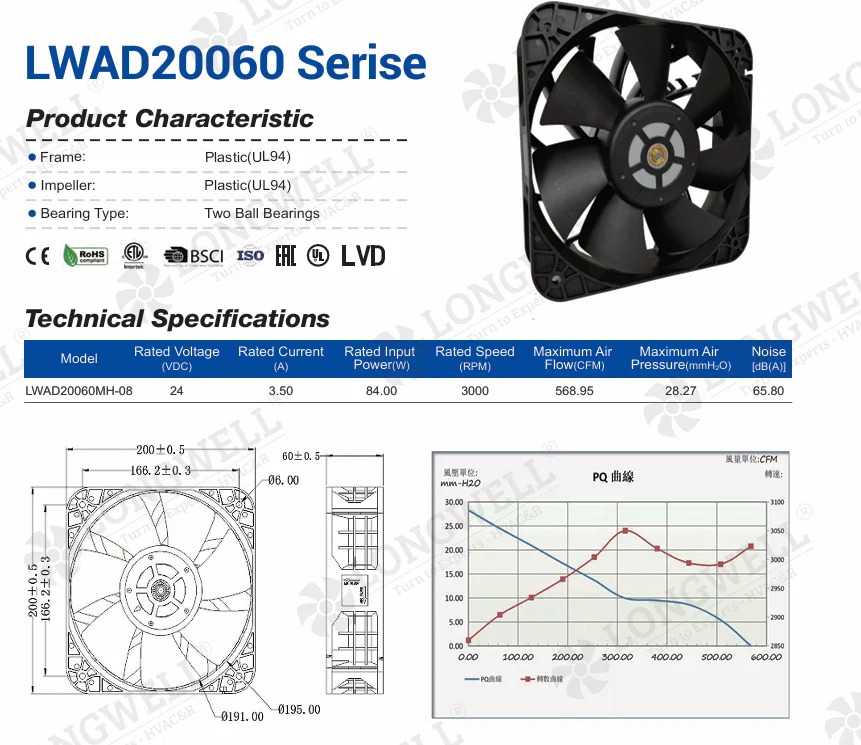 – A visual representation of the product characteristics, highlighting the 7-blade PBT impeller design and general performance metrics.
When to put weight in the spec
Fan weight belongs in more specifications than it appears in. Four cases decide when.
- Cap it whenever the mounting is sheet metal. After all, thin panels answer to grams, especially under vibration. A fan weight limit derived from the panel thickness and span protects the enclosure you already tooled.
- Check it whenever equipment moves. Indeed, vehicle, rail and portable equipment pay for every gram in fuel and in shock loading. The mass row on the datasheet is a real engineering number there, not packaging trivia.
- Watch it when you change impeller material. For example, a metal impeller swap adds mass exactly where it works hardest, at the rotor. The bearings, the mount and the balance all feel a change the airflow figures never show.
- Weigh samples at incoming inspection. Mass is the cheapest audit that exists: a scale, thirty seconds, and a number comparable against the datasheet. A unit far off its stated fan weight has different parts inside, and you want to know which ones.
See our axial fans range, the DC axial fans section, or DC cooling fans.
Questions about fan weight
Does a lighter fan mean a weaker fan?
Not at all; it means material chosen deliberately. Engineered plastics like PBT carry demanding duties at a fraction of metal mass, and flammability-rated grades satisfy the safety file too. Weight becomes weakness only when it is removed from the wrong component, such as bearings.
How do I derive a weight limit for my panel?
From the panel thickness, the span between supports and the vibration environment, the same way you assess any mounted mass. If that analysis is unavailable, the practical route is the one this customer took: cap the fan at the mass the existing panel was proven with.
Why do heavy fans loosen their mountings over time?
Because every start and stop swings the mass, and thin sheet metal flexes with it. Then the holes stretch a little at a time, the fasteners lose preload, and the resulting rattle raises noise and accelerates the very fatigue that caused it.
Is the FG signal worth wiring on a simple cooling fan?
On one fan, perhaps not. However, on 1600 in the field, the speed feedback converts silent degradation into a measurable trend, so maintenance happens on schedule instead of after a thermal shutdown. The wire costs nothing compared to the first avoided incident.
Technical Documentation & Resources
Need the same thing for your own unit?
Give us the numbers and the envelope, and you get a shortlist rather than a catalog. Meanwhile custom spec sheets and samples run to 90 days. Since 1990 Longwell has supplied EC fans and blowers to OEMs in HVAC, cold chain, data center and industrial markets.
Browse Related Products:
🏆 ISO 9001 / ISO 14001 / ISO 45001 | CE (TÜV) | UL/ETL | ATEX Zone 21/22 | AMCA 210/211 / ISO 5801 tested
Choose the right axial fan
Longwell manufactures 1,086 axial fans in-house. Send airflow, static pressure and voltage — an engineer replies with a matching model, performance curve and price within one working day.