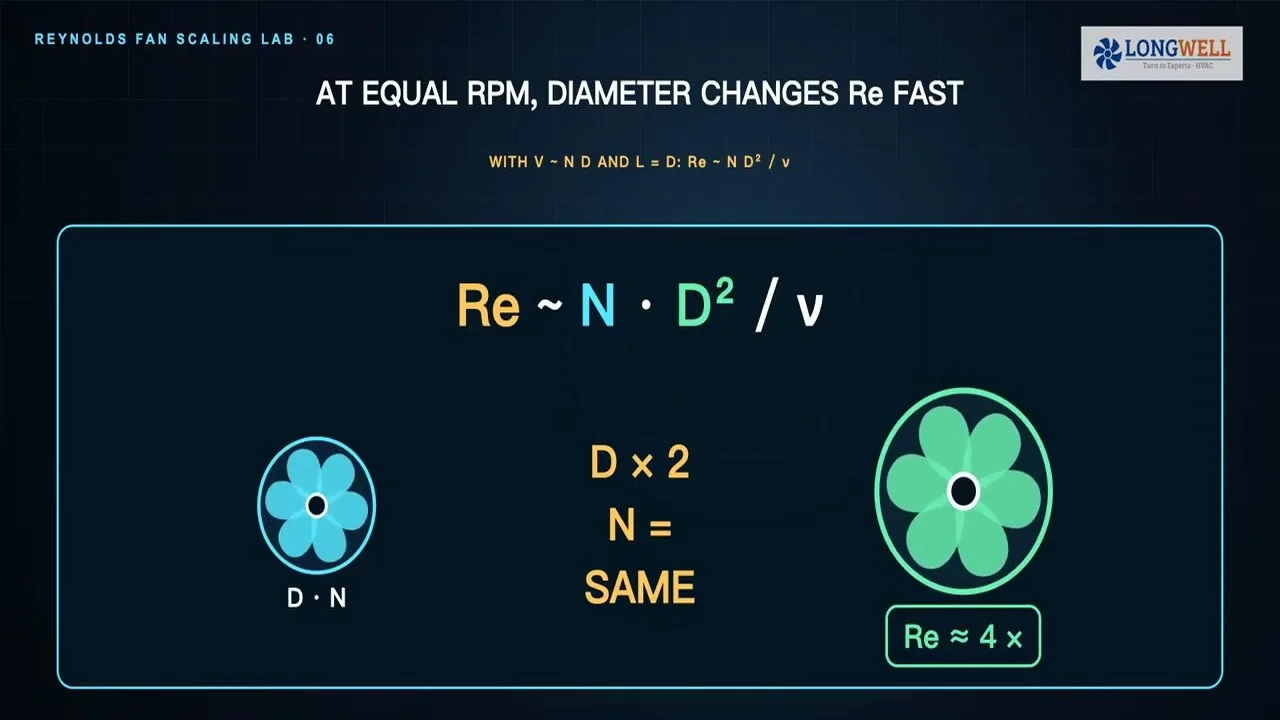
Reynolds number compares inertial forces in a flow against viscous ones, and it explains something the fan laws quietly ignore.
Scale a fan up and it gets slightly more efficient, even though the fan laws assume performance simply scales in proportion.
Reynolds number rises with size and speed, so a larger wheel operates in a flow where friction matters less relative to the work done. That is why a 900 mm wheel typically reaches two to five efficiency points higher than a geometrically identical 250 mm wheel. The fan laws ignore this, which is why scaled predictions are slightly pessimistic for larger fans.
What the number describes
Reynolds number compares two forces in a flow: inertia against stickiness.
At low values, stickiness wins, so the slow layer near the wall is thick. At high values, inertia wins instead, and that layer gets thin.
A blade passage is really just a small duct, so the same logic applies. A bigger passage carrying faster air loses proportionally less to friction.
Why bigger wheels win
- Boundary layers occupy a smaller fraction of a larger blade passage.
- Surface roughness becomes relatively smaller as dimensions grow.
- Tip clearance is a manufacturing tolerance, so it shrinks proportionally.
- Weld beads and edge radii matter less on a bigger blade.
- Bearing and seal losses form a smaller share of total power.
- Finally, larger motors are inherently more efficient than small ones.
Together these explain the efficiency gap between a small compact fan and a big industrial wheel from the same family. So it is not a design difference at all.
How much difference it makes
| Wheel diameter | Typical peak static efficiency |
|---|---|
| 120 mm | 35–50% |
| 250 mm | 55–65% |
| 450 mm | 70–78% |
| 700 mm | 75–82% |
| 1,000 mm | 78–85% |
Consequently a fan array of many small wheels is aerodynamically at a disadvantage against one large wheel, which is worth knowing when someone claims otherwise. Our array against single fan guide covers that argument honestly.
Where the fan laws break down
The fan laws assume two fans are the same shape, and they ignore scale entirely.
For small changes in speed or diameter, that is close enough. Scale a 200 mm test model up to a 2 metre fan, though, and the prediction will understate the real efficiency. Our fan laws guide covers where they do hold.
Model testing is used in large fan development precisely because it works, provided a Reynolds correction is applied. Without that correction, a scaled prediction is conservative rather than wrong.
When Reynolds effects matter to buyers
- Comparing published efficiency across very different fan sizes.
- Judging a fan array against one large fan.
- Scaling test data up from a smaller model in the same family.
- Very small fans, since efficiency is inherently low there.
- Hot or unusual gases, because stickiness changes with them.
- Finally, deciding whether a supplier scaled a curve or measured it.
That last point is worth asking about directly. A curve scaled up from a smaller model is not the same thing as a measured one, although both may look identical on a datasheet.
Density, viscosity and unusual conditions
Reynolds number depends on density and stickiness, so both shift the picture in unusual duties.
Hot air is thinner and stickier, which lowers the number and raises friction losses. Meanwhile altitude thins the air too. So a fan on hot gas does slightly worse than a plain density correction suggests.
For test methods and how rated performance is established, AMCA publications remain the reference.
None of this changes what you should do day to day. Size the fan on its measured curve, at your duty point, in your conditions. Reynolds number simply explains why the small fan on the shelf can never match the big one on efficiency, however well it is made.
Scale effects FAQ
Do the fan laws still work?
Yes, for practical speed and diameter changes within a family. They simply ignore scale effects, which makes their predictions slightly conservative for larger fans.
Why are small fans so inefficient?
Low Reynolds number means friction losses form a large share of the work done. Add relatively larger tip clearances and less efficient small motors, and the gap widens further.
Can I scale test data from a model fan?
Yes, with a Reynolds correction applied. Manufacturers do this routinely for very large fans, since testing a 3 metre wheel is expensive and sometimes impossible.
Does Reynolds number affect noise?
Indirectly. Thinner boundary layers and less separation mean less turbulence, so larger wheels tend to be quieter per unit of air moved as well as more efficient.
Reynolds number is why size flatters a fan. Larger wheels really are more efficient, so any comparison across sizes has to allow for it before the numbers mean anything.