What the AHU maker asked for
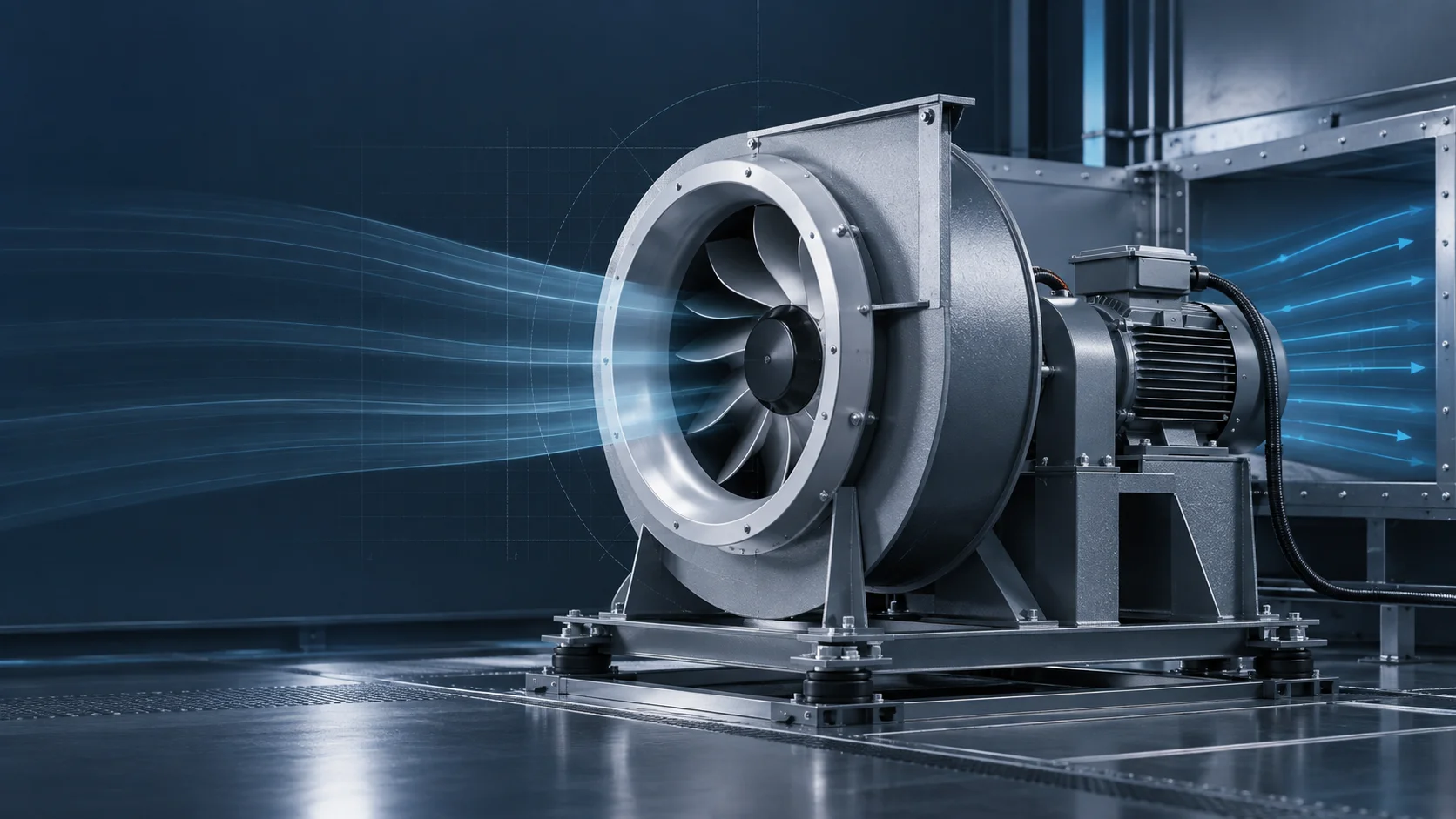
A European OEM building air handling units asked for drawings and prices on four inline duct fan models. Thirty units of each. That is a fan supplier qualification.
Notably that quantity pattern is the tell. Nobody buys 30 units of four models to build one machine. So this was a qualification, not an order.
What the four models spanned
Notably airflow ran from 2,300 to 5,500 m3/h across the set. The mid model targets 4,000 m3/h at 500 Pa.
Consequently they are building a family of air handling units at different tiers. They want one supplier across all of it.
- First, mandatory CE certification for European market access.
- Next, exact dimensional drawings, since their existing chassis designs set hard size limits.
- Meanwhile a standard European single-phase 220V supply at 50Hz.
- Finally, performance data verifiable against AMCA 210/211 for system modeling.
Answering a fan supplier qualification
All four models were already standard, so no development was needed. Even so, a fan supplier qualification deserves a different response from an order.
What a qualification actually tests
The customer is not evaluating one fan. Rather, they ask whether we can cover a family consistently, document it well, and still be here in three years.
So one coherent package mattered more than speed on any single drawing. Mixed formats across four models would be an answer, and a poor one.
Why AC, and why we did not argue
Here the request specified AC-powered fans explicitly. Certainly an EC variant would give variable speed and better efficiency.
However, specifying AC across a whole family points at first cost and simplicity. Pushing EC would answer a question they never asked. On a qualification, that is exactly what gets noticed.
The dimensional work
Here exact drawings mattered more than usual. Their chassis designs already exist, so a fan missing by a few millimetres fails regardless of performance.
That is why they asked for drawings before samples. In short, fit is the first gate in any fan supplier qualification, and performance only matters after it.
What it cost
Efficiency across the range, given up on purpose. An AC fan at 780W, where EC would draw less, is a real cost over a decade.
The customer feels that in their own product positioning, not in ours. Ultimately it was their call. So we supplied what they specified, while noting the alternative exists.
Technical Specifications
One model of the four is detailed below. Meanwhile the others sit at different points on the same platform.
| Parameter | Value |
|---|---|
| Model | LWDA600S-B05 |
| Airflow | 4,000 m³/h (2354 CFM) |
| Static Pressure | 500 Pa |
| Input Power | 780 W |
| Speed | 1420 RPM |
| Voltage | 220 V AC |
| Frequency | 50 Hz |
| Current | 3.6 A |
| Noise Level (@1m) | 71 dB(A) |
| Connection Dimensions | 600 x 350 mm |
| Overall Dimensions (L x W x H) | 775 x 652 x 403 mm |
| Protection Class | IP44 |
| Insulation Class | F |
| Certifications | CE |
Technical Documentation
Meanwhile the approved drawings sit below, one per model. Between them they carry the mounting dimensions a fan supplier qualification actually turns on.
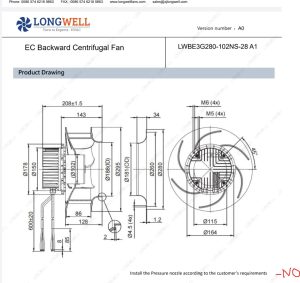
Final Engineering Drawing (LWDA600S-B05.pdf)
The final approved engineering drawing provides all critical dimensions, mounting points, and specifications for system integrators to incorporate the fan into their master CAD assembly.

The performance data for the selected LWDA600S-B05 is detailed in this datasheet, alongside other variants in the same sub-family.

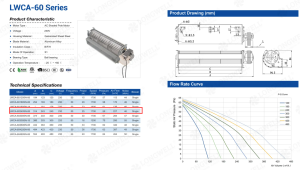
Here the datasheet provides the performance curve and specifications for the LWDA-500 series, which the client evaluated for lower-capacity requirements.

This document outlines the LWDA-600 series models B01-B03, offering a range of performance points within the 600mm duct size.

Above, the datasheet covers the higher-capacity LWDA-700 series, considered for applications requiring up to 5,500 m³/h.
If you are qualifying a new supplier
Qualifying a new fan supplier is worth doing deliberately. These make the exercise tell you something.
- Ask for the whole range at once, not the fan you need today. Fan supplier qualification is about coverage and consistency. Requesting one model tells you they have that model. Requesting four tells you whether they can support a family.
- Compare the paperwork, not just the fans. Ask each candidate for drawings, curves and certificates on all models at once. Whoever returns a consistent set understands what you are buying.
- Check the data is testable. Curves stated against AMCA 210/211 or ISO 5801 compare across suppliers. Data with no stated method does not, however precise it looks.
- Settle fit before performance. Exact dimensional drawings are the first gate when your chassis already exists. A fan that outperforms and does not fit is not a candidate.
See our duct fan range, the inline fan section, or air handling units. Airflow testing follows AMCA 210.
Questions about this range
Why request four models instead of the one we need?
Because it tests coverage, not availability. A supplier stocking one size may not support the tier above. Finding that out after you design a family is costly. So ask for the range up front.
How do I compare curves between suppliers fairly?
Check both were measured to the same standard, usually AMCA 210/211 or ISO 5801, at the same air density. Then find your duty point on each. Headline maxima tell you almost nothing. Fans that match at free delivery can part company under real resistance.
Should we have specified EC instead?
It depends on run hours. A unit running all day repays the EC premium in energy. It also lets you modulate airflow to load. One running now and then does not. So the answer follows your operating profile, not the technology.
What does CE on a component actually give us?
Evidence for your own declaration, not a replacement for it. You still own the assembled unit. What it saves is retesting the parts you did not make. On a four-model family, that is a lot of work.
Technical Documentation & Resources
Need the same thing for your own unit?
Give us the numbers and the envelope, and you get a shortlist rather than a catalog. Meanwhile custom spec sheets and samples run to 90 days. Since 1990 Longwell has supplied EC fans and blowers to OEMs in HVAC, cold chain, data center and industrial markets.
Browse Related Products:
🏆 ISO 9001 / ISO 14001 / ISO 45001 | CE (TÜV) | UL/ETL | ATEX Zone 21/22 | AMCA 210/211 / ISO 5801 tested
Choose the right duct fan
Longwell manufactures 254 duct fans in-house. Send airflow, static pressure and voltage — an engineer replies with a matching model, performance curve and price within one working day.