How a PWM Controlled Cabinet Fan Handles Dense Filters
A customer came to us with a heat problem. They had to cool a control box outdoors. A PWM controlled cabinet fan was the route. Consequently, this box needed a PWM controlled cabinet fan. The PWM controlled cabinet fan had to move 618 m3/h of air.
Furthermore, it had to overcome a steep system impedance of 618 Pa. High static pressure usually means loud fans. However, the application imposed a strict noise ceiling. Engineers had to keep sound levels at or below 62 dB(A).
Therefore, finding the right aerodynamic balance became our main goal. Next, the design had to run reliably outdoors. The customer required an ambient temperature range of -20°C to 60°C. A -20°C limit means the equipment faces freezing winter conditions.
Meanwhile, the end market demanded documented safety compliance. The chosen blower assembly had to pass EN 60335-1 rules. Finally, it also needed to meet UL 507 safety standards. We reviewed these inputs carefully.
In short, the high static pressure requirement dictated the physical shape of the air mover. Designers also had to fit this unit into a tight physical space. Therefore, the fan dimensions could not exceed the standard 180mm footprint. By contrast, a larger fan would require a complete cabinet redesign. This size limit made the airflow target much harder to hit.
Evaluating Topologies for the 24V DC Centrifugal Fan
We evaluated several fan shapes to hit the 618 Pa pressure requirement. Initially, an axial fan seemed appealing for its slim depth. However, axial designs fail to generate enough pressure for dense cabinet layouts. We rejected the axial approach quickly.
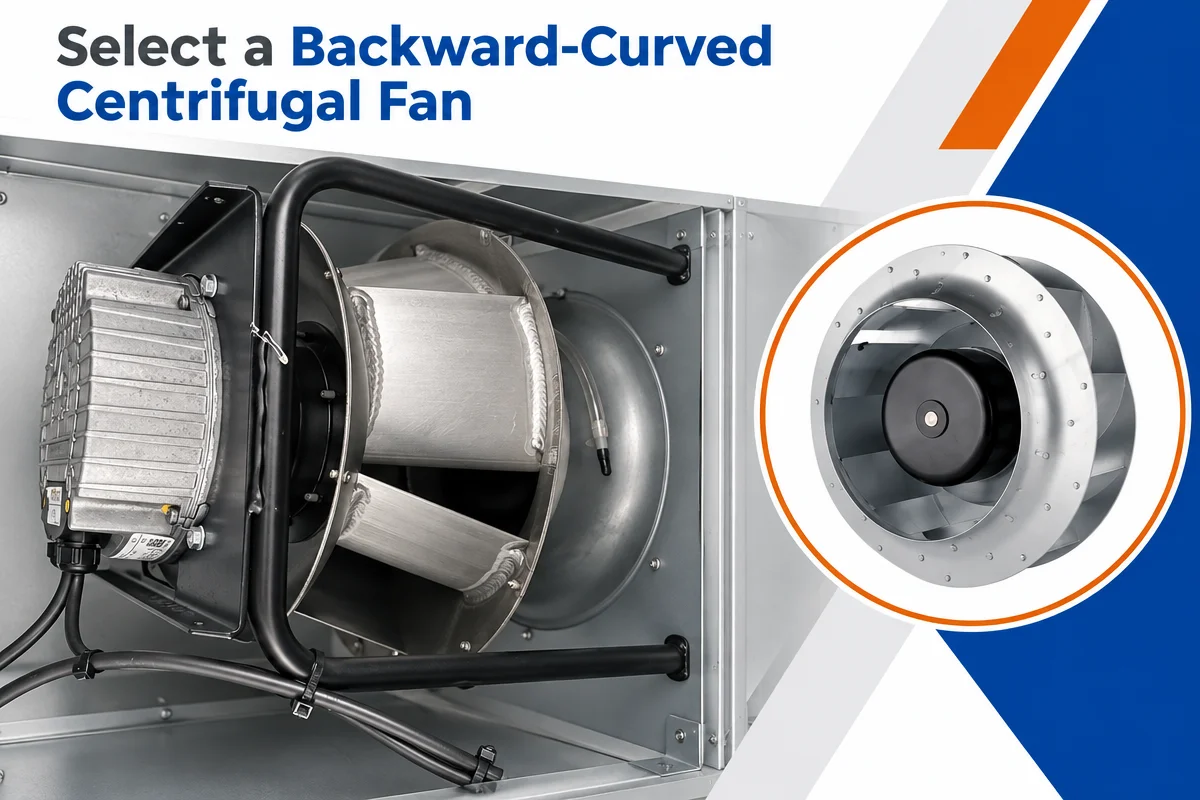
Instead, we knew it would stall heavily under this specific load. Next, we looked at backward-curved centrifugal fans. A backward-curved wheel uses less power. Even so, it requires a much higher speed to reach 618 Pa.
That high speed would easily break the 62 dB(A) noise limit. Consequently, we selected a forward-curved 24V DC centrifugal fan. This specific shape delivers high pressure at low rotational speeds.
Aerodynamic and Material Trade-offs
Every engineering choice carries a strict cost. Here, selecting a forward-curved 180mm wheel meant accepting lower peak efficiency. Therefore, the S1 continuous duty motor must draw 4.2 A. Furthermore, it must consume 100 W to deliver the required flow.
By contrast, a backward-curved fan would consume less power but ruin the acoustic goals. Next, we specified PA66 plastic for the impeller. This material choice keeps the rotating mass very low. Consequently, the lighter wheel reduces bearing wear.
This reduction extends the L10 life expectancy to 20,000 hours at 40°C. However, the cost of using PA66 is a strict upper ambient limit of 60°C. High heat can warp plastic blades. Even so, this 60°C limit matched the customer specification perfectly.
External Speed Control Integration
Finally, the customer needed precise airflow modulation. A fixed-speed setup could not handle their changing thermal loads. Therefore, we paired the blower with an external LWSC-DC-008 motor governor. This 12A controller accepts 0-10V or PWM signal inputs.
The trade-off for this flexibility is a materially higher cost. Furthermore, it requires a more complex cabinet wiring harness. Instead of a simple two-wire hookup, workers must route separate control cables. Even so, the governor provides a highly adjustable PWM frequency.
You can set it from 1kHz to 99kHz. We set the default to 20kHz. This frequency sits just above human hearing. Consequently, it stops audible electrical switching noise. In short, the final LWFD3G180-092SM-01-00 package meets every initial parameter.
Technical Specifications
| Parameter | Value |
|---|---|
| Model Number | LWFD3G180-092SM-01-00 |
| Nominal Voltage | 24 VDC |
| Voltage Range | 16~28 VDC |
| Speed | 1250 RPM |
| Current | 4.2 A |
| Power Input | 100 W |
| Air Flow (Max) | 618 m3/h (368 CFM) |
| Static Pressure (Max) | 618 Pa |
| Noise Level (LpA) | 62 dB(A) |
| Ambient Temperature | -20°C to 60°C |
| Insulation Class | Class B |
| Protection Type | IP44 |
| Work System | S1 |
| Bearing Type | Two Ball Bearing |
| Life Expectancy | 20,000 Hours (L10) at 40°C |
| Certifications | CE, ETL (UL 507, CSA C22.2#113), RoHS, REACH |
| Speed Control | 0~10VDC / PWM |
First, note the relationship between the 1250 RPM speed and the 618 Pa static pressure. Achieving this pressure at such a low speed keeps the acoustic signature down to 62 dB(A). Furthermore, the IP44 protection type dictates a specific physical shield. Consequently, the unit is guarded against solid objects over 1mm and splashed water.
Reference: AMCA 210 covers the test method behind these figures.
Technical Documentation
Primary performance specification document for the LWFD3G180-092SM-01-00 assembly.
Controller data for the LWSC-DC-008 governor wiring and configuration.
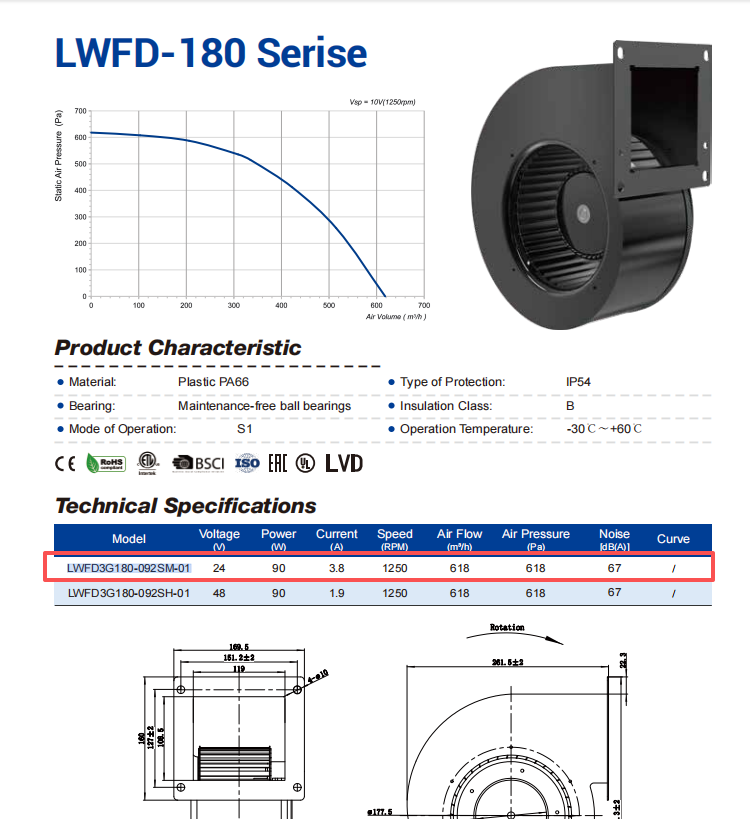
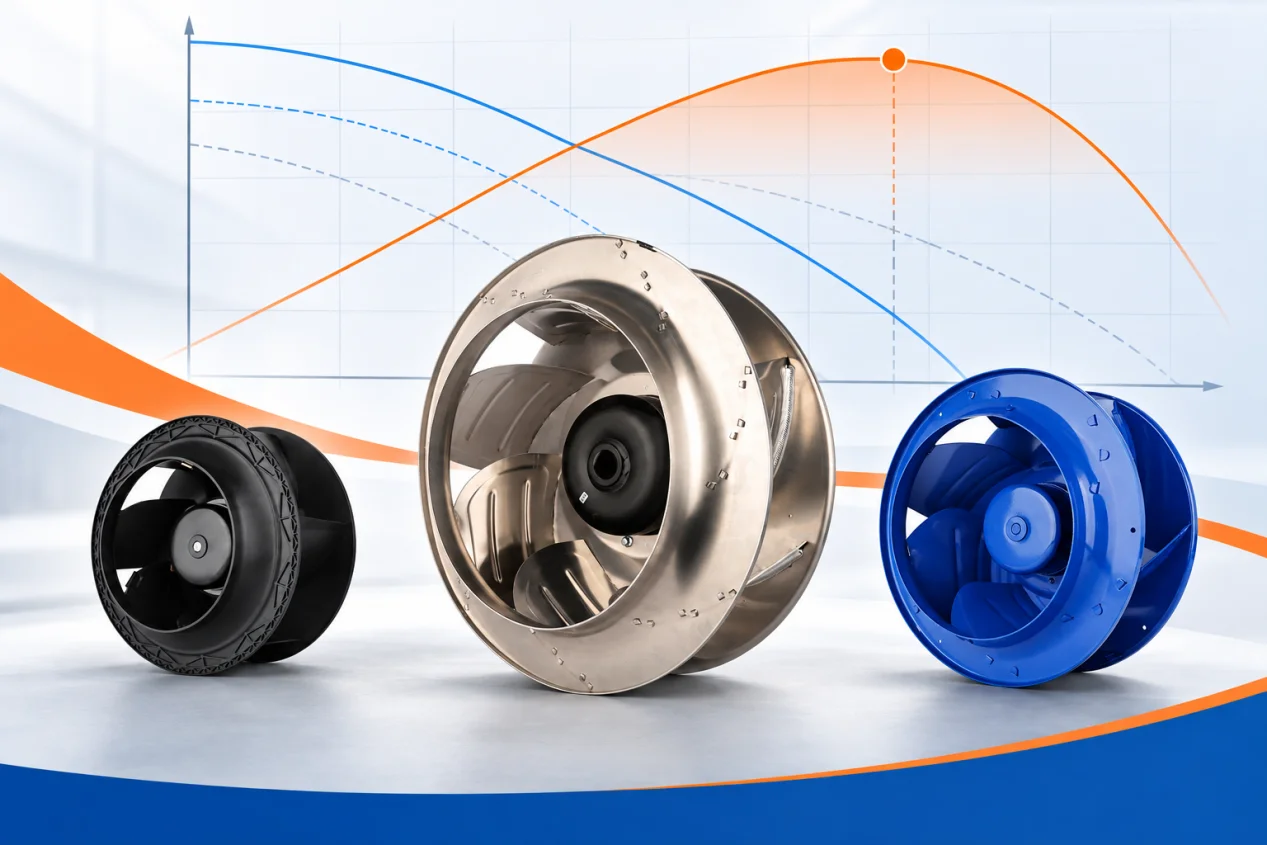
This performance curve charts static pressure against air volume. Therefore, it helps engineers map system impedance accurately.
Practical Guidance for Component Specification
- First, always plot your exact cabinet impedance curve against the fan performance chart. System designers frequently underestimate the real pressure drop. Dense internal wiring and thick filters create severe airflow blocks. Consequently, fans often miss their targeted cooling rates.
- Next, specify the exact operating frequency when you use a PWM controller. A frequency mismatch between controller and motors cause major acoustic problems. Therefore, they often result in harsh, audible ringing noises.
- Third, understand the hard limits of physical material choices. Plastic impellers reduce rotational mass and extend bearing life greatly. However, they strictly cap the maximum operating temperature at 60°C. By contrast, metal wheels survive higher heat but weigh much more.
- Finally, provide your supplier with the exact safety standards your final equipment must pass. Longwell already holds UL 507 and CE certifications for these motor types. So this baseline testing cuts your own approval timelines significantly.
Related: Centrifugal Fans.
Common Engineering Questions
Technical Documentation & Resources
A PWM controlled cabinet fan sits in our centrifugal range, and a PWM controlled cabinet fan of this class suits filtered boxes. Browse our centrifugal fans range, the backward-curved fans section, or forward-curved fans.
Have a Similar Fan Requirement?
Longwell’s engineering team delivers custom spec sheets and samples within 90 days. Since 1990, we have supplied EC fans and blowers to OEMs across HVAC, cold chain, data center, and industrial applications worldwide.
Browse Related Products:
🏆 ISO 9001 / ISO 14001 / ISO 45001 | CE (TÜV) | UL/ETL | ATEX Zone 21/22 | AMCA 210-16 / ISO 5801 tested
Choose the right centrifugal fan
Longwell manufactures 1,130 centrifugal fans in-house. Send airflow, static pressure and voltage — an engineer replies with a matching model, performance curve and price within one working day.