What the transformer builder needed
The number that framed this job was 2900 cubic meters per hour. An OEM building dry-type enclosures for a photovoltaic power station needed a top-blown transformer cooling fan capable of that, and needed it to keep running.
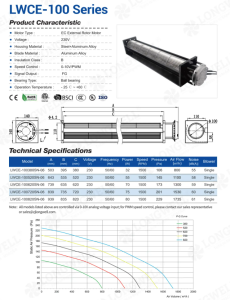
Reliability was not a soft wish here. If the fans stop, the transformer overheats and the site consequently stops generating. That single fact drove every decision that followed. The customer also needed two configurations rather than one, because the enclosures come in two sizes. One takes a 470mm impeller, while the other takes a 590mm version.
- 220V AC at 50Hz, the supply already on site.
- A 420mm mounting center distance, fixed by the existing enclosure.
- Hot-rated double ball bearings, named by the customer rather than by us.
- Compliance with GB/T13933-2008, the Chinese national safety standard for this equipment.
- Final drawings and data complete enough for a project submittal.
Here the thermal point deserves emphasis. A transformer cooling fan basically lives inside the waste heat it is there to remove. Bearings, therefore, give out first in that heat. That is exactly why the customer named them in the specification, rather than leaving the choice open.
Getting the transformer cooling fan to 2900 m3/h
Two questions had to be settled before any part number existed. First, which motor technology. Second, whether the standard chassis could reach the airflow target at all.
Why the AC motor won
A SmartEC motor would have given variable speed. On many projects that is certainly the right answer. Here, however, it was not. The cooling logic is staged, switching fans on at discrete temperature thresholds rather than modulating them. In other words, once the control scheme is a thermostat, variable speed buys nothing.
Furthermore, choosing a plain AC external rotor motor removed a DC supply and a run of 0-10V control cable from the enclosure. As a result, there are fewer components, fewer terminations and fewer things to go wrong in a cabinet nobody opens for years.
Why cross-flow rather than axial
The customer asked for cross-flow. It is the right pick for a transformer cooling fan, and for a good reason. A cross-flow impeller throws a wide, even sheet of air along its full length. That is exactly what a transformer coil needs, since heat must leave the whole surface equally. An axial fan, by contrast, concentrates air into a turbulent column. On a coil surface that produces hotspots, and hotspots are what shorten transformer life.
Getting to 2900 m3/h
Meanwhile the standard D470 and D590 fans did not initially reach the airflow target at the smaller size. Instead of tooling a new chassis, engineers took a more powerful motor from our own line and fitted it to the standard 470mm frame. Paired with a 200mm impeller, that became the LWF-D470-200AS-01. The resulting transformer cooling fan delivered the required 2900 m3/h.
The larger enclosure, meanwhile, took the standard LWF-D590-150AS-01 with its 150mm impeller. That model sits at a different point on the curve, and it therefore suits the second transformer. Both units received high-temperature rated NSK double ball bearings, in line with the ThermoFlex approach we use wherever a fan runs hot for years at a time.
Internally this counted as light development, not a new product. That distinction matters commercially. The next section explains why.
Technical Specifications
Here the project resulted in two distinct, approved fan models. The specifications below are taken directly from the final engineering drawings supplied to the customer.
Model: LWF-D470-200AS-01
| Parameter | Value |
|---|---|
| Voltage | 220 V |
| Frequency | 50 Hz |
| Speed | 1400 RPM |
| Input Power | 280 W |
| Current | 1.27 A |
| Airflow | 2900 m³/h |
| Dimensions (L x W x H) | 470 x 430 x 250 mm |
| Bearing Type | High-Temperature Double Ball Bearings |
Model: LWF-D590-150AS-01
| Parameter | Value |
|---|---|
| Voltage | 220 V |
| Frequency | 50 Hz |
| Speed | 1400 RPM |
| Input Power | 90 W |
| Current | 0.60 A |
| Airflow | 1600 m³/h |
| Dimensions (L x W x H) | 590 x 550 x 165 mm |
| Bearing Type | High-Temperature Double Ball Bearings |
These two fan models provide the OEM with tailored cooling capacities. The high-power 280W motor in the LWF-D470-200AS-01 delivers substantial airflow in a compact length, while the LWF-D590-150AS-01 offers a wider, lower-velocity airstream for a different thermal profile.
Technical Documentation
Final approved documents are archived and provided to the customer for system integration and compliance verification.
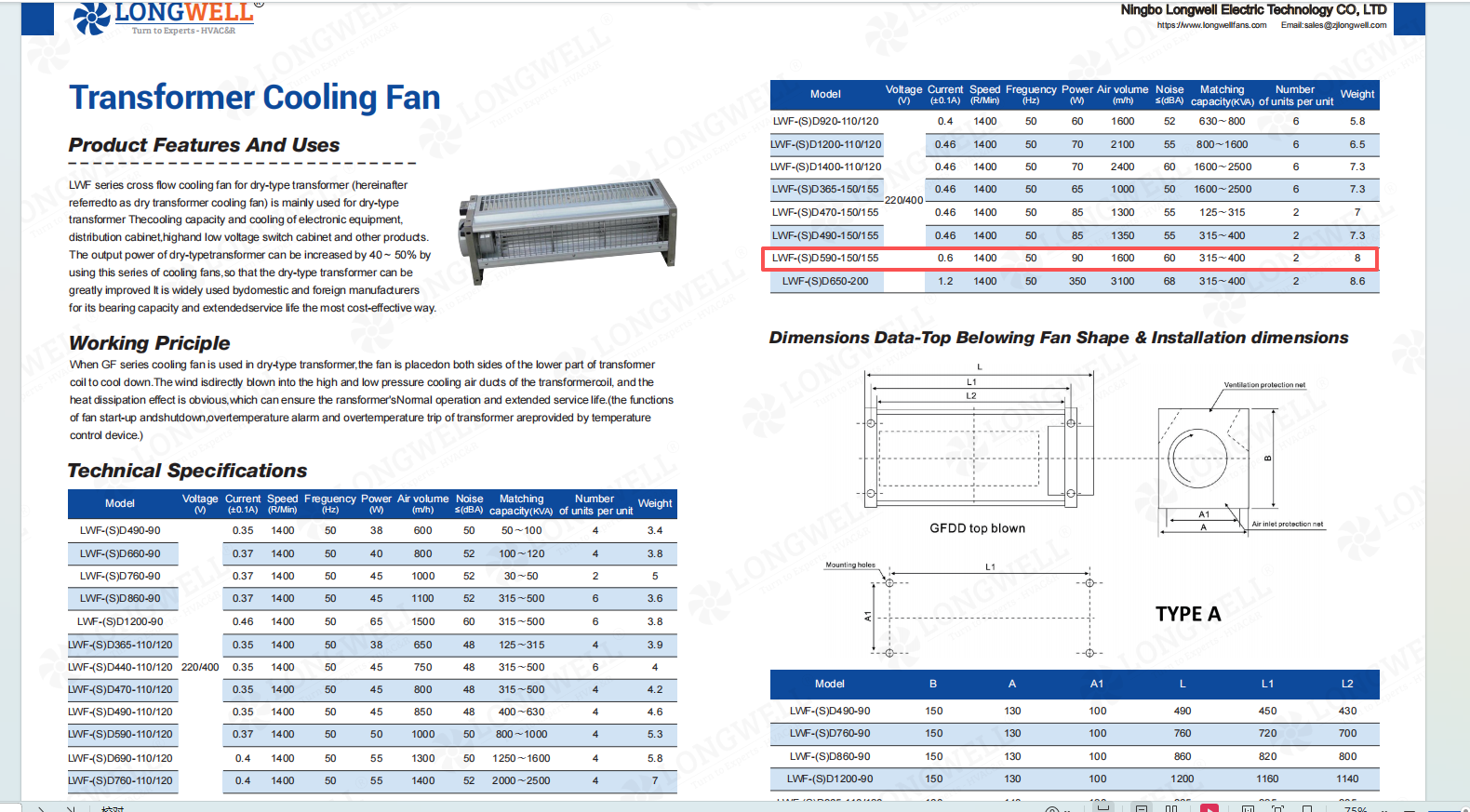
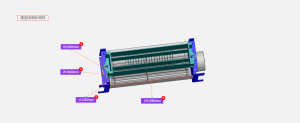
The image shows the general configuration of the cross-flow fans supplied for the project.
- LWF-D470-200AS-01 General Arrangement Drawing
Here the pDF drawing provides key dimensions, mounting points, and technical specifications for system integrators working with the 470mm fan. - LWF-D470-200AS-02 General Arrangement Drawing
This document details a minor variant of the 470mm fan, ensuring procurement managers have the correct part number for their specific build. - LWF-D590-150AS-01 General Arrangement Drawing
Above, the pDF drawing contains all mechanical and electrical data for the 590mm fan model. - LWF-D590-150AS-02 General Arrangement Drawing
The drawing shows the variant of the 590mm model, used for compliance and quality assurance checks.
Why an OEM in critical infrastructure buys here
Infrastructure buyers tend to weigh four things. This project touched all of them.
- We changed a frame we had, rather than start from scratch. The customer needed performance a catalog part did not offer. Up-rating a frame we already build gave them a documented transformer cooling fan in weeks. By comparison, a full NPI cycle at a European supplier commonly runs 12 to 18 months.
- Airflow figures you can rely on. When cooling protects a transformer, a claimed number is not good enough. Our performance is tested to AMCA 210/211 and ISO 5801 methods. In short, the 2900 m3/h is measured rather than estimated.
- Cost that survives a tender. We build the parts in house, so what we quote is our own cost structure rather than a stack of supplier margins. On solar bids, where the fan is one line among hundreds, that is what keeps the line competitive.
- Bearings chosen deliberately. High-temperature double ball bearings and a robust AC motor are not defaults. Rather, they come from 35 years of building fans for places where failure is expensive, from data centers to cold chain.
Browse the full cross-flow fan range. Alternatively, see the AC cross-flow fan series, which is where this transformer cooling fan sits. Dry-type transformer thermal classes are defined by the IEC in IEC 60076-11.
Questions this project raised
What ambient range do these fans handle?
They carry high-temperature double ball bearings and are specified for continuous running from -40C to +60C. Consequently that window covers both the transformer heat load and the weather an outdoor enclosure sees.
Can the speed be controlled?
Not on this model. It uses a single-speed AC motor, chosen for reliability and cost. Where you do need variable airflow, though, we build the same fan on a SmartEC motor. Those units accept 0-10V, PWM or Modbus RS485.
What is the lead time on 100 units or more?
A make-to-order product like this runs 15 to 25 days after order confirmation. For OEMs needing continuous supply, meanwhile, we set up a delivery schedule against a rolling 30-day forecast. That keeps material on hand without tying up your capital.
Why does bearing choice matter so much in a transformer enclosure?
Grease life falls sharply as temperature rises. A standard bearing that lasts years in open air can therefore fail inside a hot housing. A high-temperature bearing uses grease formulated for that duty, which is usually what separates a five-year fan from a one-year fan.
Technical Documentation & Resources
Project Gallery & Technical Drawings
Working on something similar?
Send us the duty point, the envelope and the supply, and our engineers come back with a shortlist rather than a catalog. Meanwhile custom spec sheets and samples run to 90 days. Since 1990 we have built fans for HVAC, cold chain, data center and industrial OEMs.
Browse Related Products:
🏆 ISO 9001 / ISO 14001 / ISO 45001 | CE (TÜV) | UL/ETL | ATEX Zone 21/22 | AMCA 210/211 / ISO 5801 tested
Choose the right external rotor motor
Longwell manufactures 11 external rotor motors in-house. Send airflow, static pressure and voltage — an engineer replies with a matching model, performance curve and price within one working day.