A proven fan and a different grid
An OEM with a working 900mm axial fan on 380 V 50 Hz needed the same duty in a 440 V 60 Hz market, which is a 50 Hz to 60 Hz conversion of a design that was never asked to do it.
Meanwhile their targets carried over: 27,200 m3/h against 150 Pa, inside a 1650 W power limit.
The unchanged boundaries
- First, the standard 1070 by 1070mm wall plate, no deeper than 290mm.
- Next, -30C to +60C, with reliable cold starts.
- Meanwhile 80 dB(A) maximum, which is tight for a 900mm impeller.
- Finally, EN 60335-1 safety, ISO 5801 performance proof, and 30,000 hours L10 at 40C, since the fan cools a continuous process.
Why this is not a relabelling
An AC motor takes its speed from the grid. So on 60 Hz the same rotor turns 20% faster whether anyone planned for it or not.
Consequently every derived number moves: airflow up roughly 20%, pressure up around 44%, and shaft power up about 73%. The 1650 W limit that was comfortable at 50 Hz is suddenly the binding constraint.
What 50 Hz to 60 Hz really changes
The physics of a 50 Hz to 60 Hz shift travels through two paths at once: the magnetics and the aerodynamics. Both need deliberate answers.
The magnetic side
A motor winding lives around its volts-per-hertz ratio. The original ran at 380 V over 50 Hz. The new grid offers 440 V over 60 Hz, a slightly lower ratio, so the iron does not work harder.
That makes this pairing kinder than most 50 Hz to 60 Hz conversions. The dangerous case is raising voltage without raising frequency, which drives the core toward saturation and the winding toward overheating. Here the ratio survived. However, the operating point did not.
The aerodynamic side
Fan laws are not negotiable. At 20% more speed the impeller wants 73% more power. Consequently the original blade setup would have sailed straight through the 1650 W ceiling.
So we re-matched the rotating parts to the new speed. Winding and blade pitch were chosen together, and the fan now meets 27,200 m3/h at 150 Pa on the 60 Hz grid inside the power budget, rather than overshooting airflow the customer never asked for.
The options we rejected
Firstly, a DC platform would accept any input. But the customer cabinet has no DC bus, and no appetite for adding conversion hardware at 1650 W scale.
Secondly, we declined to slow the fan with a drive. A VFD large enough for this motor costs panel space and money, only to recreate the 50 Hz behavior the customer was leaving behind anyway.
The noise dividend of doing it properly
A re-matched fan meets its duty at the lowest speed that achieves it. By contrast, the lazy 50 Hz to 60 Hz conversion, running the old design fast, would have spent the entire acoustic margin. The 80 dB(A) cap held because the design point moved with the grid. Verification follows ISO 5801 methods on the 60 Hz supply, not scaled from 50 Hz data.
Technical Specifications
Compare the speed row here with the 50 Hz original and every other difference in the table explains itself.
| Parameter | Value (High Speed / Low Speed) |
|---|---|
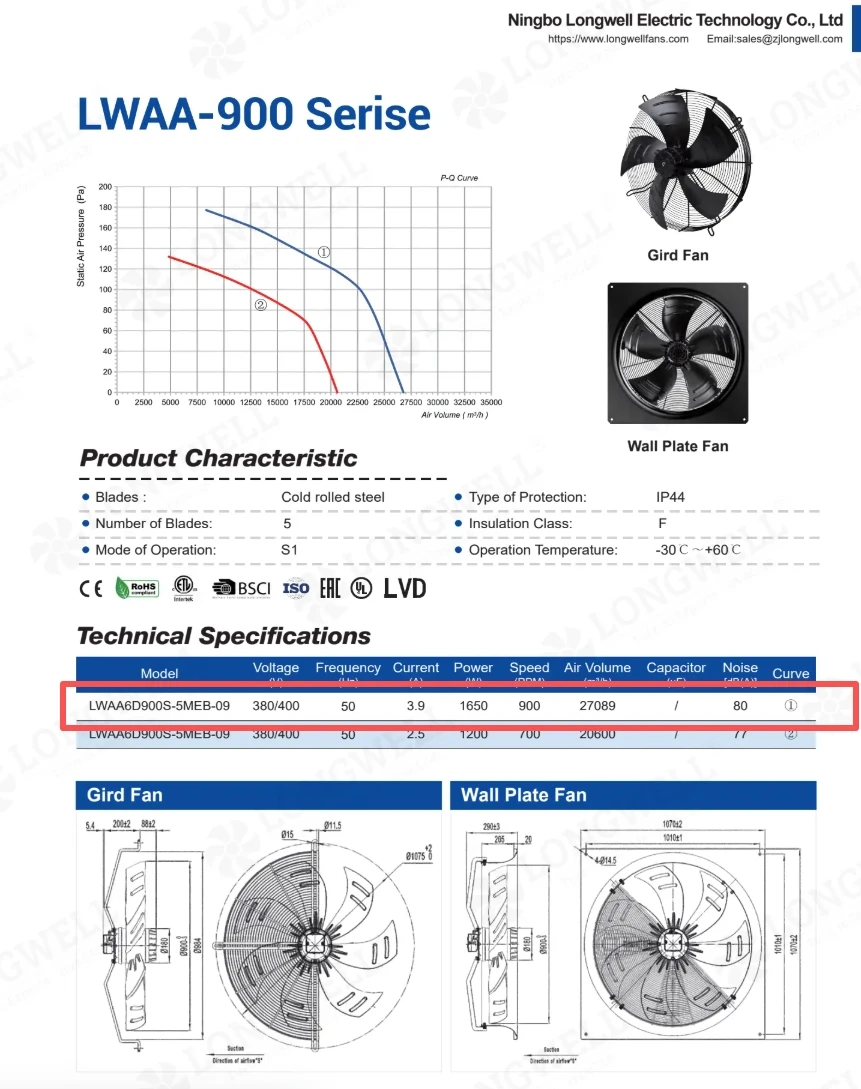
| Model Number | LWAA6D900S-5MKB-16-07 |
| Nominal Voltage | 440 VAC |
| Voltage Range | 396~484 VAC |
| Frequency | 60 Hz |
| Speed | 900 / 700 RPM |
| Current | 3.9 / 2.5 A |
| Power Input | 1650 / 1200 W |
| Air Flow (Max) | 27,089 / 20,600 m³/h |
| Air Flow (Max CFM) | 15,935 / 12,118 CFM |
| Noise Level | 80 / 77 dB(A) |
| Max. Ambient Temp | 60 °C |
| Min. Ambient Temp | -30 °C |
| Insulation Class | Class F |
| Protection Type | IP54 |
| Work System | S1 (Continuous) |
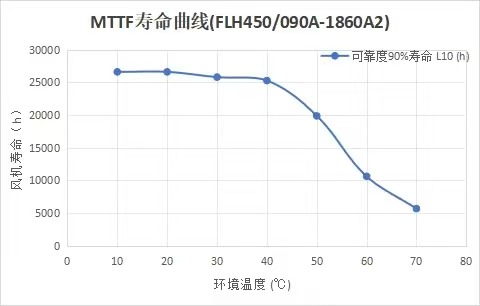
| Life Expectancy | 30,000 Hours (L10) at 40°C |
| Dimensions (Wall Plate) | 1070 x 1070 x 290 mm |
| Certifications | CE, RoHS, Reach |
Technical Documentation
View project requirement summary (DOCX)
The internal specification file contains the original sales requirements from the OEM procurement team, detailing the initial 60Hz parameters requested before engineering review.
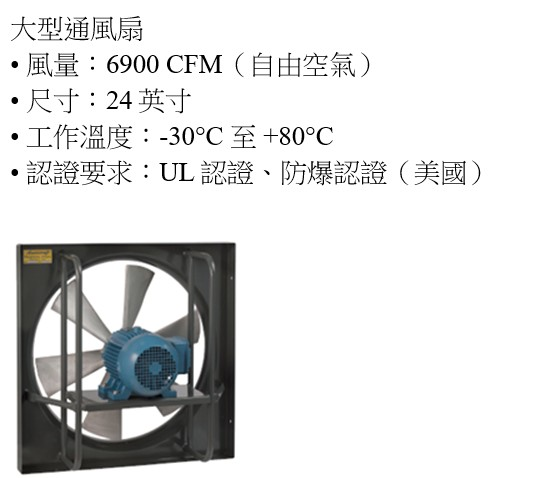
Here the original file highlights the client’s product enclosure dimensions and initial performance targets for the 900mm axial fan.
Get LWAA6D900S-5MKB-16-07 Technical Specification (PDF)
The final engineering approval drawing provides the complete wiring diagrams, P-Q performance curves, and detailed mounting dimensions for the 1070mm wall plate version.
Planning a grid conversion
Grid conversions come up whenever equipment crosses an ocean. Four checks keep a 50 Hz to 60 Hz project honest.
- Never relabel; recalculate. A 50 Hz to 60 Hz change moves speed 20%, pressure about 44% and power about 73%. Any fan carried across grids on its old datasheet is a different fan pretending otherwise.
- Check the volts-per-hertz ratio first. 380/50 and 440/60 sit close, which makes the pairing workable. A mismatched ratio saturates iron or starves torque, and that check takes one division before any money moves.
- Re-verify on the target grid. Curves measured at 50 Hz do not certify a 60 Hz product, whatever the scaling laws suggest. Test at the frequency the customer will actually plug into.
- Reclaim the design point. The right conversion re-matches the winding and blade angle to deliver the required duty at the new speed. Otherwise you ship surplus airflow, burnt margin and noise, and call it the same product.
See our axial fans range, the industrial axial fans section, or AC axial fans.
Questions about frequency conversion
Can I run a 50 Hz fan on 60 Hz in an emergency?
It will spin, 20% fast, drawing far more power and making more noise. Meanwhile the motor margin gets eaten from both ends. As a temporary measure with monitoring it may hold; as a product decision it ships an overloaded fan with an inherited nameplate math.
Why does power rise so much faster than speed?
Because of the fan laws: airflow scales with speed, pressure with its square, and power with its cube. The 20% frequency step therefore costs roughly 73% more shaft power, which is why the power limit, not the airflow target, dominated this conversion.
Is 440 V on a 380 V motor not dangerous by itself?
What matters is voltage relative to frequency. Specifically, at 440 V and 60 Hz the volts-per-hertz ratio sits slightly below the original 380/50 design, so the magnetic circuit is safe. The same 440 V applied at 50 Hz would be a genuinely dangerous overvoltage.
Do 60 Hz versions need their own certification testing?
Yes. After all, performance to ISO 5801 and safety to EN 60335-1 apply to the product as sold, and the 60 Hz build is a different operating point with different currents and temperatures. This project was tested on the 60 Hz supply rather than extrapolated.
Technical Documentation & Resources
Need the same thing for your own unit?
Give us the numbers and the envelope, and you get a shortlist rather than a catalog. Meanwhile custom spec sheets and samples run to 90 days. Since 1990 Longwell has supplied EC fans and blowers to OEMs in HVAC, cold chain, data center and industrial markets.
Browse Related Products:
🏆 ISO 9001 / ISO 14001 / ISO 45001 | CE (TÜV) | UL/ETL | ATEX Zone 21/22 | AMCA 210/211 / ISO 5801 tested
Choose the right axial fan
Longwell manufactures 1,067 axial fans in-house. Send airflow, static pressure and voltage — an engineer replies with a matching model, performance curve and price within one working day.