What the OEM needed
An OEM building commercial air handling units needed 2369 m3/h against 407 Pa. It ended up as a forward-curved fan, which is not where the rule of thumb points.
The constraints
- First, a 380V three-phase supply at 50Hz.
- Next, a 250mm class impeller with total mounting depth no greater than 165mm.
- Meanwhile an ambient range of -30C to +60C, covering cold store makeup air through to warm plant rooms.
- Noise below 75 dB(A) at the duty point.
- Finally, existing CE certification and EN 60335-1 compliance, to simplify their own product certification.
The depth limit shaped everything. A 165mm cabinet is shallow for this duty. Consequently it removes options before performance is even discussed.
Choosing a forward-curved fan anyway
Two decisions mattered here, and the second one runs against the usual advice.
Why AC rather than EC
An EC motor would give variable speed and better efficiency. However, their system already distributes 380V AC, and adding EC means control wiring plus a higher unit cost for a product tier that does not modulate.
So an AC induction motor was the direct path.
The blade direction call
Here the general rule is straightforward. Below roughly 200 Pa a forward-curved wheel is usually smaller and cheaper. Above that, backward-curved wins on efficiency and on achievable pressure.
At 407 Pa, that rule points at backward-curved. However, we went the other way, and the cabinet is the reason.
A forward-curved fan produces high airflow from a very compact housing. By contrast a backward-curved wheel at the same duty needs more diameter, and that needs depth this cabinet does not have.
Consequently the depth constraint overruled the efficiency argument. That is a legitimate reason, and it is worth being explicit that it is a trade rather than a free win.
What it cost
Power. The fan draws 870W to deliver 2369 m3/h at 407 Pa.
A backward-curved wheel at this duty would draw meaningfully less. So the customer pays that difference every hour the unit runs, in exchange for a cabinet that fits.
Noise too, at 72 dB(A). That sits inside their 75 dB(A) limit with little margin, which is also characteristic of pushing a forward-curved wheel to this pressure.
The build
Impeller and housing are galvanized sheet steel. Meanwhile maintenance-free deep groove ball bearings support a 25,000-hour L10 life at 40C. The IP54 motor covers dust and water spray in a plant room.
Technical Specifications
Read the power row against the pressure row below. That ratio is what this choice cost.
| Parameter | Value |
|---|---|
| Model Number | LWFA4D250-138NT-01 |
| Nominal Voltage [VAC] | 380 |
| Frequency [Hz] | 50 |
| Max Airflow [m³/h] | 2369 |
| Max Airflow [CFM] | 1394 |
| Max Static Pressure [Pa] | 407 |
| Speed [RPM] | 1400 |
| Input Power [W] | 870 |
| Current [A] | 1.8 |
| Noise Level [dB(A)] | 72 |
| Impeller Diameter [mm] | 252 |
| Overall Depth [mm] | 162 |
| Ambient Temperature Range [°C] | -30 to +60 |
| Protection Class | IP54 |
| Insulation Class | Class F |
| Work System | S1 (Continuous Duty) |
| Certifications | CE, RoHS, Reach |
Technical Documentation
LWFA4D250-138NT-01 Datasheet (PDF)
The document contains all performance data, technical specifications, and mechanical drawings, essential for design engineers integrating the fan into their system.
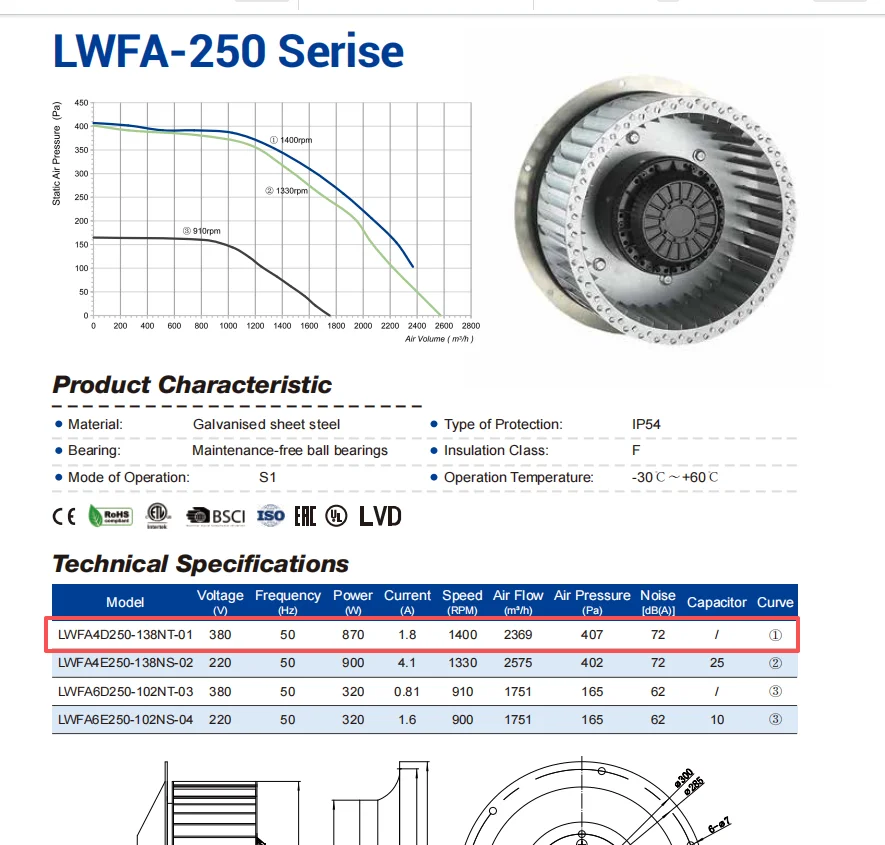
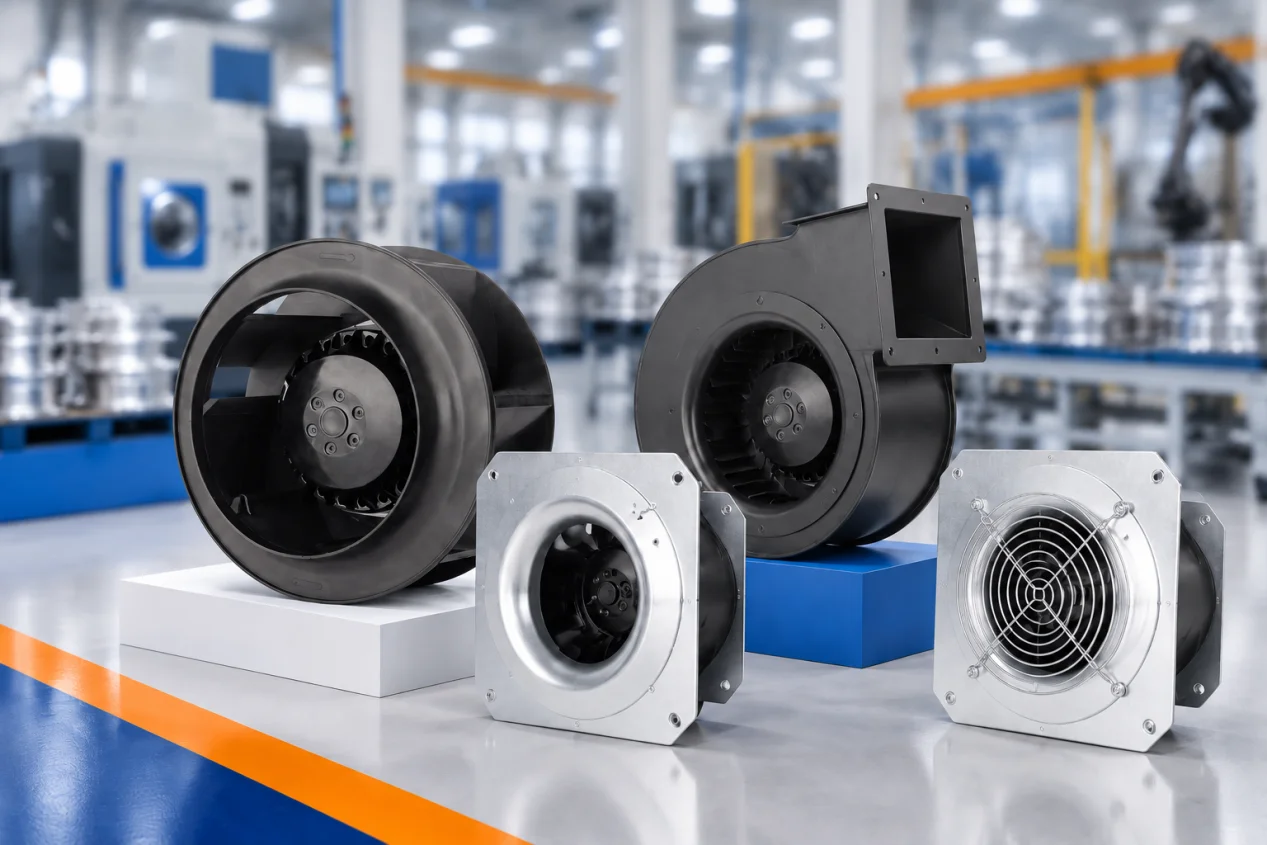
Here the product image and data summary provides a quick visual reference for procurement managers and application engineers during the initial selection phase.
When to break the blade-direction rule
Blade direction has a good rule of thumb and a real exception. Knowing which case you are in saves a design round.
- Apply the pressure rule first, then check your envelope. Backward-curved above roughly 200 Pa is right when you have room for the diameter. Where cabinet depth is fixed and tight, a forward-curved fan may be the only geometry that fits.
- Price the exception in watts, not in purchase cost. Choosing forward-curved above its efficient range costs continuous power. Multiply the difference by annual running hours before deciding, since on a unit running year-round that figure dwarfs the fan price.
- Check the noise margin, not just the limit. A forward-curved wheel worked hard sits close to its acoustic ceiling. Meeting 72 against a 75 dB(A) limit leaves little room for installation effects.
- Ask whether the cabinet is genuinely fixed. Sometimes 15mm of extra depth is available and nobody checked. That is often cheaper than paying the efficiency penalty for the life of the product.
See our centrifugal fan range, the forward curved fan section, or backward curved fans. Efficiency rules come from ASHRAE 90.1.
Questions about blade direction
Is forward-curved wrong above 200 Pa?
Not wrong, just less efficient. A forward-curved fan will reach higher pressures, drawing more power and making more noise than a backward-curved wheel at the same duty. The rule of thumb is about where each is efficient, not about where each is possible.
How much more power does the exception cost?
It depends on the duty point, and it is worth calculating rather than estimating. Ask for both curves at your airflow and pressure, then compare the input power figures. Multiply the gap by your annual running hours and you have the real cost of the decision.
Why does backward-curved need more depth?
Because it develops pressure through blade shape and tip speed rather than by packing many small blades into a small wheel. At a given duty the backward-curved impeller is generally larger, and a larger wheel needs a deeper scroll around it.
Does IP54 suit a plant room?
Generally yes. It covers dust ingress and water spray, which matches an indoor mechanical space. For outdoor mounting or washdown areas, ask about a higher rating, and remember that ingress protection says nothing about corrosion resistance.
Technical Documentation & Resources
Working on something similar?
Send us the duty point, the envelope and the supply, and our engineers come back with a shortlist rather than a catalog. Meanwhile custom spec sheets and samples run to 90 days. Since 1990 we have built fans for HVAC, cold chain, data center and industrial OEMs.
Browse Related Products:
🏆 ISO 9001 / ISO 14001 / ISO 45001 | CE (TÜV) | UL/ETL | ATEX Zone 21/22 | AMCA 210/211 / ISO 5801 tested
Choose the right forward curved centrifugal fan
Longwell manufactures 93 forward curved centrifugal fans in-house. Send airflow, static pressure and voltage — an engineer replies with a matching model, performance curve and price within one working day.