What the HVAC OEM asked for
An existing OEM building large HVAC equipment wanted a change to their standard condenser fan. Specifically, a guard grille added to the suction side of our LWAA6D900S series, making it a dual-grille axial fan.
Guarded on both sides, a technician cannot reach the blades from either direction. That is a common need wherever a fan sits in a reachable part of an air-cooled chiller or a rooftop unit.
The constraints were mostly about paperwork rather than physics.
- 380V AC, since both their 50Hz and 60Hz lines need documents.
- A drop-in fit to the existing 1070 by 1070mm panel mounting, within 290mm of depth.
- Two signed-off spec sheets, one for each frequency.
- A new model number for the 60Hz version, replacing a legacy part ending in -00.
- Lastly, testing to ISO 5801, plus safety under EN 60335-1.
That fourth point is a quality system rule rather than an engineering one. Their traceability depends on the changed design carrying a number that never meant anything else.
Proving the dual-grille axial fan still performs
Here the ran as minor development. Basically the work was paperwork and adaptation, not design.
What a second grille costs
One question came before all others. A grille on the suction side adds resistance, and resistance changes the P-Q curve.
Our engineers modeled it. Since the grille is a standard part of ours, its resistance was already known. Consequently this was sums, not guesswork.
The answer came back under 10 Pa of extra static pressure at the target duty point. Against a fan moving over 27,000 m3/h that is nothing, so the existing data stays valid. Consequently the customer never had to re-rate their system.
The part numbers
With performance settled, the real deliverable turned out to be part numbers.
Their 50Hz systems used a base model ending -09-00. So for the dual-grille axial fan we created a separate model ending -09-34, which breaks cleanly from the original.
For 60Hz we generated a separate model number entirely, satisfying their instruction to leave the legacy -00 suffix behind.
Here the sounds like admin. Inside a quality system, though, it counts as engineering. A changed fan sharing a number with an unchanged one is how the wrong part reaches a line two years later.
The motor stayed as it was
Meanwhile the dual-grille axial fan keeps its standard AC external rotor motor, with two speeds through simple Y/Δ wiring at 900 and 700 RPM. That varies output without a drive, which suits a cost-driven platform.
An EC variant on our SmartEC platform was available, offering better efficiency and finer control. However, the customer asked for a minimal change. Adding a new motor type to a safety change is not minimal.
Technical Specifications
Two dual-grille axial fan model numbers appear below, one for 50Hz and one for 60Hz. The speed and power rows differ, while everything else is shared.
| Parameter | Value |
|---|---|
| Model Number | LWAA6D900S-5MKB-09-34 (50Hz) / LWAA6D900S-5MKB-17 (60Hz) |
| Nominal Voltage | 380 VAC |
| Frequency | 50 Hz / 60 Hz |
| Speed (High/Low) | 900 / 700 RPM |
| Input Power (High/Low) | 1650 / 1200 W |
| Current (High/Low) | 3.9 / 2.5 A |
| Max Airflow (High/Low) | 27,089 / 20,600 m³/h (15935 / 12118 CFM) |
| Noise Level (High/Low) | 80 / 77 dB(A) |
| Ambient Temperature Range | -30°C to +60°C |
| Protection Class | IP54 |
| Insulation Class | Class F |
| Dimensions (W x H x D) | 1070 x 1070 x 290 mm |
| Life Expectancy (L10) | 30,000 Hours @ 40°C |
| Certifications | CE, RoHS, Reach |
Technical Documentation
Final Specification Sheet (60Hz)
This is the final technical specification sheet for the 60Hz model (LWAA6D900S-5MKB-17), essential for system integrators and compliance engineers in North American and other 60Hz markets.
Final Specification Sheet (50Hz)
This is the final technical specification sheet for the 50Hz model (LWAA6D900S-5MKB-09-34), required by procurement and technical teams for validation in 50Hz regions.
Original Customer Product Info (50Hz)
This reference specification for the original 50Hz base model (LWAA6D900S-5MKB-09-00) was used by engineering to establish the modification baseline.
Original Customer Product Info (60Hz)
This is the customer-provided information for the existing 60Hz fan (LWAA6D900S-5MKB-16), which served as the starting point for the dual-grille modification request.
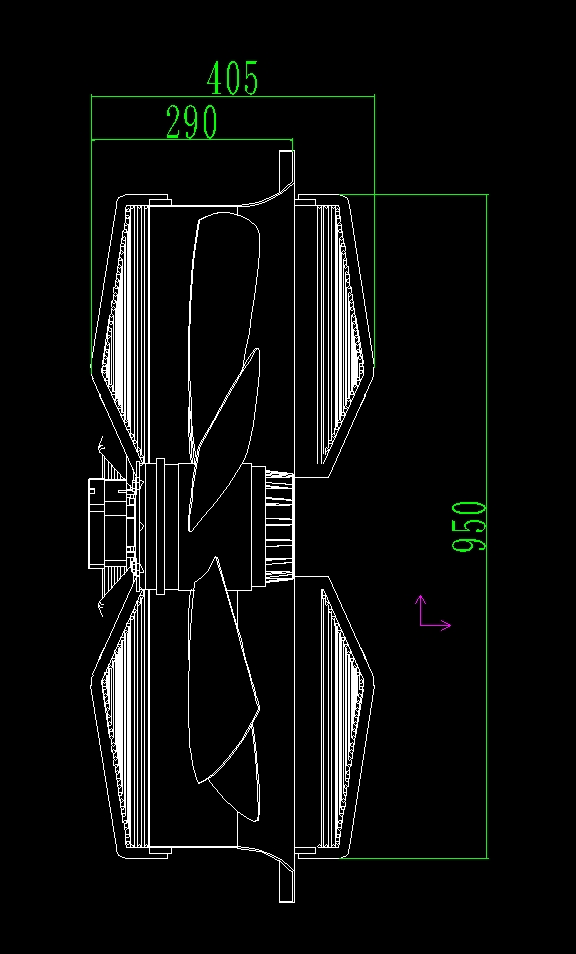
Above, the customer-provided reference drawing was used for an initial fit-check and to confirm the double-sided grille concept before formal engineering work began.
Why a small change got a formal process
On a change this small, four things mattered.
- Small requests get processed. This was a modification, yet it needed a formal engineering and documentation process. Our workflow dealt with it fast. European suppliers often push small jobs like this to the back of the queue.
- Safety added without a price penalty. The customer built this dual-grille axial fan on an AC platform for cost reasons, and wanted the second grille anyway. Making the guard in house meant the safety feature could be added without having to be justified against the fan budget.
- Certified documents without delay. Certified datasheets were the deliverable. The line already holds CE, and our records are tight, so they went out at once. Our local TUV NORD relationship then covers any future certification far faster than a trans-continental process.
- Every change reviewed. Even a minor modification gets a project manager and a formal review here. Consequently the OEM gets a checked answer, and their own fitting risk drops.
Browse our AC axial fan range, or the condenser fan section. Appliance safety requirements come from IEC 60335-1.
Questions about the modification
How much does the second grille cost in performance?
Very little. On this series it raises static pressure by under 10 Pa at the nominal operating point. Final performance stays well inside the published figures, still above 27,000 m3/h. We validate that so no re-rating of your system is needed.
Can it be speed-controlled with a VFD?
The standard motor gives two speeds through Y/Δ wiring at 900 and 700 RPM. Many AC motors will run on a VFD, though we strongly suggest checking compatibility with our technical team first, since resonance, harmonics and overheating are all real risks. For genuine variable speed, the SmartEC variant with 0-10V and PWM control is the recommended route.
What L10 life applies at maximum temperature?
Here the datasheet quotes 30,000 hours at a 40C ambient, on maintenance-free deep groove ball bearings, with the fan rated to +60C. Running near that upper limit shortens bearing life, following the Arrhenius rule. Send us your duty cycle and ambient profile for a specific calculation.
Why does a guard grille need a new part number at all?
Because the two fans are no longer interchangeable on paper, even though they perform alike. A quality system tracks what was built rather than what was intended. Consequently giving the dual-grille axial fan its own number is what stops an unguarded unit reaching a job that specified a guarded one.
Technical Documentation & Resources
Need the same thing for your own unit?
Give us the numbers and the envelope, and you get a shortlist rather than a catalog. Meanwhile custom spec sheets and samples run to 90 days. Since 1990 Longwell has supplied EC fans and blowers to OEMs in HVAC, cold chain, data center and industrial markets.
Browse Related Products:
🏆 ISO 9001 / ISO 14001 / ISO 45001 | CE (TÜV) | UL/ETL | ATEX Zone 21/22 | AMCA 210/211 / ISO 5801 tested
Choose the right ac axial fan
Longwell manufactures 218 ac axial fans in-house. Send airflow, static pressure and voltage — an engineer replies with a matching model, performance curve and price within one working day.