Matching Airflow Profiles for a Facility Roof Exhaust
A facility manager brought us a unique ventilation problem involving a commercial roof exhaust fan. Meanwhile, they needed to upgrade the entire system across a large building. The existing metal roof had waterproofed structural curbs already in place. Therefore, we could not change these built-in curbs.
Modifying old metal roofs often causes severe water leaks. So, the new units had to drop into exact footprints. The site featured two distinct ventilation zones. First, the main process area needed high airflow.
The customer asked for two units delivering 19,000 m³/h at 120 Pa. Next, the secondary zones required lower extraction rates. They needed eleven smaller units moving 4,500 m³/h at 100 Pa. In practice, furthermore, all equipment had to run on a standard 3-phase 380V power rail.
The customer needed these distinct zones to handle different heat loads within the building. Meanwhile, the facility sits outdoors and faces harsh weather. Therefore, the units needed heavy sealant compatibility. Therefore, the site constraints forced a strict dimensional boundary.
The large roof curbs measured exactly 1050 by 1050 mm. Meanwhile, the smaller curbs measured 580 by 580 mm. Any replacement had to match these base dimensions perfectly. In practice, we test our airflow rates to AMCA 210-16 methods.
This testing guarantees the published curves match real field performance. In short, we had to find a precise aerodynamic fit without altering the building structure.
Choosing the right commercial roof exhaust fan size
We had to fulfill two very different duty points. As a result, we explored several design paths before making a final choice.
Rejecting a single topology
Initially, we considered using one fan family for all thirteen points. An all-axial setup seemed cheaper at first glance. However, an axial fan scaled to 19,000 m³/h needs a huge diameter. It would overhang the 1050 mm structural curb. This overhang creates a severe risk of wind shear damage. Thus, we rejected the all-axial approach. Next, we looked at an all-centrifugal solution. Centrifugal units handle high pressure easily. Yet, placing thirteen big centrifugal fans on the roof causes new problems. The electrical load would climb too high. Therefore, we rejected standardizing on a single fan type.
Sizing the smaller zones
For the eleven secondary points, the customer needed 4,500 m³/h at 100 Pa. We selected the LWARF410-11E axial unit. This model fits the 580 by 580 mm curb perfectly. It delivers 4,800 m³/h at 187 Pa. Consequently, it gives the system a comfortable pressure buffer. It achieves this while drawing just 550 W. This low draw keeps the continuous power load very small. The 1450 RPM speed keeps noise down to 67 dB(A). As a result, it works perfectly for general facility areas.
Sizing the main process areas
The two main extraction points demanded 19,000 m³/h at 120 Pa. We specified the LWCRF800-01 centrifugal model. This commercial roof exhaust fan moves up to 19,428 m³/h. Furthermore, it provides static pressure up to 887 Pa. This steep pressure easily overcomes the internal stack effect of the large building. The 1050 by 1050 mm base drops right onto the existing structural curb.
The cost of the split design
This split engineering decision carried a clear cost. Managing two different product types adds complexity to the final order. The large centrifugal fans require a heavy 5,500 W motor. Even so, this mixed design saved a lot of energy. If we used the 5.5 kW centrifugal model everywhere, the site load would hit 71.5 kW. By matching the exact fan type to the local zone, the total load dropped to just 17.05 kW.
Technical Specifications
| Parameter | LWCRF800-01 (Centrifugal) | LWARF410-11E (Axial) |
|---|---|---|
| Airflow | 10,478 – 19,428 m³/h | 4,800 m³/h |
| Static Pressure | 887 – 651 Pa | 187 Pa |
| Input Power | 5,500 W | 550 W |
| Speed | 960 RPM | 1450 RPM |
| Voltage | AC 3~380V | AC 3~380V |
| Frequency | 50 Hz | 50 Hz |
| Base Dimensions | 1050 x 1050 mm | 580 x 580 mm |
| Noise | – | 67 dB(A) |
The base dimensions dictated which unit could sit on the roof curbs. Furthermore, the massive gap in input power between the two models stands out. This gap highlights exactly why we split the commercial roof exhaust fan. Using smaller axial models saved thousands of watts across the whole facility.
Reference: AMCA 210 covers the test method behind these figures.
Technical Documentation
Centrifugal Fan Dimensional Drawing
This document shows the 1050 by 1050 mm base required for structural alignment.
Axial Fan Dimensional Drawing
Next, this print confirms the 580 by 580 mm base parameters for the smaller points.
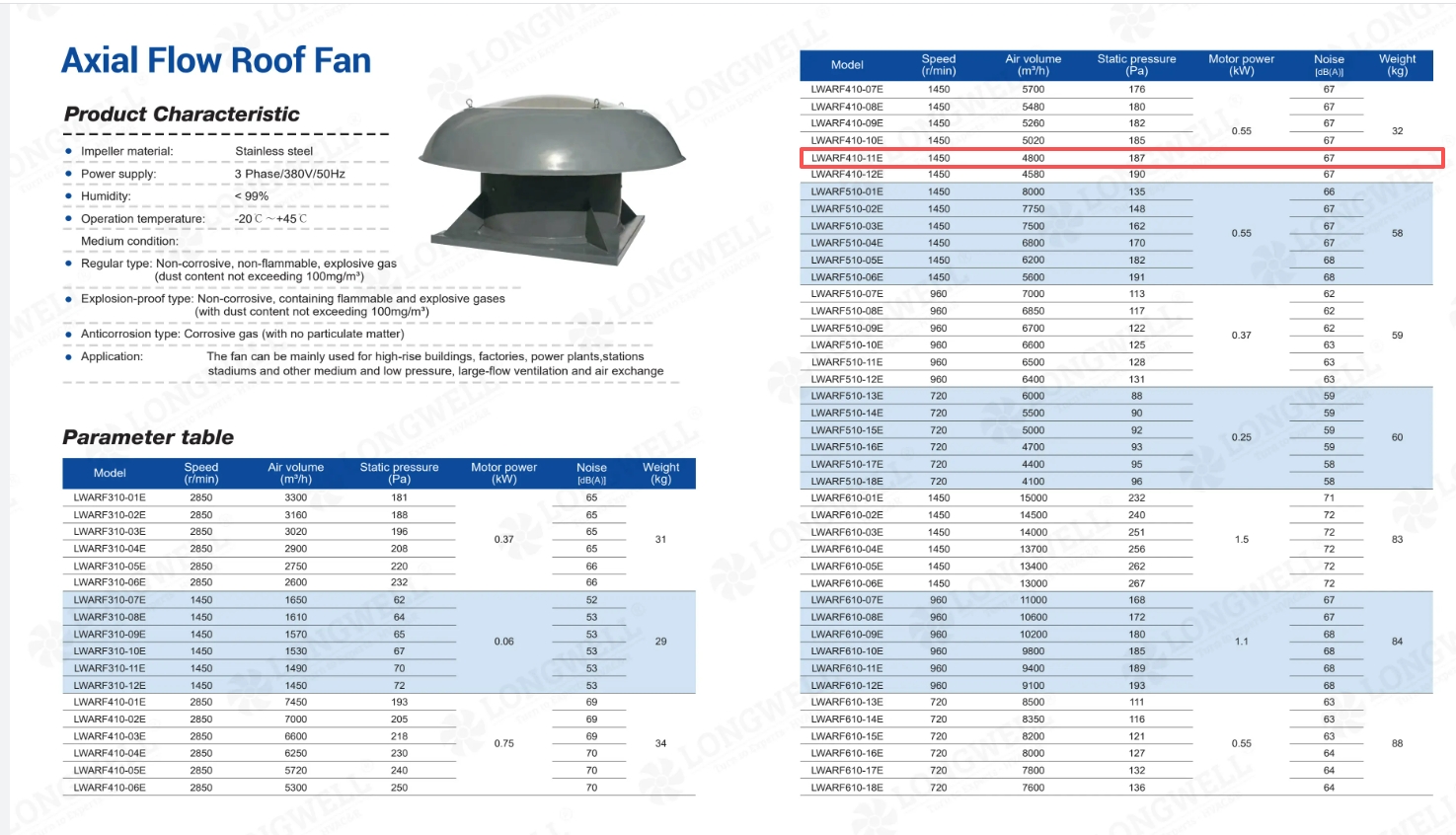
This catalog page lists the exact operating points and electrical draw for both chosen models.
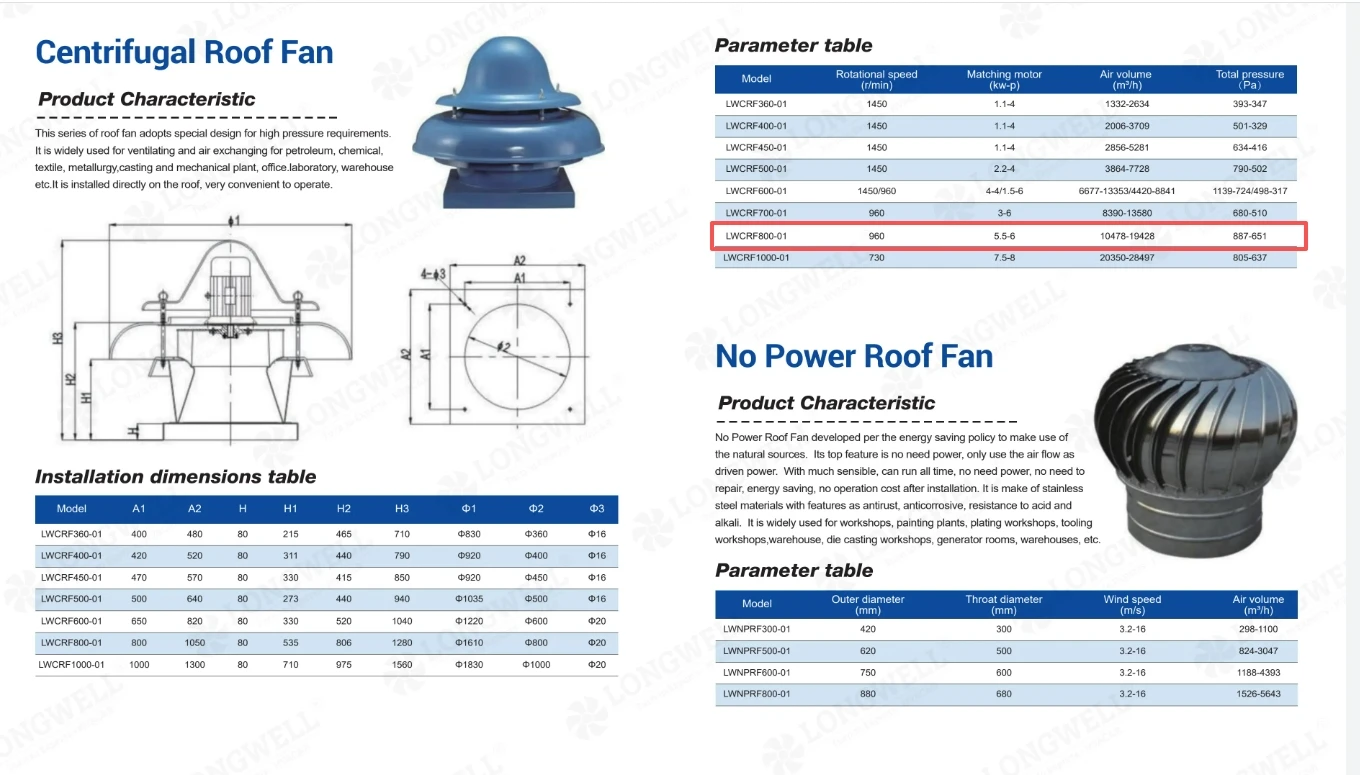
Furthermore, this photograph reveals the heavy sealant and metal curb constraints our units had to match.
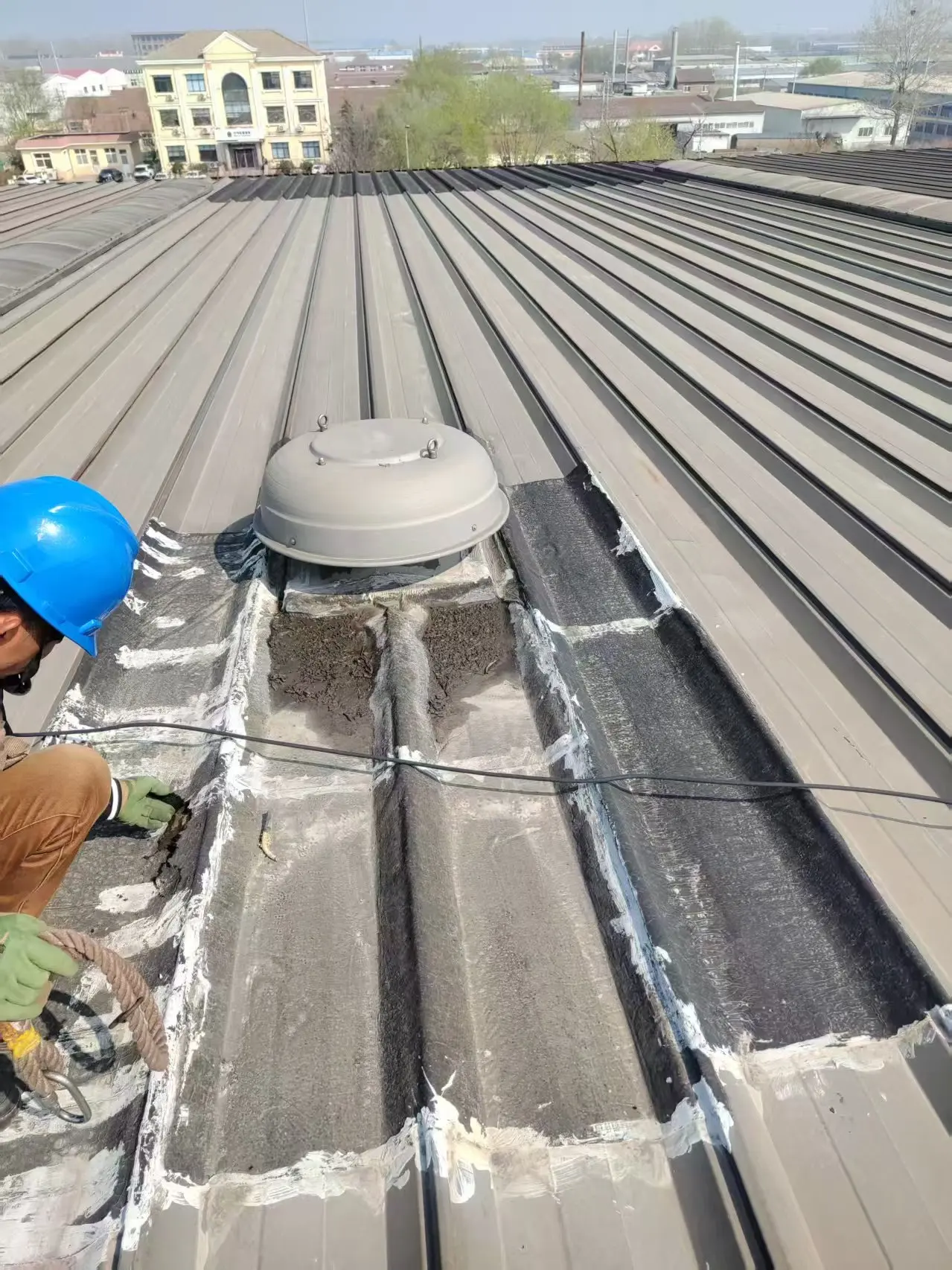
This image shows the weathered installation that dictated our strict dimensional boundaries.
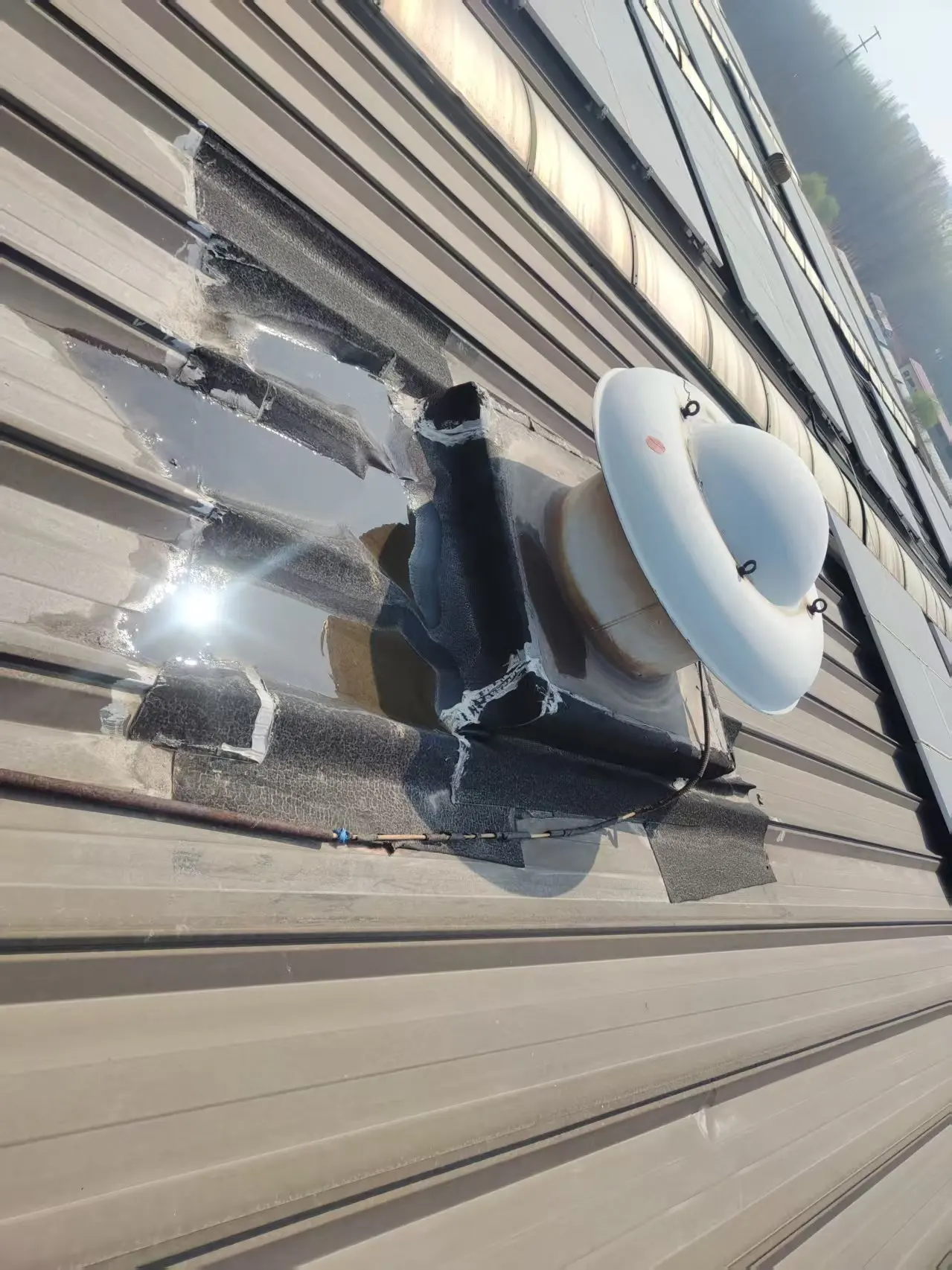
Finally, this broad view displays the metal structure that restricted any mechanical modifications.
How to Specify a Facility Roof Exhaust System
- First, measure the exact outer dimensions of the existing roof curb. You must also measure the internal drop-in diameter. Do not guess these numbers. A mismatch of even 20 mm requires custom transition plates.
- Next, calculate the required static pressure for each separate zone. You should evaluate the building makeup air supply. Main process floors need high pressure to clear fumes, while storage areas only need basic turnover.
- Instead of over-sizing every extraction point, split your specification. Use a mix of axial and centrifugal designs. Running a 5.5 kW motor where a 550 W motor works wastes money. Match the motor class to the local zone.
Related: Roof Exhaust Fans.
Frequently Asked Questions
Technical Documentation & Resources
Browse our axial fans range, the AC axial fans section, or EC axial fans.
Have a Similar Fan Requirement?
Longwell’s engineering team delivers custom spec sheets and samples within 90 days. Since 1990, we have supplied EC fans and blowers to OEMs across HVAC, cold chain, data center, and industrial applications worldwide.
Browse Related Products:
🏆 ISO 9001 / ISO 14001 / ISO 45001 | CE (TÜV) | UL/ETL | ATEX Zone 21/22 | AMCA 210-16 / ISO 5801 tested
Choose the right roof exhaust fan
Longwell manufactures 23 roof exhaust fans in-house. Send airflow, static pressure and voltage — an engineer replies with a matching model, performance curve and price within one working day.