Air Curtain Airflow and Dimensional Constraints
The customer requested a high pressure air curtain fan for a wide commercial doorway. First, the high pressure air curtain fan had to blow a large volume of air. A high pressure air curtain fan is what forms a firm thermal barrier across a wide entrance. Next, the aerodynamic specs were tough.
This high pressure air curtain fan had to move 1735 m³/h (1020 CFM). It also had to overcome 229 Pa of internal static pressure. Furthermore, the power source was a standard 230 VAC single-phase line. This supply could fluctuate widely between 184 and 276 VAC.
Consequently, the physical size limit created huge structural hurdles. The customer’s existing cabinet allowed a strict 140 mm by 140 mm cross-section. Meanwhile, the job required a long active impeller of 820 mm. The total unit length could not exceed 939 mm.
Therefore, we faced extreme space limits for the motor and bearings. The noise limit sat at just 61 dB(A). We measure this at a one-meter distance. Even so, the ambient temperature range was brutal.
The specs listed a span from -25°C to 60°C. This wide range proves the equipment lives outdoors in harsh weather. Finally, the market demanded CE certification. The site also required direct 0-10V or PWM speed control to link with their building systems.
Engineering the 820mm High Pressure Air Curtain Fan Rotor
We looked at a few different ways to build this blower. First, we thought about splitting the airflow. We could use two smaller 400 mm blower modules. However, we quickly rejected that dual-module idea.
A center bearing block interrupts the continuous air stream. Consequently, it creates a turbulent dead zone in the air curtain. Instead, we committed to a single 820 mm wide EC cross flow fan. This long design greatly increased the physical stress on the spinning parts.
We used an all-aluminum impeller. Aluminum blades offer the needed stiffness across the full 820 mm span. They will not warp under load at 1500 RPM.
Motor and Structure Trade-offs at High Pressure
By contrast, a plastic impeller would have cost much less to produce. We rejected plastic anyway. It risks thermal failure at the 60°C upper limit. It also gets brittle near -25°C.
Therefore, choosing an all-aluminum wheel and a cold-rolled steel frame added a materially higher cost. It also added weight. Even so, it guaranteed long-term dynamic balance. Next, we solved the motor problem.
We used a SmartEC external rotor motor. This motor fits perfectly inside the 140 mm profile constraint. Furthermore, the EC design keeps the total footprint small. It integrates the 0-10VDC and PWM signal inputs directly into the motor housing.
Finally, we tackled the noise rules. Pushing 1735 m³/h through a tight slot always creates loud wind shear. We adjusted the blade angles to smooth the air exit path. So, we hit the 229 Pa static pressure goal.
At the same time, we held the maximum noise to exactly 61 dB(A). However, running this single long rotor at 1500 RPM demands precise factory balancing. This step adds a few days to our lead time. In short, the final LWCE-100820SN-06 unit hit every size limit. It also delivered the exact smart controls the site needed.
Technical Specifications
| Parameter | Value |
|---|---|
| Airflow | 1735 m³/h (1020 CFM) |
| Static Pressure | 229 Pa |
| Input Power | 80 W |
| Speed | 1500 RPM |
| Voltage | 230 VAC (Range: 184-276 VAC) |
| Frequency | 50/60 Hz |
| Noise | 61 dB(A) |
| Operating Temperature | -25°C to 60°C |
| Dimensions | 939 mm (Total Length) x 140 mm x 140 mm |
| Impeller Material | Aluminum |
| Bearing Type | Ball Bearing |
| Lifespan | 30,000 hours (L10) at 25°C |
| Certifications | CE |
The 229 Pa static pressure rating is highly important here. Air curtains need high exit speeds to block outside drafts at floor level. Furthermore, the 80 W input power shows great energy efficiency. The EC cross flow fan hits 1500 RPM using very little electricity.
Reference: AMCA 210 covers the test method behind these figures.
Technical Documentation
Download the technical specification and wiring diagram for the EC cross flow fan.
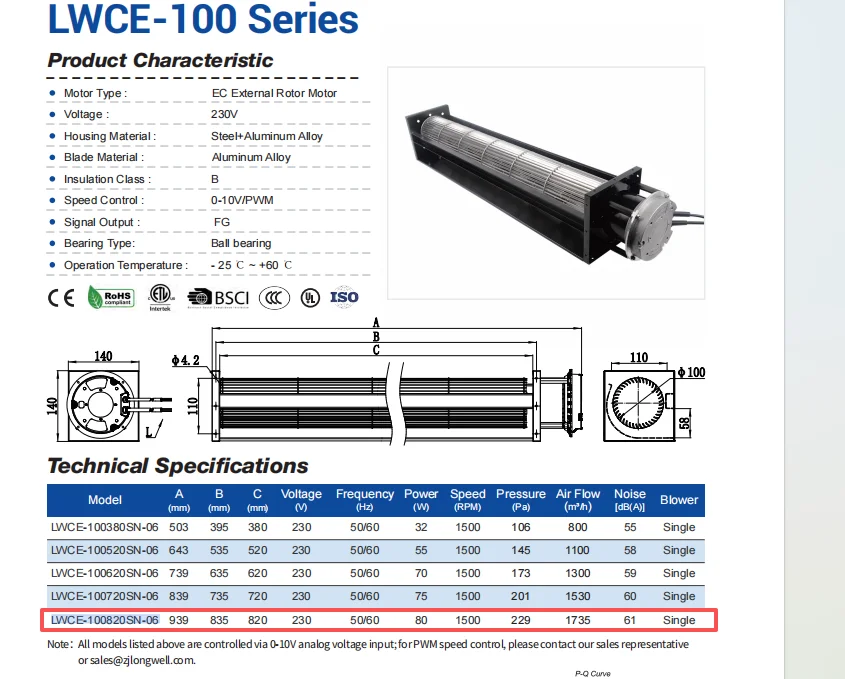
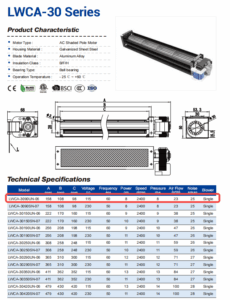
The reference table details the exact dimensional variations across the LWCE-100 series, which mechanical engineers need for structural enclosure modeling.
Specifying Long Blowers for Commercial Enclosures
Engineers putting an EC cross flow fan into a cabinet face unique aerodynamic traps.
- First, measure the true clearance for the whole fan. Do not just measure the air slot. You must leave room for the motor and the side flanges. These parts add exactly 119 mm to the active 820 mm blade length.
- Next, match your impeller material to your top heat limit. A cheap plastic rotor feels fine at room temperature. However, it will melt and warp if placed near overhead heating coils.
- Furthermore, bending is the most common failure point. Driving a single fan shaft past 800 mm invites heavy vibration. Therefore, specify dynamic balancing in your order to protect the bearings.
- Finally, send your supplier the exact voltage range you expect. Because we build our own impellers, we can adjust the blade angles to match your exact noise target.
Related: Cross Flow Fans.
Engineering Questions
Technical Documentation & Resources
Browse our cross-flow fans range, the AC cross-flow fans section, or cross-flow impellers.
Have a Similar Fan Requirement?
Longwell’s engineering team delivers custom spec sheets and samples within 90 days. Since 1990, we have supplied EC fans and blowers to OEMs across HVAC, cold chain, data center, and industrial applications worldwide.
Browse Related Products:
🏆 ISO 9001 / ISO 14001 / ISO 45001 | CE (TÜV) | UL/ETL | ATEX Zone 21/22 | AMCA 210-16 / ISO 5801 tested
Choose the right cross flow fan
Longwell manufactures 495 cross flow fans in-house. Send airflow, static pressure and voltage — an engineer replies with a matching model, performance curve and price within one working day.