Constraints for a 220V Commercial Cooling Application
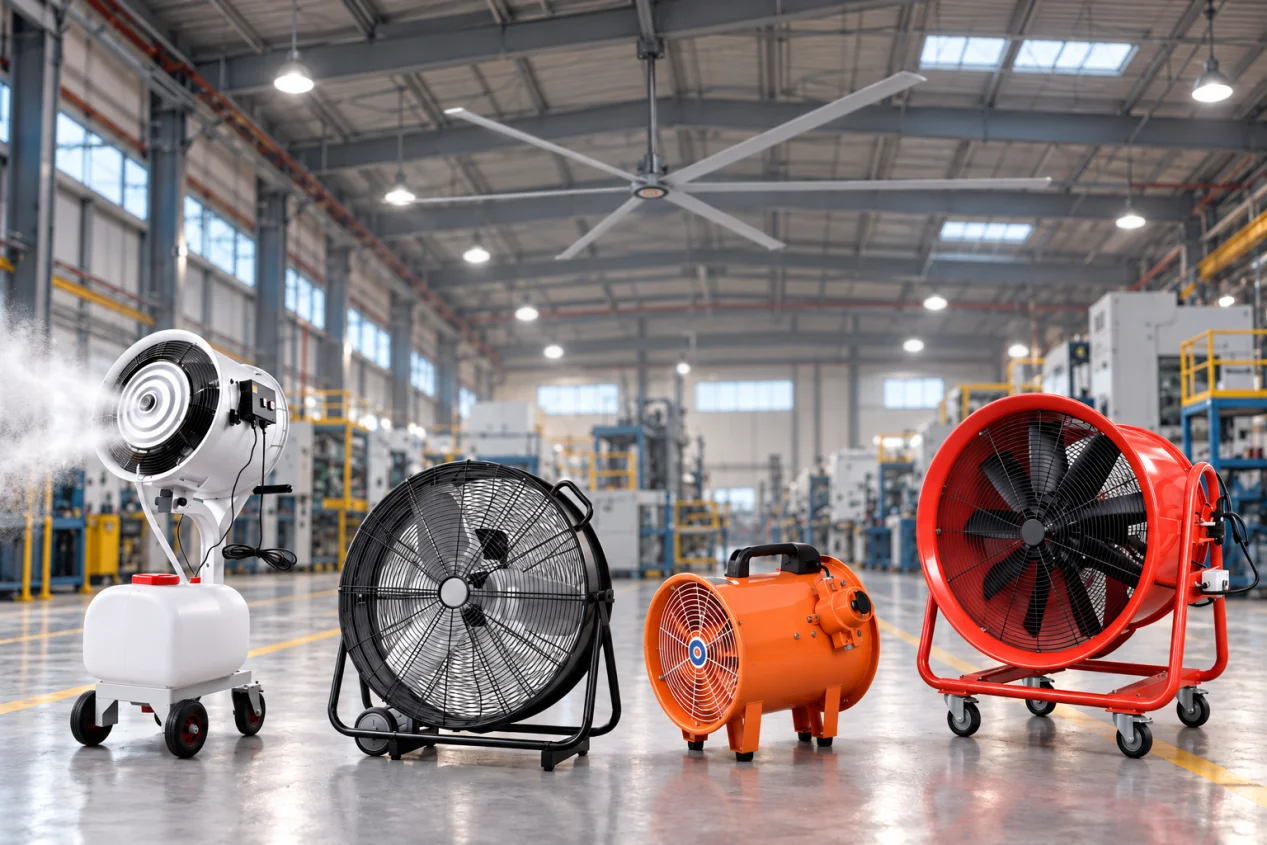
We recently reviewed the strict requirements for a 30 inch pedestal mist fan, as the customer needed this exact unit for a demanding open-space cooling application. The equipment operates in a busy commercial environment. Hard constraints included a 220V power supply natively fitted with a standard UK plug. This indicates deployment in regions matching the BS 1363 standard.
Therefore, we avoided generic hardwired systems because they complicate relocation. Space restrictions dictated an overall height of exactly 1.75 meters from the floor to the unit’s apex. Furthermore, the cooling cycle demanded an onboard water reservoir capable of holding exactly 45 liters. We noted this specific volume minimizes refill frequency during standard operating shifts.
Staff will not need to constantly monitor the water level throughout the day. Next, airflow represents a critical performance metric for effective evaporation in the surrounding air. The specification required a high-volume output of 155 cubic meters per minute (m³/min) at 50Hz operation. So, our design team needed to select a drive unit rated for 350W input power to overcome aerodynamic drag.
The unit also requires a thickened mesh cover. This complies with machinery safety guidelines for operator protection in high-traffic areas. By contrast, a smaller 26-inch variant evaluated earlier would only deliver 145 m³/min. This smaller volume failed the customer’s precise thermal load requirements.
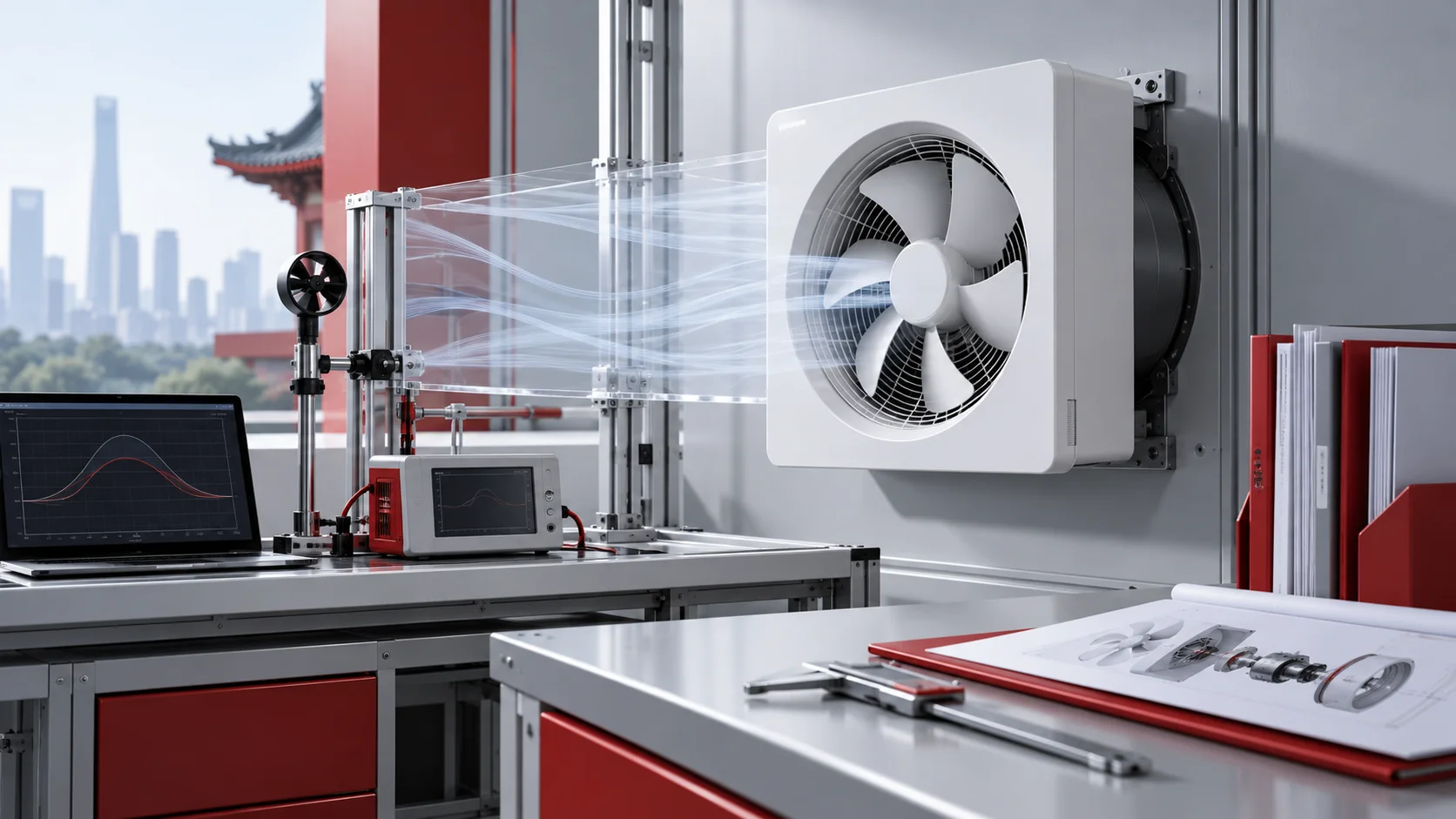
In short, the application demanded the larger 750mm impeller diameter to maintain proper mist dispersion over the wide target area. Finally, our lab tests performance to AMCA 210-16 methods to confirm these exact operational parameters before final approval.
Sizing the 30 Inch Pedestal Mist Fan
Selecting the correct drive mechanism requires balancing raw copper mass against overall thermal performance. First, we evaluated standard aluminum-wound stators for the initial design phase. However, a 350W input power draw generates substantial heat under continuous load conditions. We rejected aluminum windings because their higher resistance lowers electrical efficiency and shortens component life dramatically. Instead, we specified a 100% copper motor construction. This decision carried a materially higher cost and added noticeable weight to the upper assembly. Even so, the copper stator delivers stable, continuous operation at the target 155 m³/min airflow without dangerous temperature spikes. This ensures the motor survives long operational shifts.
Aerodynamics and Speed Control
Next, we carefully analyzed the aerodynamic profile of the main impeller. A three-blade configuration was chosen over a denser five-blade alternative. We rejected the five-blade option because it increases aerodynamic noise beyond the acceptable limit for inhabited spaces. Inhabited commercial areas require quieter cooling solutions to maintain comfort. Consequently, the three-blade profile maintains low noise operation while successfully moving the required 9,300 cubic meters per hour. Furthermore, the selected motor supports three distinct velocity settings. This flexibility allows equipment operators to reduce rotational speed during cooler periods, which actively extends bearing life. It reduces internal wear and tear over the long term.
Structural Stability and Tank Sizing
Integrating a large 45-liter capacity tank heavily dictates the structural base dimensions. First, we evaluated a direct water-line feed system for the unit. This would provide endless water for the misting cycle. We rejected the direct feed because it severely limits unit mobility across vast facility floors. Users cannot safely drag a pressurized hose everywhere. By contrast, the self-contained 45L reservoir safely lowers the center of gravity. So, the 1.75-meter stand can be positioned anywhere within reach of a standard 220V receptacle without dangerous tipping hazards. Therefore, the resulting LWIF-750(30″)S-02A model perfectly balances high evaporative cooling capacity with highly practical deployment. Finally, the standard black finish perfectly meets the customer’s visual requirements.
Technical Specifications
| Parameter | Value |
|---|---|
| Model | LWIF-750(30″)S-02A |
| Impeller Size | 30 inch (750mm) |
| Voltage | 220 V |
| Frequency | 50 Hz |
| Input Power | 350 W |
| Motor Winding | 100% copper |
| Airflow | 155 m³/min |
| Tank Capacity | 45 L |
| Overall Height | 1.75 meters |
| Velocity Settings | 3 speeds |
| Color | Black |
An input power of 350W directly supports the high airflow requirement. The 100% copper motor in this 30 inch pedestal mist fan pushes 155 m³/min through the protective grille. Meanwhile, the 45L tank capacity dictates exactly how long the unit runs. Therefore, it determines the time between manual refills. Ultimately, these specifications define the physical footprint.
Reference: AMCA 210 covers the test method behind these figures.
Technical Documentation
longwell-lwif-750-technical-doc-01.pdf
Our technical drawing details the exact dimensional specifications. Furthermore, it includes the electrical parameters for the specified 220V unit required for final site planning.
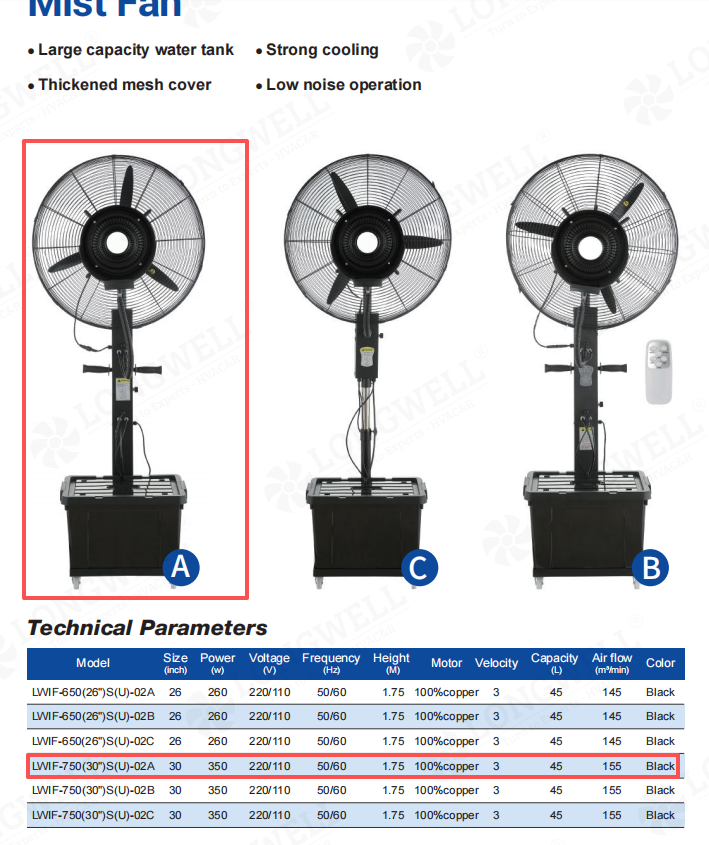
This catalog extract compares the 30-inch model against the smaller 26-inch variants. First, it confirms the 155 m³/min airflow target and component sizing.
Specification Guidelines for Evaporative Cooling Projects
- First, measure the exact floor space available. You must do this before specifying the base dimensions of any portable 30 inch pedestal mist fan. The physical footprint matters greatly in commercial spaces.
- Next, verify the regional power and frequency standards early in the design phase. A unit shipped with bare wires limits immediate deployment. An incorrect plug frustrates end users immensely and delays installation.
- Furthermore, calculate the required runtime to determine accurate tank sizing. A 45-liter water capacity typically acts as the binding constraint. It affects both dry shipping weight and structural portability.
- So, engineers must account for an additional 45 kilograms of mass at the base. They need this precise data when evaluating caster wheel load ratings.
- However, the most common mistake is undersizing the main impeller. Designers do this to save initial material costs. This forces the motor to run at maximum speed continuously. It wears out the bearings faster to meet the high cooling load.
- Instead, specifying a larger 750mm diameter allows slower operation. It provides a quieter environment while pushing the exact identical volume of air.
Related: Commercial Fans and Blowers.
Common Design Questions
Browse our axial fans range, the AC axial fans section, or EC axial fans.
Have a Similar Fan Requirement?
Longwell’s engineering team delivers custom spec sheets and samples within 90 days. Since 1990, we have supplied EC fans and blowers to OEMs across HVAC, cold chain, data center, and industrial applications worldwide.
Browse Related Products:
🏆 ISO 9001 / ISO 14001 / ISO 45001 | CE (TÜV) | UL/ETL | ATEX Zone 21/22 | AMCA 210-16 / ISO 5801 tested
Choose the right industrial fan
Longwell manufactures 38 industrial fans in-house. Send airflow, static pressure and voltage — an engineer replies with a matching model, performance curve and price within one working day.