Sizing a 172mm AC Cooling Fan for a Compact Rack
You must measure the physical space closely to fit a 172mm ac cooling fan. The customer had a very tight 172x150x51mm space for this project. Therefore, a standard round fan would not fit. Furthermore, they needed to plug the unit directly into a 230 VAC wall supply.
So, we had to provide an AC fan without adding an extra circuit board. The customer requested four samples to test inside their equipment rack. Next, we looked at the thermal targets. The system needed 178 CFM of airflow at zero static pressure.
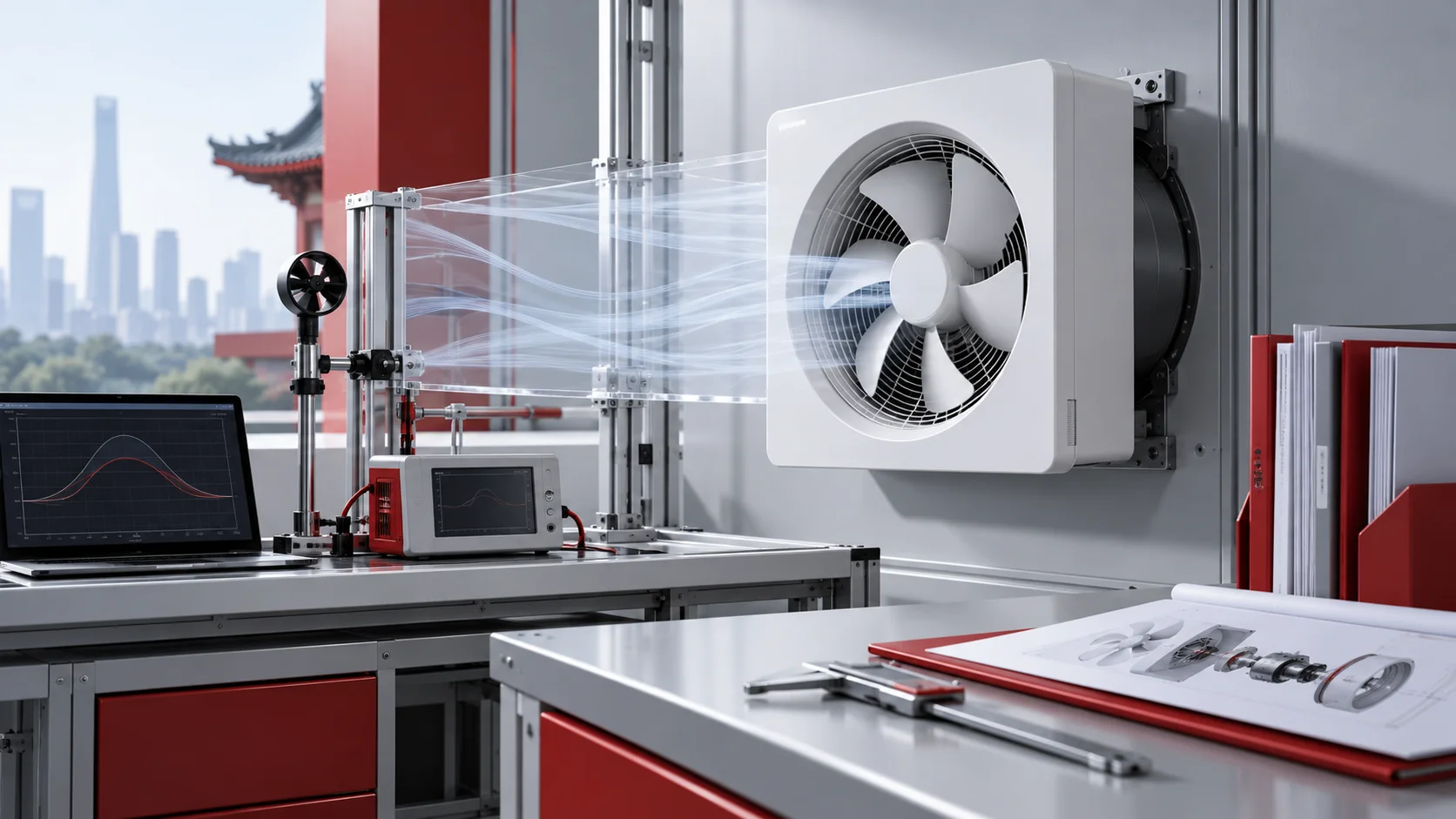
Consequently, we tested prototypes to standard AMCA 210-16 methods. This testing confirmed the fan moved enough air to cool the rack. The cabinet sat in a busy office room. Therefore, the fan noise could not pass 43 dBA.
Meanwhile, the indoor space kept the ambient heat between -10 C and +65 C. Finally, the whole rack needed to pass basic electrical safety checks. In short, the fan had to survive a 1800VAC test for one full second. It also needed Class A insulation to meet standard safety rules.
Choosing the Right Parts for the 172mm AC Cooling Fan
We looked at different ways to build this AC fan. First, we tested a cheap sleeve bearing. The sleeve model reached the exact 178 CFM target. It also hit the 43 dBA noise limit. However, sleeve bearings fail quickly when the heat goes up. Therefore, we rejected the sleeve bearing design. Instead, we chose a two-ball bearing setup. The ball bearing design costs slightly more money. Even so, it gives the fan 50,000 hours of run time at 40 C.
Motor Power and Cost Choices
Next, we reviewed the motor style. A modern EC motor draws much less power. In fact, an EC motor drops the power from 30W to just 8W. However, an EC motor has a materially higher cost. It also needs extra electronic parts inside the hub. The customer just wanted a simple part to plug into their 230 VAC line. Consequently, we picked a standard shaded pole motor. This choice gave them a much lower upfront cost. Instead, the customer accepted a 30W power draw. They also accepted a fixed 2400 RPM speed. Finally, this choice made the fan much easier to install.
Bearing Life and Acoustic Impacts
We also checked how the bearings affect noise over time. Standard sleeve bearings run quietly on day one. However, they get louder as the oil dries out over time. Therefore, the noise level climbs above the 43 dBA limit after just one year. Instead, we used high-quality steel ball bearings. The ball bearings create a slightly higher starting noise. Even so, the sound remains constant for 50,000 hours. Consequently, the customer avoids noise complaints later in the product life.
Impeller Weight and Material
Next, we had to select the impeller material. We could make the blades out of heavy metal. A metal blade works well for extreme heat. Instead, we used PBT plastic for the fan blades. This plastic has a strong UL94V-0 fire rating. Furthermore, the plastic keeps the total weight down to 850g. A heavy metal blade would put extra stress on the bearings. Therefore, the lighter plastic extends the life of the fan. The air in the room never gets hotter than +65 C. Consequently, the plastic blades handled the heat perfectly. In short, this setup met all the physical and noise limits.
Technical Specifications
| Model Number | LWAA17050SM-11-00 |
| Rated Voltage | 230 VAC |
| Frequency | 50/60Hz |
| Input Current | 0.19/0.18A |
| Input Power | 30/28W |
| Speed | 2400/2300 RPM |
| Max Airflow | 178/166 CFM |
| Acoustical Noise | 43/42 dBA |
| Dimensions | 172 x 150 x 51 mm |
| Weight | 850g |
| Frame Material | Aluminum alloy |
| Impeller Material | PBT Plastic UL94V-0 |
| Bearing Type | Two Ball Bearings |
| Operating Temperature | -10 C to +65 C |
| Insulation Type | UL: CLASS A |
You can see the most important details in the size and heat rows. The flat sides help this unit slide into a rack where a round fan fails. Therefore, you get maximum air power in a narrow space.
Reference: AMCA 210 covers the test method behind these figures.
Technical Documentation
The files below show the exact size and power details for this 172mm ac cooling fan project.
LWAA17050SM-11-00 Specification Sheet. First, the spec sheet lists the wire lengths and drop test rules.
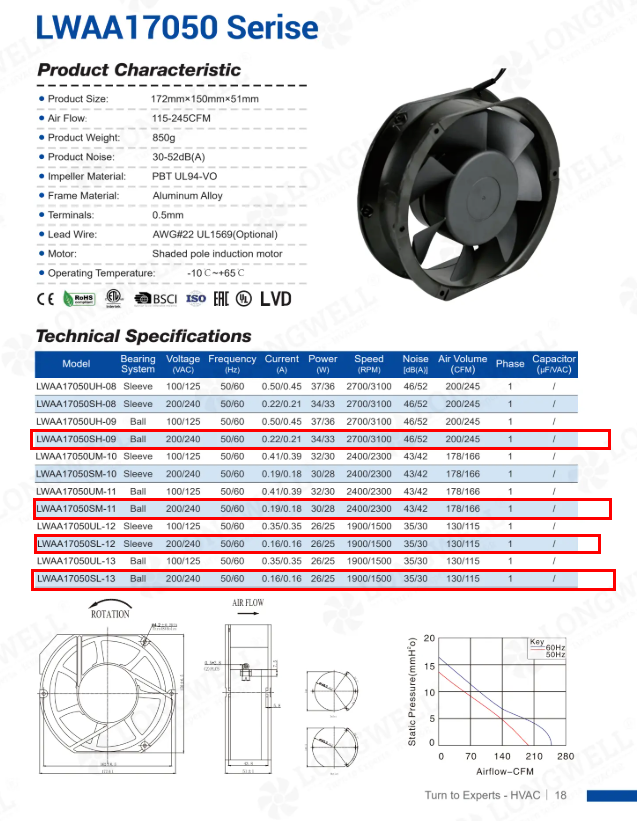
Next, the image shows the flat housing sides and plastic blades.
Practical Steps for Sizing Compact Fans
You can save time by checking a few simple things before you order parts. Follow these steps if you have a similar cooling problem.
- First, measure the exact space between the mounting holes. This frame looks like a 172mm fan, but it uses a 162mm hole spacing.
- Next, find out how much noise your room allows. Moving 178 CFM of air through a small hole makes a lot of noise. Therefore, you must check your local rules first.
- Next, consider the internal heat of your equipment over time. A basic sleeve bearing works well for short tests. However, it will fail early if the heat stays near 40 C. Therefore, you should request ball bearings for continuous duty.
- Finally, confirm the exact power frequency in your building. A shaded pole motor spins based on the power frequency. Consequently, changing from 50Hz to 60Hz will change your airflow.
Related: Axial Fans.
Technical Documentation & Resources
Browse our axial fans range, the AC axial fans section, or EC axial fans.
Have a Similar Fan Requirement?
Longwell’s engineering team delivers custom spec sheets and samples within 90 days. Since 1990, we have supplied EC fans and blowers to OEMs across HVAC, cold chain, data center, and industrial applications worldwide.
Browse Related Products:
🏆 ISO 9001 / ISO 14001 / ISO 45001 | CE (TÜV) | UL/ETL | ATEX Zone 21/22 | AMCA 210-16 / ISO 5801 tested
Choose the right dc cooling fan
Longwell manufactures 38 dc cooling fans in-house. Send airflow, static pressure and voltage — an engineer replies with a matching model, performance curve and price within one working day.