Requirements for a Farm Cooling Project
We recently built a custom vertical circulation fan for a large farm project. First, the client needed 200 units for a major building upgrade. Their power grid provided a strict 380V, 60Hz three-phase supply. Next, they asked for exactly 5800 m³/h of downward airflow.
The original documents also set a 300W power limit and a 0.6A operating current. Furthermore, they wanted a noise level of 60 dB(A) at a speed of 1500 RPM. This setup presented tough physical limits. For example, the fan had to survive ambient temperatures from -25°C to +55°C.
Therefore, we knew the fans would operate near uninsulated roofs. In these spots, they face harsh seasonal changes. Because workers walk directly below, the units needed a built-in safety guard. Meanwhile, the customer also required a suspended bracket mount.
However, we could not attach any plastic ducting to the final assembly. Finally, the motor needed IP54 protection and Class F insulation. In short, this protection guards against the wet and dusty air common in indoor farming. Even so, we had to meet all these limits while ensuring the equipment passed AMCA 210-16 testing.
Our engineers reviewed the client request carefully. So, we quickly noticed a major conflict between the requested speed and the noise target.
Fixing the Vertical Circulation Fan Design
We found a direct conflict in the original customer specifications. The client wanted 5800 m³/h of airflow using only 300W of power. To achieve this, they suggested spinning the impeller at 1500 RPM. However, we rejected this high-speed approach immediately.
Running a large sickle-shaped blade at 1500 RPM creates excessive noise. By contrast, a 60 dB(A) sound level might seem acceptable on paper. But installing 200 unshielded fans in one enclosed building multiplies that noise. Consequently, the workers below would suffer from a highly disruptive environment. Engineers needed a better way to balance airflow and sound.
Choosing Lower Noise Over Low Power
Our team changed the target speed to a much quieter 1100 RPM. Therefore, the noise profile dropped to under 50 dB(A). This massive 10 dB(A) drop creates a much safer workspace. Even so, this acoustic upgrade came with a clear cost.
Pushing 5800 m³/h of air at only 1100 RPM demands a very steep blade pitch. First, this steep angle greatly increases the aerodynamic resistance. So, the required input power jumped from 300W to 370W. The customer gladly accepted this 70W penalty per unit. Instead, they agreed that a quieter room was worth the extra power draw.
Final Mechanical Limits and Upgrades
Next, we locked in the mechanical dimensions. The final assembly uses a strong suspension frame. It also features a flared top cone measuring 643 mm across. Furthermore, this wide intake draws air smoothly from the upper roofline.
The complete exterior package measures exactly 680 x 680 x 370 mm. Meanwhile, we tackled the extreme -25°C to +55°C operating range. We picked special bearing lubricants that withstand intense thermal stress. In short, standard grease would freeze in winter or leak in summer.
Finally, building these fans locally offered a materially lower cost than imported brands. We delivered this savings while keeping the strict IP54 rating.
Technical Specifications
| Parameter | Specification |
|---|---|
| Model Number | LWPVC-500(20″)T-01 |
| Airflow | 5800 m³/h |
| Input Power | 370 W |
| Speed | 1100 ± 150 RPM |
| Voltage | 3~380 V |
| Frequency | 60 Hz |
| Noise Level | ≤ 50 dB(A) |
| Complete Size | 680 x 680 x 370 mm |
| Operating Temperature | -25°C to +55°C |
| IP Rating | IP54 |
| Insulation Class | F |
The lower 1100 RPM speed and the resulting ≤ 50 dB(A) noise limit matter most here. First, they show the real engineering trade-off we made for this project. We chose to prioritize a quiet workspace over the original 300W electrical goal. Therefore, this choice ensures the vertical circulation fan performs well without harming worker comfort.
Reference: AMCA 210 covers the test method behind these figures.
Technical Documentation
Dimensional Drawing for LWPVC-500(20″)T-01. Mechanical engineers use this file to verify the 680 mm mounting space and suspension points.
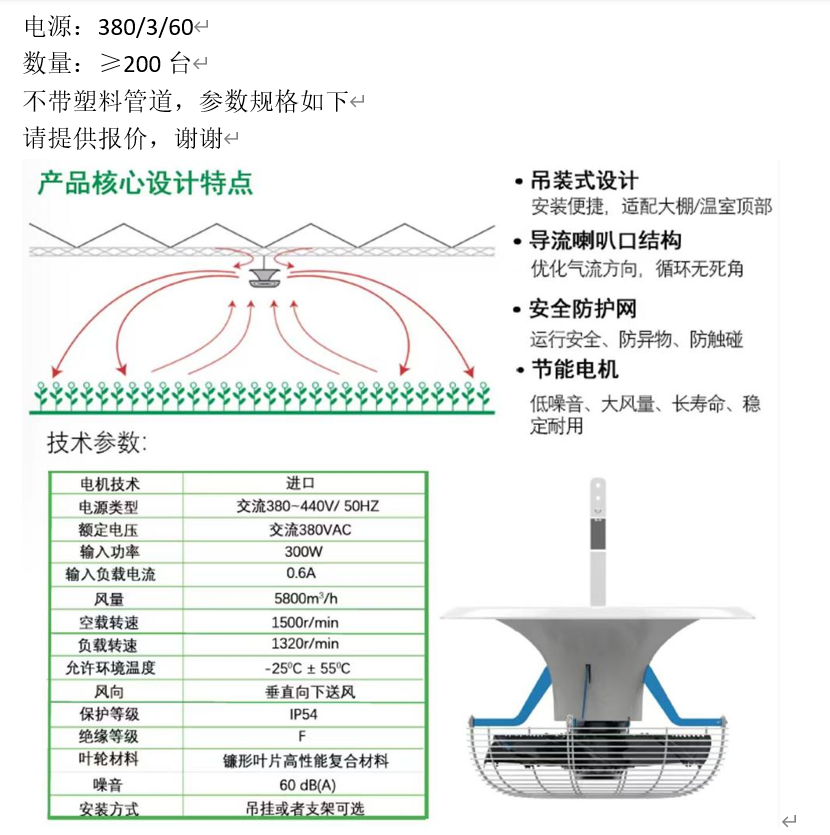
First, the customer supplied this initial sheet showing the 1500 RPM and 300W targets we later changed.
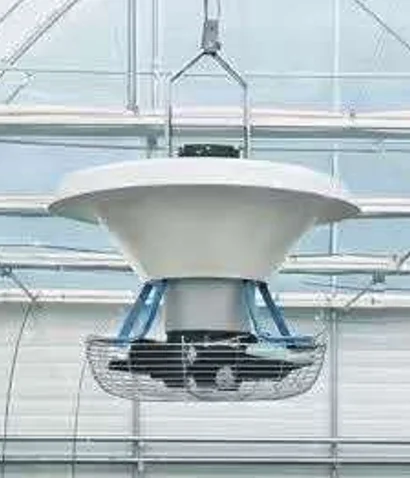
Next, this reference photo displays the requested suspended bracket hardware and the open wire guard.
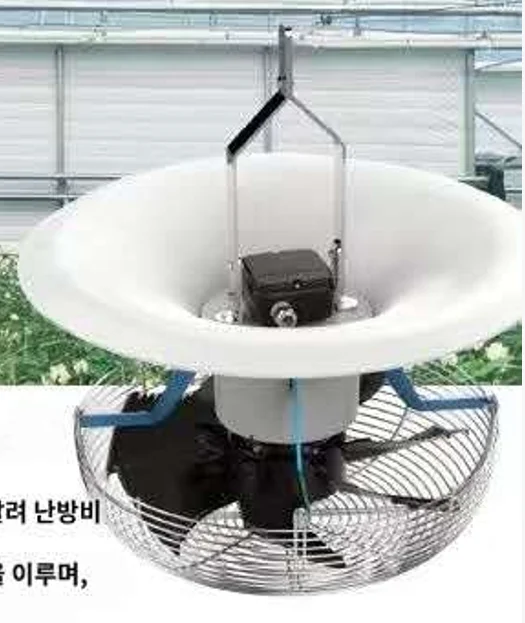
Finally, a secondary install photo demonstrates how the flared upper cone pulls warm air down from the ceiling.
How to Specify Your Own Farm Cooling System
- Planning a suspended overhead cooling project requires careful data collection and realistic limits. First, always measure your true ambient temperature extremes near the actual roofline.
- Stratified air inside a glass greenhouse easily exceeds 50°C during hot summer afternoons. Therefore, this extreme heat demands specific bearing grease and strong motor insulation.
- Next, you must decide whether acoustic comfort or electrical efficiency is your main goal. You simply cannot maximize both traits simultaneously when pushing 5800 m³/h of air.
- By contrast, a slower and quieter vertical circulation fan will always draw more electrical power to move the same air volume. Furthermore, always provide your exact physical mounting space and local grid voltage to your supplier.
- Supplying exact details like 380V and 60Hz upfront ensures the first technical quotation fits your building perfectly. Finally, only work with a supplier that tests equipment to AMCA 210-16 methods.
- We use these strict internal testing standards to guarantee our airflow numbers match the real world.
Related: Axial Fans.
Common Questions About This Vertical Circulation Fan
Technical Documentation & Resources
Browse our axial fans range, the AC axial fans section, or EC axial fans.
Have a Similar Fan Requirement?
Longwell’s engineering team delivers custom spec sheets and samples within 90 days. Since 1990, we have supplied EC fans and blowers to OEMs across HVAC, cold chain, data center, and industrial applications worldwide.
Browse Related Products:
🏆 ISO 9001 / ISO 14001 / ISO 45001 | CE (TÜV) | UL/ETL | ATEX Zone 21/22 | AMCA 210-16 / ISO 5801 tested
Choose the right industrial fan
Longwell manufactures 38 industrial fans in-house. Send airflow, static pressure and voltage — an engineer replies with a matching model, performance curve and price within one working day.