What the humidifier OEM needed
An OEM building industrial humidifiers needed a stainless steel cross-flow fan. Specifically, one delivering 2,700 m3/h at 104 Pa.
Their design ducts air through a wet chamber, so the fan sits in damp air with water forming on every surface. Coated steel rusts there, and the customer knew it. So they asked for a full 304-grade stainless housing rather than a coating.
Meanwhile the performance side was equally firm.
- The custom fan must match the catalog LWCE-150700SN-06 exactly, at 2,700 m3/h and 1000 RPM.
- Enough static pressure to hold that airflow through filters and duct.
- 230V at 50Hz, plus 0-10V variable speed control from their own board.
- A fixed envelope of roughly 860mm long, because the machine was already built around it.
One detail made the job far easier. The customer agreed a standard aluminum impeller was fine, since the wheel never sits in standing water. In short, that single point removed the hardest part of the work.
Building the stainless steel cross-flow fan
This was a light change rather than a new design. Namely a material swap on a platform that already worked.
The starting point was already right
The standard LWCE-150700SN-06 already carries an EC external rotor motor, with 0-10V and PWM control built in through our SmartEC platform. Its base output of 2,700 m3/h at 104 Pa also hit the target.
An AC motor was never on the table. For OEM work of this kind, the EC motor is more efficient and far simpler to control.
Why 304 and not 316
Here the real decision was the grade. Our engineers chose 304 stainless for the side plates, the inlet plate and the outlet plate.
304 handles fresh water and damp air comfortably. 316 costs far more, and it earns that money only where chlorides or harsh chemicals appear. Inside a humidifier they do not. Consequently 316 would simply have loaded the customer bill of materials.
Keeping the performance identical
This is where a material swap quietly goes wrong. The gap between wheel and housing sets both the airflow and much of the noise. Furthermore, stainless sheet forms differently from coated steel.
So the drawing, LWCE-150700SN-08-00, kept the same tight tolerances as the standard model instead of easing them for the new metal. We kept ball bearings for long life. Finally we checked the built fan against every figure in the catalog unit before approving it for production.
Technical Specifications
Housing material is the only line that changed from the catalog model. Meanwhile every performance row had to come across untouched. That was the whole brief for this stainless steel cross-flow fan.
| Parameter | Value |
|---|---|
| Model | LWCE-150700SN-06 (Customized) |
| Voltage | 230 V |
| Frequency | 50/60 Hz |
| Airflow | 2,700 m³/h / 1589 CFM |
| Static Pressure | 104 Pa |
| Input Power | 250 W |
| Speed | 1000 RPM |
| Motor Type | EC External Rotor Motor |
| Housing Material | 304 Stainless Steel |
| Impeller Material | Aluminum Alloy |
| Dimensions (A x B x C) | 860 x 720 x 700 mm |
| Bearing Type | Ball Bearing |
| Insulation Class | B |
| Speed Control | 0-10V / PWM |
| Signal Output | FG (Tacho) |
| Operating Temperature | -25°C to +60°C |
| Noise | 71 dB(A) |
Technical Documentation
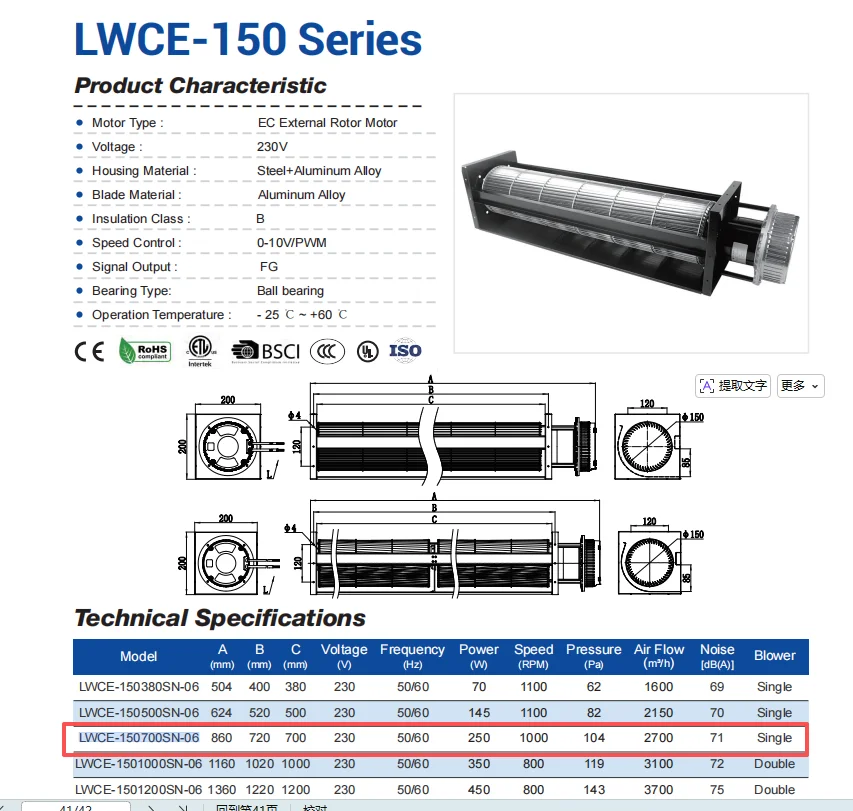
The engineering drawing specifies the final materials, dimensions, and assembly for the customized stainless steel cross-flow fan. It is a critical document for OEM system integrators and quality control teams. LWCE-150700SN-06 Engineering Drawing
Meanwhile the project image illustrates the LWCE-150 series cross-flow fan form factor. Procurement managers and engineers use this for initial visual confirmation and integration planning.
Why the customization came here
In the end, four things made this material change straightforward.
- A customization reviewed and quoted quickly. A request of this kind can take 12 months or more at a European supplier. Here it was engineered, quoted and confirmed in a fraction of that, well inside our 90-day NPI framework.
- Sheet metal made in the same factory. Moving housing work to 304 stainless was easy, since we do our own fabrication in Ningbo alongside motor winding. No new supplier meant no new lead time and no new quality risk.
- The right material, not the expensive one. Meeting the corrosion requirement with 304 rather than 316 kept cost down without weakening the part. Specifying up a grade when the environment does not demand it is a common habit and an expensive one.
- Proof before the first unit shipped. The customer needed to know the stainless steel cross-flow fan performed like the catalog one. Our in-house lab, verified to AMCA 210/211 and ISO 5801 methods, produced the data showing the P-Q curve matched.
Browse our cross-flow fan range, or the EC cross-flow fan series for speed-controlled versions. Stainless grades are described by ASTM in A240.
Questions about the stainless version
Can it be integrated with a BMS?
Yes. The SmartEC motor accepts a standard 0-10V analogue or PWM signal, which suits nearly any modern BMS or PLC output. It also provides an FG tachometer output, so the control system can read actual RPM for closed-loop control or fault detection.
What is the lead time on a semi-custom order like this?
After the one-time NPI, which runs 30 to 90 days depending on complexity, repeat orders of this stainless steel cross-flow fan fall into our standard make-to-order window of 25 to 35 days. European manufacturers commonly quote 12 to 18 weeks for customized products.
Is 304 stainless right for every humid application?
It is excellent for fresh water and damp air, which is exactly this case. However, where there is salt spray, chlorides or acid fumes, we would review the job and most likely recommend 316 or another alloy instead.
Why does impeller clearance matter so much after a material change?
Because the gap between wheel and housing controls leakage. Widen it slightly and air slips back around the wheel, so both pressure and airflow drop. Stainless forms differently from coated steel. Consequently holding the original tolerance is what keeps performance identical.
Technical Documentation & Resources
Need the same thing for your own unit?
Give us the numbers and the envelope, and you get a shortlist rather than a catalog. Meanwhile custom spec sheets and samples run to 90 days. Since 1990 Longwell has supplied EC fans and blowers to OEMs in HVAC, cold chain, data center and industrial markets.
Browse Related Products:
🏆 ISO 9001 / ISO 14001 / ISO 45001 | CE (TÜV) | UL/ETL | ATEX Zone 21/22 | AMCA 210/211 / ISO 5801 tested
Choose the right cross flow fan
Longwell manufactures 495 cross flow fans in-house. Send airflow, static pressure and voltage — an engineer replies with a matching model, performance curve and price within one working day.