What the equipment maker needed
An OEM building semiconductor back-end cleaning equipment needed an intake and exhaust fan pair inside one machine chassis.
One fan draws air in. The other pushes it out. Mechanically they are the same 300mm axial fan, yet functionally they are opposites.
The constraints
- First, 1906 m3/h airflow from a 300mm impeller.
- Next, a fixed 220 VAC supply at 50Hz.
- Meanwhile an envelope of 358mm outer diameter and 214mm maximum depth.
- An operating range of -30C to +60C, with IP54 against dust and water spray.
- Finally, CE certification for their target market.
They asked for two samples of each direction, then prices at 50 and 100 units. Notably that ramp means a real product program rather than a one-off build.
Supplying an intake and exhaust fan pair
The 220 VAC requirement settled the motor type at once. An AC induction motor runs straight off facility power, with no DC supply or inverter. Consequently it removes parts and failure points from a machine that has plenty of both.
An EC version was considered and dropped, since the duty is fixed-speed and the control capability would go unused.
Why direction needs two part numbers
This is the part worth understanding, because it surprises people.
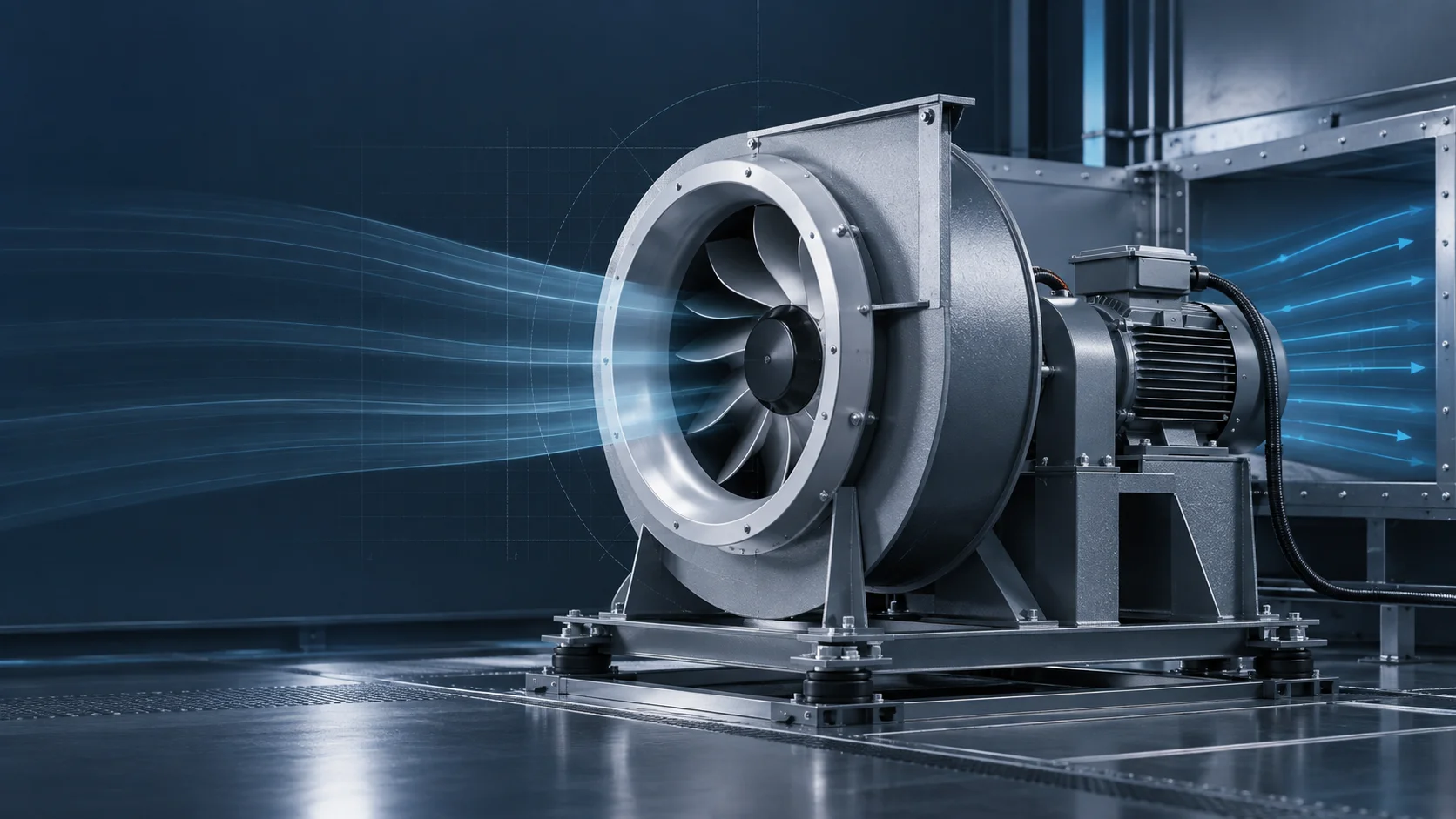
You cannot reverse an axial fan by reversing the motor. Blade pitch is asymmetric, so the blade is shaped to move air one way. Run it backwards and it moves far less air, noisily, at poor efficiency.
Consequently an intake and exhaust fan pair is genuinely two products. The difference comes from blade pitch combined with the motor orientation relative to the housing, which is why each direction carries its own designation.
What is shared
Everything electrical, and most things mechanical. Both use the same four-pole AC motor at 1350 RPM on 50Hz, giving 1906 m3/h at 60 dB(A).
Meanwhile the cold-rolled steel impeller, Class F insulation and maintenance-free deep groove ball bearings are common to both, supporting a 30,000-hour L10 life under continuous duty.
The protection that matters here
Integrated thermal protection disconnects the motor between 150 and 160C.
On semiconductor kit that is not a nicety. A cleaning machine runs long cycles with costly material inside. So a fan that fails by stopping is recoverable, whereas one that fails by overheating is not.
What it cost
Two line items instead of one. In practice the customer now stocks and tracks two part numbers that look nearly identical.
The physics makes that unavoidable. However, labelling helps. Ask for the direction marked on the housing rather than on the box, since the box gets thrown away and the fan does not.
Technical Specifications
Two model numbers appear below for one intake and exhaust fan pair. Only the airflow direction differs.
| Parameter | Value |
|---|---|
| Model Number | LWAA4E300S-5MYW-15-00 / LWAA4E300B-5MYW-15-00 |
| Nominal Voltage | 220 VAC |
| Voltage Range | 198~242 VAC |
| Frequency | 50 Hz |
| Speed | 1350 RPM |
| Airflow (Max) | 1906 m³/h / 1120 CFM |
| Static Pressure (Max) | 112 Pa |
| Input Power | 85 W |
| Current | 0.39 A |
| Noise Level | 60 dB(A) |
| Capacitor | 3 µF |
| Operating Temperature | -30°C to +60°C |
| Protection Class | IP54 |
| Insulation Class | Class F |
| Life Expectancy (L10) | 30,000 Hours at 40°C |
| Work System | S1 (Continuous Duty) |
| Certifications | CE, RoHS, Reach |
Technical Documentation
LWAA4E300S-5MYW-15-00.pdf
The technical data sheet provides full specifications, drawings, and the P-Q curve for the ‘Sucking’ airflow model, essential for design engineers integrating the intake fan.
LWAA4E300B-5MYW-15-00.pdf
Here the document contains the identical performance data but specifies the ‘Blowing’ airflow direction, required by engineers designing the exhaust portion of the system.
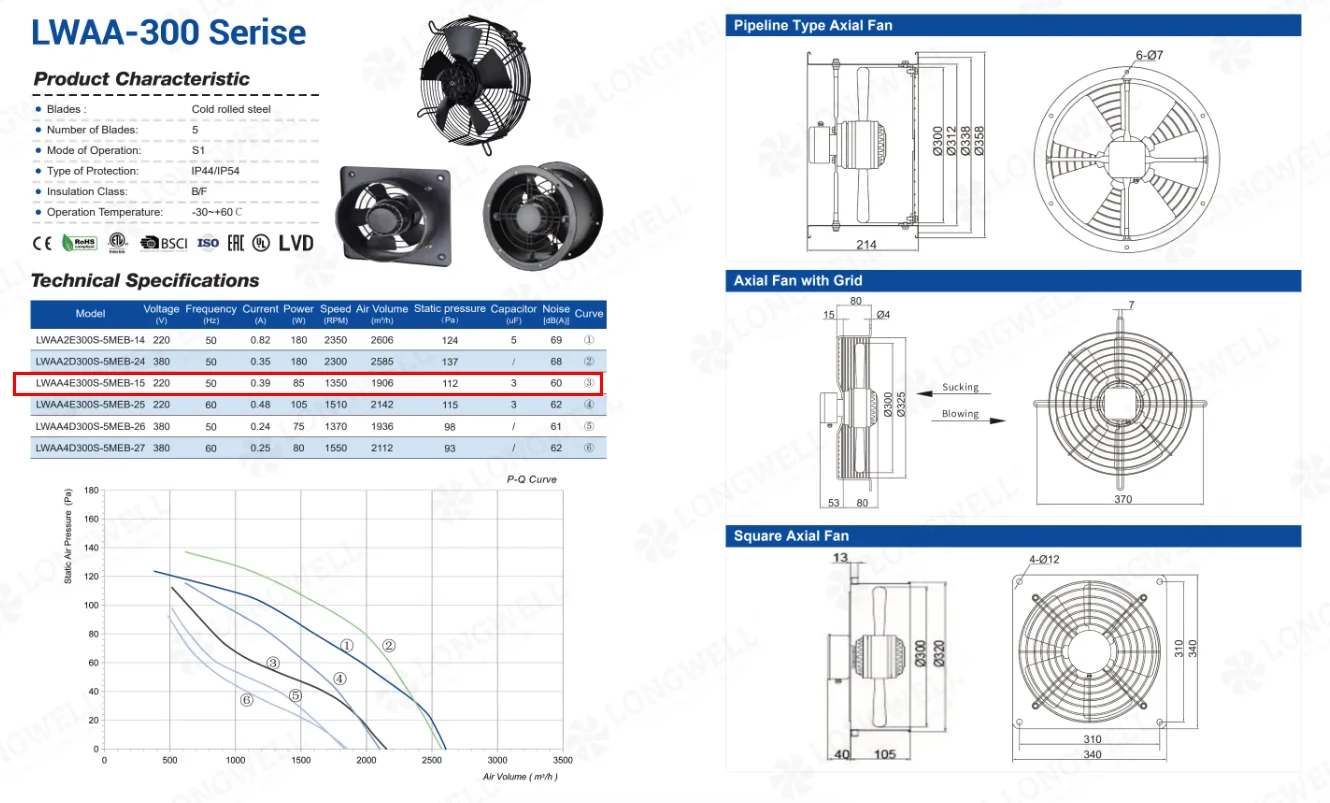
This product summary image offers a quick-reference guide for the LWAA-300 series, showing key specifications and performance curves for multiple models in the family.
LWAA4E300S-5MYW-15-00.docx and LWAA4E300B-5MYW-15-00.docx
These source documents are provided for procurement managers and documentation teams to easily incorporate product data into their internal bill of materials (BOM) and technical manuals.
If your machine needs both directions
An intake and exhaust fan pair comes up often in process machines. So these save a round of confusion.
- Specify direction from a fixed reference. Blowing and sucking mean nothing without saying which face you are looking at. Instead say air moves towards or away from the motor. Then both parties read it the same way.
- Do not plan to reverse a fan electrically. Reversing rotation on an axial fan cuts airflow sharply and raises noise, because the blade profile only works one way. If you need both directions, order both parts.
- Mark the direction on the fan itself. Two visually similar parts on one assembly line will eventually be swapped. A molded or printed arrow on the housing prevents a fault that is very hard to diagnose afterwards.
- Take thermal protection on anything inside a process machine. The cost of a stopped fan is a service call. The cost of an overheating one, inside equipment holding product, is considerably higher.
See our axial fan range, the AC axial fan section, or industrial axial fans. Ingress ratings follow IEC 60529.
Questions about airflow direction
Can I reverse the fan by rewiring the motor?
Not usefully. Axial blades have asymmetric pitch, so running one backwards moves a fraction of the rated air. Furthermore it makes more noise and wastes power. For a real change of direction, order an intake and exhaust fan pair instead.
How much airflow does a reversed fan actually lose?
Enough that it is never a viable substitute. The exact figure depends on blade profile, though a substantial reduction is typical, along with a rise in noise. Rather than estimate it, treat reverse running as a fault condition instead of a mode.
What is the practical difference between the two models?
Blade pitch and motor orientation in the housing. Voltage, speed, power, bearings, insulation and protection class are all identical. That is why they share a specification sheet in everything except the direction line.
Is IP54 enough for semiconductor equipment?
For a fan handling machine ventilation air, generally yes, since IP54 covers dust and water spray. However, if the fan sits in an airstream carrying process chemicals, ingress protection is not the right measure at all. Corrosion resistance and material compatibility matter more, and those need specifying separately.
Technical Documentation & Resources
Got a duty point you need matched?
Tell us the airflow, the pressure and the space you have. Then we mark your duty point on a tested curve and send the drawing back. Meanwhile samples and custom spec sheets take up to 90 days. Since 1990 we have supplied OEMs across HVAC, refrigeration and industry.
Browse Related Products:
🏆 ISO 9001 / ISO 14001 / ISO 45001 | CE (TÜV) | UL/ETL | ATEX Zone 21/22 | AMCA 210/211 / ISO 5801 tested