What the North American buyer needed
The one arrived as a request for final production drawings. Usually that means the choosing is over, and somebody wants to raise a purchase order. The model was the LWIF-750(30″)S(U)-01A, an industrial misting fan bound for North America.
Basically the job is spot cooling, where fixed HVAC either does not exist or cannot cope. Namely factory floors, loading docks and half-open workshops.
Here the constraints followed from the market and the use.
- Standard US 110V, 60Hz power, with no adaptation expected on site.
- Real mobility, because hot spots move with the work schedule and the sun.
- High airflow at low pressure, since an industrial misting fan fights almost no duct.
- A 49-liter tank, so a full shift runs without a refill.
- UL 507 compliance, because that applies to anything sold there as an electric fan.
Airflow alone was never the whole point. Moving air makes people feel cooler, because it helps sweat evaporate. A mist system, however, drops the real air temperature. On a 38C afternoon, that difference is what people notice.
How this industrial misting fan is built
This was a drawings request against a standard product. Consequently the engineering here sits in the existing design rather than in anything new.
Why 750mm and not smaller
The fan must throw air across an open space with almost no pressure to fight. A big, slow blade does that far better than a small fast one, so size was never in doubt. At 750mm this industrial misting fan gives 155 m3/min, or about 5,474 CFM. Moreover it reaches far enough down a workshop to be useful. A smaller blade would have failed on throw and reach, though not on the airflow number itself.
Why misting, not just circulation
A plain fan just stirs the air. An industrial misting fan takes heat out of it, since evaporating water absorbs energy. In a dry or fairly dry shed, that can drop the felt temperature a long way. A circulation fan simply cannot do it.
Why a three-speed AC motor
Meanwhile the unit runs a 350W AC motor wound with 100% copper. A SmartEC motor would give finer speed control. However, there is nothing here for it to control. Somebody turns the fan on in the morning, picks a speed, and leaves it. There is no BMS, no 0-10V signal and no Modbus network on a loading dock.
Copper windings matter more here than the motor type. They run cooler and last longer than aluminum, too. That is what you want in kit that spends the whole summer at full load.
The chassis
A stable base, large wheels and the 49-liter tank give mobility and runtime together. In short, that combination is the product. We reviewed the approved drawing, filed it and sent it on, and the customer confirmed the order from it.
Technical Specifications
The figures below come from the approved production drawing. Tank capacity and speed count matter as much as the airflow row when you are cooling people rather than equipment.
| Parameter | Value |
|---|---|
| Model | LWIF-750(30″)S(U)-01A |
| Airflow | 155 m³/min (~5,474 CFM) |
| Fan Diameter | 750 mm (30 inch) |
| Input Power | 350 W |
| Voltage | 110V / 220V |
| Frequency | 60 Hz / 50 Hz |
| Speed Settings | 3 |
| Motor Type | AC Motor (100% Copper Winding) |
| Water Tank Capacity | 49 Liters |
| Height | 1.75 m |
Technical Documentation
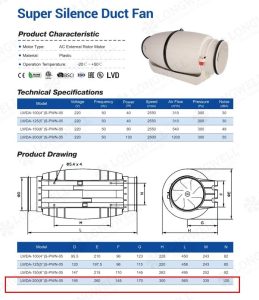
Here the product image and parameter table offer a quick visual reference of the fan’s configuration and key performance metrics for facility managers evaluating its suitability.
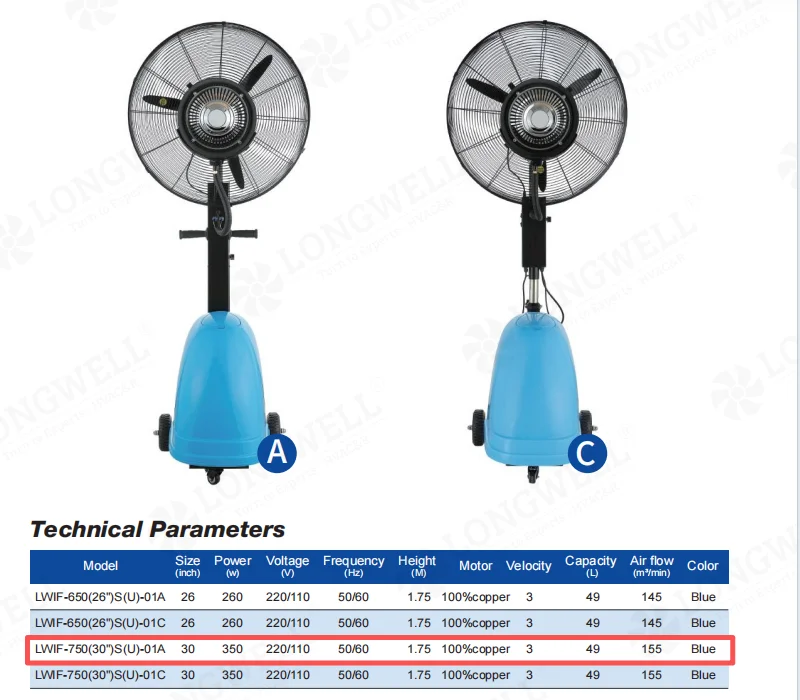
Here the technical drawing provides the final dimensional and specification data for the LWIF-750(30″)S(U)-01A, used by procurement managers for order verification and receiving teams for incoming inspection.
Download the LWIF-750 technical drawing
Why facility managers buy these here
Facility managers buy these in quantity. Therefore four practical things decide the supplier.
- Coverage within budget. Performance matches European and North American brands, yet the price point is materially lower. Consequently a manager can deploy four units instead of two and actually cover the floor.
- Fast when the weather turns. Make-to-order lead time runs 15 to 25 days. That matters when a heatwave arrives and cooling suddenly becomes urgent.
- Built for the target market. This industrial misting fan is engineered for 110V/60Hz and designed against UL 507. Therefore it arrives ready to plug in, rather than needing electrical work.
- Motors made in the same factory. We wind the copper motors ourselves. Consequently quality control stays tight, and parts match across a batch.
Browse our industrial fan range, or the misting fan series for other sizes. Heat stress guidance for workplaces is published by OSHA.
Questions before you order one
How long does a full 49-liter tank last?
It depends on the mist rate you pick and on how damp the air is. At a medium setting, expect roughly 6 to 8 hours of cooling. That covers a normal shift without a refill.
What area does it cool?
In a semi-enclosed industrial space, it noticeably cuts felt temperature across 50 to 70 square meters, or roughly 500 to 750 square feet. However, ambient temperature, humidity and existing air movement all shift that figure.
Does it need a dedicated circuit?
No. The North American version runs from a standard 110V, 60Hz single-phase outlet. At its 350W maximum it draws about 3.2 amps. That sits well inside a normal 15A or 20A commercial circuit, so no special wiring is needed.
Does misting work in humid climates?
Less well, and it is worth saying so plainly. Evaporative cooling needs air with room to take up moisture. In very humid weather you get air movement and only a small drop in temperature. Consequently a plain high-volume fan may be the better buy.
Technical Documentation & Resources
Have a fan requirement like this one?
Send the datasheet you are working against, or simply the duty point. Then our engineers tell you what fits and what does not. Meanwhile custom spec sheets and samples take up to 90 days. Since 1990 we have been building fans for OEMs worldwide.
Browse Related Products:
🏆 ISO 9001 / ISO 14001 / ISO 45001 | CE (TÜV) | UL/ETL | ATEX Zone 21/22 | AMCA 210/211 / ISO 5801 tested