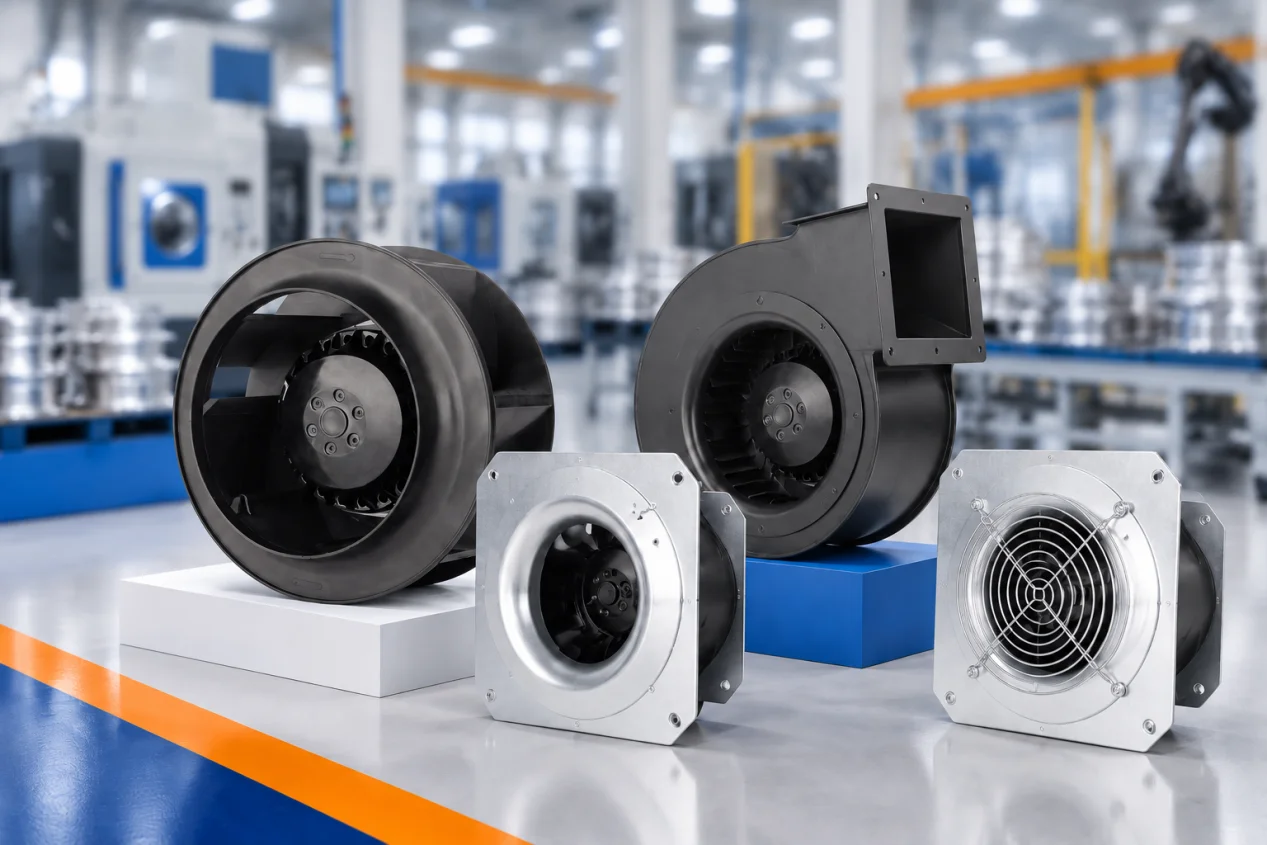
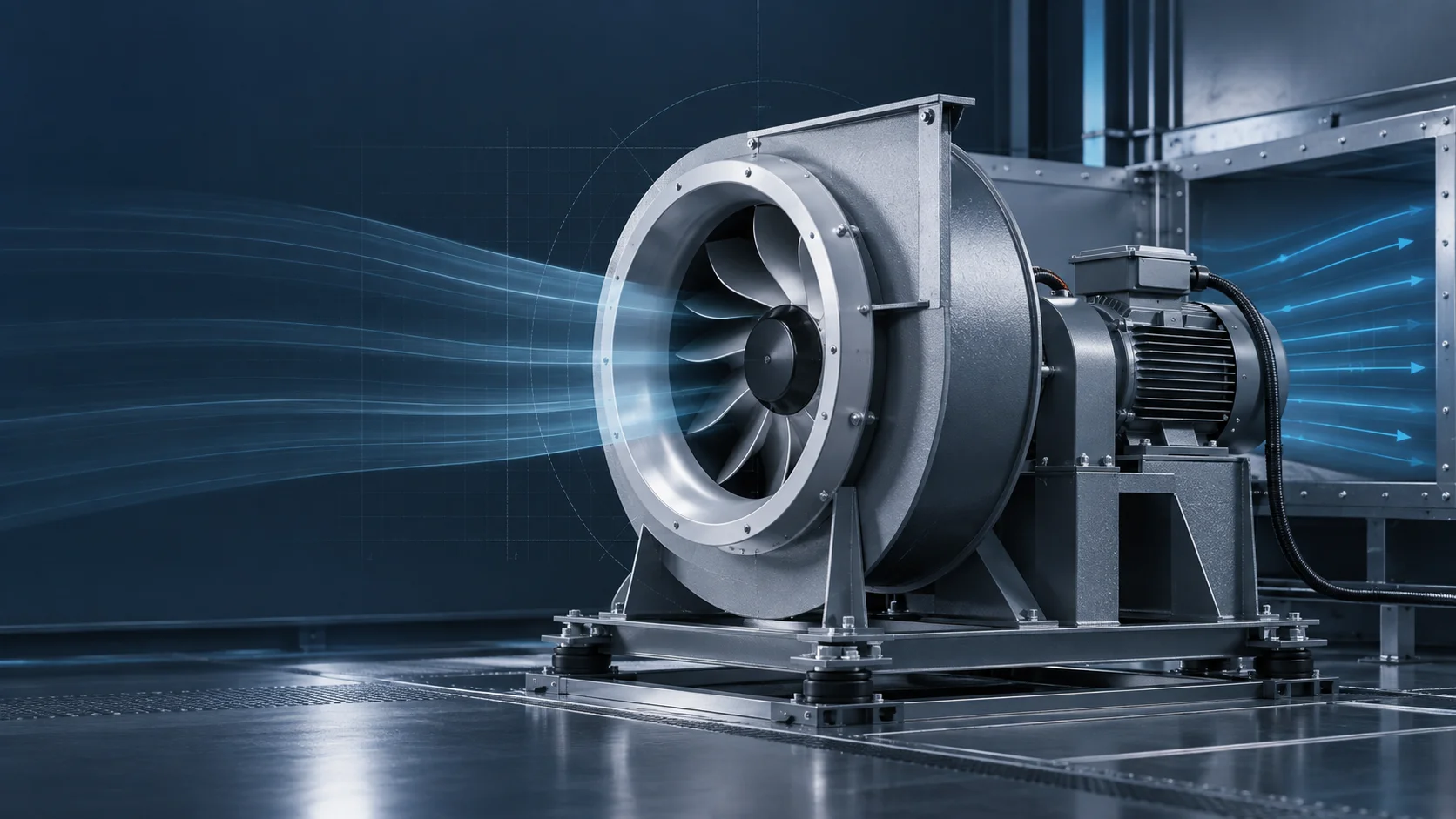
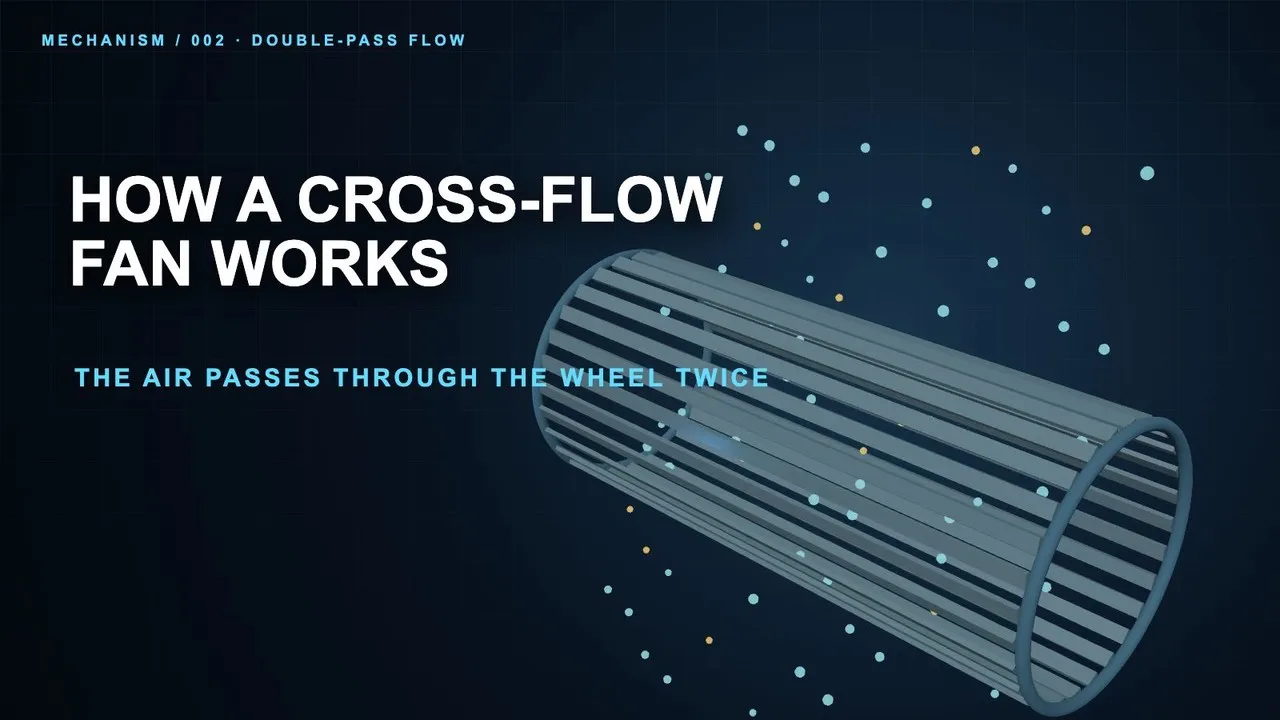
Centrifugal fans are widely used in AHUs, ventilation equipment, and HVAC systems. For duct HVAC systems, they usually contain filters, coils, dampers, and ductwork. Using centrifugal fans to generate static pressure against system resistance is a common solution in HVAC systems. The best centrifugal fan in an HVAC system is not necessarily the model with the highest airflow or static pressure. It is the centrifugal fan that can operate efficiently at the required operating point. A practical ordering process starts with defining the HVAC system curve and installation conditions, then moves to centrifugal fan configuration, motor and control requirements, performance verification, and finally prototype and production confirmation.
HVAC System Requirements
Define Required Airflow and Static Pressure
Engineers must establish precise system requirements before choosing fans for commercial ventilation projects. Technicians use specialized tools to measure physical duct parameters across the entire HVAC system. A balometer or velocity probe measures supply outlet airflow volume, while a manometer measures static pressure at the fan inlet and outlet. Measuring total static pressure requires subtracting inlet pressure losses from discharge pressure readings. Air density, duct cross-sectional area, and volumetric flow rate directly determine total system resistance.
Evaluate Installation Constraints
HVAC OEMs should measure the maximum installation space before performance is considered. The constraints include mounting position, inlet and outlet arrangement, fan maximum dimensions, and the space available around the fan for integration and maintenance. In compact HVAC systems, these limits are especially important. A centrifugal fan may meet the required airflow and pressure but still be unsuitable if its housing, motor position, inlet geometry, or service clearance conflicts with the equipment layout. Space restrictions can also influence the preferred fan configuration and impeller design.
Consider Operating Environment
The centrifugal fan supplier should therefore know not only the required airflow and pressure, but also where the centrifugal fan will operate and what type of air it will handle. Temperature, humidity, dust, corrosive substances, and outdoor exposure can affect the materials, motor protection, and construction required for the centrifugal fan.
For normal HVAV applications, the standard centrifugal fan configurations are usually sufficient. Specific demanding environments may require additional consideration. For instance, higher IP ratings are required in high-humidity or outdoor applications.
Centrifugal Fan Blade Types
Forward–Curved Centrifugal Fan
Forward-curved fans use many small blades curved in the same direction as the impeller rotation. They can move a high volume of air at relatively low static pressure and are commonly used for clean-air ventilation where compact size and quiet operation are important. Correct system sizing is necessary because motor power can increase as system resistance decreases.
Backward–Curved Centrifugal Fan
Backward-curved fans use fewer, longer blades that curve opposite to the direction of rotation. This design reduces aerodynamic losses and provides higher efficiency with stable performance across a wider operating range. They are suitable for medium- to high-pressure applications such as AHUs, filtration systems, process cooling, and industrial ventilation.
Improvements were made on the basis of the simple, flat blade. The airfoil blade further reduces aerodynamic noise and brings about higher efficiency due to its streamlined shape. The cross-section of this kind of fan blade is similar to an aircraft wing. They are best suited to clean-air applications where energy efficiency and acoustic performance are important.
Radial Centrifugal Fan
Radial centrifugal fans have straight blades extending outward from the hub. Their robust construction makes them suitable for higher-pressure applications and air streams containing dust, fibres, or abrasive particles. Compared with curved-blade designs, radial fans are often selected where durability and resistance to contaminated air are more important.
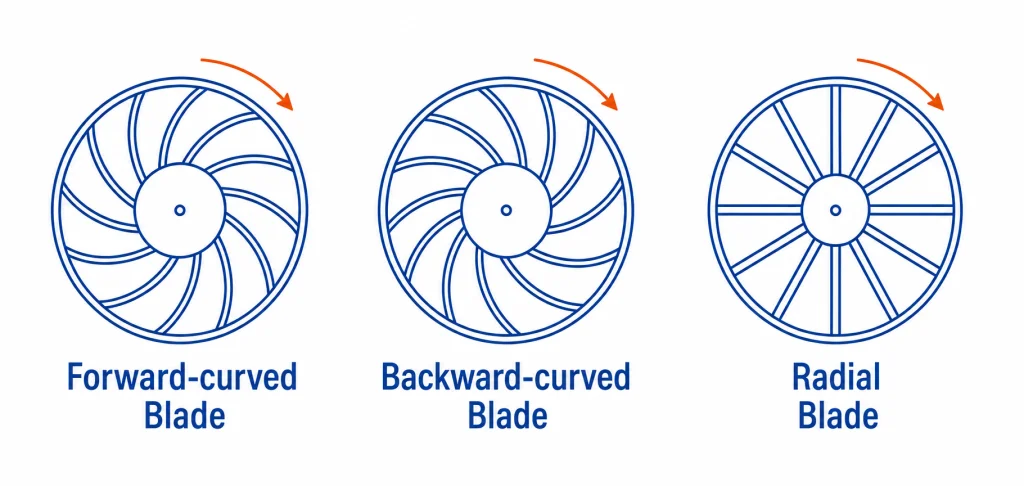
Centrifugal Fan Comparative Overview
| Centrifugal Fan Types | Efficiency | Main Advantages | Typical Applications |
| Forward-Curved Centrifugal Fan | Moderate | High airflow, compact design, relatively quiet at low pressure | General HVAC ventilation, clean-air systems |
| Backward-Curved Centrifugal Fan | Higher | High energy efficiency, stable performance, lower power demand, better pressure capability | Filtration systems, process cooling, commercial and industrial HVAC |
| Radial Centrifugal Fan | Moderate to Low | Robust construction, handles dust and particles | Dust extraction, pollution control, industrial exhaust |
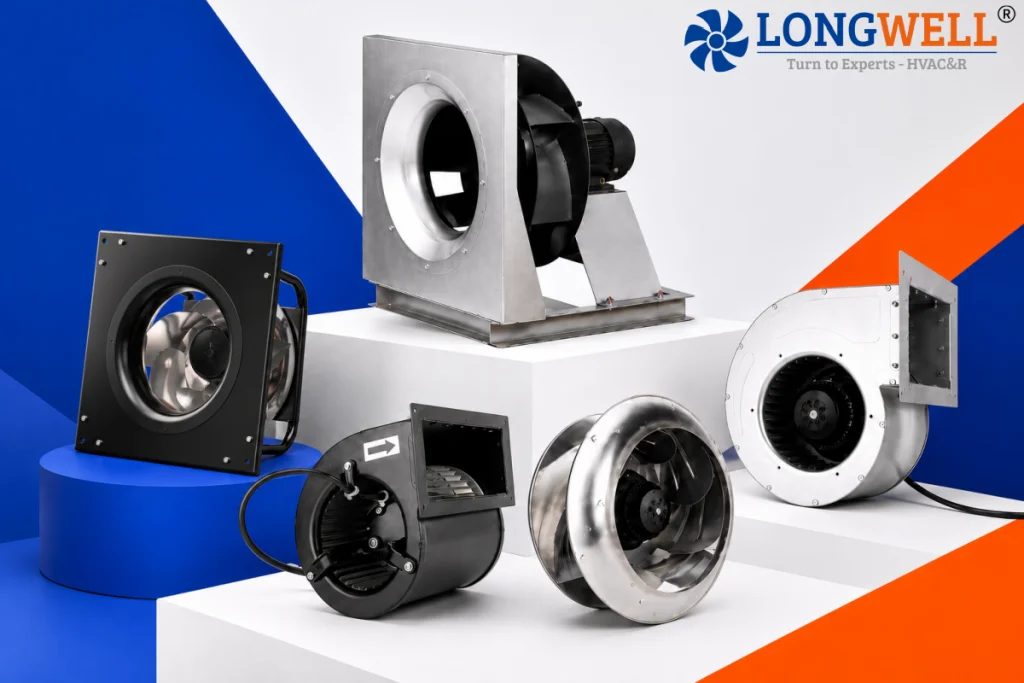
Centrifugal fans can be classified in several ways beyond blade shape. According to the air inlet arrangement, they can be single-inlet or double-inlet centrifugal fans. The double-inlet designs are generally used when a larger airflow capacity is required. They can also be categorized by structure and drive configuration, such as scroll-housed fans, plug fans, direct-drive fans, and belt-drive fans. Motor options further include AC, DC, and EC configurations depending on the HVAC system requirements.
Among these classifications, impeller blade design has one of the most direct influences on airflow, static pressure, and operational efficiency. For a more detailed comparison of centrifugal fan impeller design, see our guide: Types of Centrifugal Fan Impellers Explained.
Centrifugal Fan Key Specifications
Performance Curve
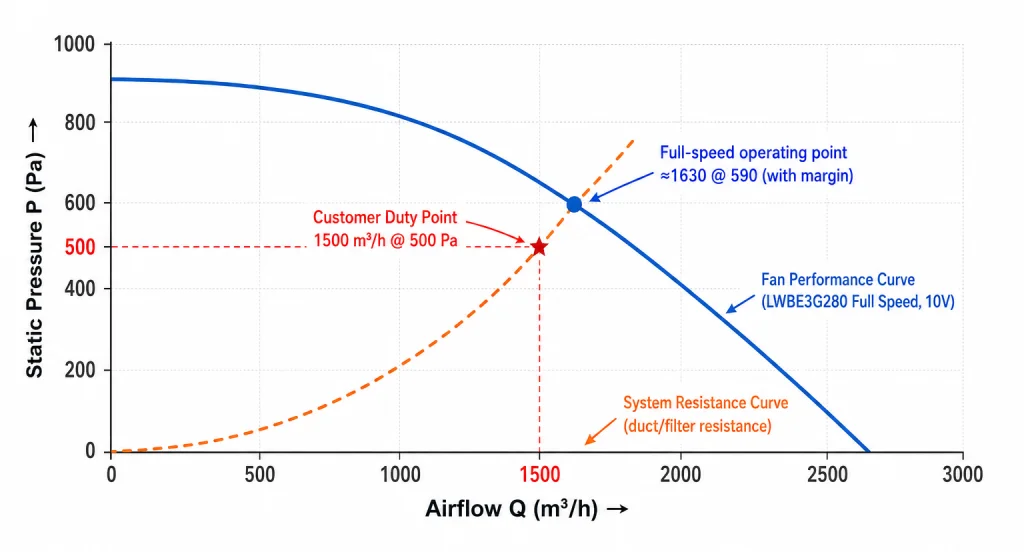
The selection of centrifugal is not by only maximum airflow or static pressure. Instead, the combination of these two parameters is the key specification. The P-Q curve shows how the available static pressure decreases as airflow increases. During fan selection, the required airflow and pressure should therefore be considered together as the system’s operation point.
For example, the HVAC system in the following figure requires 1,500 m³/h at 500 Pa. This required point lies below the full-speed performance curve of the selected LWBE3G280 fan, which means the centrifugal fan has sufficient capacity to meet the requirement. When the centrifugal fan curve is plotted together with the system resistance curve, their intersection represents the actual operating point. At full-speed operation, the example fan and system intersect at approximately 1,630 m³/h and 590 Pa, providing some performance margin above the specified requirement.
Motor Type with Control Options
Motor type selection affects both the electrical configuration of a centrifugal fan and how easily its adjustment of airflow and static pressure.
- AC motor centrifugal fans are suitable for fixed-speed HVAC systems. When variable airflow is required, an AC centrifugal fan normally needs an external variable frequency drive (VFD) to adjust motor speed.
- DC motors are more common in low-voltage and compact equipment and can typically use PWM-based speed control.
- For modern HVAC systems, EC motors provide an option of combining a brushless motor with electronic commutation and speed-control electronics. The control interfaces may include 0–10 V, PWM, or RS485 communication, allowing the fan speed to respond to system demand without a separate VFD. This makes EC centrifugal fans particularly suitable for applications where the operating point changes with real-time system resistance.
When placing an order, the motor should therefore be specified together with the control requirement rather than treated as a separate component. HVAC OEMs should confirm the power supply, required speed range, control signal, and BMS integration requirements so that the selected centrifugal fan can operate at the intended duty point.
Certification Standards
Different target markets will have different certification requirements. For the European market, CE marking is primary requirement for products covered by applicable EU legislation. Energy Efficiency should also be checked. The ErP 2026 introduces stricter minimum efficiency requirements to fans with an electric input power from 125 W to 500 kW.
The North American market commonly requests third-party safety certifications such as UL or ETL. UL 507 is one of the relevant safety standards that may apply depending on the product configuration.
How to Order a Centrifugal HVAC Fan: A Step-by-Step Checklist
Step 1: Prepare Application Data
Before requesting a centrifugal fan recommendation, prepare the basic operating and installation requirements. The most important information includes:
- Required airflow and static pressure
- Power supply and frequency
- Available installation dimensions
- Impeller configuration
- Motor and speed-control requirements
- Operating temperature and environmental conditions
- Noise requirements
- Target market and required certifications
Step 2: Centrifugal Fan Selection
The centrifugal fan supplier can then compare the required operation point with available fan performance curves and identify a suitable impeller size, motor, and configuration. The goal is not simply to choose a fan whose maximum airflow exceeds the requirement. The required operating point should fall within an appropriate part of the fan’s performance range, with enough margin for actual system conditions. Users can enter the required airflow and static pressure, select the fan type and application, and obtain a recommended LONGWELL EC fan SKU.
Step 3: Prototype Validation
The next step is to test a sample or prototype in the actual HVAC equipment whenever possible. The final operating point can shift after the fan is installed because of the cabinet, heat exchanger, filters, inlet conditions, or duct connections.
Prototype validation confirms whether the fan reaches the required airflow and pressure under realistic conditions. If the measured operating point differs from the design target, the supplier and OEM can adjust fan speed, control settings, impeller size, motor selection, or installation arrangement before freezing the specification.
Step 4: Confirm Mass Production
The approved drawings and performance data should then become the reference for subsequent production batches. For customized HVAC projects, it is also necessary to confirm inspection requirements, packaging, labeling, expected order quantities, and the production time.
How to Order a Centrifugal HVAC Fan From LONGWELL?
For HVAC OEM projects where a standard centrifugal fan cannot fully match the equipment, LONGWELL uses a structured 90-Day NPI process to move the project from specification review to production release.
Specification Confirmation
Confirm the required airflow and static pressure, installation interface, electrical supply, control requirements, certification target, and project schedule.
Design
Complete fan selection, CFD analysis, impeller and structural optimization, 3D integration, and control-interface review.
Prototype Verification
Produce engineering samples for installation, aerodynamic testing, control debugging, and customer DV validation.
Release
Complete DV/PV verification, freeze the approved specification and production process, and prepare the first mass-production order delivery.
Why Choose LONGWELL for Centrifugal HVAC Fan Supplier?
LONGWELL AC/DC/EC Centrifugal Fans deliver reliable performance across modern HVAC systems. Critical solutions cover 9 areas, including data centers, commercial and home HVAC systems, and industrial dust collection.
A recent commercial HVAC project shows how LONGWELL supports OEMs beyond standard fan supply. For a Top-3 North American RTU manufacturer, LONGWELL provided six customized specs to replace an existing solution.
The project moved from specification review to CFD design, engineering samples, DV/PV validation, and mass-production release within 90 days. The final centrifugal fan combined with axial fans achieved 70–72% fan system efficiency, reduced noise by 6.5 dB(A) versus the previous solution, and completed UL/ETL certification across all six sizes.
For AHU and RTU applications, LONGWELL’s LWBE3G backward-curved centrifugal fans combine EC motor control, BMS compatibility, and multiple size options for different airflow and pressure requirements. If your HVAC project needs a new centrifugal fan or a replacement for an existing model, send us your requirements to start the selection process.
FAQs
What maintenance do HVAC centrifugal fans require?
A centrifugal fan in HVAC system typically need maintenance every 6 month or one year. The maintenance action including visual inspection, debris removal, and belt check. For detailed maintenance tips, please refer to: What maintenance do HVAC centrifugal fans require?
What are the disadvantages of centrifugal fans?
The main disadvantage lies in their higher initial costs. For centrifugal fans with volute, they need a bigger space for installation.
What is the common lifespan of a centrifugal fan?
For LONGWEL centrifugal fans, the reliability indicators are manifested as MTBF > 60,000 hours and L10 life > 45,000 hours. They can operate stably for many years under normal operating conditions.
Choose the right centrifugal fan
Longwell manufactures 1,130 centrifugal fans in-house. Send airflow, static pressure and voltage — an engineer replies with a matching model, performance curve and price within one working day.