What one request revealed
A manufacturer of commercial HVAC equipment sent one line: please send the 3D STEP file for this 500mm condenser fan.
That is a small request, and it says a great deal. Asking for a 3D model rather than a datasheet means they have already chosen the fan on performance and are now checking whether it physically fits.
What the model choice implied
They had selected a three-phase axial unit, which places the application squarely at an air-cooled condenser or a commercial air handler.
- Airflow near 6,700 m3/h, with a low static pressure profile typical of air crossing a condenser coil.
- A 380/400V three-phase supply at 50Hz.
- Meanwhile an outer guard no larger than 570mm and total depth under 150mm.
- At least IP54, since the unit sits outdoors or in rough indoor conditions.
- Finally, -30C to +60C, a 69 dB(A) ceiling, and CE with LVD compliance for Europe.
Low pressure with high volume is the signature of condenser duty. The air has to cross a coil and leave, not travel through ductwork.
Validating the 500mm condenser fan
The customer had chosen correctly, so our job was validating it and getting them the model quickly. Even so, one decision deserved a second look.
The EC question
An EC version of this 500mm condenser fan exists. It would bring variable speed over 0-10V or PWM and better part-load efficiency.
However, their system runs at a fixed duty point, switched by a contactor or driven by an external VFD they already own. Consequently the EC control capability would be paid for and left unused, while the unit cost rises.
For an OEM competing on equipment price, a standard three-phase AC motor was the better commercial answer here.
When that answer reverses
It is worth being clear about the boundary, because this decision goes the other way often.
If the condenser modulates head pressure against ambient temperature, EC repays itself quickly, since a condenser fan runs most of the year and rarely needs full output. If it simply switches on and off with the compressor, AC is fine and cheaper.
The build
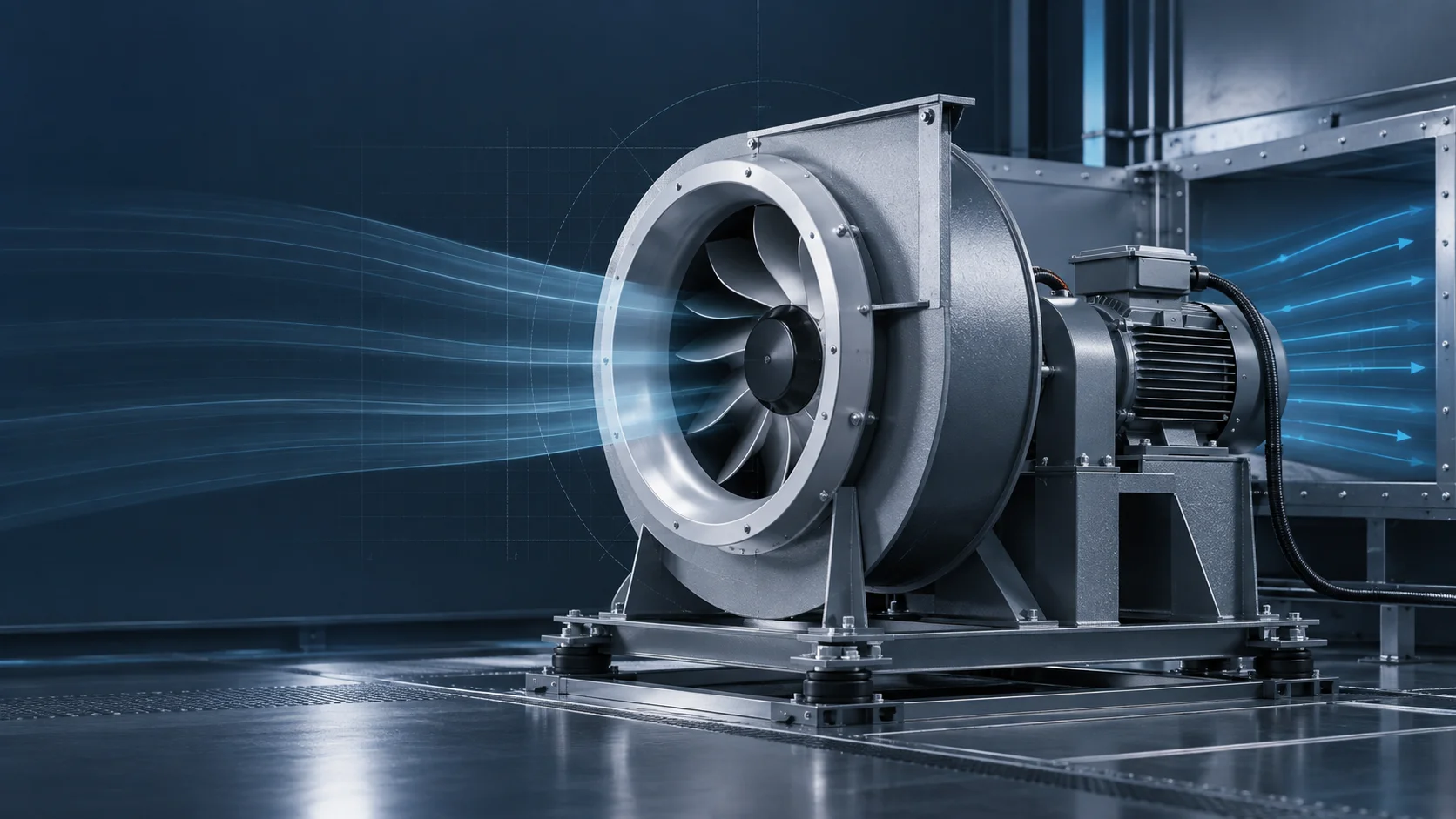
In this 500mm condenser fan a steel plate impeller runs at 1350 RPM on 420W, giving 6,695 m3/h at 69 dB(A). Meanwhile IP54 and Class F insulation cover the environmental and thermal side across the full -30C to +60C range.
What it cost
Control. With a fixed-speed AC fan, the only way to reduce airflow is to switch the fan off or add a drive later. There is no fine adjustment available once the unit is built.
That constrains what the equipment can do about noise at night or efficiency at low ambient. It was the right trade for this product, and it is a door that closes at the design stage rather than one that can be reopened cheaply.
Technical Specifications
Note the static pressure entry below refers to the P-Q curve rather than a single figure. On a condenser that is the honest way to state it.
| Parameter | Value |
|---|---|
| Model | LWAA4D500S-5MEB-03 |
| Voltage | 380/400 V (Three-Phase) |
| Frequency | 50 Hz |
| Current | 0.9 A |
| Input Power | 420 W |
| Speed | 1350 RPM |
| Max Airflow | 6695 m³/h (~3940 CFM) |
| Static Pressure | See P-Q Curve ① |
| Noise Level | 69 dB(A) |
| Impeller Diameter | 500 mm |
| Protection Class | IP54 |
| Insulation Class | F |
| Operating Temperature | -30°C to +60°C |
| Impeller Material | Steel Plate |
Technical Documentation
Here the following documents were provided to support the customer’s design and integration phase.

The consolidated technical datasheet provides engineers with essential performance specifications, dimensional drawings, and the P-Q performance curve in a single view. A detailed 3D STEP file (`.stp`) was also delivered, enabling the customer’s design team to perform precise virtual fitment checks and CFD analysis within their CAD environment.
If you are integrating a condenser fan
Integrating a 500mm condenser fan into a new unit has a few points where time gets lost.
- Ask for the STEP file early, before the chassis is fixed. Guard diameter and total depth including the terminal box are what actually decide fit, and they are hard to read from a drawing. A 3D model settles it in an hour.
- Decide the control strategy before choosing the motor. Fixed-speed AC and modulating EC lead to different fans, different wiring and different prices. Making this call after the sheet metal is designed usually means living with the first choice.
- Check the guard is included in your envelope. The impeller diameter is not the installed diameter. Guards, mounting rings and cable glands all add, and the difference regularly exceeds the clearance people leave.
- Look at the P-Q curve, not a single pressure figure. Condensers operate across a range as the coil fouls and ambient changes. A curve tells you what happens at both ends; one number does not.
Browse our axial fan range, the condenser fan section, or industrial axial fans. Ingress ratings follow IEC 60529.
Questions about this fan
Why does the datasheet not give a single static pressure?
Because a 500mm condenser fan operates across a range rather than at one point. Coil fouling, ambient temperature and airflow obstruction all move the operating point during service. The P-Q curve shows what the fan does across that range, which is more useful than a single figure taken at one condition.
Would EC have been worth the extra cost?
It depends on how the equipment runs. A condenser that modulates against ambient temperature spends most of the year below full output, where EC efficiency shows clearly. A condenser that switches on and off with the compressor gains far less. Work out the running hours at part load before deciding.
Is IP54 enough for an outdoor condenser?
For most installations, yes. IP54 handles dust and splashing water, which covers rain on a fan mounted behind a guard. However, coastal sites, heavy snow or regular pressure washing justify a higher rating, and the motor coating matters as much as the IP number in corrosive air.
Can I add a VFD to this fan later?
Yes, since it is a three-phase induction motor. However, sustained running at low frequency reduces the motor own cooling, because the fan that cools it is turning slower too. Set a minimum frequency, and check the motor rating for drive operation rather than assuming it.
Got a duty point you need matched?
Tell us the airflow, the pressure and the space you have. Then we mark your duty point on a tested curve and send the drawing back. Meanwhile samples and custom spec sheets take up to 90 days. Since 1990 we have supplied OEMs across HVAC, refrigeration and industry.
Browse Related Products:
🏆 ISO 9001 / ISO 14001 / ISO 45001 | CE (TÜV) | UL/ETL | ATEX Zone 21/22 | AMCA 210/211 / ISO 5801 tested