What the OEM specified
A European HVAC OEM needed a high-power cross-flow fan for a new line of commercial air handling equipment.
Their spec pulled well away from anything in a catalog. They wanted 370W at 50Hz and 440W at 60Hz from a single-phase 230V supply. Meanwhile the cross-flow format normally handles a fraction of that.
The sample deadline was three weeks.
The detail that shaped the design
- At 50Hz: 370W, 1.7A, 1360 RPM, with an external 8uF start capacitor.
- At 60Hz: 440W, 1.72A, 1440 RPM, with a 6uF capacitor instead.
- Notably, the capacitor had to sit outside the fan, in their own assembly.
- Static pressure of at least 60 Pa, with a 120mm impeller in the housing.
- Finally, ErP 2015 compliance and CE, plus IP10 and Class 155 insulation.
Keeping the capacitor external is not a small detail. In effect the OEM owns that component, so one high-power cross-flow fan serves both frequencies by fitting the right capacitor at build time.
Building a high-power cross-flow fan fast
Here the problem showed up at once. Our standard model in this size produces 109W, whereas they were asking for roughly four times that from the same format.
What a shaded-pole motor cannot do
Cross-flow fans of this shape normally use a shaded-pole AC motor. Certainly that type is cheap and reliable, though it tops out far below 370W.
So the motor in a high-power cross-flow fan has to change. Meanwhile a three-week sample deadline rules out designing one.
The option we did not take
Admittedly an EC motor would meet the power and efficiency targets easily.
However, the customer asked specifically for single-phase AC, which usually signals an existing control architecture and a settled cost structure. We respected that rather than arguing for a different product. Their constraint was theirs to set.
Integration instead of development
Instead we kept everything we already had, and changed only the part that had to change.
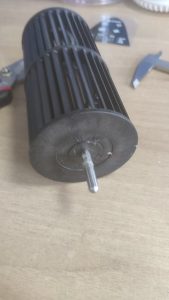
The galvanized steel housing and the 120 by 380mm aluminum impeller came straight from existing tooling. So we paired that assembly with a pre-qualified single-phase capacitor-start motor that already met the dual-frequency figures.
Consequently the sample could be built from known parts rather than waiting on new ones. New assembly drawings and a full specification went out under a new model number, confirming the 60 Pa figure and every mechanical and electrical interface.
What it cost
Two things. First, the motor comes from a supplier rather than from us. Consequently the electrical side is less ours to tune than usual.
Second, a capacitor-start AC motor at this power is markedly less efficient than an EC one. The design meets ErP 2015, although anyone expecting EC-class energy figures will be disappointed. That was the right trade for a three-week deadline and an AC requirement. Even so, it is a trade.
Technical Specifications
Two operating points appear below, one per supply frequency. Notably the capacitor value changes between them.
| Parameter | Value |
|---|---|
| Model | LWCA-120380SN-07-00 |
| Voltage | 230V |
| Frequency | 50 / 60 Hz |
| Input Power (Target) | 370W @ 50Hz / 440W @ 60Hz |
| Current (Target) | 1.7A @ 50Hz / 1.72A @ 60Hz |
| Speed | 1300 RPM @ 50Hz / 1400 RPM @ 60Hz |
| Static Pressure | ≥ 60 Pa |
| Overall Dimensions (L x W x H) | 504 x 160 x 120 mm |
| Impeller Dimensions (Ø x L) | 120 x 380 mm |
| Protection Class | IP10 |
| Insulation Class | Thermal Class 155 (F) |
| Bearings | Ball Bearing |
| Certifications Compliance | ErP 2015, CE |
Technical Documentation
Meanwhile the following documents were produced as the final approved deliverables for this project.
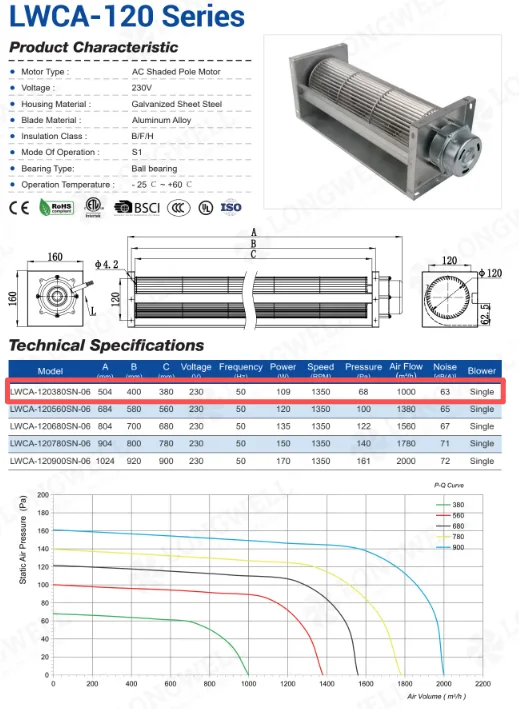
Here the image from the technical file shows the overall assembly and key dimensional callouts an OEM would use for validating the mechanical fit.
If you need unusual power in a standard format
Asking for a high-power cross-flow fan in a standard format is common enough. A few things make it go faster.
- Say whether the motor technology is fixed. This customer specified single-phase AC and meant it. Stating that up front stopped us from spending a week proposing EC, and saved a round trip on a tight schedule.
- Separate what must be new from what can be reused. The housing, impeller and tooling here were all fine. Only the motor was wrong. A brief that identifies which part is the problem gets a much faster answer than one that describes the whole product.
- Decide where the capacitor lives early. Inside the fan is simpler for assembly. Outside lets you switch between 50Hz and 60Hz builds by changing one component. Both are reasonable; changing your mind afterwards is not cheap.
- Check the efficiency standard against the motor type. ErP compliance and EC-class efficiency are different bars. A capacitor-start AC motor can clear the first and be nowhere near the second.
See our cross flow fan range, or the AC cross flow fan section. Efficiency rules come from the EU ErP framework.
Questions about this build
Why does the capacitor value change between 50Hz and 60Hz?
Because the capacitor sets the phase shift that starts and runs a single-phase motor in this high-power cross-flow fan, and the right value depends on supply frequency. At 60Hz the motor needs 6uF; at 50Hz it needs 8uF. Fitting the wrong one causes poor starting torque, higher current and extra heating, so it is worth checking at build rather than assuming.
Can the capacitor be built into the fan?
Yes, and we do it often. Keeping it external was this customer choice, and it has a real advantage: one fan part number serves both frequencies, with the capacitor selected during their assembly. Building it in simplifies their line but ties each fan to one frequency.
Would an EC version have been better?
On efficiency and controllability, clearly yes. On this project, no. Their control system was built around single-phase AC, and the schedule was three weeks. However, an EC alternative exists if the constraints change, and the aerodynamic package carries over unchanged.
Why is cross-flow used here rather than a centrifugal fan?
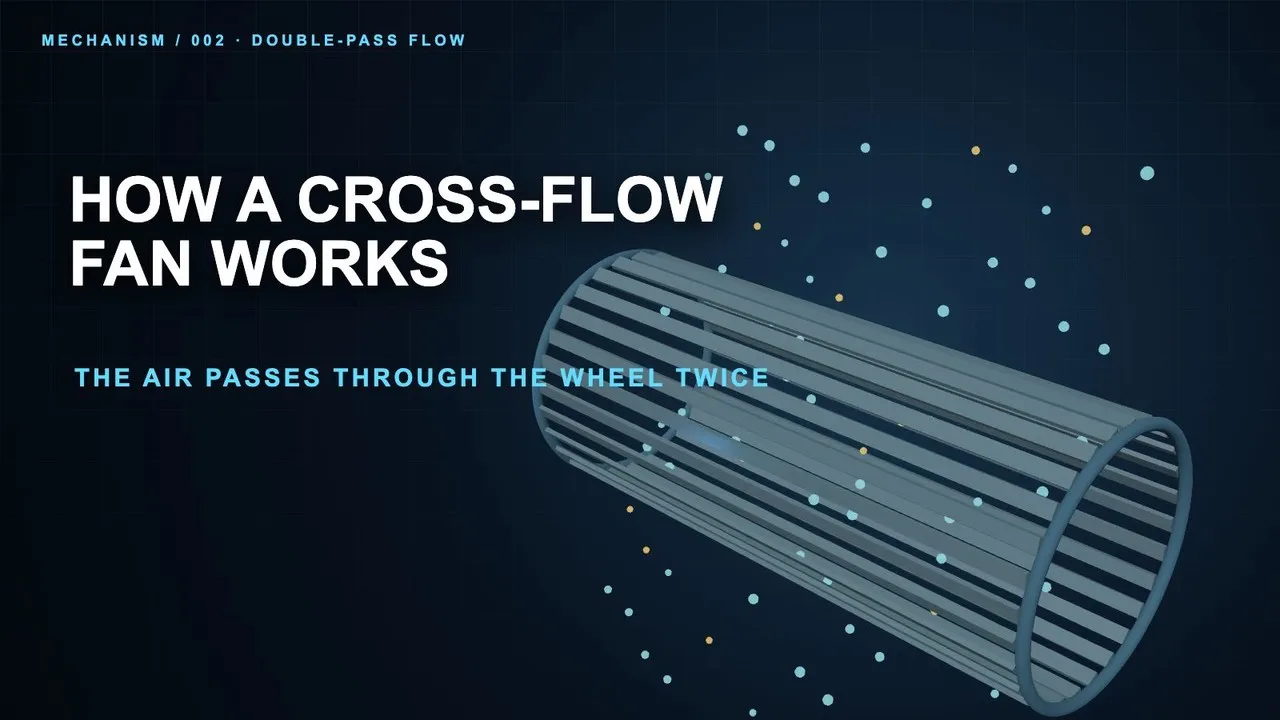
Because of the shape of the air it produces. A cross-flow impeller gives a wide, even sheet of air across its whole length, which suits a long narrow outlet in air handling equipment. A centrifugal fan concentrates flow through a much smaller opening, so the equipment would need ductwork to spread it out again.
Technical Documentation & Resources
Got a duty point you need matched?
Tell us the airflow, the pressure and the space you have. Then we mark your duty point on a tested curve and send the drawing back. Meanwhile samples and custom spec sheets take up to 90 days. Since 1990 we have supplied OEMs across HVAC, refrigeration and industry.
Browse Related Products:
🏆 ISO 9001 / ISO 14001 / ISO 45001 | CE (TÜV) | UL/ETL | ATEX Zone 21/22 | AMCA 210/211 / ISO 5801 tested
Choose the right cross flow fan
Longwell manufactures 495 cross flow fans in-house. Send airflow, static pressure and voltage — an engineer replies with a matching model, performance curve and price within one working day.