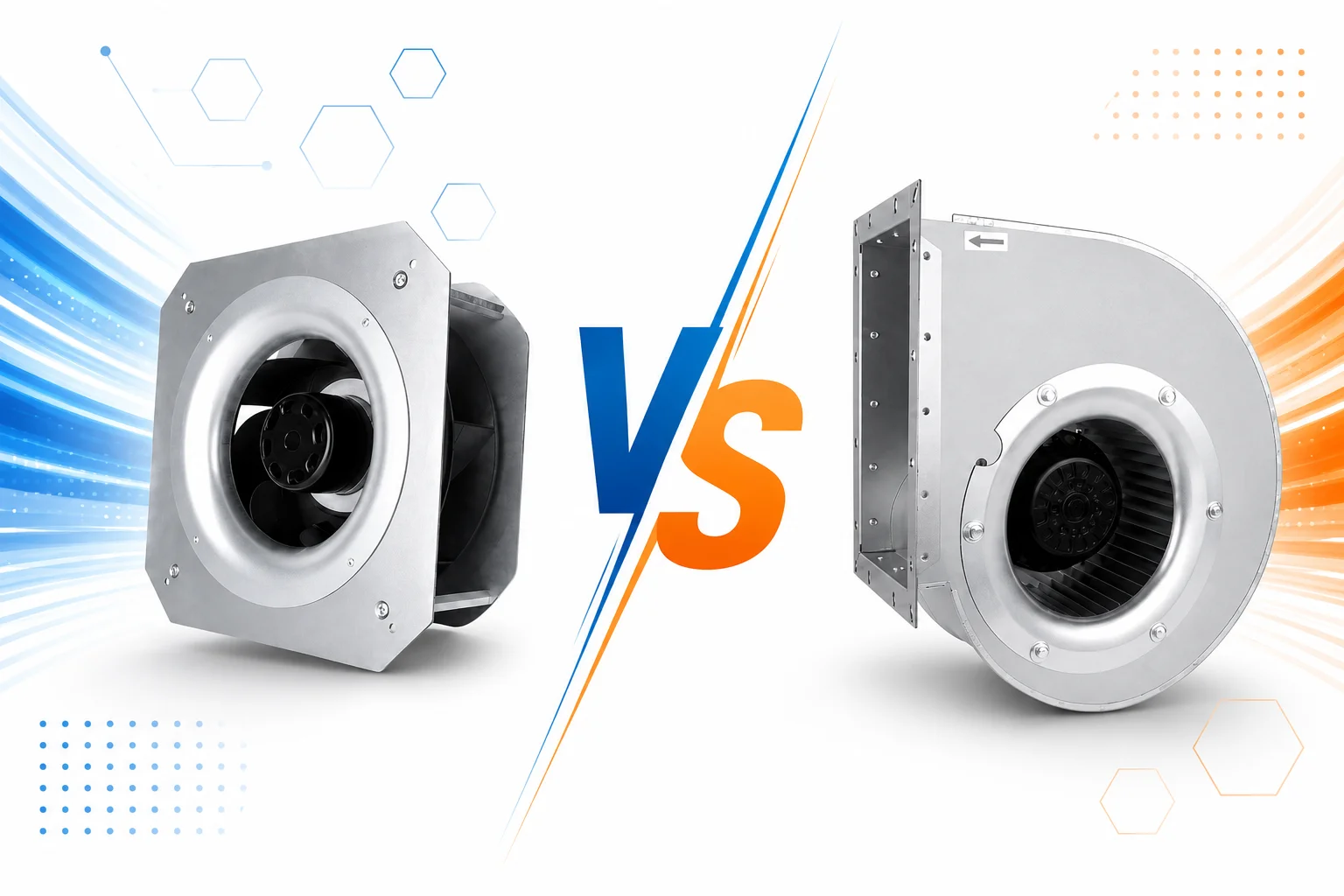
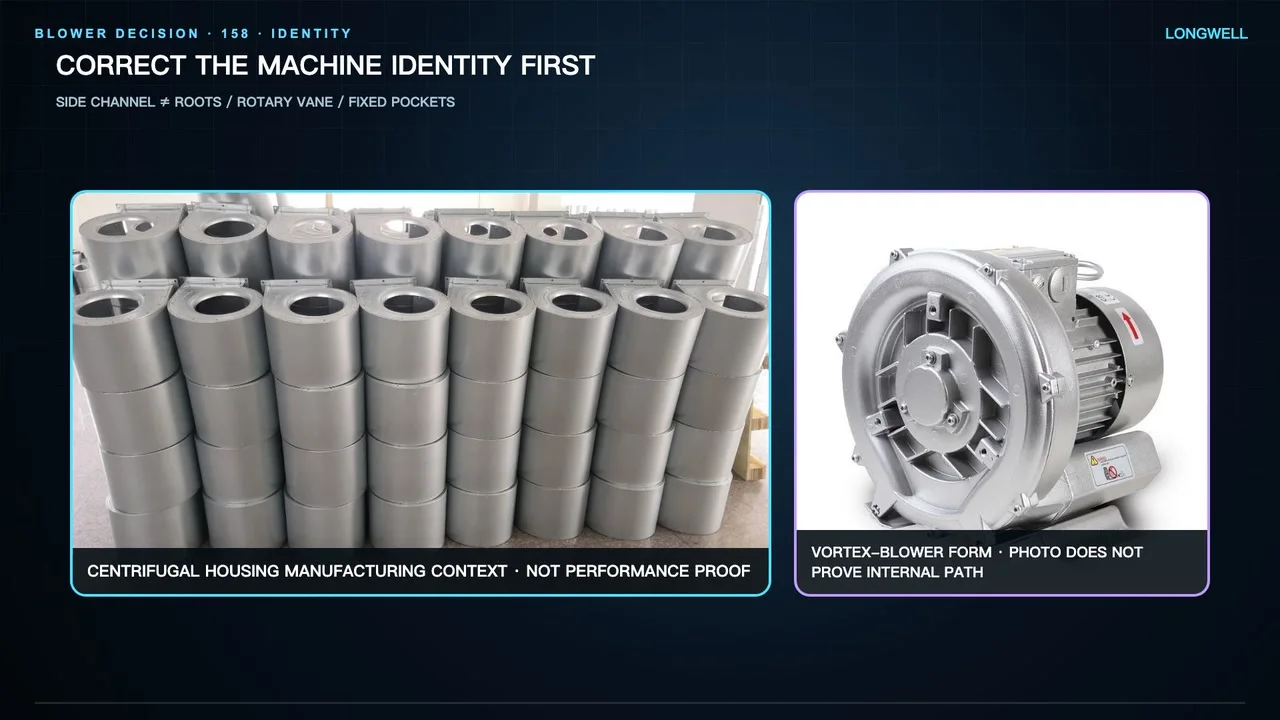
A regenerative blower looks like a small centrifugal machine, although it behaves nothing like one.
Air enters the impeller, gets thrown outward, then comes back to the blades again. That cycle repeats many times as the air travels around the housing.
A centrifugal blower gives one pressure rise per pass, so it suits moderate pressure at high airflow. A regenerative blower recirculates air repeatedly, building far higher pressure at low airflow, typically 10 to 60 kPa. Efficiency is lower and noise is higher, which is the price of that pressure.
How regeneration builds pressure
The impeller runs in a channel that curves round the housing, and the blades stay open on both sides.
Air thrown out by one blade drops back into the next blade further round, and picks up more energy. So a parcel of air may pass through the blades dozens of times before it reaches the outlet.
That repeated boost is where the pressure comes from, and it gives the machine its name.
It also explains the shape of the curve. Pressure holds up well as flow falls, which is exactly the opposite of how an axial fan behaves, and it is why these machines suit vacuum work so readily.
Comparing the two
| Centrifugal blower | Regenerative blower | |
|---|---|---|
| Typical pressure | 1–10 kPa | 10–60 kPa |
| Typical airflow | High | Low to moderate |
| Efficiency | 55–85% | 30–50% |
| Noise | Moderate | High, tonal |
| Oil free | Yes | Yes |
| Can pull vacuum | Limited | Yes, readily |
| Maintenance | Bearings only | Bearings only |
The efficiency row is the honest cost. You buy pressure and pay for it in watts.
Where regenerative wins
- Pond and wastewater aeration, where depth demands pressure.
- Vacuum lifting and hold-down tables.
- Pneumatic conveying of light material over short distances.
- Packaging machinery needing suction and blowing.
- Printing and paper handling with vacuum feed.
- Finally, medical and laboratory air supply at moderate pressure.
Aeration is the classic case. Our pond aeration guide covers how depth sets the duty.
Where a centrifugal blower is better
Below about 8 kPa, a centrifugal machine does the job more efficiently and more quietly.
It also moves far more air for the same power, so ventilation, extraction and dust work sit firmly in centrifugal territory. Meanwhile a regenerative blower at low pressure just wastes energy.
The two overlap between roughly 8 and 12 kPa. Below that, choose centrifugal. Above it, regenerative is usually the only sensible option short of a positive displacement machine.
Practical points on regenerative blowers
- Fit an inlet filter, since the running clearances are small.
- Provide a pressure relief valve, because a blocked line raises pressure fast.
- Allow generous cooling, as they run hot at high pressure.
- Expect tonal noise and plan for a silencer.
- Keep the airstream clean and dry, since there is no tolerance for debris.
- Finally, check the duty point, because efficiency falls away either side of it.
The relief valve matters. Deadheading a regenerative blower raises both pressure and temperature quickly.
Noise is a real consideration
These machines are loud for their size, and the noise is tonal rather than broadband.
Blade passing frequency dominates, and the repeated recirculation reinforces it. So a silencer on both inlet and outlet is normal rather than optional in an occupied space.
Our sound power guide explains why octave band data matters when sizing attenuation. For the test methods behind any curve you are offered, AMCA publishes the standards.
One buying note is worth adding. Ask for the curve rather than a single pressure figure, because these machines fall away sharply either side of their best point. A regenerative blower running well off duty is both loud and expensive to run.
Regenerative blower FAQ
Can a regenerative blower pull a vacuum?
Yes, readily, which is one of its main uses. The same machine can often be plumbed for either pressure or vacuum duty.
Why is efficiency so low?
Because air passes through the blades many times, and each pass adds friction and turbulence losses. That repeated passage is exactly what generates the pressure.
Do they need oil?
No. There is no contact between rotating and stationary parts, so they are oil free and deliver clean air. Bearings are the only serviceable item.
What happens if the outlet blocks?
Pressure and temperature both rise quickly, which can damage the machine. A pressure relief valve is essential rather than optional.
A regenerative blower buys pressure with efficiency and noise. Below about 8 kPa a centrifugal machine is better; above it, regeneration is usually the practical answer.