Thermal overload protection exists because heat kills windings. A motor has no other way to tell you it is too hot.
When one trips, the device is doing its job. So the real question is what made the motor hot in the first place.
Fan motors use internal bimetallic protectors, PTC thermistors or external overload relays. Bimetallic devices reset automatically after cooling, which produces the classic cycling pattern. Thermistors feed a control device that usually latches. An external overload senses current rather than temperature, so it misses some overheating causes entirely.
The common thermal overload devices
| Type | Senses | Reset behaviour |
|---|---|---|
| Bimetallic, internal | Winding temperature directly | Automatic after cooling |
| Bimetallic, manual reset | Winding temperature directly | Requires a button press |
| PTC thermistor | Winding temperature directly | Via a relay, usually latching |
| External overload relay | Motor current | Manual or automatic |
| Drive electronic protection | Current and board temperature | Configurable |
That gap matters. A motor starved of cooling air gets hot while drawing normal current, so a current-sensing relay never sees it at all.
Reading the cycling pattern
A self-resetting thermal overload device gives you a very recognisable pattern.
The fan runs ten to thirty minutes, stops, then starts again fifteen minutes later. And repeats. So the pattern is the diagnosis. It points at thermal overload rather than at a wiring fault.
Automatic reset devices are designed to protect against occasional events. Continuous cycling means the underlying cause is still there, and every cycle stresses the winding a little more.
What makes a motor overheat
- Blocked airflow, since the motor needs that air to stay cool.
- A weak run capacitor, which pushes current up on a single-phase motor.
- A dirty wheel, because it loads the motor harder.
- Low supply voltage, or an uneven three-phase supply.
- Tired bearings, which add drag the motor has to overcome.
- Finally, a hot room, which adds straight to all of the above.
Our overheating motor guide works through each of these with the checks that identify them.
PTC thermistors and why they latch
A PTC thermistor changes resistance sharply above a set temperature. A relay then watches for that change.
Because the relay usually latches, somebody has to reset it on purpose. That is a feature rather than a nuisance, since it forces a look at the cause instead of endless cycling.
Thermistors also sit right in the winding, so they react faster than any device watching current from outside. That speed matters when a fan stalls suddenly.
Protection on EC fans
An EC fan handles thermal overload itself, and it does so more cleverly than a bimetallic strip.
- The drive watches phase current all the time and caps it.
- It reads board temperature, then eases off output when needed.
- Many models slow down instead of stopping dead.
- Fault flags keep a record of what went wrong.
- Some units report the fault over a bus.
- Finally, you can set what happens after a fault rather than accept a default.
Consequently an EC fan that slows down on a hot day is protecting itself rather than failing. Our EC control guide covers how to read that behaviour.
What never to do
Two shortcuts turn up on site, and both end badly.
Never bypass a thermal overload device to stop nuisance tripping, since the next event burns the winding instead. Never fit a larger overload relay either, because the setting exists to match the motor.
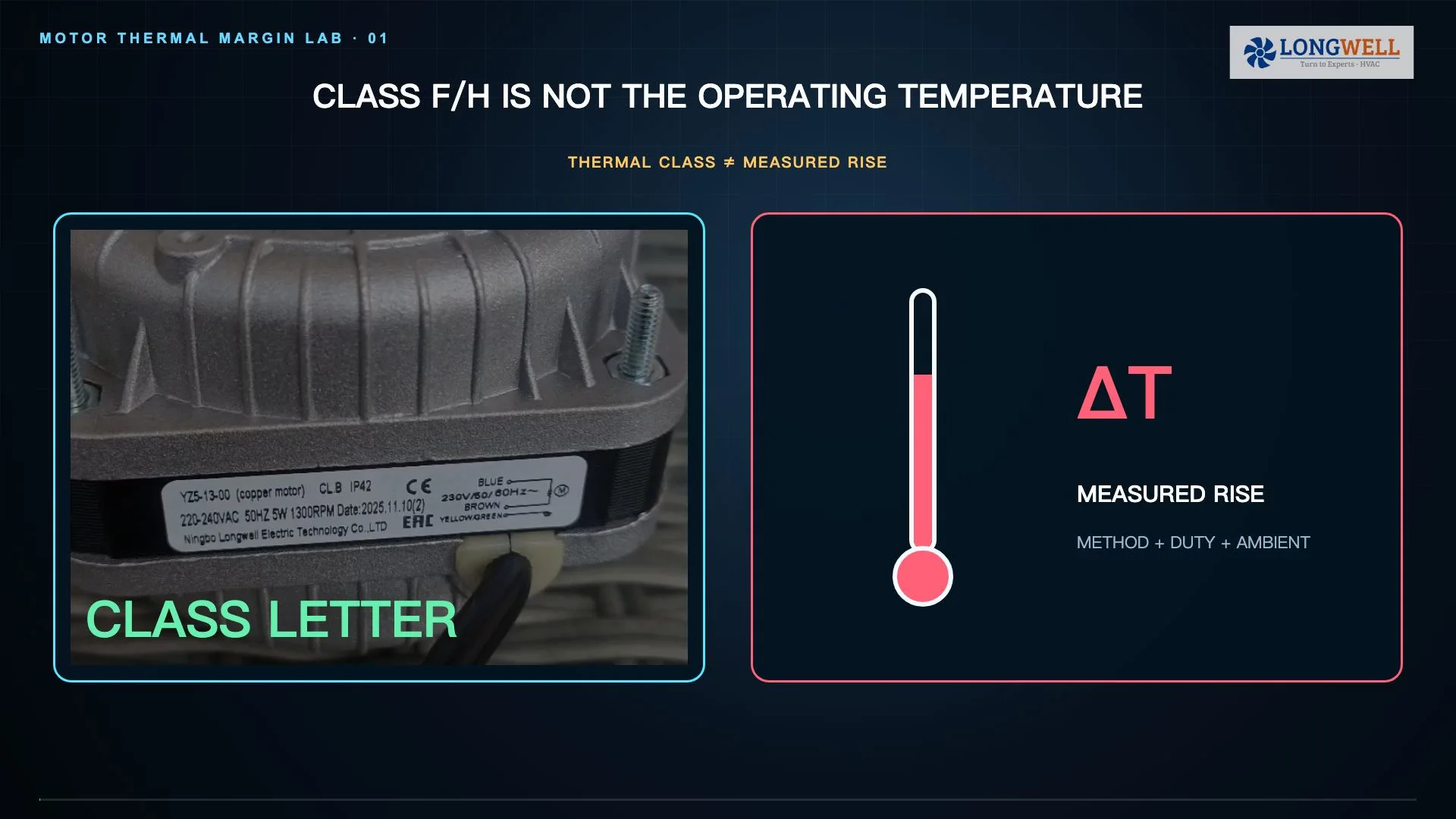
For thermal classes and protection rules, IEC 60034 sets out the framework.
Log the trips instead. Note the time, the ambient and what the fan was doing. Three entries usually reveal the pattern, and the pattern names the cause far faster than any meter will.
Thermal protection FAQ
Why does my fan restart on its own after stopping?
That is an automatically resetting thermal protector. It opens when the winding is too hot and closes again once the motor cools, which produces a regular cycling pattern.
Is a tripping thermal protector a fault?
The device is working correctly, so the fault lies elsewhere. Check airflow, capacitor, bearings, supply voltage and ambient temperature in that order.
Can I reset a thermal protector manually?
Only on manual reset types, and only after finding the cause. Repeatedly resetting without investigating simply postpones a winding failure.
Does an external overload replace an internal protector?
No, since it senses current rather than temperature. Both have their place, and many motors carry internal protection alongside an external relay.
Thermal overload protection is a messenger. Fix what made the motor hot, and the protector goes back to doing nothing, which is exactly what you want.