In large industrial and logistics facilities, maintaining air quality and temperature is essential. High ceilings, dense racking, and frequent loading activity in warehouses all lead to uneven airflow distribution. An effective warehouse ventilation system must do more than simply move a large volume of air. Fresh air needs to reach the occupied and storage areas. The contaminated air is removed through suitable exhaust points.
This guide covers the main types of warehouse ventilation fans and common system designs. Then provide the key factors and maintenance tips for warehouse ventilation fan selection.
Why Warehouse Ventilation Matters?
Air Quality
Large warehouses will accumulate dust, fumes, moisture, and odors, especially in areas with limited airflow or frequent industrial activity. Poor ventilation allows these pollutants to remain in the occupied space and can create uneven or stagnant air conditions.
The effective ventilation system creates a controlled airflow path. Exhausting the contaminated air and supplies fresh air into the building, which generates an airflow circulation. This airflow helps dilute airborne pollutants and directs them toward the exhaust points.
A properly designed warehouse ventilation system removes contaminated indoor air while bringing in enough fresh air to replace it. This maintains more consistent air quality across storage zones.
Common Ventilation Issues
- Uneven air distribution: Large spaces, high-density storage layouts, multiple corners, and enclosed areas obstruct the distribution of airflow. Some areas may receive insufficient air movement, which creates stagnant zones.
- Temperature stratification: Due to the high ceiling of the warehouse, warm air naturally rises and accumulates. This brings temperature differences between upper and lower areas. Under this condition, workers are in an uncomfortable working environment, increasing cooling demand.
- Inefficient ventilation system: When selecting or installing fans based only on airflow capacity without considering actual warehouse conditions, the ventilation system is often inefficient. A matched ventilation fan with airflow volume and static pressure specifications is necessary.
Warehouse Ventilation Fan Types
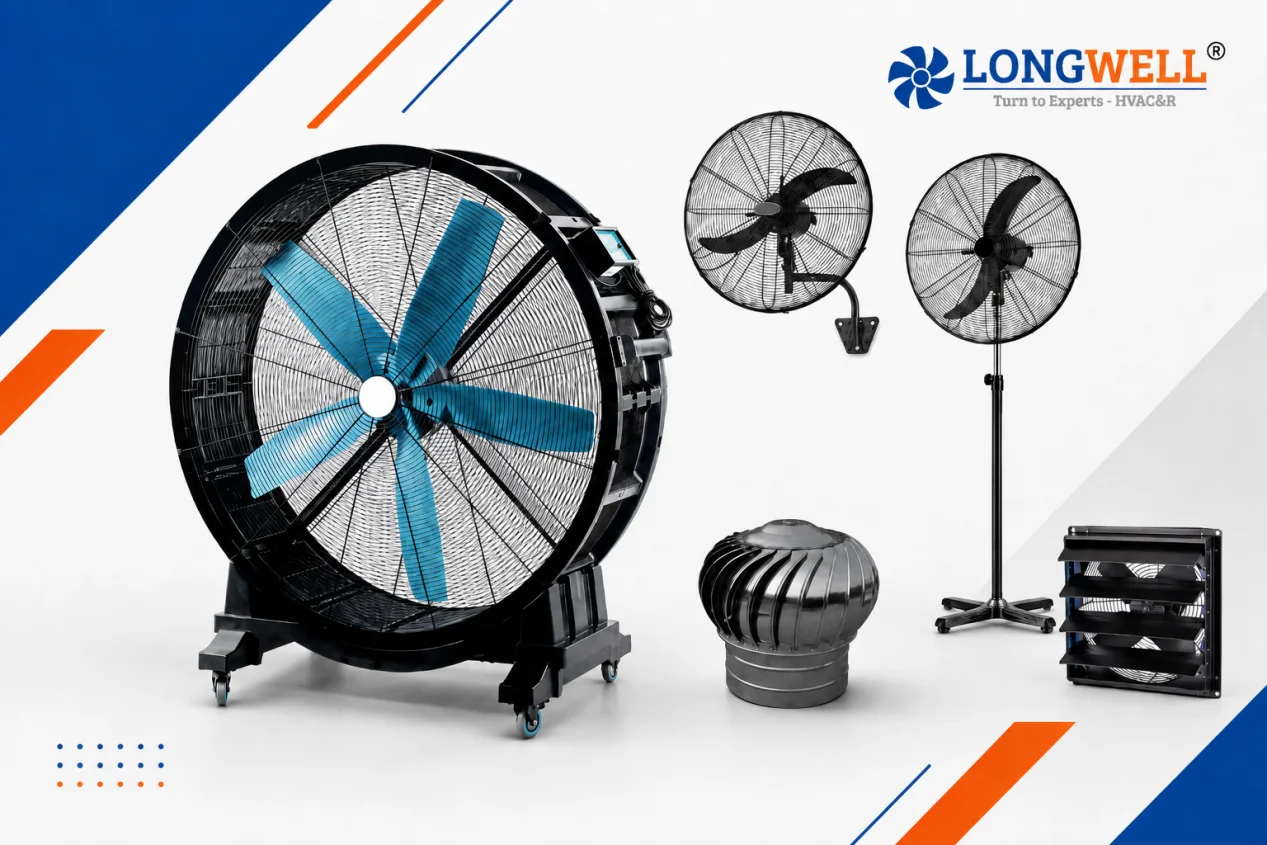
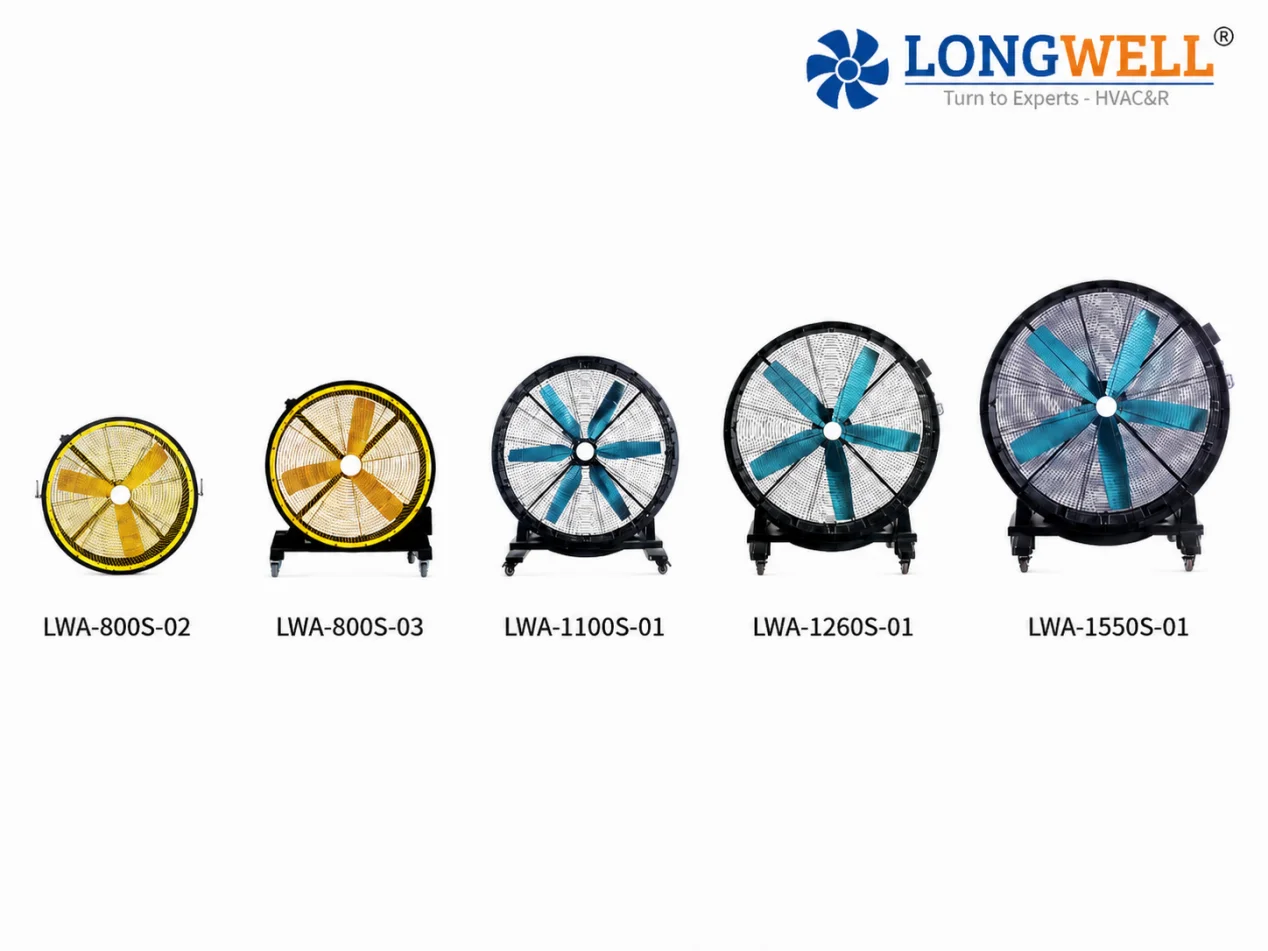
Drum Fans
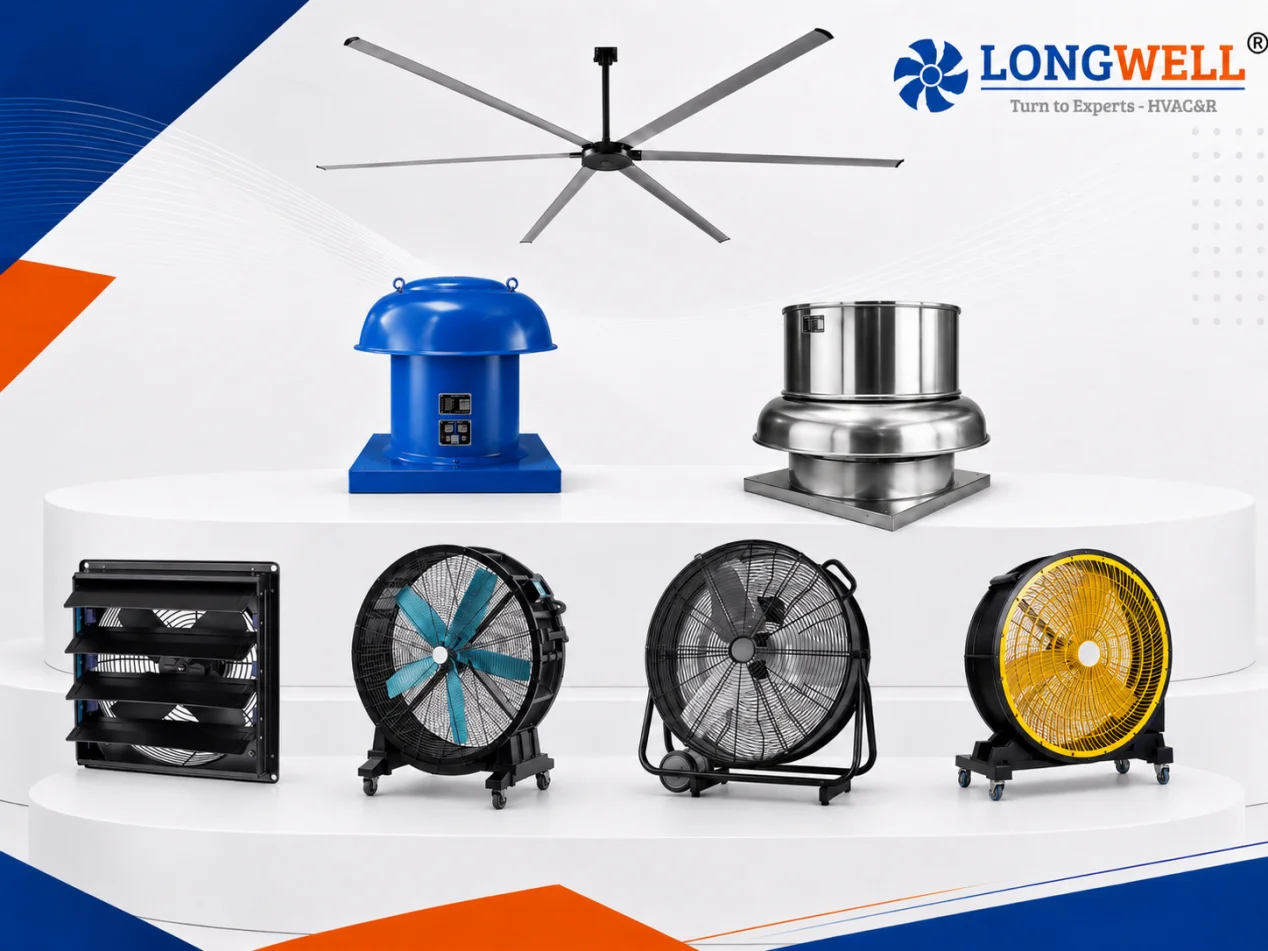
A drum fan is a heavy-duty industrial fan designed to move large volumes of air quickly across open space. The round drum shape traps the air and pushes it straight forward into a powerful and focused airflow. It creates a strong wind tunnel effect for large spaces and stops air from spreading out to the sides. LONGWELL industrial mobile fans, for example, are designed for an air delivery distance of approximately 35–40 m, depending on the model.
The drum fan has a plug-and-play design and does not require permanent installation. Its casters allow the drum fan to be positioned according to real-time requirements. Depending on the model, permanent-magnet motors and variable-speed control can also improve energy efficiency. Some drum fans also support 360° tilt adjustment for wide-angle air supply. By loosening the knobs on both sides, operators can freely adjust and lock the fan at the required tilt angle, making it easier to direct airflow toward different warehouse zones or work areas.
Roof Exhaust Fans
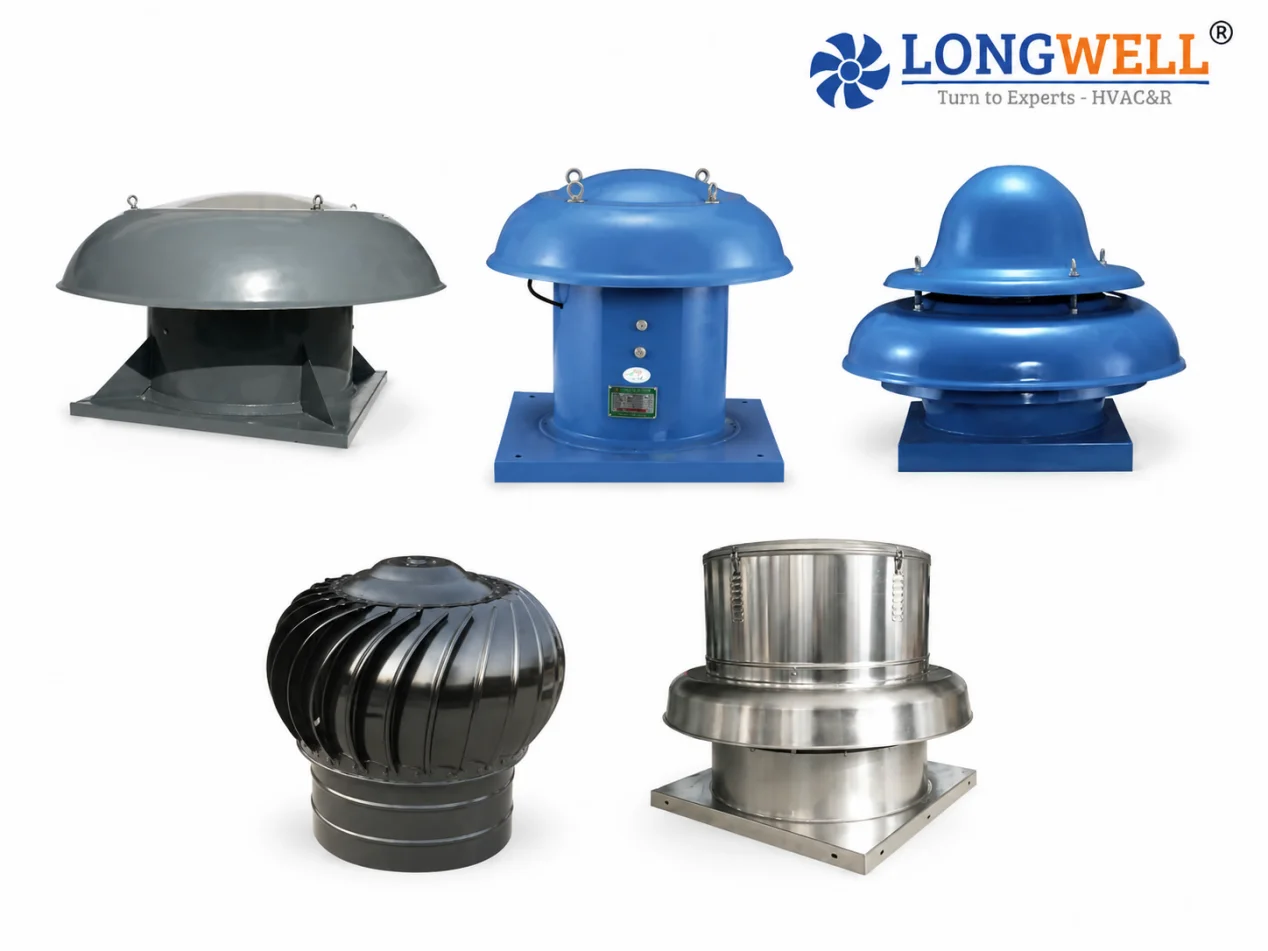
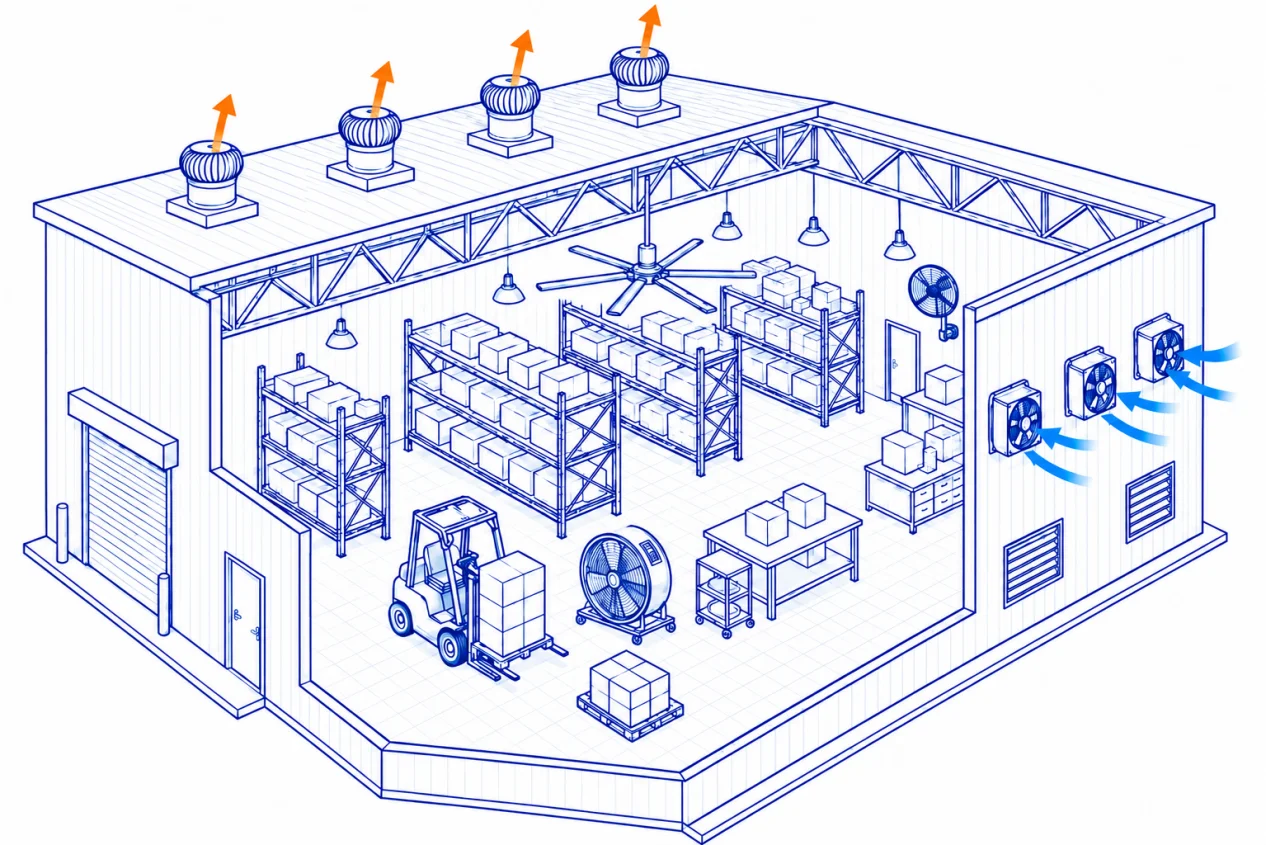
Warm air is easy to rise and accumulates in the roof area. The roof exhaust fans work by creating a controlled airflow path that removes indoor air through an opening installed on the roof. When the motor drives the impeller, the rotating blades generate a pressure difference between the warehouse interior and outdoor environment. This pressure difference draws hot and contaminated airflow upward and discharged. As indoor air is exhausted, replacement air enters the warehouse.
Based on the airflow mechanism and structural design, roof exhaust fans can be classified into several types, including centrifugal and axial. Axial roof exhaust fans are typically designed for high airflow and relatively low static pressure applications. Centrifugal exhaust fans are for high-airflow and higher static pressure warehouses.
Wall-Mounted Exhaust Fans
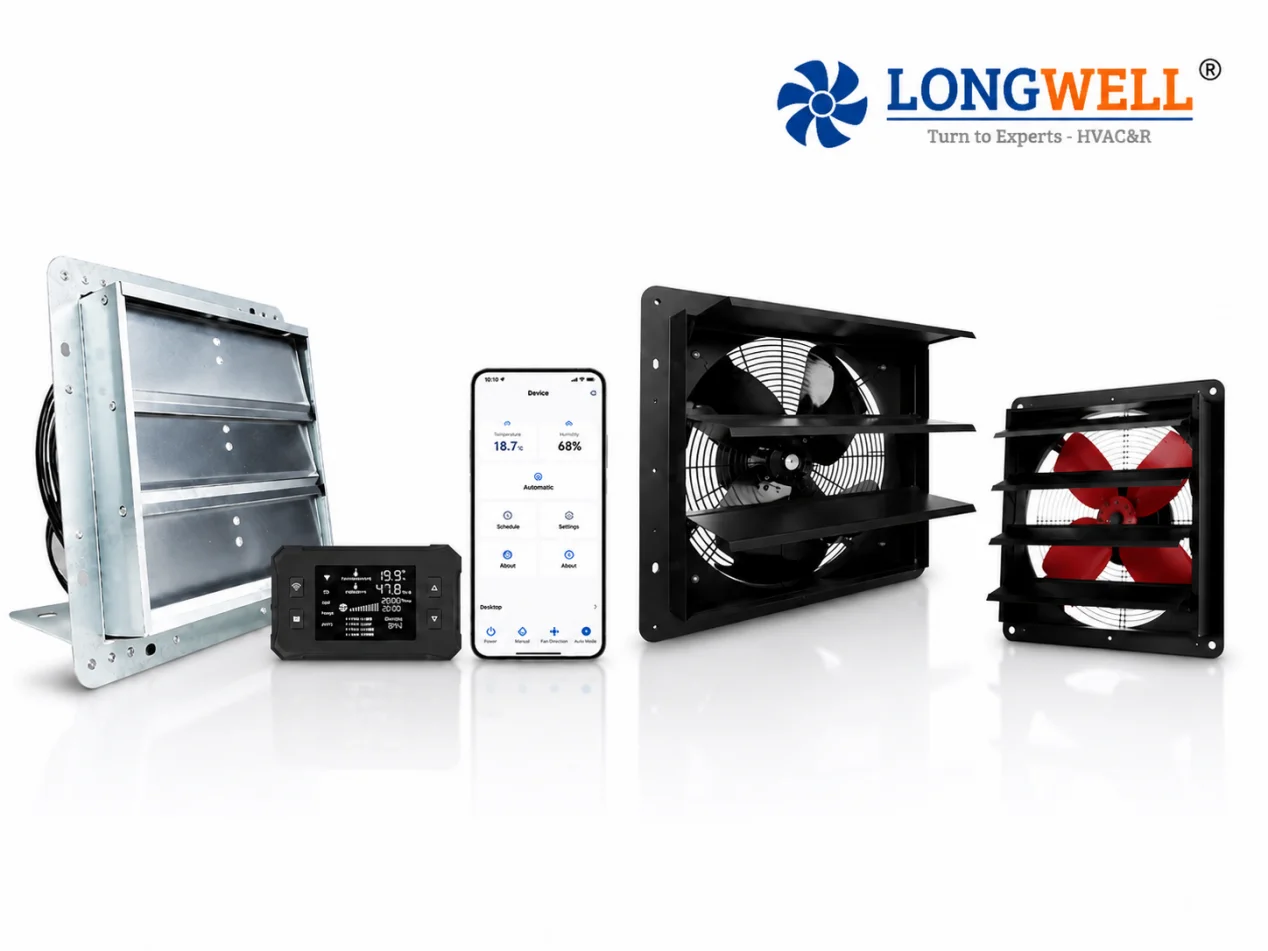
Wall-mounted exhaust fans are installed directly on warehouse sidewalls to discharge hot or stale indoor air to the outside. By moving air horizontally through the wall opening, they provide a straightforward way to increase air exchange frequency.
Most wall-mounted exhaust fans use axial impellers. As the blades rotate, indoor air is drawn through the fan and discharged outside. The continuous exhaust creates a slight negative pressure inside the warehouse, allowing fresh air outside to enter.
Some industrial wall-mounted exhaust fans are equipped with louvers. They will open when the fan is operating. The louvers help reduce reverse airflow and limit rain, dust, and insects from entering the warehouse.
HVLS Fans
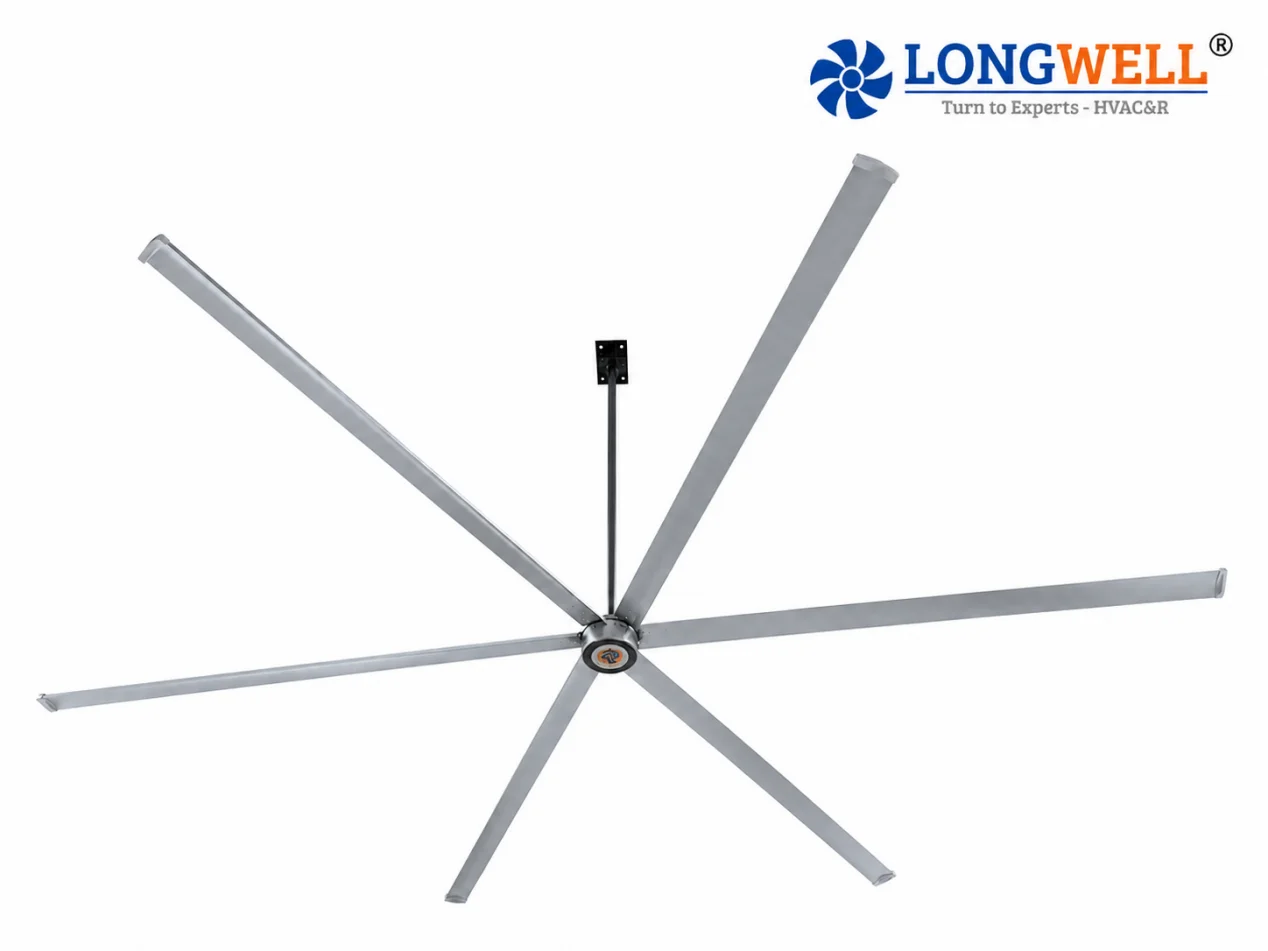
High-volume low-speed fans are large diameter ceiling fans. As their large-diameter blades rotate, HVLS fans move a broad column of air downward from the ceiling. After reaching the occupied zone, the airflow spreads outward across the floor and circulates through the surrounding space.
Although racking and stored products may interrupt the airflow pattern, the HVLS fan is still important to maintain circulation and reduce areas with limited air movement. They push warmer air from the upper part of the building downward and mix it with the cooler air below, creating a more even temperature and airflow pattern throughout the space.
Warehouse Ventilation Design
Cross Ventilation
In a cross-ventilation layout, air does not simply enter and leave through nearby openings. Intake points are usually placed on one side of the building. Exhaust fans or vents are arranged farther away, often on the opposite wall or at a higher level. This gives the incoming air enough distance to pass through work and storage areas. If an intake is too close to an exhaust fan, part of the fresh air may be removed immediately, while other areas receive little airflow.
Inside the warehouse, racks, machinery, partitions, and stacked products often divide the space into separate airflow zones. For long rack aisles, air may move easily along the aisle but poorly across adjacent rows. Fan and opening locations should be selected with these obstructions in mind so that air can reach deeper areas of the warehouse.
Air Supply and Exhaust System
Warehouse exhaust fans remove indoor contaminated air from the building. As air is discharged, replacement air must enter at a similar rate. If too much air is exhausted without sufficient make-up air, negative pressure will develop. This may reduce fan performance and make warehouse doors harder to open.
A complete warehouse ventilation system therefore needs both air supply and air exhaust. Exhaust fans remove indoor air, while fresh outdoor air enters through design inlets. The supply and exhaust sides should be matched so that discharged air can be adequately replaced.
For instance, a warehouse ventilation system uses roof exhaust fans to remove warm air and draws air through wall louvers. In another layout, wall-mounted exhaust fans are installed on one side of the building, with supply fans positioned on the opposite side. This creates a defined airflow path across the storage area.
The whole system design also depends on building orientation, prevailing winds, internal heat sources, or loading areas. Simply applying the same ventilation layout to every warehouse is not the optimal method.
How to Choose a Warehouse Fan?
Airflow and ACH
Choosing a warehouse fan starts with defining the actual ventilation requirement rather than selecting a fan by size alone. Warehouse volume, airflow demand, system resistance, layout, operating environment, and control requirements all affect which fan type and configuration will perform effectively. Every ventilation design starts with the required airflow, that measured in cubic feet per minute (CFM).
For general ventilation, airflow is commonly estimated from warehouse volume and the required air changes per hour (ACH):
CFM = (Warehouse Volume × ACH) ÷ 60
Worked Example: For a warehouse with dimensions 100 ft × 200 ft × 24 ft (Volume = 480,000 ft³) and a target of 6 ACH:
CFM = (480,000 × 6) ÷ 60 = 48,000 CFM
Static Pressure
Combine airflow with static pressure can define the fan’s duty point. Components in a ventilation system such as louvers, shutters, filters, ducts, and dampers can create resistance. For direct wall or roof exhaust needs, axial-type fans are often suitable for providing high airflow volume with relatively low static pressure. Duct systems with filtration and higher resistance may require centrifugal fan designs.
Fans Layout
Warehouse ventilation fan layout needs to consider racking, mezzanines, machinery, and loading areas. Roof exhaust fans can discharge air from upper areas, wall-mounted exhaust fans provide direct sidewall air exchange, and HVLS fans circulate air across large indoor spaces.
In addition, warehouse fans often operate for long periods; energy efficiency is an important operating consideration.
Control System
Warehouse fan control can range from simple manual operation to fully automated multi-fan management. Manual control is suitable for systems that only require basic on/off operation. When ventilation demand changes throughout the day, speed control can help reduce unnecessary energy consumption. It can adjust fan output to match actual requirements. Common control options include 0–10V, PWM, RS485, and Modbus.
Fan Compliance
Warehouse ventilation fans should also comply with the electrical, safety, efficiency, and environmental requirements.
- CE: Commonly required for products supplied to the EU market.
- UL/ETL: Commonly used for electrical safety compliance in North American applications.
- RoHS: Restricts the use of certain hazardous substances in electrical and electronic equipment.
- IP Protection: Indicates the fan’s resistance to dust and water ingress. Higher IP ratings may be required for outdoor, dusty, or humid warehouse environments.
- ATEX: Required for certain equipment used in potentially explosive atmospheres within the European Economic Area.
5 Tips for Warehouse Fan Maintenance
- Remove dust, grease, and debris from the impeller to the housing.
- Check the temperature and noise of operating bearings.
- Monitor unusual noise, overheating, vibration, and changes in the motor.
- Follow the manufacturer’s recommendations to add lubricating oil at regular intervals.
- For belt-driven fans, inspect belt tension, wear, pulley alignment, mounting bolts, and fasteners.
Warehouse ventilation fans often operate for long periods under high-dust working environments. Regular maintenance is important for keeping stable airflow performance. The frequency of maintenance can be adjusted according to the actual operating hours and the fan manufacturer’s instructions.
LONGWELL Warehouse Fan Matrix
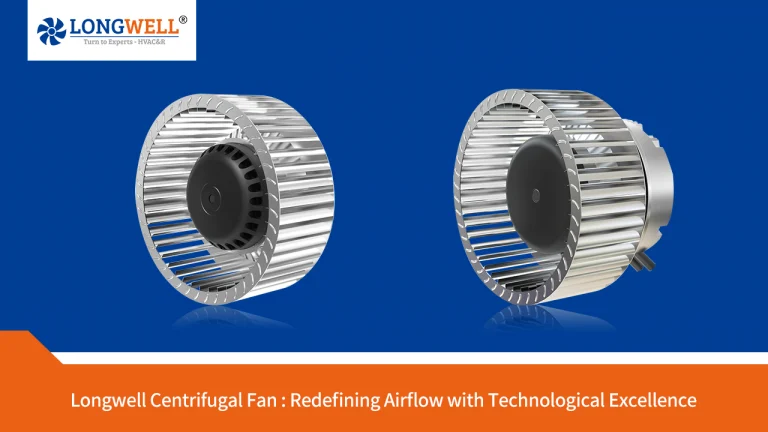
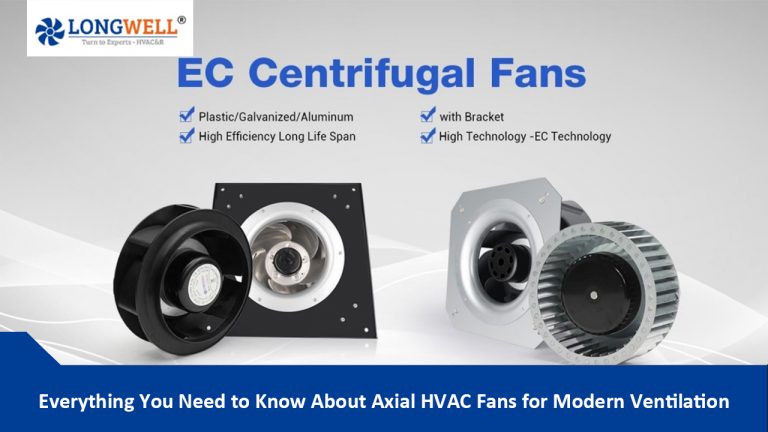
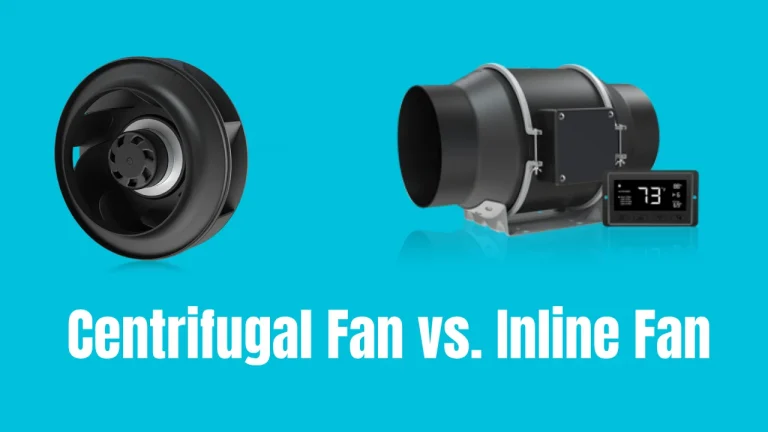
LONGWELL provides a broad warehouse ventilation fan matrix covering AC, DC, and EC motor models. The product range includes axial, centrifugal, cross-flow, and duct fans.
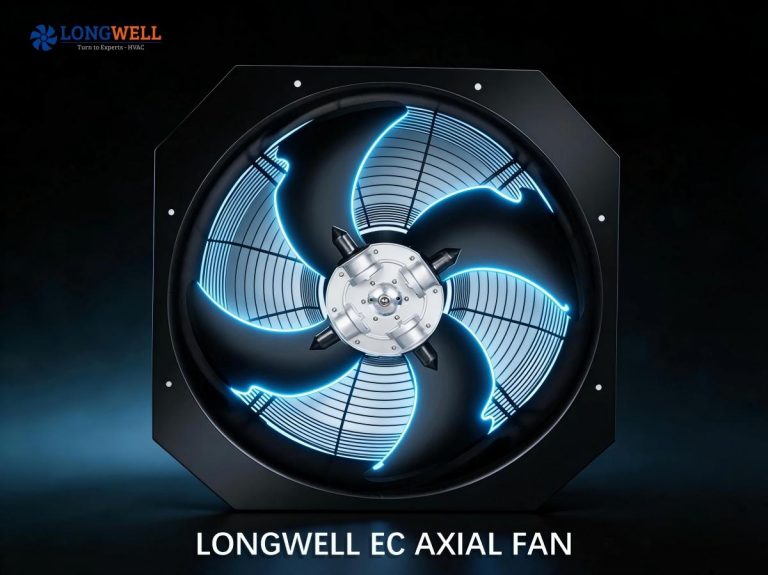
LONGWELL EC axial fans are suitable for warehouse and industrial spaces that require high and stable airflow. The metal or aluminum-alloy impellers provide durability for industrial operating conditions. EC motor technology supports higher efficiency with variable-speed operation.
Recommended LONGWELL Fan Models for Warehouse Ventilation
|
Warehouse Ventilation Products |
Typical Series |
Warehouse Ventilation Use |
|
Axial Fans |
LWAA / LWAE |
High-volume general ventilation and large-space air exchange |
|
Forward-Curved Centrifugal Fans |
LWFC |
Compact ventilation systems and localized air movement |
|
Backward-Curved Centrifugal Fans |
LWBE3G / LWBE |
Higher-pressure ventilation, ducted systems, and energy-saving retrofit projects |
|
Cross-Flow Fans |
LWCD |
Localized airflow and ventilation for specific warehouse areas |
For warehouse ventilation projects, LONGWELL can support from fan selection to installation. We also provide customization products according to airflow, static pressure, noise, energy consumption, installation dimensions, and control requirements. This allows different fan technologies to be combined within one ventilation system. For the new product introduction project, we can achieve the transition from design lock-in to the first order delivery within 90 days.
FAQ
Which type of fan is commonly used in a warehouse?
High-Volume Low-Speed (HVLS) ceiling fans are the most common choice for large warehouses. They perform better in whole-facility air mixing, lower humidity, and large open areas with high ceilings.
What is the best fan for a warehouse?
There is no single best fan for every warehouse. The choice depends on airflow volume, static pressure, building layout, installation position, and ventilation purpose.
How to size an exhaust fan for a warehouse?
Start by calculating the warehouse volume and then determine the required air changes per hour. The selection of an exhaust fan should then depend on static pressure requirements.
What are the ventilation requirements for a warehouse?
A complete warehouse ventilation system should provide sufficient fresh-air supply, effective exhaust airflow, and a clear airflow path through occupied and storage areas.