One of the most important measurement for electric motor is its efficiency classes. The efficiency class indicates the level of electrical energy that the motor converts into mechanical work and the energy losses. With the stricter global regulation and climbing energy costs, understanding motor IE efficiency is essential. Motor efficiency classes include IE1, IE2, IE3, IE4, and IE5. This article covers definitions, efficiency values, technology, energy savings, regulatory statue, and practical selection guidance.
IE Motor Classification Explained
Before diving into each IE class, it’s important to understand the framework that defines them.
What is IEC 60034-30-1?
IE efficiency classes are defined by the international IEC 60034-30-1, so you need firstly know what this standard is. IEC 60034-30-1 standard defines IE efficiency classes for low-voltage, three-phase AC electric motors, setting the minimum efficiency requirements each class should meet. It specifies:
- Five efficiency classes: IE1 (Standard), IE2 (High), IE3 (Premium), IE4 (Super Premium), and IE5 (Ultra Premium)
- Sets the minimum efficiency for different power outputs, different pole counts including 2, 4, 6, and 8-pole motor, and supply frequencies (50 Hz and 60 Hz)
- Scope definitions specifying which motor types are covered and which are exempt
An electric motor with a higher IE class is usually built with better materials and designs, which means precise manufacturing and longer lifespan.
Which Motors Are Covered?
IEC 60034-30-1 standard covers a wide range of motors ranging from 120 W to 1200 kW. These are the motors covered by the standard:
- Single-speed, three-phase motors
- Motors with 2, 4, 6, and 8-pole designs
- Power output from 0.12 kW to 1,000 kW
- Motors with 50 Hz and 60 Hz supply
- Duty type S1 (continuous) and S3 (≥80% cyclic duration)
Some motor types are outside the scope of the standard. For example, motors with 10 pokes or more, motors fully integrated into the machine, brake motors, and motors built for specific environments is not in the scope.
How Efficiency is Measured?
η (Efficiency) = (Mechanical Output Power ÷ Electrical Input Power) × 100%
The difference between input and output is loss—energy dissipated as heat, friction, and magnetic losses rather than converted to useful work.
IE Motor Efficiency: Five Efficiency Classes
| Class | Name | Loss Reduction |
| IE1 | Standard Efficiency | Baseline |
| IE2 | High Efficiency | -20% vs IE1 |
| IE3 | Premium Efficiency | -15% – -20% vs IE2 |
| IE4 | Super Premium Efficiency | -15% – -20% vs IE3 |
| IE5 | Ultra Premium Efficiency | −20% vs IE4 |
IE1 vs IE2 vs IE3 vs IE4 vs IE5 Comparison
The International Electrotechnical Commission (IEC) classifies motors into different efficiency levels, from IE1 Standard Efficiency through IE5 Ultra-Premium Efficiency. We’ll delve into each IE efficiency classes in detail in the following content.
IE1: Standard Efficiency
The IE1 class is the lowest efficiency level and the baseline of the IE classification system. The IE1 class has been the industry standard for decades, but it has gradually phased out with many countries’ stricter regulations including the EU, United States, China, and Australia.
IE1 Key Characteristic
- Design: Traditional and basic squirrel-cage induction motors built with standard-grade electrical steel and manufacturing
- Loss profile: High stator and rotor copper losses, moderate iron losses, standard friction and windage losses
- Energy wasted: A 50 kW IE1 motor loses approximately 5.6–6.2 kW as heat at full load
IE2: High Efficiency
IE2-Class motors provide a more efficient option by operating with lower energy losses. It reduces losses by approximately 20% compared to IE1 through better materials and modest design improvements. IE2 served as the minimum regulatory in modern markets.
IE2 Key Characteristic
- Technology: IE2 motors are improved induction motors featuring lower-loss silicon electrical steel (still 0.50 mm but better grade), optimized slot geometry, increased conductor material, and improved rotor bar design
- Usually used in applications paired with a variable speed drive (VSD)
- Energy wasted: A 50 kW IE2 motor loses approximately 4.3–4.9 kW as heat at full load
IE3: Premium Efficiency
IE3 (Premium Efficiency) is the current regulatory baseline for most motor sizes in major markets. IE3 class motors are the balanced choice between cost and energy efficiency as they use less energy, operate quieter, and have longer lifespan than IE2 motors.
IE3 Key Characteristic
- Technology: IE3 motors are highly optimized squirrel-cage induction motors with premium-grade electrical steel, design optimization, and tighter manufacturing tolerance.
- Energy wasted: A 50 kW IE3 motor loses approximately 2.9–3.2 kW as heat at full load
- Default choice for general-purpose applications
IE4: Super Premium Efficiency
The IE4 (Super Premium Efficiency) class motors have more advanced motor technology. IE4 motors are preferred by high electricity consumption application where motors need to operate all day. Achieving IE4 requires fundamentally different motor topologies that eliminate or drastically reduce specific loss components.
IE4 Key Characteristic
- Technology: SynRM rotors use specially shaped magnetic flux barriers in laminated steel and rare-earth permanent magnets (typically NdFeB) embedded in the rotor create a fixed magnetic field.
- Energy wasted: A 50 kW IE4 motor loses approximately 1.8–2.2 kW
IE5: Ultra Premium Efficiency
IE5 is the highest energy efficiency class among current technologies. High-energy neodymium-iron-boron (NdFeB) magnets are embedded in the rotor and permanent magnet assisted synchronous reluctance reduces rare-earth magnet usage to achieve IE5 efficiency. IE5 motors are especially ideal for production where energy cost is extremely high.
IE5 Key Characteristic
- Technology: Use permanent magnet synchronous motors and a hybrid approach combining the reluctance torque of a SynRM with a smaller quantity of permanent magnets. Also designed with high-quality and advanced materials.
- Energy wasted: A 50 kW IE5 motor loses approximately 1.0–1.5 kW
IE1 vs IE2 vs IE3 vs IE4 vs IE5 Comparison Chart
| Parameter | IE1 | IE2 | IE3 | IE4 | IE5 |
| Efficiency Level | Standard | High | Premium | Super Premium | Ultra Premium |
| Technology | Basic induction | Improved induction | Optimized induction | SynRM / PM / Adv. IM | PMSM / PMaSynRM |
| Electrical Steel | 0.50 mm standard | 0.50 mm low-loss | 0.35 mm premium | 0.30 mm or better | 0.30 mm + PM rotor |
| Rotor Type | Aluminum die-cast | Aluminum optimized | Aluminum optimized | Copper / SynRM / PM | Permanent magnet |
| VFD Required? | No | No | No (optional) | Sometimes | Yes |
| Rare-Earth Magnets | None | None | None | Optional | Typically yes |
| Best Application | Very low use, replaced | Legacy, low-duty, usually with a drive | General purpose, minimum standard of the industry | High-duty, high consumption facilities | Facilities where energy cost is critical |
Global Regulatory Snapshot (2026)
| Region | Regulation | Current Minimum (2026) |
| European Union | Reg. 2019/1781 | IE3 (0.75–75 kW) / IE4 (75–375 kW) |
| United States | DOE 10 CFR 431 | IE3 (NEMA Premium), 1–500 HP |
| China | GB 18613-2020 | IE3 (since June 2021) |
| Canada | CSA C390 | IE3 |
| Australia/NZ | MEPS | IE3 (since 2019) |
| India | IS 12615 | IE2 (transitioning to IE3) |
| Japan | Top Runner Program | ~IE3 equivalent |
How to Choose the Right Efficiency Class?
Choosing the right efficiency class has no single rule. It is affected by many factors, including the motor’s running time, energy load profile, and specific application requirements.
When to Choose IE3?
- Operating hours are relatively low (fewer than 3,000-4,000 hours/year)
- Replacing a failed IE2 motor
- Initial investment is relatively limited
- Energy costs are moderate
When to Choose IE4?
- Regulatory requirement: Your motor is in the 75–375 kW range and law mandates IE4
- Medium to high load applications
- With high electricity costs
- Total cost of ownership (TCO) focus: Lifecycle cost analysis drives procurement rather than upfront price alone
When to Choose IE5?
- Motor runs 8,000+ hours/year or more in data centers or commercial HVAC systems
- Energy efficiency is a top priority
- Long-term investment horizon and future-proofing
- Variable load profiles: Motor frequently operates at 25–75% load, where IE5’s superior partial-load efficiency delivers outsized benefits
There are also some tips for choosing the right motor:
- Equipment Running Hours: The more hours a device runs each year, higher class of motor you should choose for reduced costs.
- Load Profile: The motor doesn’t always run at its full load and the efficiency changes with the load. A motor that operates continuously near its rated load can benefit significantly from reduced losses.
- Energy Costs: If the equipment can produce large energy costs, IE4 and IE5 motors can be the best choice for the maximum efficiency.
- Application Requirement: Fans and pumps require high-efficiency motors because of their large energy consumption.
- For equipment operating continuously, choosing IE3, IE4, and IE5 can make your project future-proofing.
LONGWELL Fan IE Motor Efficiency
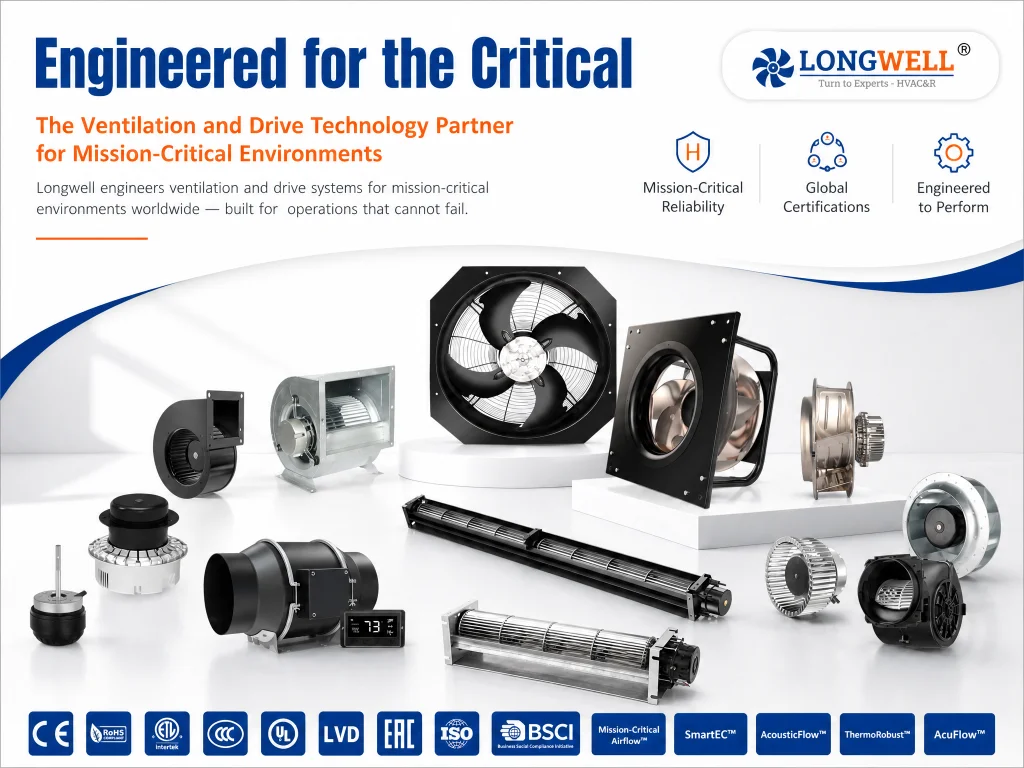
LONGWELL is a professional fan manufacturer and airflow solution provider, providing various fan types including axial fans, centrifugal fans, cross flow fans, industrial fans, and corresponding motors. Commercial and industrial fans spend roughly 70% of their operating hours in the 30-70% load range. EC fans maintain 80%+ efficiency at 50% part-load.
LONGWELL EC motors deliver efficiency up to 90%, corresponding to IE4/IE5 efficiency levels — the same class the EU is now mandating for large motors.
Since 1990, LONGWELL has engineered high-efficiency air-movement solutions from a 40,000+ m² manufacturing facility, exporting to 30+ countries for HVAC, energy storage, and OEM appliance customers — including Fortune 500 brands. EC technology is the core of our product strategy.
| Product Family | Key Efficiency Features |
| EC Plug Fans | High-pressure EC control, ErP-ready; drop-in replacement for legacy plug/plenum fans |
| EC Axial Fans | 100% speed-adjustable, IP54/IP55 options, compact high-airflow designs |
| EC Centrifugal Fans | Backward-curved (non-overloading, dust-resistant) and forward-curved (low noise, compact scroll) |
| EC Cross Flow Fans | Uniform airflow, low noise, compact — HVAC and appliances |
| EC Fan Coil Units | EC-driven, silent comfort, slim profile |
| Industrial Centrifugal Blowers | High static pressure for demanding process duty |
| Explosion-proof Fans | ATEX/IECEx certified, spark-resistant, hazardous areas |
| Support | What You Get |
| OEM/ODM customization | Custom voltage, connectors/cables, brackets, scroll housings, impeller aero optimization, labels |
| European brand replacement | Drop-in cross-references for ebm-papst / Ziehl-Abegg — matching mounting, electrical interface, and curves |
| Engineering selection | Airflow vs. static-pressure calculation and best-configuration recommendation |
| Technical documentation | 3D CAD STEP/IGES files; full product catalogs |
| Fast response | Proposal & quote within 1 business day; samples 1–3 days; custom samples 7–14 days; volume 15–30 days |
| Warranty | 12-month warranty with responsive after-sales service |
FAQs
What does IE mean?
IE stands for International Efficiency. It is the efficiency classification system used to indicate how effectively an electric motor converts electrical input power into mechanical output power.
What’s the most efficient IE class?
IE5 is currently the highest IE efficiency class defined by the IEC classification system.
Can an IE2 motors still be used in modern applications?
IE motors are still used in some applications, but they are often paired with a frequency drive.
Do IE4 and IE5 motors require a VFD?
Not necessarily. An IE4 or IE5 motor does not automatically require a variable frequency drive (VFD). Whether a VFD is needed depends on the application and the motor’s design.
What is the difference between IE and EFF classes?
EFF (EFF1, EFF2, EFF3) was the older European efficiency classification system that preceded the IE standard.