Meeting Hazardous Zone Ventilation Requirements
We recently received a request for an explosion proof portable fan. A shipyard customer needed continuous ventilation for chemical environments. First, they required a unit to handle volatile gases safely. Next, they specified a dual-frequency 220V 50/60Hz power supply.
So, the system had to adapt easily to different regional power grids. The physical limits were extremely strict. Space aboard ships is heavily restricted. Consequently, the entire unit had to fit within a 511 mm height.
Furthermore, the maximum duct length was capped at 370 mm. Therefore, we had to work within a very tight structural envelope. The intake diameter needed to be exactly 470 mm. This matched their existing flexible ducting hookups.
Meanwhile, aerodynamic demands remained high. The client required an airflow of 5860 to 6840 m³/h. In addition, it had to overcome a massive static pressure of 750 to 800 Pa. Finally, safety certifications dictated every design choice.
The project required compliance with Class I, Division 1 and Class II, Division B standards. Specifically, it covered explosive gas environments from temperature groups T1 to T4. As a result, the explosion proof portable fan needed a confirmed ExdIIBT4 marking. Therefore, standard commercial motors were rejected.
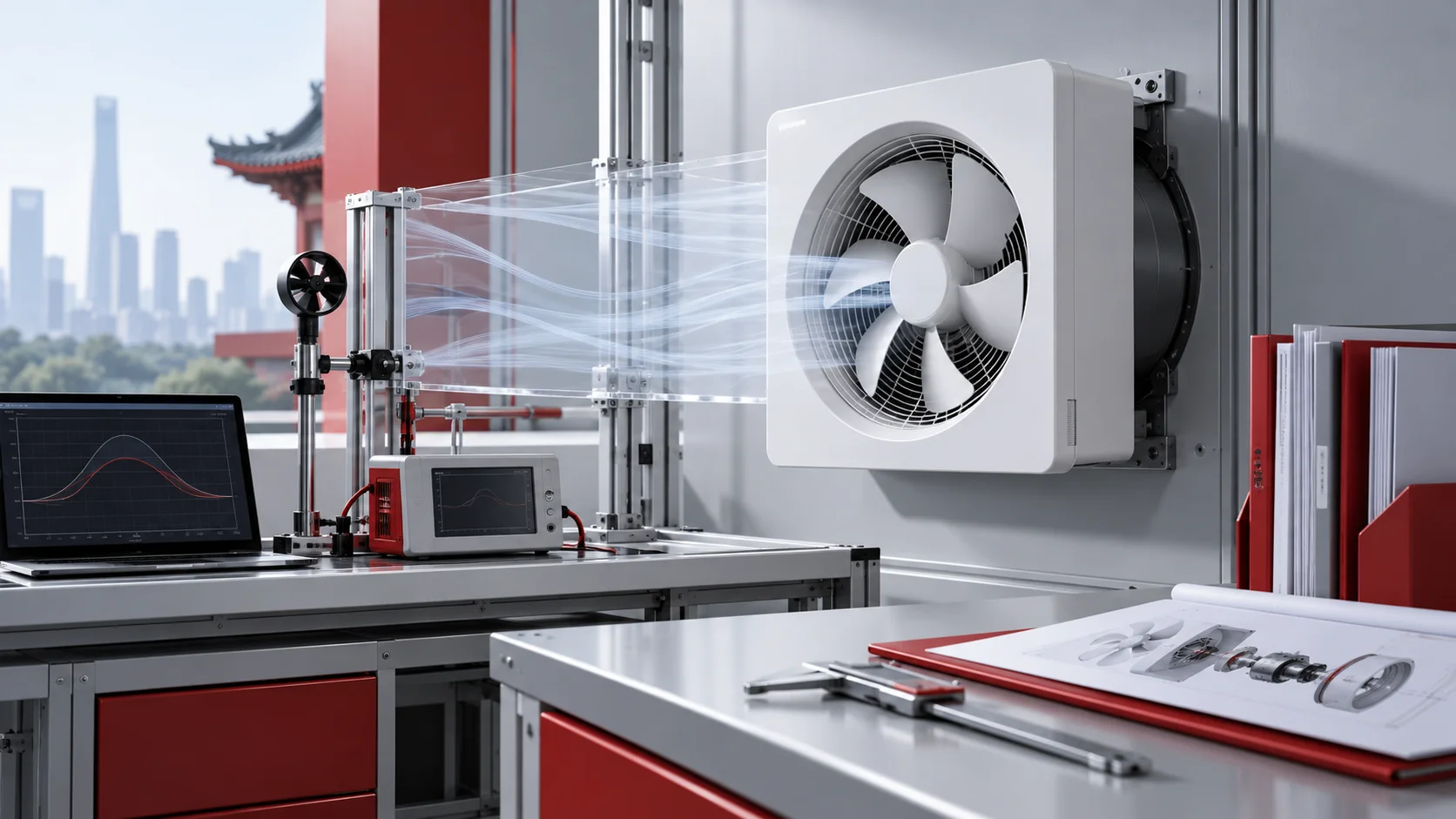
Instead, testing to AMCA 210-16 methods became mandatory. This verified the high pressure delivery at 2800 RPM.
Selecting the Right Aerodynamic Profile
When designing for hazardous zones, standard axial fans fail compliance. First, we considered using a large 500 mm impeller. We could run it at a lower speed to hit the required airflow. However, we rejected this option.
The customer’s 511 mm total height limit made a 500 mm blade impossible. Consequently, we chose a smaller 390 mm impeller diameter. This allowed the explosion proof portable fan to fit the required enclosure easily. A larger blade would have required a complete structural redesign of the surrounding ventilation shaft.
Trade-Offs in an Explosion Proof Portable Fan
Achieving 800 Pa of static pressure with a 390 mm blade requires high speed. Therefore, we selected a motor capable of 2800 RPM. This choice came with notable trade-offs. First, it requires high power consumption.
By forcing high air volume through a 406 mm internal duct, the aerodynamic resistance spikes. So, we had to use a heavy 900W motor to overcome this drag. Next, the acoustic output increases. High tip speeds shear the air violently.
Running a fan at 2800 RPM generates considerably more noise than a low-speed model. The operators must wear ear protection when working nearby. Even so, prioritizing static pressure was non-negotiable. The explosion proof portable fan must push air through long lengths of heavy flexible ducting.
Motor Safety and Cost Implications
Furthermore, the ExdIIBT4 marking dictated our structural choices. Explosive atmospheres demand spark-free environments. We could not use our proprietary ThermoFlex or SmartEC platforms. Instead, those designs lack the heavy cast iron enclosures needed to contain an internal blast safely.
Consequently, we integrated a specialized explosion-proof induction motor. This decision resulted in a materially lower cost compared to fully custom ATEX ECM designs. However, it added substantial weight to the final assembly. Ultimately, the finalized LWA-400S(T)M-05E model solves the problem.
It delivers 6840 m³/h at 220V. In short, it maintains the strict 370 mm duct length while ensuring safe operation.
Technical Specifications
| Parameter | Specification |
|---|---|
| Model | LWA-400S(T)M-05E |
| Impeller Diameter | 390 mm |
| Air Volume | 5860 – 6840 m³/h |
| Static Pressure | 750 – 800 Pa |
| Speed | 2800 ±10% RPM |
| Frequency | 50/60 Hz |
| Input Power | 900 W (0.9 kW) |
| Voltage | 220 / 380 VAC |
| Air Inlet (A) | 470 mm |
| Duct Length (B) | 370 mm |
| Total Height (H) | 511 mm |
| Air Outlet | 434 mm |
| Duct Inner Diameter | 406 mm |
| Explosion-Proof Marking | ExdIIBT4 |
The static pressure and duct inner diameter rows dictate the ventilation system’s ability to maintain airflow. Specifically, the 800 Pa capacity ensures high performance. Even when operators attach long sections of flexible ducting, the explosion proof portable fan still pushes fumes effectively. Therefore, the 406 mm inner ring handles the high velocity air without stalling. This prevents dangerous gas accumulation in confined work areas.
Reference: AMCA 210 covers the test method behind these figures.
Technical Documentation
longwell-lwa-400s-technical-doc-01.pdf
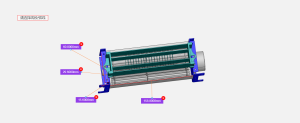
This engineering drawing provides the exact dimensional layout required by system integrators to ensure physical fit. First, it highlights the 370 mm depth constraint. Next, it details the heavy-duty mounting brackets required for stable operation.

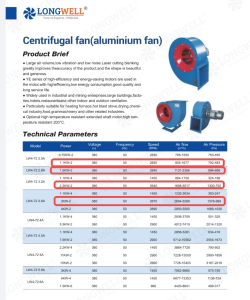
The datasheet outlines the operational scope and hazardous classification limits that site safety managers need to verify. It confirms the 6840 m³/h capacity and electrical ratings across different regional grid standards.
Specifying Fans for Hazardous Zones
If you are evaluating a hazardous area ventilator for a demanding site, keep these factors in focus. First, you must prevent costly delays during deployment. Safety violations shut down projects immediately.
- Identify the exact hazard class first: Always confirm your environment rules. You must know if the site needs Class I or Class II compliance before looking at airflow. Selecting a fan without confirming the ExdIIBT4 requirement guarantees a rejection from safety teams.
- Measure total system resistance: High airflow ratings mean nothing if the explosion proof portable fan cannot push through ductwork. Therefore, calculate the resistance of your longest planned hose run. Next, specify your static pressure target based on that friction. Ignoring this step often results in stalled fans and hazardous fume buildup.
- Check the physical footprint: Portable units often operate in cramped maintenance tunnels. Consequently, verifying maximum height and duct length constraints early prevents clearance issues later.
- Specify dual-frequency needs upfront: If your equipment moves between geographic regions, state a 50/60Hz requirement immediately. This ensures the manufacturer selects the correct winding configuration. At Longwell, our local TUV NORD Notified Body relationship shortens the certification time for these adaptations considerably.
Related: Commercial Fan & Blower.
Frequently Asked Questions
Technical Documentation & Resources
Browse our axial fans range, the AC axial fans section, or EC axial fans.
Have a Similar Fan Requirement?
Longwell’s engineering team delivers custom spec sheets and samples within 90 days. Since 1990, we have supplied EC fans and blowers to OEMs across HVAC, cold chain, data center, and industrial applications worldwide.
Browse Related Products:
🏆 ISO 9001 / ISO 14001 / ISO 45001 | CE (TÜV) | UL/ETL | ATEX Zone 21/22 | AMCA 210-16 / ISO 5801 tested