Two duty points and one certification
A North American HVAC OEM came to us with two duty points rather than one. The larger EC centrifugal fan had to deliver 979 m3/h at 484 Pa. Meanwhile the smaller one needed 433 m3/h at 263 Pa.
Both were destined for a new product family. Consequently the OEM wanted them from one supplier on one motor platform. That preference shaped the project just as much as the airflow figures did.
The hard constraints were these.
- 230 VAC across a wide 176 to 264V window, at either 50 or 60Hz.
- Speed control from the system controller by 0-10VDC or PWM, with no exceptions.
- A housing no wider than 270mm and no taller than 223mm on the larger unit.
- A 180 by 172mm envelope on the smaller one, since space was tight there too.
- An ETL Listed mark on the higher-performance model, covering UL 507 and CSA C22.2 #113.
- Reliable running from -25C to +60C, since the end product ships into very different climates.
That ETL requirement is the one that decides suppliers. Without an existing file, a fan maker adds six to nine months to the launch. In practice, no OEM absorbs that willingly.
Selecting the EC centrifugal fan pair
Two decisions came first. Firstly the impeller type, then the drive technology. Neither took long, though both are worth explaining.
Why forward-curved suits these duty points
A forward-curved impeller moves a lot of air from a compact scroll at low to moderate pressure. That describes both duty points here precisely. A backward-curved wheel is the better choice at higher pressure. However, at 263 and 484 Pa it would be oversized, and it would run off its best efficiency point.
Why EC rather than AC
Here the customer needed 0-10V or PWM control. Basically, an AC motor cannot take either on its own. Adding a VFD would solve it, yet it also adds cost, cabinet space, wiring and one more component to fail. An integrated EC centrifugal fan, by contrast, avoids all four. Furthermore, our SmartEC controller reads the customer signal directly, so the electrical interface is genuinely plug and play.
The two models that matched
Two fans in the LWFE series fitted without modification. The LWFE3G120-072DS-01 covers the 433 m3/h point, while the LWFE3G133-072DS-02 covers 979 m3/h. Impellers are galvanized sheet steel, since these units usually see damp air.
Both models already run from -25C to +60C, part of the ThermoFlex approach we apply wherever ambient swings widely. Most importantly, the LWFE3G133-072DS-02 already held a complete ETL certification file. That removed the single largest schedule risk from the customer’s North American launch.
Technical Specifications
Both fans below are approved production specifications. However, the IP rating differs between them, and the reason for that is covered in the questions at the end.
| Parameter | Value |
|---|---|
| Nominal Voltage | 230 VAC (176-264 V Range) |
| Frequency | 50/60 Hz |
| Max Airflow | 979 m³/h / 576 CFM |
| Max Static Pressure | 484 Pa |
| Speed | 1450 RPM |
| Input Power | 120 W |
| Current | 0.95 A |
| Noise Level | 70 dB(A) |
| Operating Temperature | -25°C to +60°C |
| Protection Class | IP54 |
| Insulation Class | Class F |
| Certifications | CE, ETL (UL 507, CSA C22.2#113) |
| Parameter | Value |
|---|---|
| Nominal Voltage | 230 VAC (176-264 V Range) |
| Frequency | 50/60 Hz |
| Max Airflow | 433 m³/h / 255 CFM |
| Max Static Pressure | 263 Pa |
| Speed | 1900 RPM |
| Input Power | 70 W |
| Current | 0.55 A |
| Noise Level | 59 dB(A) |
| Operating Temperature | -25°C to +60°C |
| Protection Class | IP44 |
| Insulation Class | Class F |
| Certifications | CE |
Technical Documentation
Complete engineering documentation was provided to the customer for integration and approval. These files include dimensional drawings, performance curves, and electrical connection details.

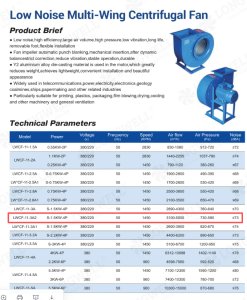
The LWFE3G133-072DS-02 EC centrifugal fan, capable of 484 Pa static pressure.

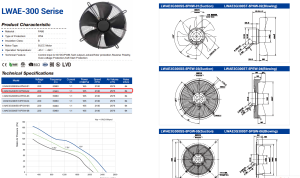
Meanwhile the LWFE3G120-072DS-01, the compact variant for the OEM’s product line.
System integrators require this document for full performance data, including P-Q curves and electrical specifications.
Mechanical engineers use this PDF drawing to confirm mounting points and fit within the final product assembly.
The datasheet provides the complete performance specification for the smaller fan variant.
Here the drawing details the compact footprint and mechanical interface for the LWFE3G120 model.
Why the OEM consolidated on one supplier
Here the OEM weighed us against European and domestic suppliers. In the end, four things settled it.
- The ETL file already existed. It cut six to nine months and the associated cost out of the program. For new certifications, our working relationship with a China-local TUV NORD notified body shortens CE and ATEX timelines substantially.
- One supplier for the whole air-moving subsystem. Both fans share the SmartEC platform and one engineering contact. As a result, a surprising amount of internal coordination disappears from the customer side.
- European-level engineering at a lower price. Performance, control and reliability match the top European brands, yet the price point is materially lower. That difference goes straight to the OEM margin.
- Curves that hold up in the system. Every performance curve comes from testing to AMCA 210/211 and ISO 5801 methods, so the OEM’s engineers avoid a round of design iterations they would otherwise budget for.
Browse our centrifugal fan range, or the EC forward-curved series where this EC centrifugal fan sits. ETL listings can be checked in the Intertek directory.
Questions OEMs ask about these fans
Does the ETL mark cover both the USA and Canada?
Yes. An ETL Listed Mark from Intertek means a nationally recognized testing laboratory checked the product against UL 507 for the USA and CSA C22.2 #113 for Canada. Your finished equipment therefore needs no separate certification for the EC centrifugal fan in either market.
Can these fans run on RS485 Modbus instead of 0-10V?
The standard LWFE3G120 and LWFE3G133 are configured for 0-10VDC and PWM. However, the SmartEC platform underneath does support Modbus RTU, so a Modbus variant can be built through our 90-day NPI process at qualifying volumes.
The datasheet quotes 40,000 hours at 40C. What happens at 60C?
Bearing life falls as temperature rises. Consequently, running continuously at the 60C limit will not reach 40,000 hours. Where the number matters, send us your duty cycle and ambient profile. We will then calculate an MTBF for your case rather than the datasheet case.
Why is the larger fan IP54 and the smaller one IP44?
IP54 adds meaningful dust protection over IP44. The 133mm platform goes into dustier HVAC work, so it was built that way deliberately. Otherwise IP44 is adequate for general ventilation, protecting against solids above 1mm and splashing water from any direction.
Technical Documentation & Resources
- View the LWFE3G133-072DS-02 specification sheet (DOCX)
- Open the LWFE3G133-072DS-02 technical drawing (PDF)
- View the LWFE3G133-072DS-02 technical drawing 2 (PDF)
- Get the LWFE3G133-072DS-02 technical drawing 3 (PDF)
- Get the LWFE3G133-072DS-02 specification sheet (PDF)
- Open the LWFE3G133-072DS-02 specification sheet 2 (DOCX)
Need the same thing for your own unit?
Give us the numbers and the envelope, and you get a shortlist rather than a catalog. Meanwhile custom spec sheets and samples run to 90 days. Since 1990 Longwell has supplied EC fans and blowers to OEMs in HVAC, cold chain, data center and industrial markets.
Browse Related Products:
🏆 ISO 9001 / ISO 14001 / ISO 45001 | CE (TÜV) | UL/ETL | ATEX Zone 21/22 | AMCA 210/211 / ISO 5801 tested
Choose the right centrifugal fan
Longwell manufactures 1,130 centrifugal fans in-house. Send airflow, static pressure and voltage — an engineer replies with a matching model, performance curve and price within one working day.