In today’s fast developing pace, efficiency is paramount in every industry. As global demand for energy-efficient buildings continues to rise, HVAC manufacturers and facility operates are under increasing pressure to reduce power consumption while improving airflow performance. Traditional fans may not be enough for modern ventilation systems that require intelligent control, quiet operation, and lower operating costs.
This is where EC fans are transforming the HVAC industry. EC (Electronically Commutated) fans combine the efficiency of DC motors with the convenience of AC power input, delivering a smarter and more sustainable airflow solution for commercial, industrial, and residential HVAC systems.
In this guide, we’ll explore how EC fans are shaping the future of HVAC ventilation and why they have become the preferred choice for next-generation air movement systems.
What is EC Fan Technology?
The concept of EC fan technology dates back to the 1960s, and today, EC technology continues to evolve and play a critical role in modern engineering and HVAC ventilation systems.
When people refer to “EC fan technology,” they are actually talking about fans powered by EC motors (Electronically Commutated motors). Unlike traditional AC fans that rely on mechanical commutation and carbon brushes, EC fans use intelligent electronic commutation to control motor rotation more efficiently.
An EC fan includes four core components: permanent magnet motor, integrated PCB control system, variable speed functionality, and aerodynamically optimized fan blades. This advanced technology allows EC fans to deliver higher energy efficiency, precise speed control, lower noise levels, and longer operational lifespan.
So, how do EC fans work? Read on for more information.
How Do EC Fans Work?
EC fan technology works by replacing traditional mechanical commutation with intelligent electronic control.
Instead of using carbon brushes, an EC (Electronically Commutated) motor first converts AC power into DC through an integrated control module. This allows the fan to operate with a fully brushless design, improving efficiency and reliability.
Inside the motor, a permanent magnet rotor interacts with a stator containing electromagnetic windings. When the system is powered, an electronic controller precisely energizes the stator coils in a controlled sequence. This generates a rotating magnetic field that causes the rotor to spin smoothly.
At the same time, sensors (or sensorless feedback algorithms) continuously monitor the rotor’s position. The controller uses this real-time data to adjust the timing and intensity of coil energization, ensuring optimal synchronization and stable operation.
In essence, EC fans are brushless DC (BLDC) motors with an integrated electronic control board, enabling highly efficient airflow, electromagnetic interaction between stator and rotor, and intelligent real-time control within a single compact system.
Why EC Fans Are Gradually Replacing Traditional AC Fans in Modern HVAC Systems?
Before understanding why EC fans are gradually replacing traditional AC fans in HVAC systems, it’s important to understand the role of HVAC systems.
HVAC stands for Heating, Ventilation, and Air Conditioning. An HVAC system is a technology used in residential, commercial, and industrial environments to regulate indoor temperature, air quality, humidity, and airflow. These systems are widely applied in homes, office buildings, data centers, hospitals, factories, and various industrial facilities to maintain comfortable, safe, and controlled indoor environments.
With the wide spreads of HVAC systems in modern days, EC (Electronically Commutated) fans are rapidly becoming the preferred choice in modern HVAC ventilation systems due to their superior energy efficiency, intelligent control capabilities, and compliance with global energy regulations. Compared to traditional AC fans, EC fans offer a more advanced and sustainable solution for today’s energy-conscious building environments.
As global energy efficiency standards continue to tighten and sustainability becomes a key priority in building design, EC fans are increasingly replacing traditional AC fans across commercial, industrial, and residential HVAC systems.
Main Advantages of EC Fans
- High Energy Efficiency: EC motors deliver significantly higher efficiency levels compared to AC motors. By adjusting speed based on demand, they reduce unnecessary energy usage and improve overall system efficiency.
- Intelligent Speed Control: EC fans support variable speed operation through electronic control systems, allowing precise airflow regulation for different HVAC conditions.
- Plug-and-Play Replacement: EC fans are designed for easy integration into existing HVAC systems. Their plug-and-play compatibility makes upgrading from traditional AC fans simple, reducing installation complexity and downtime.
- Lower Operating Costs: Although the initial investment may be higher, EC fans greatly reduce long-term operating expenses through lower power consumption. This is especially beneficial for continuously operating systems such as data centers, commercial buildings, and industrial ventilation equipment.
- Quiet Operation: Brushless motor design and optimized aerodynamics reduce vibration and noise, making EC fans ideal for noise-sensitive HVAC environments.
- Longer Service Life: With no carbon brushes or mechanical commutation, EC fans experience less wear and require minimal maintenance.
EC Fans vs. Traditional Fans Comparison Chart
| Features | EC Fans | Traditional Fans |
| Motor Technology | Electronically Commutated (EC) motor | AC induction motor |
| Energy Efficiency | Very high efficiency with lower energy consumption | Lower efficiency with higher power loss |
| Speed Control | Intelligent variable-speed control | Usually fixed speed or limited control |
| Operating Costs | Lower long-term electricity costs | Higher energy and operating costs |
| Noise Level | Quiet operation with reduced vibration | Higher noise and vibration levels |
| Maintenance Requirements | Minimal maintenance | More maintenance due to mechanical wear |
| HVAC System Compatibility | Excellent for modern smart HVAC systems | Suitable for traditional HVAC systems |
| Best Applications | Data centers, commercial HVAC, cleanrooms, smart ventilation | Basic ventilation and conventional HVAC systems |
EC Fans in HVAC Ventilation
EC fans are now commonly applied in a wide range of HVAC ventilation applications, including:
- Air Handling Units (AHUs): EC plug fans are widely used in Air Handling Units because they provide highly efficient and controllable airflow performance.
- Commercial Ventilation Systems: In commercial buildings such as offices, shopping malls, hotels, and hospitals, EC fans are widely used in ventilation systems to improve indoor air quality and energy performance.
- Exhaust Ventilation Systems: Exhaust ventilation systems are designed to remove stale air, heat, humidity, smoke, dust, and airborne contaminants from indoor environments. EC fans play a critical role in these systems by delivering efficient and stable exhaust airflow while minimizing energy consumption.
- Residential HVAC Systems: Modern residential HVAC systems increasingly adopt EC fan technology to improve home comfort and reduce electricity consumption.
Market Requirements for Energy Usage
In both the consumer appliance and HVAC industries, global regulations are increasingly focused on energy efficiency and environmental sustainability. These standards are driving manufacturers to adopt high-efficiency technologies such as EC fans. Take the United States Market Regulation and European Union Energy Standards as an example.
Two major examples of these energy-efficiency regulations are the United States market regulations and the European Union energy standards.
United States Market Regulations
In the United States, the Department of Energy (DOE) enforces minimum energy efficiency standards established under the National Appliance Energy Conservation Act. In addition, the ENERGY STAR program, managed by the Environmental Protection Agency (EPA), sets voluntary but stricter efficiency benchmarks for energy-saving products.
Some energy conservation standards have been established so far, while others are in process. Examples of some of these standards are as follows:
• Commercial and industrial fans and blowers – 81 FR 75742 (November 1, 2016 – proposed rule)
• Residential mechanical ventilation system fans – 82 FR 2857 (January 10, 2017)
European Union Energy Standards
The European Union has established some of the world’s strictest energy-efficiency regulations to reduce electricity consumption, lower carbon emissions, and promote sustainable product design across HVAC and ventilation industries.
Two key eco-design directives form the foundation of these regulations:
- Directive 2005/32/EC for Energy-Using Products (EuP)
- Directive 2009/125/EC for Energy-Related Products (ErP)
As the European Union continues strengthening its environmental policies, the ErP 2026 (Regulation EU 2024/1834) introduces stricter EU ecodesign rules for fans on July 24, 2026, replacing the 2015 standards. The updated regulation applies to fans with input power ratings ranging from 125 W to 500 kW and establishes substantially higher minimum energy-efficiency requirements across multiple fan categories. For certain centrifugal fan designs, the required minimum total efficiency can reach up to 64%, pushing manufacturers toward more advanced and energy-efficient motor technologies.
LONGWELL EC Fan Technology: Reliable Global HVACR Ventilation Solution
Longwell EC technology is a high-efficiency intelligent fan solution based on Electronically Commutated (EC) motors. It integrates advanced motor design, aerodynamic optimization, and intelligent control technology, and is widely used in HVACR systems and industrial ventilation applications.
- High-Efficiency EC Motor Technology: Combines the stability of AC power with the high efficiency of DC motors, achieving a measured efficiency of up to 92%. Compared with traditional AC fans, it achieves about 30% energy savings.
- Aerodynamic Optimization Design: Uses ANSYS Fluent for full 3D flow field analysis. Unequal blade spacing + blade tip chamfer design reduces tonal noise frequency.
- Intelligent Control System: Supports real-time performance monitoring, temperature detection, and fault diagnosis. It can be seamlessly integrated with Building Management Systems (BMS) for remote centralized control. Moreover, LONGWELL provides multiple control interfaces such as 0–10V, PWM, and RS485, enabling precise airflow adjustment for different application scenarios.
- High Quality Materials: Offers impellers made from metal, plastic, and aluminum alloy to suit demanding environments such as high temperature and corrosion conditions.
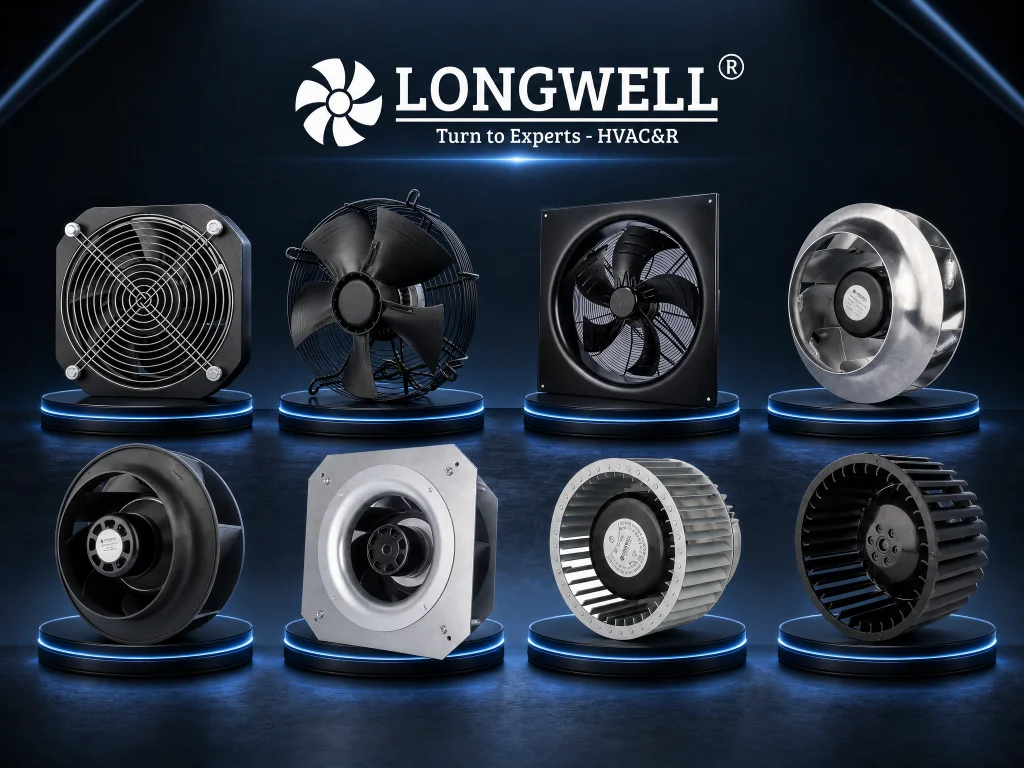
With 30 years of technological expertise and an annual production capacity of 1 million units, Longwell has become a trusted provider of intelligent HVACR power solutions for Fortune 500 companies and customers in more than 30 countries worldwide.
The Future of HVAC Belongs to EC Fan Technology
The HVAC industry is undergoing a major transformation driven by energy efficiency regulations, smart building systems, and the global push for sustainability. At the center of this shift is EC (Electronically Commutated) fan technology, which is rapidly becoming the new standard for modern HVAC ventilation systems.
As smart buildings, IoT integration, and sustainability goals continue to evolve, EC fan technology will play a central role in shaping the future of HVAC systems.
Future HVAC systems will increasingly rely on EC fans to deliver:
- Intelligent airflow management
- Real-time system optimization
- Lower environmental impact
- Higher energy efficiency performance