An HVAC fan does not become smart simply because an EC motor is connected to a network. The useful questions are more demanding: which functions stay local, which data leave the equipment, who can issue a command, and what happens when a layer becomes unavailable?
That turns “EC + IoT” from a label into a system-engineering discipline. Airflow hardware, motor electronics, controls, sensors, communications and software must work together without confusing connectivity with performance, security or intelligence.
Start with a layered HVAC fan architecture
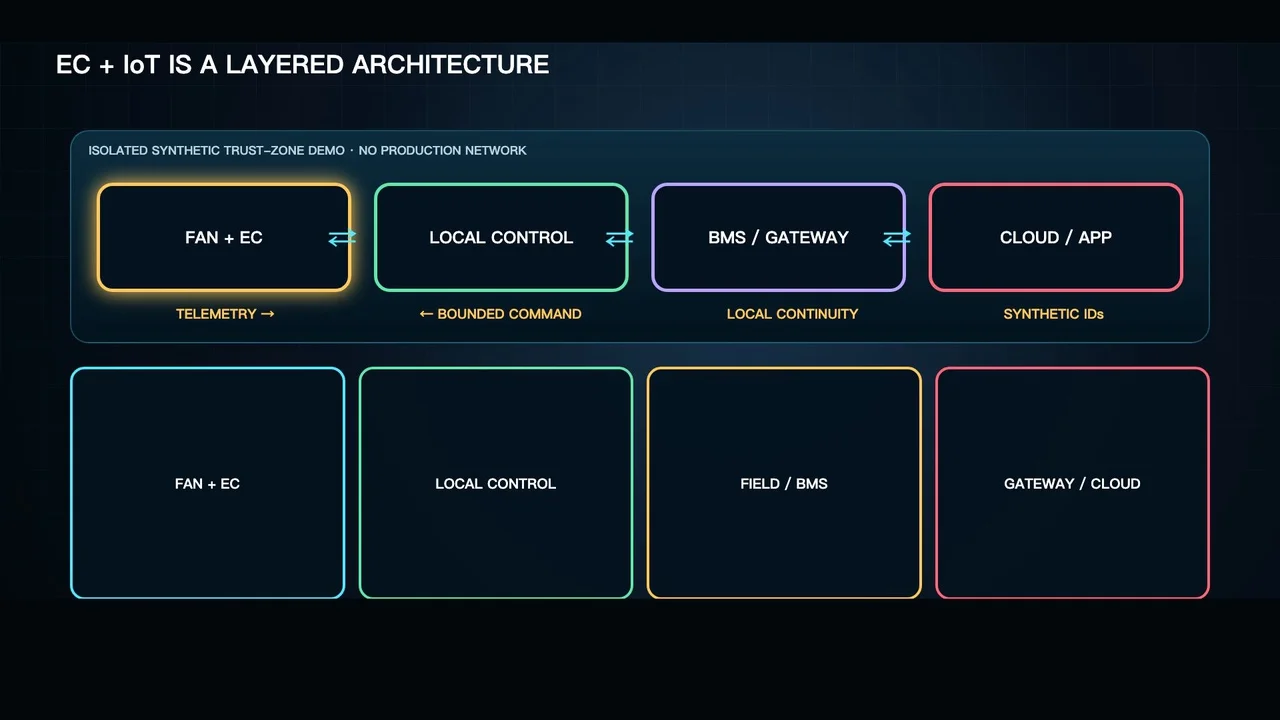
Draw the system as distinct layers: fan and aerodynamic hardware, EC motor electronics, local control and safety, sensors, the field network, a building management system (BMS) or gateway, remote services, cloud analytics and user applications. Each layer has its own authority, trust boundary and failure modes. A dashboard may display fan information, but it is not the fan control itself.
Show what crosses every boundary. Telemetry reports measurements and state; configuration changes approved parameters; a bounded command requests an operational action. Separating those paths helps locate validation, access control, fallback behavior and logging. For broader application context, see EC fans in HVAC ventilation.
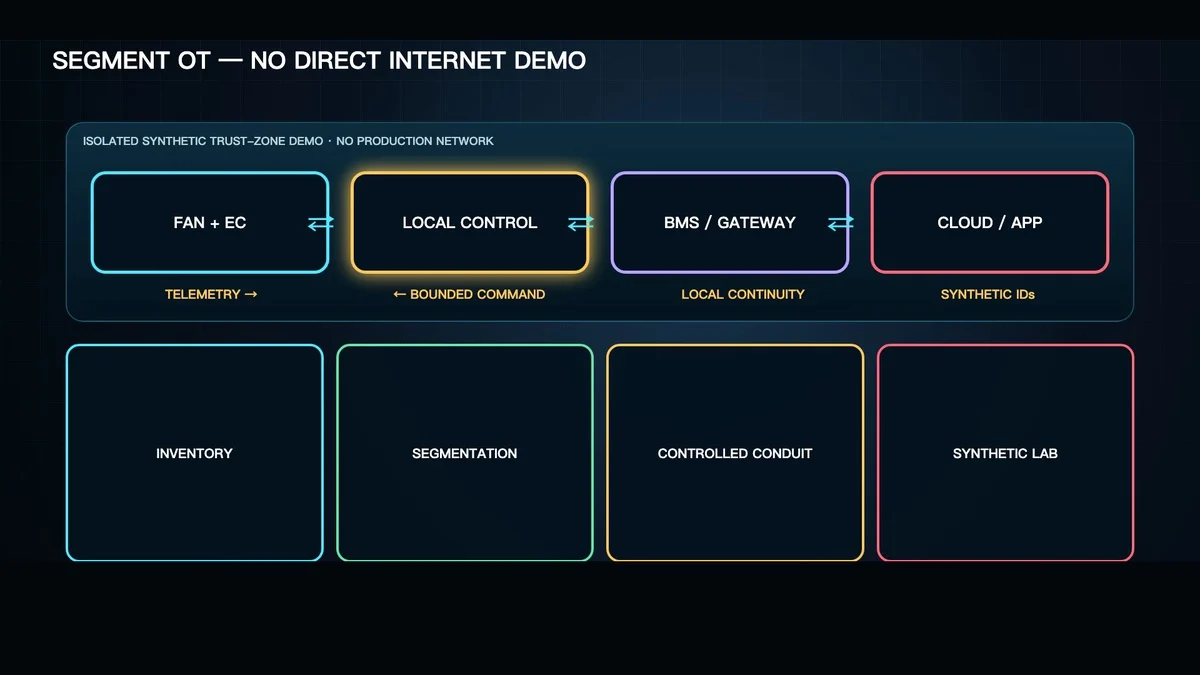
The architecture view keeps local control, the operational network, the gateway and cloud boundary visibly separate.
Define “smart” as testable fan functions
“Smart” should describe capabilities that can be inspected and tested. Depending on the product and project, they may include variable speed, closed-loop pressure or airflow control, operating feedback, alarms, trends, scheduling, diagnostics, optimization or fleet views. These are separate functions, not a package that connectivity automatically delivers.
For each claimed function, identify the sensor, decision-making layer, permitted authority and behavior when an input is invalid or stale. Then set an acceptance test. A communication port alone does not prove airflow, efficiency, indoor-air quality, reliability, predictive maintenance or secure operation. Each outcome needs its own evidence.
Keep essential control local during an outage
Applications requiring continuity cannot assume that a network, BMS, gateway or cloud service will always respond. The fan and local controller need documented autonomous or degraded behavior for each relevant loss, including limits, alarms, recovery rules and a controlled return to automatic operation.
There is no universal fail-safe setpoint. A fallback suitable for one ventilation, cooling or pressure-control duty may be wrong for another. Sensor failure, delayed communications, loss of a supervisory controller and power restoration are also different events. Commissioning should test them against the project’s required service, approved sequence and equipment limits rather than calling them all “offline.”
Give remote commands narrow, auditable authority
A remote command can change speed, pressure, ventilation or cooling, so authentication is only the beginning. Apply role authorization, least privilege, command validation, range and rate limits, local interlocks, timeouts and a clear priority model. Records should identify who requested a change, what changed, where it was applied and whether it succeeded.
Remote control must not bypass physical safety. Software “Off” or a zero-speed request does not isolate mains power, a DC bus, stored energy, automatic restart or windmilling. Service work still requires applicable electrical isolation, lockout/tagout, discharge verification, guarding and manufacturer procedures. Cyber access control and hazardous-energy control solve different problems.
Commission interoperability and secure the lifecycle
A protocol name does not prove security or interoperability. Packets may move while systems disagree about point identity, engineering units, scaling, valid range, data quality, freshness, command priority or fault meaning. Point-to-point commissioning should verify those semantics and write authority. A security review must separately establish which protections are configured, how identities and keys are managed, and what residual risk remains.
Do not expose an embedded fan or controller directly to the public internet. Use asset inventory, network segmentation, controlled conduits, approved remote access and boundary monitoring. Manage enrollment, certificates or keys, rotation, revocation, backup and recovery. Treat updates as operational changes: verify authenticity and integrity, test compatible versions, stage deployment, retain rollback, and verify functions afterward. Procurement should also define support, vulnerability handling and secure end-of-life.
Govern telemetry and keep analytics honest
Telemetry may reveal occupancy patterns, schedules, energy use, facility topology or operational weaknesses. Define its purpose, minimum necessary collection, ownership, retention, location, access, sharing, export and deletion. Public demonstrations should use an isolated simulator with synthetic, non-routable identities—not a production customer network or its credentials.
Analytics support decisions; they do not create automatic truth. An anomaly is not a diagnosis. Detection quality depends on sensor validity, baselines, operating regime, labeled outcomes, season and maintenance state. State confidence, plan for false positives and negatives, and require appropriate human review before maintenance or safety action. Useful investigation also correlates protected, time-synchronized fan, sensor, controller, network and human-change records.
Verify energy and optimization claims at matched duty
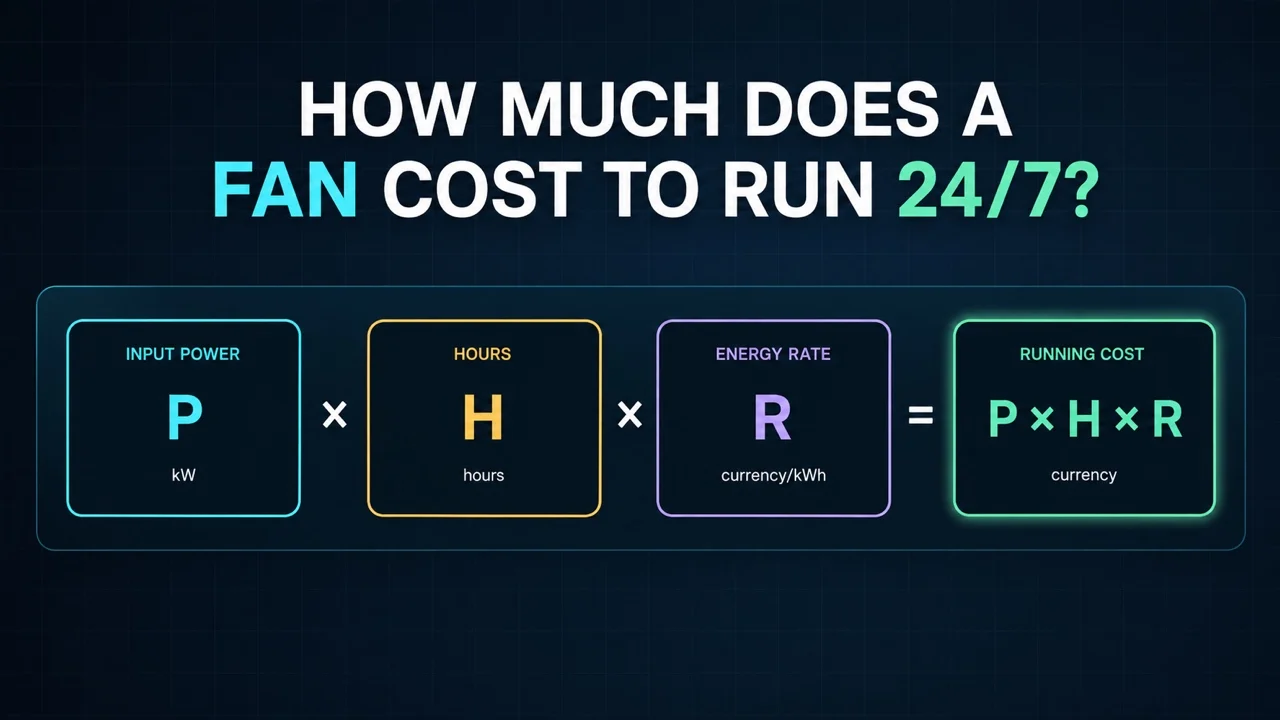
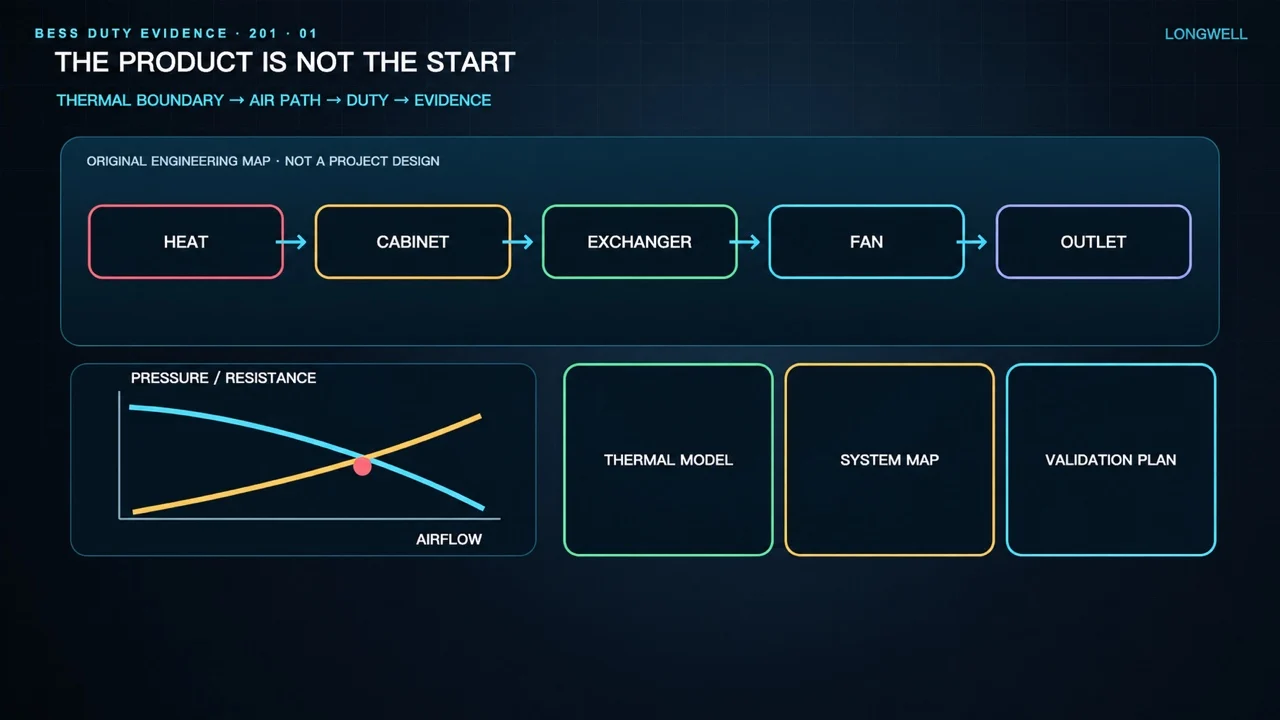
EC control and connectivity can enable modulation, scheduling and visibility, but they do not guarantee a particular saving. Compare total electrical input at the same required airflow and pressure across a representative operating profile, using a documented baseline and equivalent measurement boundaries. Otherwise, a lower power figure may simply describe a different duty.
The EC fan selection calculator can support early screening; final decisions still require current technical data for the exact model and the project’s operating point. Supervisory optimization must remain inside approved ventilation or cooling duty, stable fan range, motor and drive limits, redundancy, indoor-air-quality requirements and equipment protection. Commission baseline control first, then validate changes with abort limits and rollback.
Test failure, recovery and retirement as one system
A connected fan should be commissioned as a system, not as a collection of successful components. Tests can cover stale sensors, fan faults, loss of the BMS, gateway or cloud, network delay, credential failure, power restoration, manual override, update rollback and return to automatic operation. Where disruption would be unsafe, use an isolated test environment and formal change control.
Finally, assign responsibility for secure configuration, monitoring, incident response, software support and decommissioning. Removing an asset includes revoking its identity and handling retained data, not merely disconnecting wiring. Once requirements and evidence are in place, the EC backward-curved fan category offers a product-family browsing path; suitability, performance and compatibility still depend on verified data for the exact selection.