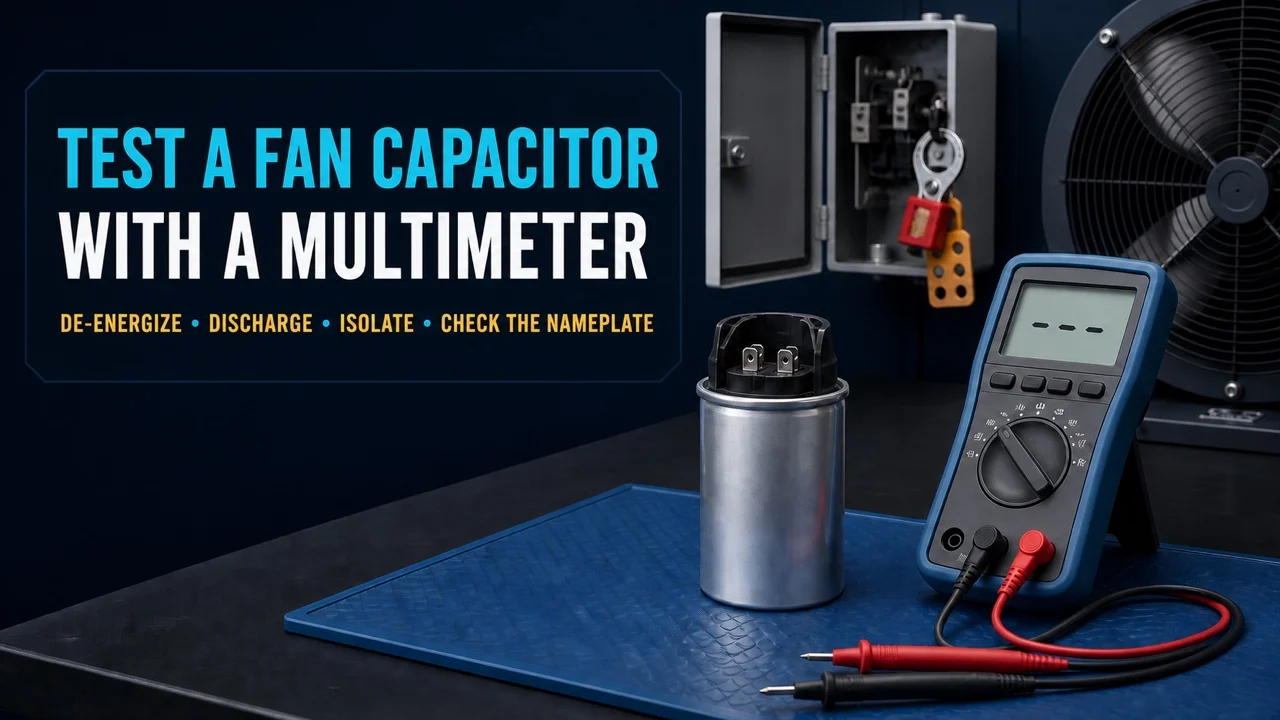
To measure a fan capacitor you need a multimeter with a capacitance range, plus a safe way to discharge the part first.
The measurement is trivial. The discharge step is what makes it safe, and it gets skipped far too often.
Isolate the supply and prove it dead. Discharge the capacitor through a resistor of about 20 kΩ, then check zero volts across the terminals. To measure a fan capacitor accurately, disconnect at least one lead, select the microfarad range and read across the terminals. Replace anything more than about six percent below its printed rating.
Safety first, and properly
- Switch off at the disconnect, not at the thermostat or a keypad.
- Lock off where site rules require it.
- Prove the circuit dead with a tester you have checked on a known source.
- Discharge the capacitor through a resistor across its terminals.
- Confirm zero volts with the meter before touching anything.
- Finally, photograph the wiring before disconnecting leads.
Never short a capacitor with a screwdriver. It welds the tip, wrecks the part and can throw molten metal.
How to measure a fan capacitor step by step
Once it is discharged, you can measure a fan capacitor in about thirty seconds.
Take off at least one lead, so the motor windings cannot skew the reading. Pick the microfarad range, touch the probes to the terminals and let the display settle. Meanwhile note the printed rating on the case, since you need it to judge the result.
Air conditioning units often use a dual capacitor with three terminals serving both the compressor and the fan. Measure between the common terminal and each of the others separately.
Reading the result
| Reading | Verdict |
|---|---|
| Within ±5% of rating | Healthy |
| 5 to 6% below rating | Marginal, monitor or replace |
| More than 6% below | Replace |
| Near zero | Open circuit, failed |
| Very high or unstable | Faulty, replace |
| Meter shows short | Failed, replace immediately |
A capacitor can also read fine when cold and fail once warm. That is why intermittent faults are so common here. So if the symptoms carry on despite a good reading, change it anyway.
Symptoms that point at the capacitor
- The motor hums and starts only when the wheel is spun by hand.
- Running speed is noticeably low.
- Current draw exceeds the nameplate figure.
- The motor runs hot and cycles on thermal protection.
- The case is bulged, leaking or discoloured.
- Finally, the fault appears on hot days and disappears on cool ones.
Our guide to fans that keep stopping covers how these symptoms overlap with other faults.
Choosing the replacement
Matching matters far more than people expect.
Capacitance has to match the original exactly, since it sets the phase shift and therefore the torque. Voltage rating may be equal or higher, never lower. Meanwhile it must be a run capacitor rather than a start capacitor, because the two are built for very different duty.
That last point catches people out on parts counters. A start capacitor looks similar and costs less, yet it is designed for a few seconds of duty rather than continuous running.
Our capacitor replacement guide covers the selection in more detail.
Why they fail
Heat and voltage stress cause nearly every capacitor failure you will meet.
A capacitor in a hot rooftop unit ages far faster than the same part in a basement. Life roughly halves for every 10 K above its rating. Meanwhile surges and steady high voltage both wear it down.
For safe working practice around capacitors, follow the appliance instructions and the electrical safety guidance in IEC standards.
Capacitor testing FAQ
Can I test a capacitor without removing it?
You need to disconnect at least one lead, otherwise the motor windings affect the reading. Leaving it fully connected gives a meaningless result.
What if my meter has no capacitance range?
A dedicated capacitor tester is inexpensive. Resistance-based checks give only a crude indication and cannot confirm the actual microfarad value.
How long do run capacitors last?
Typically five to fifteen years, heavily dependent on temperature. Hot installations sit firmly at the short end of that range.
Should I replace it with the motor anyway?
Yes. It costs very little and removes one of the most common causes of a repeat failure while everything is already apart.
Isolate, discharge, disconnect one lead, then read the microfarads. Measure a fan capacitor that way and you get a reliable answer in under a minute, although the safety steps still take longer than the test.