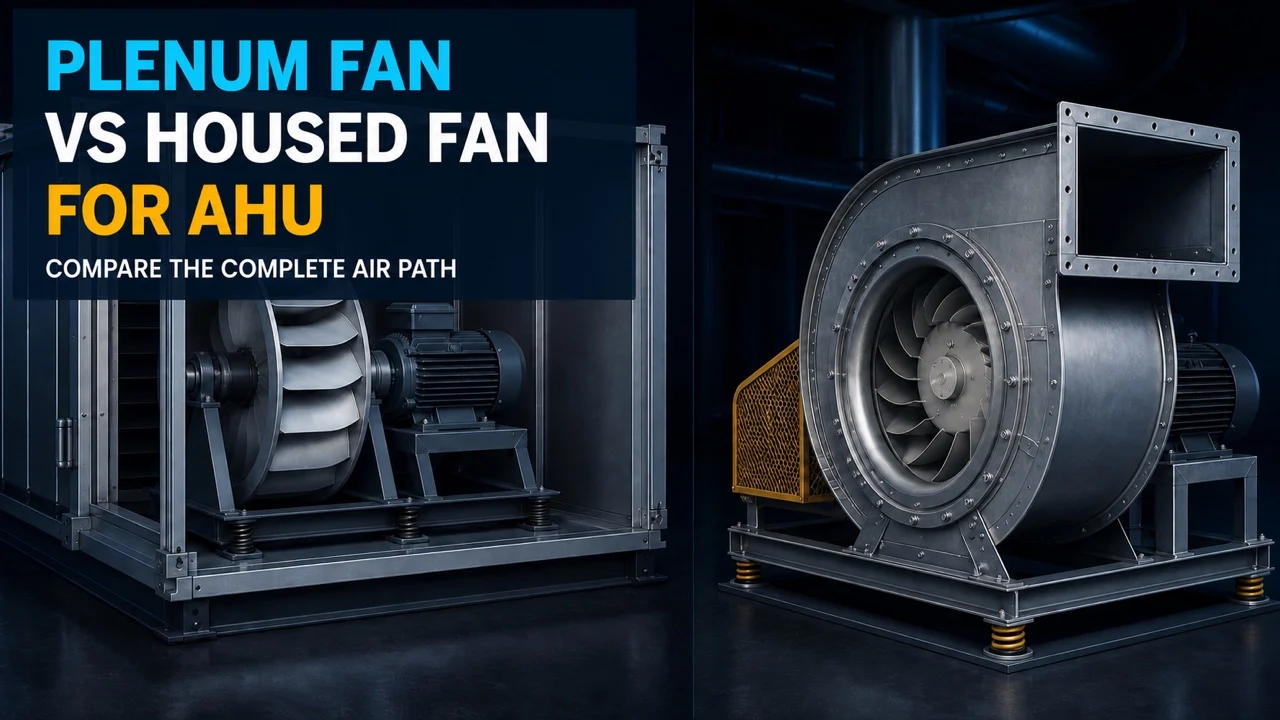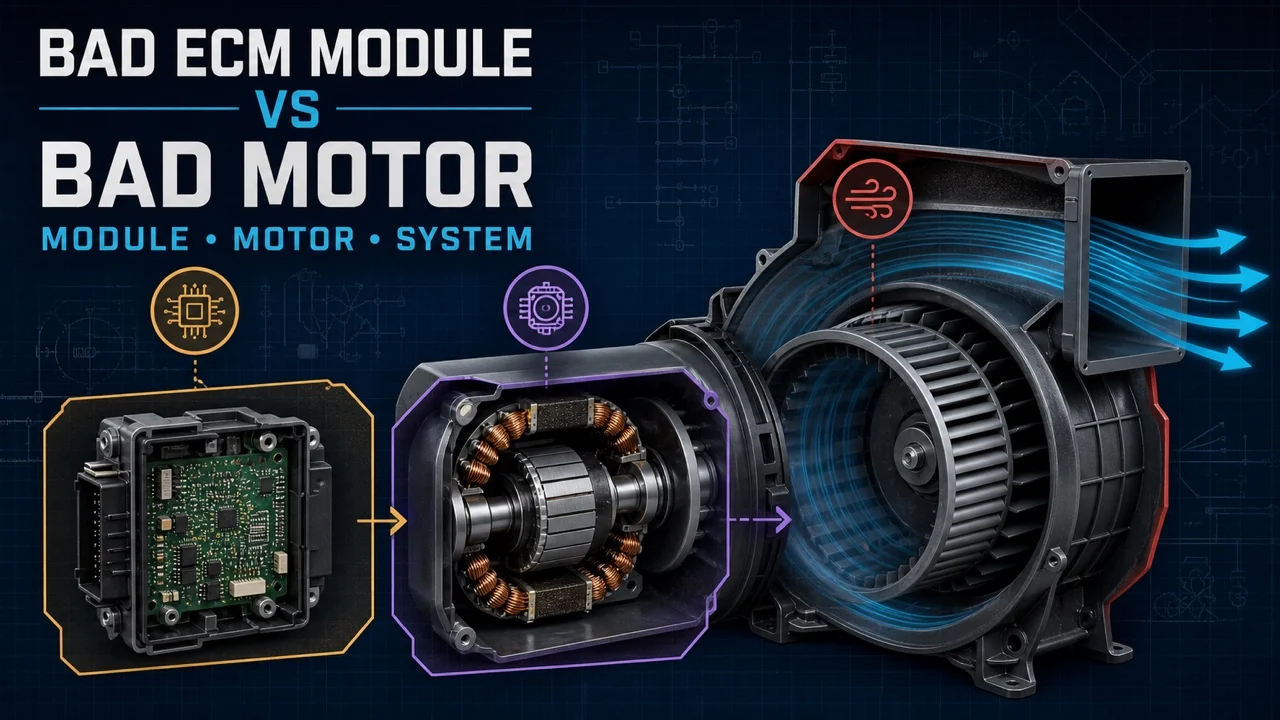
A plenum fan and a plug fan are the same thing under two names: a backward-curved wheel with no scroll around it.
It discharges into the air handling unit cabinet, and the cabinet does the job the scroll used to do, less efficiently but far more conveniently.
A housed fan recovers velocity as static pressure in its scroll, gaining roughly 5 to 10 percent. A plenum fan gives that up and saves 400 to 700 mm of cabinet length, allows discharge in any direction, and makes fan arrays possible. For air handling units below about 2,500 Pa, the plenum arrangement usually wins.
What the scroll was doing
Air leaves a backward-curved wheel at 30 to 60 m/s, which is energy worth recovering.
A scroll widens progressively so that velocity falls and part of it becomes static pressure. Remove the scroll and the air still slows, though it does so by mixing turbulently into the cabinet instead.
Consequently the recovery is less efficient. At a typical plenum fan outlet velocity of 12 m/s, the velocity pressure given up is only about 85 Pa.
What you get in return
- Cabinet length falls by 400 to 700 mm on a mid-size unit.
- Discharge direction stops mattering, so layout becomes flexible.
- Arrays become possible, since several fans share one plenum.
- Access improves, because the wheel is reachable without opening a housing.
- Direct drive removes belts and their maintenance entirely.
- Finally, the freed length often takes a deeper, lower-resistance filter.
That last point matters commercially. A deeper filter lowers system pressure permanently, which often returns more than the scroll ever did.
Comparing the ratings fairly
This is where quotations get misread, and the error always favours the housed fan.
| Housed fan | Plenum fan | |
|---|---|---|
| Usually quoted on | Static or total at a defined outlet | Static pressure only |
| Outlet velocity | Defined by the outlet | Low, into the plenum |
| Velocity pressure | Recoverable | Given up |
| Apparent rating | Looks higher | Looks lower |
| Actual work done | Similar at the same duty | Similar at the same duty |
A housed fan quoting 700 Pa static with 15 m/s outlet velocity is really doing about 835 Pa total. Our pressure guide covers the arithmetic.
Where a housed fan is still right
- Ducted discharge, since the outlet connects directly.
- Very high pressure, above roughly 2,500 Pa.
- Greasy or dirty air, where a contained wheel is easier to clean.
- Roof and wall mounted units needing weather protection.
- Retrofits where the cabinet is already long enough.
- Finally, applications where the concentrated discharge is useful.
Our industrial centrifugal range remains housed for exactly these duties.
Plenum design details
A plenum fan only works properly if the cabinet around it is designed as part of the fan.
Allow adequate distance to the downstream component, so the discharge does not blow straight onto a coil face. Seal the bulkhead properly, since leakage past it short-circuits the fan. Meanwhile allow inlet clearance of at least half a wheel diameter.
Any plenum fan in an array needs a backdraft damper. A stopped fan without one becomes a short circuit, and the running fans simply push air backwards through it.
Noise character differs
Removing the scroll removes the cut-off, and with it the blade passing tone that a housed fan produces.
In exchange, plenum turbulence adds low-frequency energy that travels further through a building. Consequently the total sound power can be similar while the character differs noticeably, so compare octave bands rather than a single figure.
Our sound power guide explains why the spectrum matters more than the total, and AMCA publishes the measurement standards behind both.
Plenum fan FAQ
Is a plenum fan the same as a plug fan?
Yes. The two terms describe the same arrangement, and manufacturers use them interchangeably. Some markets prefer one word over the other.
How much pressure do I lose?
Roughly 5 to 10 percent of what a housed fan would recover. At typical plenum velocities that is around 80 to 100 Pa, which is easily offset by lower system resistance.
Can a plenum fan connect to a duct?
Not directly, since there is no outlet to connect. It needs a plenum to discharge into, and the plenum then feeds the duct.
Do plenum fans suit dirty air?
Only moderately. Backward-curved wheels tolerate light dust, though grease and fibres load them quickly. Housed radial wheels handle those duties far better.
A plenum fan trades a little pressure recovery for a great deal of packaging freedom. In air handling units, that trade has already been settled by the market.