A food truck exhaust system faces the same physics as a restaurant kitchen, in a space roughly the size of a corridor.
Everything gets harder: less hood overhang, shorter ducts, tighter power limits and far less room for make-up air.
Size a food truck exhaust hood on appliance duty and hood face area, typically 0.25 to 0.4 m/s across the open face. Provide make-up air for at least 80 percent of the extract, since a sealed truck cannot supply it. Use grease-rated construction and design cleaning access from the start.
Sizing the food truck exhaust hood
- List the appliances and their duty, since griddles differ from fryers.
- Measure the hood open face area.
- Apply a face velocity of 0.25 to 0.4 m/s depending on appliance duty.
- Check local code requirements, which often prescribe minimum rates.
- Add duct and filter resistance to find the pressure duty.
- Finally, confirm the blower delivers that airflow at that pressure.
A hood 1.8 metres long with a 0.5 metre open face at 0.3 m/s needs roughly 970 m³/h, which is a substantial fan for a vehicle.
Make-up air is the hard part
A restaurant can cut a louvre in a wall. A food truck exhaust system has nowhere to put one.
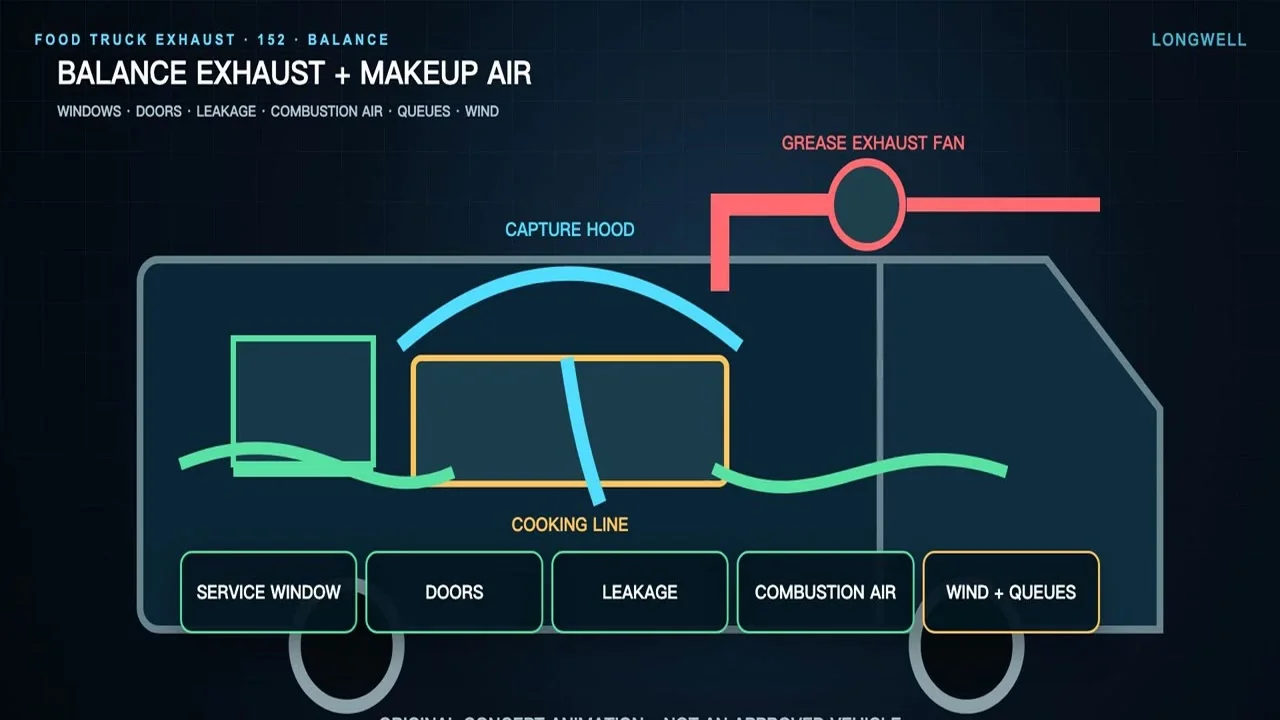
Extracting a thousand cubic metres per hour from a sealed vehicle simply creates a vacuum. The truck then pulls air through the serving window, around the door and past every gap, and the hood loses capture as a result.
Strong negative pressure inside a truck can also affect the draught of gas appliances. Provide a proper make-up air path rather than relying on the serving hatch.
Power supply constraints
| Supply | Practical limit | Note |
|---|---|---|
| 12V vehicle | Small fans only | Current draw becomes impractical |
| Onboard generator | Most common | Check surge current at start |
| Shore power | Best when available | Not available while trading |
| Inverter from battery | Short periods only | Heavy battery drain |
| Direct engine drive | Rare | Used on some older builds |
A soft-start or EC blower helps considerably here, since it removes the inrush that trips small generators.
Grease and fire safety
Grease-laden air is the reason kitchen extraction is regulated, and a vehicle is no exception.
- Use baffle filters rather than mesh, since baffles separate grease properly.
- Specify metal ductwork with welded or sealed joints.
- Keep duct velocity high enough that grease stays airborne.
- Provide access for cleaning the whole duct run.
- Fit a grease collection point at the blower.
- Finally, check whether a fire suppression system is required locally.
Our commercial kitchen exhaust guide covers the fixed-building version of the same requirements.
Practical build points
Mounting a food truck exhaust fan on a vehicle adds problems a building never has.
The blower must survive road vibration, so mounting and isolation matter more than in a fixed kitchen. Overall height affects bridge clearance, which constrains roof-mounted units. Meanwhile weather sealing has to cope with driving rain at motorway speed.
Our exhaust blower range covers suitable units, and our roof exhaust fan range covers the upblast configuration.
Cleaning and maintenance
A small system fouls faster than a large one, because everything is closer to the cooking surface.
Clean the filters daily or after each service, and clean the duct and blower on a schedule rather than by inspection. Meanwhile check the blower wheel regularly, since grease build-up unbalances it and cuts airflow.
For grease duct and cleaning requirements, NFPA 96 sets out the North American standard, and local codes apply elsewhere.
Food truck ventilation FAQ
How much airflow does a food truck hood need?
It depends on appliance duty and hood size, though 700 to 1,200 m³/h covers many builds. Local codes usually prescribe a minimum by appliance type.
Can I run the hood blower on 12V?
Only for very small units. The current draw for a real cooking hood is impractical on 12V, so most trucks use a generator or shore power.
Do I need make-up air in a truck?
Yes, and it is the most commonly skipped item. Without it the truck goes strongly negative, capture suffers and gas appliance draught can be affected.
How often should the duct be cleaned?
Far more often than a restaurant, since the run is short and close to the appliances. Monthly is common with heavy grease cooking, and filters need daily attention.
A food truck exhaust system needs the same engineering as a restaurant hood in a tenth of the space. Solve make-up air and cleaning access before choosing the blower.