In commercial, industrial, and agricultural ventilation systems, a duct fan only performs as well as the ductwork it connects to. A high-performance duct fan is important, but the duct diameter should not be overlooked. Choosing a 6-inch or 8-inch duct fan isn’t as simple as picking the larger option. In many small or medium ventilation systems, a 6-inch model can already deliver the required airflow. Moving up to an 8-inch duct fan becomes more relevant when airflow demand increases, or the system has more resistance to overcome. For different applications, the duct fan size should be selected based on required airflow and static pressure. This guide compares 6-inch and 8-inch duct fans and explains how to choose the right size for your ventilation system.
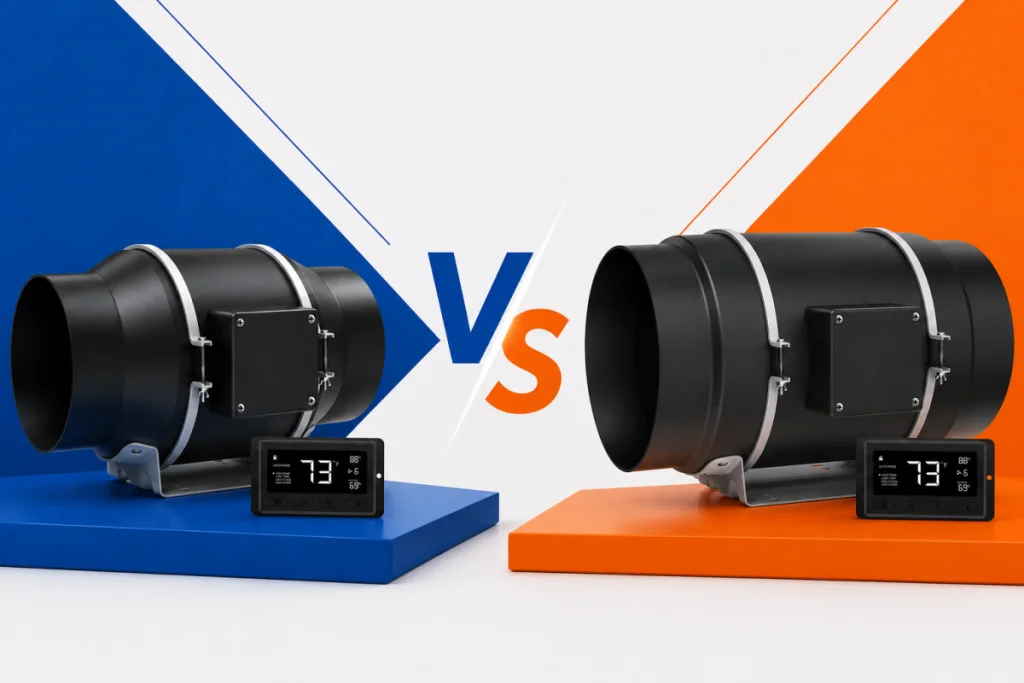
6-Inch vs 8-Inch Duct Fan: Key Differences
The main difference between a 6-inch and an 8-inch duct fan is their connection diameter. However, the size of the diameter does not only affect the physical dimensions. A larger-sized fan provides a larger airflow path to move air and support a higher ventilation load. The duct fans’ performance still depends on the motor, impeller, and speed.
Airflow Volume and Velocity
An 8-inch duct fan generally has a greater airflow volume than a 6-inch model. It is more likely to be considered for larger ventilation zones, higher air-change requirements, or systems that need to move more air continuously. A 6-inch duct fan is often sufficient for moderate airflow demands, localized exhaust, equipment ventilation, or smaller controlled environments.
A larger duct fan does not automatically generate higher pressure. The generation of static pressure relies more on the blade type and housing design. When choosing between two sizes of duct fans, it is necessary to use the P-Q curve and find out the operating point.
The duct space affects air velocity. When the same airflow passes through both duct sizes, air must travel faster in the smaller duct. It increases friction losses and aerodynamic noise. The actual noise level depends on the airflow volume, fan speed, motor, blade design, and the system resistance.
Key Parameter Difference
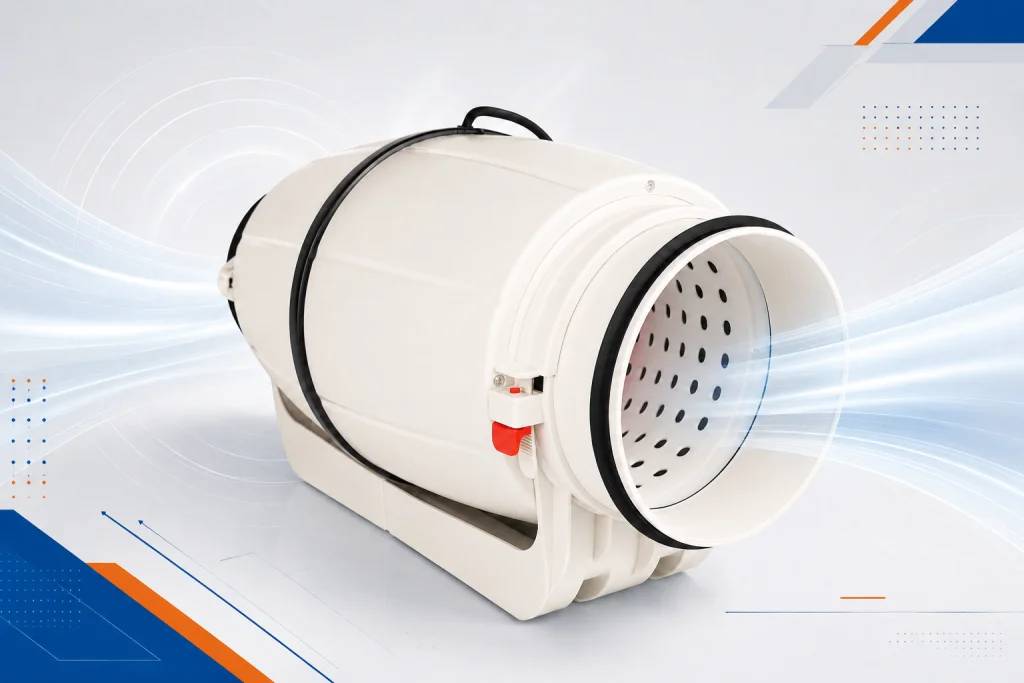
Within the same duct fan series, moving from a 6-inch to an 8-inch model usually means a noticeable increase in airflow capacity, with higher power consumption and higher noise. The LONGWELL Super Silence Duct Fan series shows how performance can differ between two sizes. At the same rated pressure of 300 Pa, the 6-inch model delivers 540 m³/h, while the 8-inch version reaches 1,200 m³/h.
| LONGWELL Super Silence Duct Fan | 6-Inch / 150 mm | 8-Inch / 200 mm |
| Voltage | 220 V | 220 V |
| Frequency | 50 Hz | 50 Hz |
| Power | 80 W | 130 W |
| Speed | 2550 rpm | 2550 rpm |
| Airflow | 540 m³/h | 1200 m³/h |
| Pressure | 300 Pa | 300 Pa |
| Noise | 48 dBA | 55 dBA |
How Does Duct Fan Size Affect Performance?
Duct Area
Duct diameter directly affects the available airflow area. The cross-sectional area of the 8-inch duct fan is approximately 80% larger than that of the 6-inch duct fan. This difference becomes important at the same airflow. The larger area of an 8-inch duct gives higher-airflow systems more room to move air at a lower velocity. However, a larger duct does not automatically mean better fan performance. The required airflow and system resistance still need to match the duct fan’s operating range.
Practical Operating Point
Long duct runs, elbows, filters, dampers, reducers, and other components add resistance and shift the fan to a different operating point. As a result, a duct fan rarely delivers at its maximum rated airflow after installation.
The actual airflow is determined by where the fan performance curve meets the system resistance curve. A 6-inch fan may perform well in a short, low-resistance duct system but deliver less airflow when resistance increases. An 8-inch system can reduce air velocity and duct losses, but the fan still needs sufficient pressure capability to overcome the complete system resistance.
For this reason, duct fan size should be evaluated together with the P-Q curve rather than by diameter or maximum CFM alone.
6-Inch vs 8-Inch Duct Fan: Different Applications
Commercial Ventilation
Restrooms, kitchens, equipment rooms, and retail spaces require commercial ventilation. Commercial kitchens in particular require project-based sizing instead of a simple room-size rule.
A 6-inch duct fan is more suitable for moderate airflow requirements, particularly where the duct is shorter with limited installation space. An 8-inch fan becomes more practical as airflow demand increases, or the duct system becomes longer and more restrictive. When the required CFM increased, the selection guide moved from a 6-inch to an 8-inch duct fan and also recommended considering duct length and bends.
Agricultural ventilation
Agricultural ventilation often requires continuous or adjustable airflow to control temperature, humidity, odors, and air exchange. The appropriate duct fan size depends on the size of the growing area and the required ventilation load.
For smaller grow areas or moderate airflow demand, a 6-inch fan may be sufficient. An 8-inch fan is more suitable when a larger growing space requires substantially higher air exchange. Filters, duct length, and other system restrictions should still be considered before making the final selection.
In the LONGWELL grow tent project, the customer used both a 6-inch duct fan and an 8-inch duct fan. The two duct fan sizes enabled the customer to match airflow more closely to different grow-tent requirements.
How to Choose Between a 6-Inch and 8-Inch Duct Fan?
1. Calculate the Required Airflow
Before looking at fan diameter, determine how much air the space needs to move. First, calculate the required ventilation area volume: Room Volume = Length × Width × Height.
For spaces where ventilation demand is defined by air changes per hour (ACH), the required airflow can be estimated using: CFM = Room Volume × ACH ÷ 60.
The requirements for ventilation in a grow tent, equipment room, or commercial area are different. After establishing the target airflow, check which duct fan size can deliver that CFM under the expected duct conditions.
2. Compare the Required CFM with Fan Performance
A larger duct connection generally provides more airflow potential, but only duct fan diameter does not determine fan capacity. In one LONGWELL agricultural ventilation project, 6-inch duct fans and 8-inch duct fans are used together to provide ventilation. The key parameters are listed in the table.
| Parameter | 6-Inch Duct Fan | 8-Inch Duct Fan |
| Airflow | 415 CFM | 855 CFM |
| Static Pressure | 465 Pa | 721 Pa |
| Noise | 34 dBA max | 51 dBA max |
| Dimensions | 315 × 225 × 210 mm | 330 × 252 × 211 mm |
The 6-inch model provided 415 CFM for lower ventilation loads, while the 8-inch model increased available airflow to 855 CFM. A grow tent require continuously an stable airflow to adjust indoor humidity and temperature. Therefore, the project used both sizes to realize a wider range of airflow control.
3. Check Actual Operating Point
Do not compare only the maximum CFM listed on the specification sheet. Installed airflow can decrease as system resistance increases. Long duct runs, small duct sections, elbows, filters, dampers, grilles, and outlet restrictions all affect the final airflow.
For this reason, the calculated CFM should be compared with the fan’s P-Q curve at the expected static pressure. A 6-inch fan may meet the airflow requirement in a short, low-resistance system but fall short after additional ductwork or filtration is added.
This is particularly important in grow-tent ventilation, where filters and duct routing can add resistance to the system. The LONGWELL project used a mixed-flow design intended to maintain airflow where air movement is restricted.
4. Consider Other Requirements
Airflow is not the only selection criterion. Installation space, allowable noise, and variation in ventilation demand should also be considered.
In the grow-tent project, both 6-inch and 8-inch duct fans used EC motors with adjustable control, allowing airflow to be matched to actual ventilation requirements instead of operating continuously at full speed.
The best choice is not simply the larger fan. It is the fan size that can meet the required CFM at the actual system static pressure with a reasonable operating margin.
LONGWELL Duct Fan Solutions
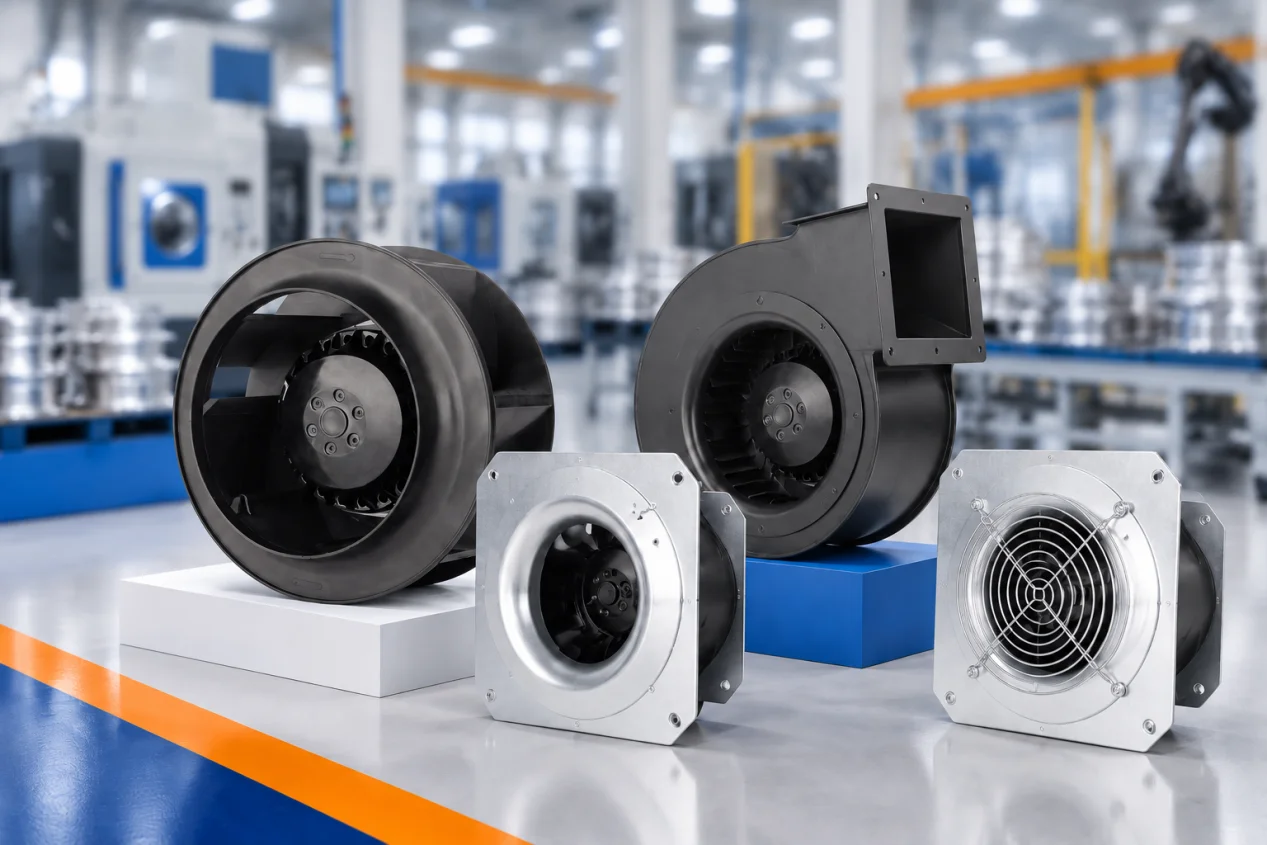
LONGWELL provides duct fan solutions for commercial HVAC and ventilation systems beyond standard 6-inch and 8-inch inline models. The product range includes rectangular duct fans, centrifugal duct fans, ultra-thin silent duct fans, split duct fans, and so on. LONGWELL allows different structures to be matched to airflow, pressure, installation space, and acoustic requirements.
For confined ceilings or limited installation spaces, compact rectangular and ultra-thin designs can be integrated directly into ductwork. For projects requiring variable airflow, LONGWELL also offers EC silent duct fans with adjustable speed control. Rather than selecting a duct fan by duct diameter alone, LONGWELL can match the duct fan to the actual system requirement. We also offer customized service for OEM/ODM projects.
FAQs
Is it better to oversize or undersize ductwork?
No. An excessively small duct will reduce the actual airflow and increase noise. A slightly larger duct can reduce resistance, but an overly large size may cause the air speed to decrease.
Are bigger duct fans quieter?
In most cases, no. The noise depends on fan rotation speed, motor design, blade geometry, airflow volume, and system resistance. A high-capacity 8-inch fan operating near full speed can still be louder than a smaller 6-inch model.
Why should sizing calculations include a safety buffer?
Calculated airflow is usually based on ideal ventilation demand. In practical installation conditions, actual installations introduce additional resistance from duct length, elbows, filters, dampers, and outlets. These losses can reduce the airflow delivered compared with the fan’s maximum rated CFM.
Choose the right duct fan
Longwell manufactures 254 duct fans in-house. Send airflow, static pressure and voltage — an engineer replies with a matching model, performance curve and price within one working day.