What the HVAC OEM asked for
An HVAC OEM wanted a variant of our standard 250mm circular EC duct fan. The request was short. Quote it, then send two evaluation samples.
One thing had to change. The impeller needed metal construction rather than the molded plastic in the existing LWDE-250S-MBN-07.
That request is more common than it sounds. OEMs whose end products face strict durability or fire safety rules often cannot put plastic in the airflow path at all.
Everything else had to stay where it was.
- 230 VAC across a 184 to 276V range.
- 0-10VDC or PWM control, since the fan joins a building management system.
- An identical footprint, with the 249mm duct connection unchanged, so it drops straight in.
- CE and ETL to UL 507, covering both Europe and North America.
- Finally, an operating range from -25C to +60C.
Meanwhile the performance envelope of the original had to survive intact. A drop-in replacement that moves less air is not really a replacement.
Putting a steel impeller in an EC duct fan
The task looks like a simple material swap. In practice it is three separate problems.
Which metal
We considered aluminum and stainless steel. However, galvanized steel sheet won.
It gives the rigidity and durability the customer wanted at a sensible cost. Furthermore, the galvanizing handles the humidity of a commercial HVAC air stream, which can reach 90% RH. Stainless would survive more, at a price this application does not justify.
The weight problem
A stamped steel impeller weighs more than a molded one, and that lands on the motor. So our engineers reviewed the bearing system and the starting torque, confirming the 40,000-hour L10 life still holds with the extra rotating mass.
Since we design and build our own EC motors, that check happened in house rather than through a supplier. On a change this small, waiting on an outside motor vendor would cost more time than the engineering itself.
The geometry problem
Here the second challenge was reproducing the molded blade shape in steel. Molding and stamping are very different processes. Consequently a blade profile that transfers imperfectly costs you pressure.
We developed new tooling to stamp and form the blades to the original shape. Afterwards the finished assembly was dynamically balanced to G6.3. That handles the extra mass, and it prevents the vibration and noise a heavier unbalanced wheel would produce.
In the end the fan reaches 795 Pa of maximum static pressure. In other words, the aerodynamics carried across to the new material rather than degrading in translation.
Technical Specifications
The impeller material row is the only visible change from the standard EC duct fan. Meanwhile the performance rows show the aerodynamics carried across intact.
| Parameter | Value |
|---|---|
| Model Number | LWDE-250S-MBN-08-00 |
| Nominal Voltage [VAC] | 230 |
| Frequency [Hz] | 50/60 |
| Max Speed [RPM] | 3000 |
| Rated Input Power [W] | 220 |
| Rated Current [A] | 1.6 |
| Max Airflow [m³/h / CFM] | 1300 / 764 |
| Max Static Pressure [Pa] | 795 |
| Noise Level [dB(A)] | 82 |
| Operating Temperature Range [°C] | -25 to +60 |
| L10 Life Expectance | 40,000 Hours (at 40°C) |
| Overall Dimensions [mm] | 386 (W) x 396 (H) x 221 (D) |
| Duct Connection Diameter [mm] | 249 |
| Impeller Material | Galvanized steel sheet |
| Speed Control | 0-10VDC / PWM |
| Certifications | CE, ETL (UL 507), FCC |
Technical Documentation
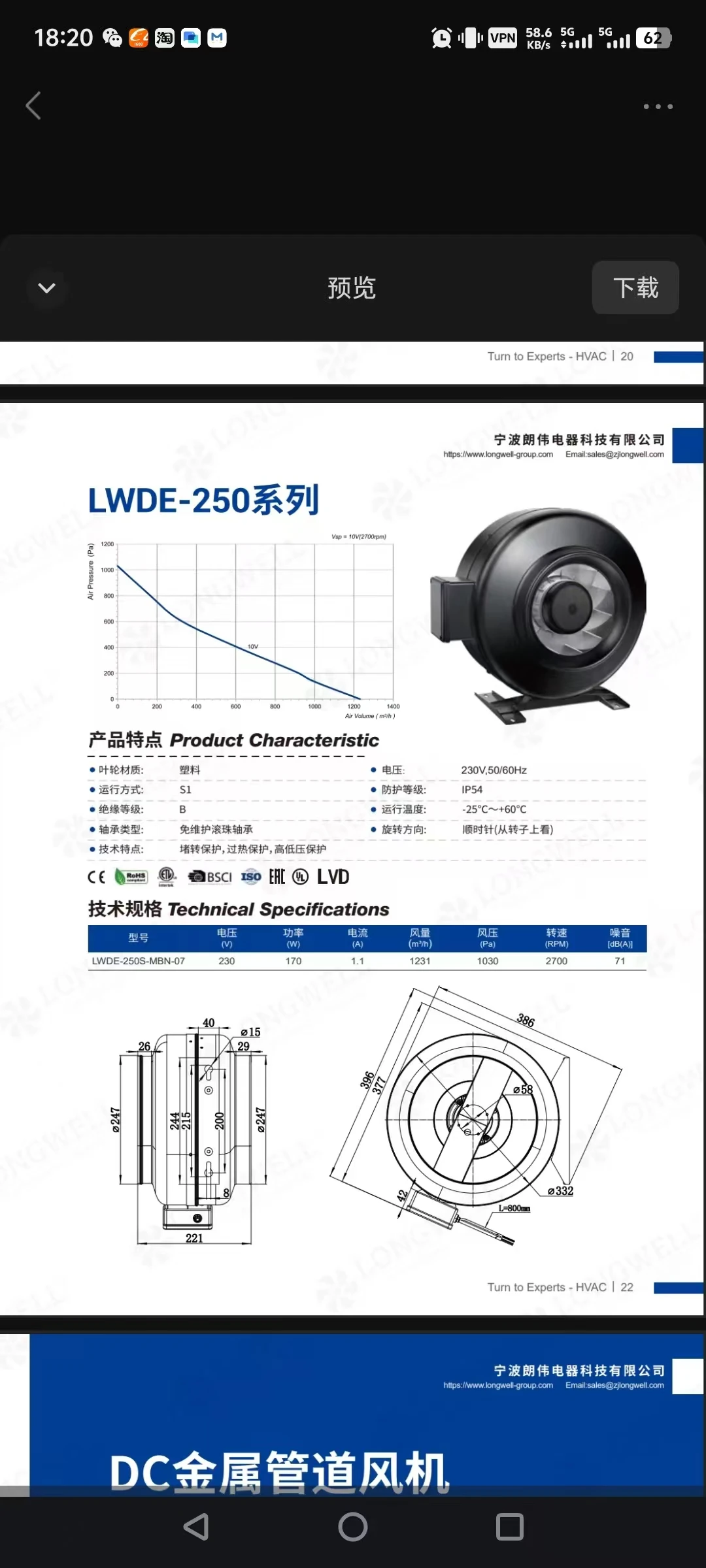
Meanwhile the complete technical data sheet is essential for system design engineers to perform integration checks and for procurement managers to confirm compliance.
Download the LWDE-250S-MBN-08 document
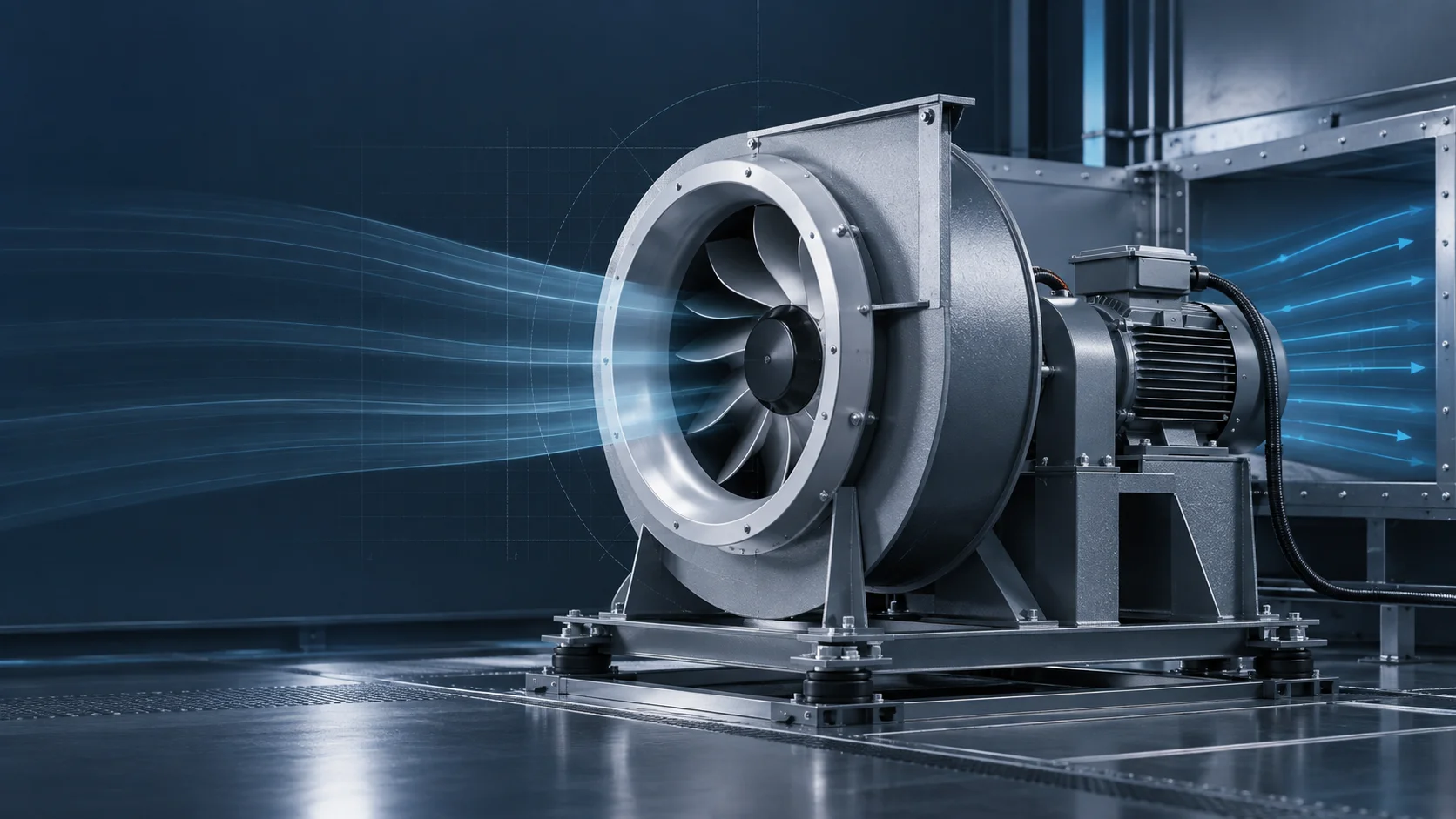
The image shows the final fan assembly, useful for mechanical designers verifying the form factor and installation points.
Why the modification came here
Two things made this EC duct fan change practical for the customer.
- A semi-custom part quoted in a day. A typical European NPI cycle for a material change like this runs 12 to 18 months. Design, documentation and quotation here were completed and approved within one working day, which is what keeps an OEM development schedule intact.
- Certification handled as part of the change. With CE and ETL both required, compliance sits on the critical path. Our working relationship with a China-local TUV NORD notified body shortens any re-validation a modified product needs.
Browse our EC duct fan range, or the metal duct fan series where a steel body is required as well. Duct fan test methods are set out in ISO 5801.
Questions about the metal version
What is the lead time for samples with the metal impeller?
Once the one-time engineering is done, samples follow our standard make-to-order schedule of 15 to 25 days. On this project, meanwhile, the engineering and quotation phase itself took under 48 hours.
Can I control speed without a BMS signal?
Yes. The SmartEC controller accepts 0-10VDC and PWM, and the electronics also provide a fixed 10VDC output. Wire that to a simple 10 kOhm potentiometer and you have manual speed control with no controller at all, which is often how commissioning and testing get done.
Is galvanized steel suitable for corrosive air?
It handles standard commercial HVAC air up to 90% RH well. It is not intended for chemically aggressive environments such as acid fumes or coastal salt spray. For those we would specify 316 stainless instead, through our 90-day custom NPI process.
Does the steel impeller change the noise?
Not materially, provided the balance is right. That is precisely why we balance the assembly to G6.3 after the change. Extra rotating mass amplifies any residual unbalance. Consequently an impeller swap done without rebalancing usually gives you an EC duct fan that is measurably louder.
Technical Documentation & Resources
Have a fan requirement like this one?
Send the datasheet you are working against, or simply the duty point. Then our engineers tell you what fits and what does not. Meanwhile custom spec sheets and samples take up to 90 days. Since 1990 we have been building fans for OEMs worldwide.
Browse Related Products:
🏆 ISO 9001 / ISO 14001 / ISO 45001 | CE (TÜV) | UL/ETL | ATEX Zone 21/22 | AMCA 210/211 / ISO 5801 tested
Choose the right duct fan
Longwell manufactures 254 duct fans in-house. Send airflow, static pressure and voltage — an engineer replies with a matching model, performance curve and price within one working day.