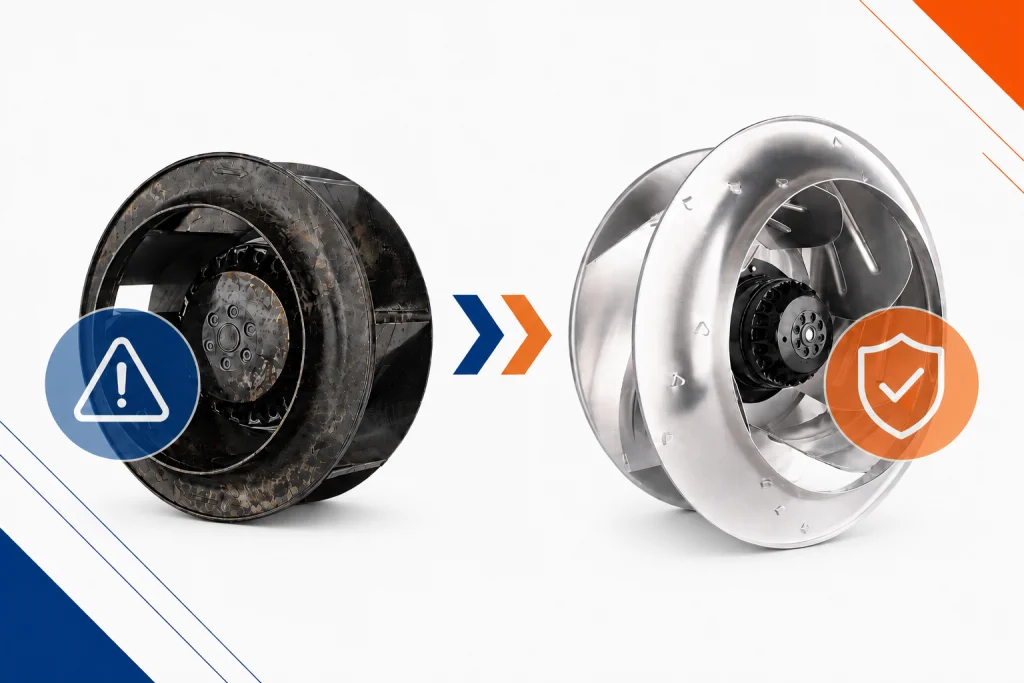
Centrifugal fans are widely used in HVAC, industrial ventilation, dust extraction, and process systems where stable airflow and pressure are critical. Centrifugal fans can degrade. Airflow can drop, the bearing can run hotter, and noise can change. Problems also come from the system rather than the fan itself, such as increasing duct resistance or an overloaded motor. The good news is that most failures give weeks of lead time. So, early detection of warning signs can prevent sudden breakdowns. This guide looks at five clear signs that your centrifugal fan needs replacement. A centrifugal fan replacement ensures your system continues to perform at peak efficiency, minimizing disruption and extending the life of your entire system.
Top 5 Replacement Signs of Centrifugal Fans
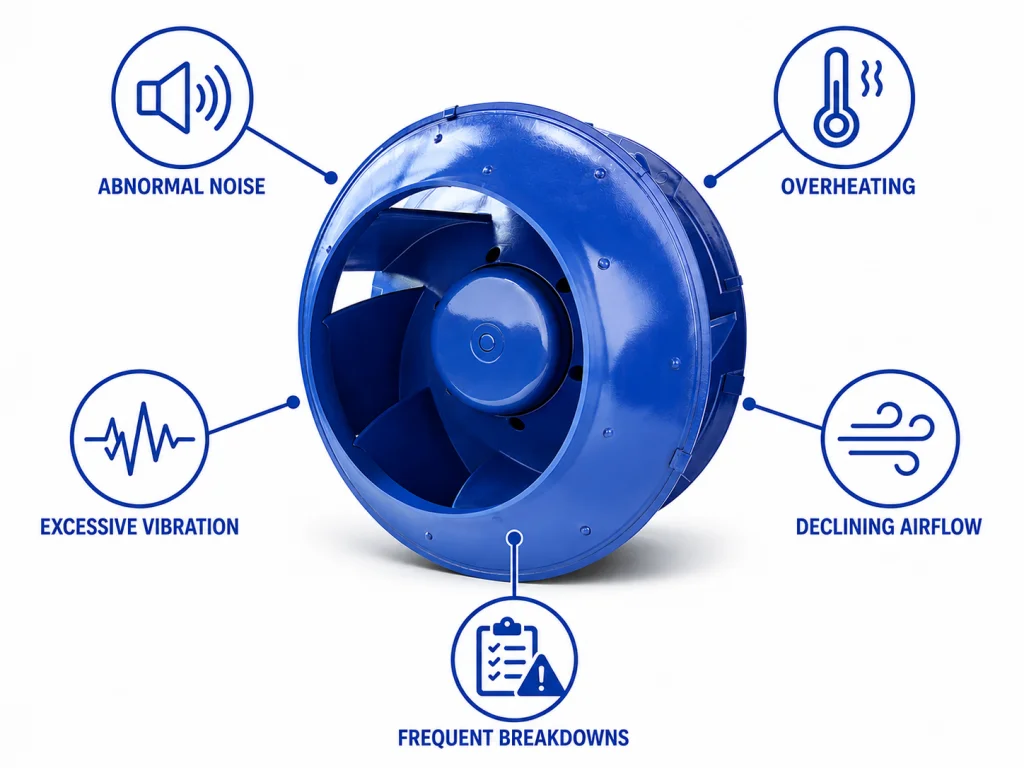
Persistent Abnormal Noise
A change in the centrifugal fan’s normal operating sound is often one of the earliest signs of mechanical wear. Grinding may come from worn bearings or contact between the impeller and housing, while rattling can point to loose components. Impeller imbalance, shaft misalignment, and duct resonance can all raise the fan’s noise level. Airflow itself may also be the cause, especially when turbulence develops or the fan is operating too far from its intended duty point.
If the noise continues after lubrication, tightening, balancing, and clearance checks, the next step is to inspect the bearings, shaft, impeller, and motor for wear or damage. When worn components begin causing repeated repairs or affect safe and stable operation, replacing the centrifugal fan may be more practical.
Excessive or Increasing Vibration
Vibration is one of the best warning signs in rotating machines. Some vibration is normal during centrifugal fan operation, but a new or steadily increasing vibration level usually indicates a developing mechanical problem. The most common causes are rotor mass unbalance and bearing wear.
Vibration problems almost never fix themselves. Worn bearings and impeller imbalance are too costly to repair. A technician may tighten loose parts for a short time, but the wear continues. Cracks in shafts or impellers grow over time, causing sudden failure. When operating speeds match natural speeds, resonance can cause severe damage. When excessive vibration appears, consider replace a new centrifugal fan.
Declining Airflow
A noticeable drop in airflow is a clear sign that a centrifugal fan is no longer working as expected. A blocked filter, duct restriction, or belt slippage- these systemic problems may cause higher resistance. When the airflow is low enough to trigger an inspection, common maintenance checks will be the airflow path, filters, dampers, and operating conditions. Then, inspect the impeller and housing for wear or air leakage. If the centrifugal fan continues to deliver insufficient or unstable airflow after adjustment, consider replacement. In some cases, replacing the inefficient centrifugal fans is more effective than continuous maintenance.
Repeated Overheating
A centrifugal fan that repeatedly runs too hot should not be treated as a one-time fault. The cause may be a worn bearing, insufficient lubrication, motor overload, poor cooling, or an electrical issue. Operating too far from the intended duty point can also add load on the motor and raise its temperature. If the fan continues to overheat after these basic issues have been corrected, the problem may already involve longer-term wear. Repeated thermal trips or recurring overheating are therefore strong signs that replacement should be evaluated.
Check the motor current and supply voltage, bearing condition, lubrication, airflow path, and drive alignment first. If overheating continues after these basic problems have been corrected, the motor insulation, bearings, or other mechanical components may already have suffered long-term damage. When a centrifugal fan repeatedly overheats or trips on thermal protection, replacement should be considered rather than continuing the same maintenance cycle.
Frequent Breakdowns
One isolated sudden failure does not usually justify replacing a centrifugal fan. The concern starts when shutdowns become more frequent or when different components begin failing one after another. Worn bearings, belt-drive problems, impeller damage, motor deterioration, shaft misalignment, and persistent vibration can all increase maintenance demands and lead to unplanned downtime.
Instead of looking only at the latest fault, review the centrifugal fan’s maintenance history. Repeated bearing changes, belt problems, motor faults, or vibration corrections can show that the overall condition of the fan is deteriorating.
If repairs restore operation only for a short period, continued maintenance may no longer be the best option. This becomes more important when unplanned shutdowns begin to interrupt production or when several major components are already approaching the end of their service life.
Centrifugal Fan Condition Assessment: Repair or Replace?
When to Repair a Centrifugal Fan?
A repair makes sense when the fault can be traced to one component and the rest of the fan is still sound. A worn bearing can be changed. An impeller with buildup can be cleaned and balanced again. Belt tension, alignment, and lubrication are also routine maintenance items. If the fan returns to its normal airflow, vibration, and temperature after the work, there is usually little reason to replace the complete unit.
When to Replace a Centrifugal Fan?
The situation changes when maintenance stops solving the problem. A bearing is replaced, but vibration comes back. The motor overheats again after servicing. Airflow continues to fall even though the duct and filters are clear. Once several of these problems begin appearing together, another repair may only last for a little more operating time.
There is another reason to replace a fan: the system may have changed. The original fan might still run, but it may no longer provide the airflow, static pressure, control range, or efficiency the equipment now requires. In that case, repairing the old unit does not address the real issue. A replacement should be selected against the current duty point rather than simply copied from the original fan specification.
Key Comparison
| Condition | Repair May Be Suitable | Replacement Should Be Considered |
| Impeller Condition | Minor buildup, small imbalance, or repairable surface wear | Cracks, severe corrosion, deformation, extensive erosion, or repeated imbalance. |
| Bearings & Shaft | Isolated bearing wear or lubrication problem | Repeated bearing failure, bent shaft, severe shaft wear, or recurring vibration. |
| Motor & Drive | Belt, pulley, coupling, or individual motor component can be repaired | Repeated motor overheating, frequent trips, or major motor/drive deterioration. |
| Fan Performance | Original airflow and pressure can be restored after maintenance | Fan can no longer achieve the required airflow or static pressure. |
| Maintenance Frequency | Failure is isolated and repair restores stable operation | Repairs become frequent and provide only short-term improvement. |
| Downtime & Cost | Repair cost and downtime remain relatively low | Repeated outages and cumulative repair costs begin affecting production. |
| System Requirements | Existing fan still matches current operating conditions | Airflow, pressure, efficiency, control, or environmental requirements have changed. |
Check Centrifugal Fan Maintenance Before Replacement
Before deciding to replace a centrifugal fan, maintenance should be used as a final verification step. The purpose is not only to correct minor faults, but also to understand whether the centrifugal fan can still return to stable and reliable operation.
A proper regular maintenance review should include:
- Condition of key mechanical components
- Cleanliness of the airflow path
- Lubrication status
- Belt, pulley, or drive condition
- Fastening points and mounting stability
- Shaft and impeller alignment
- Visible wear on the impeller or housing
- Operating data before and after maintenance
Keeping a clear inspection and maintenance history is equally important. If you notice the same components require repeated attention, or maintenance intervals are becoming shorter, the replacement centrifugal fan may need to be taken into consideration.
For more detailed inspection and servicing guidance, see our centrifugal fan maintenance guide.
Replacement Time is the Right Moment to Go EC
A centrifugal fan with an AC motor that has reached end of life is the natural point to convert to EC:
- Higher energy saving at full load, more at part load
- 4-6 dB(A) quieter with bionic blade design
- Static efficiency up to 92%
- Bearing L10 life up to 60,000 h
- 0-10 V / PWM control, no external VFD needed
- Drop-in dimensions in many retrofit cases
There is a maintenance angle too. Direct-drive EC removes the belt, the tensioning, and the belt-replacement labor from the annual routine. The onboard protection PCB catches over-temperature, over-current, and locked-rotor faults before they become failures, which is why we position the EC series as a low-maintenance option.
Get A Replacement Sized for Your Project
Replacing a centrifugal fan is not simply a matter of changing the impeller diameter or motor power. The original operating point of airflow and static pressure, installation dimensions, electrical supply, input power, speed, control interface, and operating environment all need to be checked before a replacement model is selected.
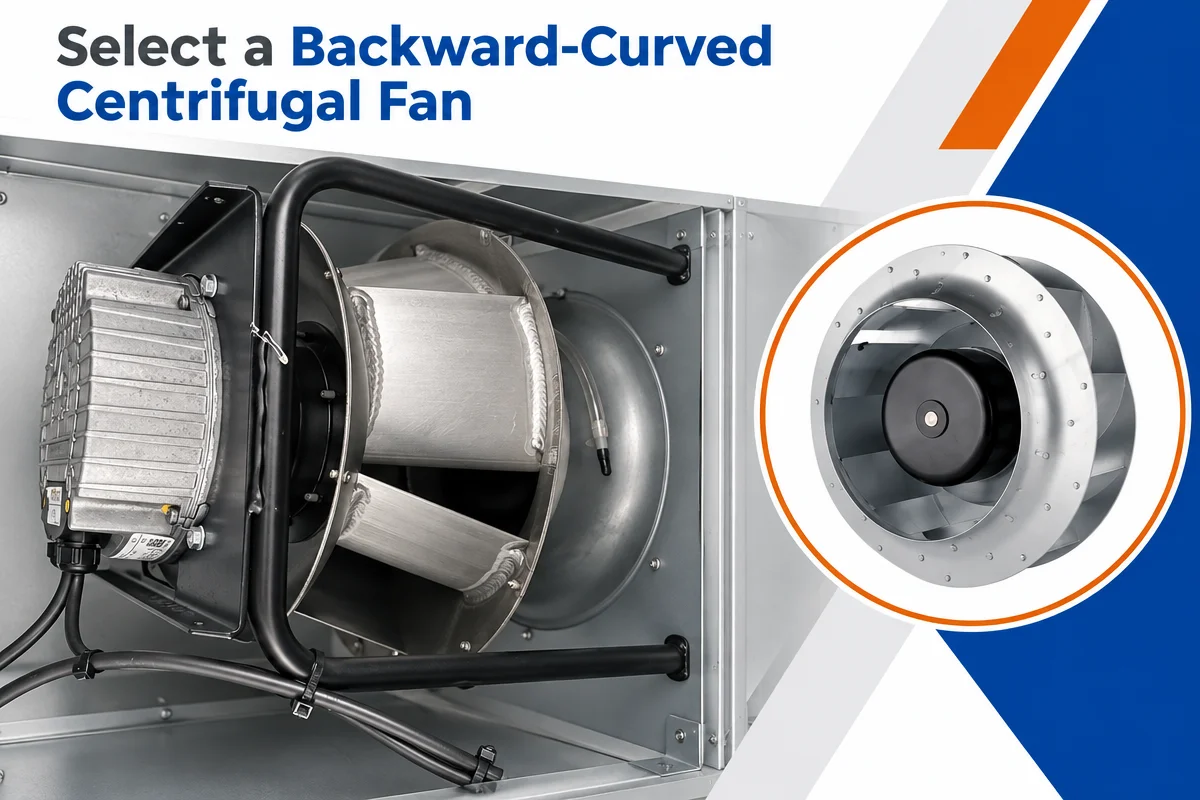
For EC backward-curved centrifugal fans, LONGWELL has LEBE3G series covers Ø133-900mm. Replacement options can be selected as a dimensional drop-in match, an energy-saving improvement, or a higher-performance alternative. LONGWELL supports this process with a centrifugal fan cross-reference sheet. This makes LONGWELL suitable not only for replacing an aging fan, but also for OEMs seeking a second-source centrifugal fan without redesigning the complete system.
LONGWELL EC models are available with control options including 0-10V, PWM, and Modbus. This allows old fans to be replaced while retaining or upgrading the system control strategy. However, before production approval, final replacement suitability should still be verified against the actual operating point, electrical specifications, and other regulatory requirements. If the existing fan data is incomplete or the replacement requires dimensional or performance verification, customers can contact LONGWELL for application-specific selection support.
FAQ
Can I replace a centrifugal fan with an axial fan?
They are usually not direct replacements. Axial fans typically move larger volumes of air at lower pressure. The centrifugal fans are better suited to higher static pressure applications.
What is the lifespan of a centrifugal fan?
The centrifugal fan’s lifespan depends on the operating environment. LONGWELL LWBE3G series is engineered for a 10-year service life.
What is the correct orientation for a centrifugal fan?
There is no single correct orientation for every centrifugal fan. The installation should follow the manufacturer’s specified rotation direction, discharge position, shaft orientation, mounting method, and inlet clearance.
Is fan repair better than replacement?
Minor fan repair work for issues like loose belts. Repair costs for a centrifugal fan with worn bearings or cracked impellers add up fast.
Choose the right centrifugal fan
Longwell manufactures 1,130 centrifugal fans in-house. Send airflow, static pressure and voltage — an engineer replies with a matching model, performance curve and price within one working day.

![[Air Exchanger Ventilation Knowledge Series] Industrial Ventilation and Cleanroom Air-Exchange Requirements](https://i.longwellfans.com/wp-content/uploads/2025/03/longwell-axial-fans-300x169.webp)