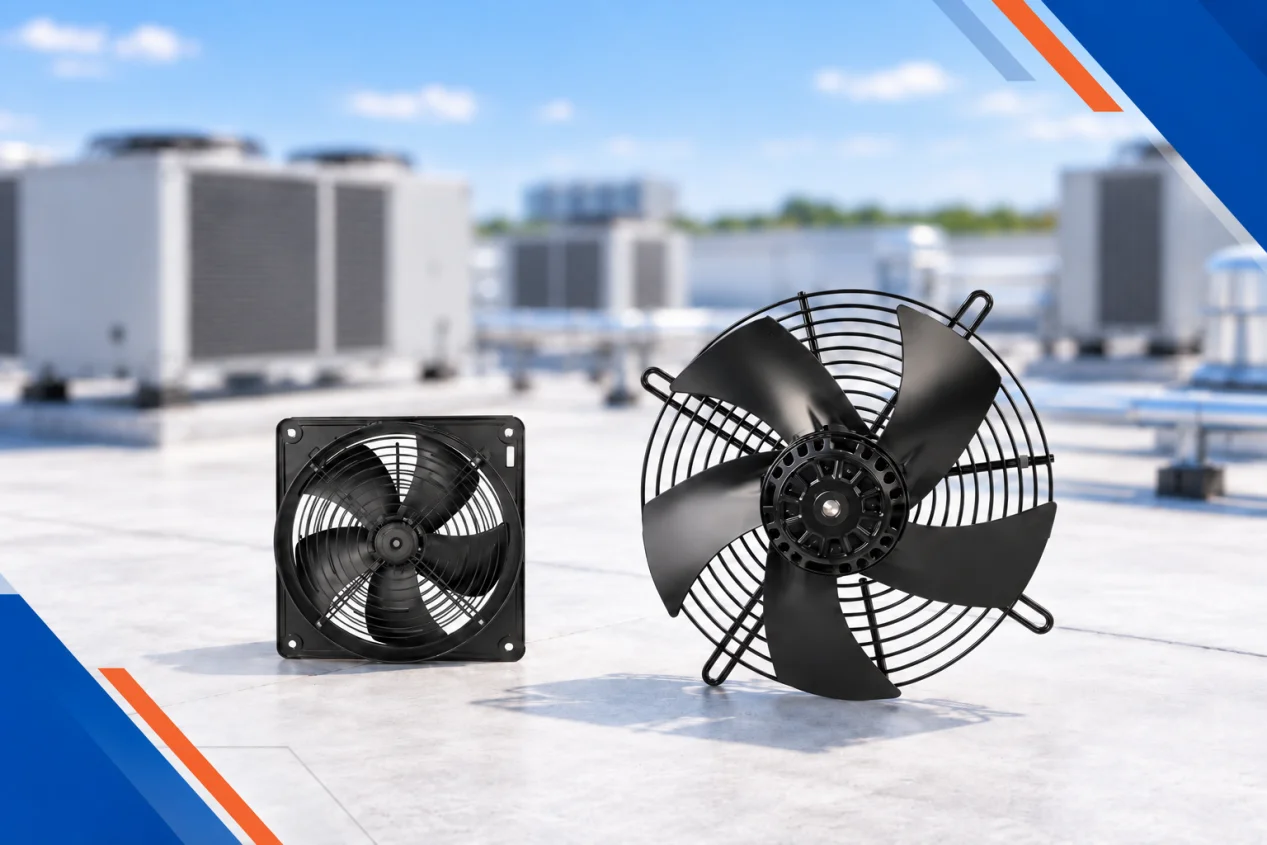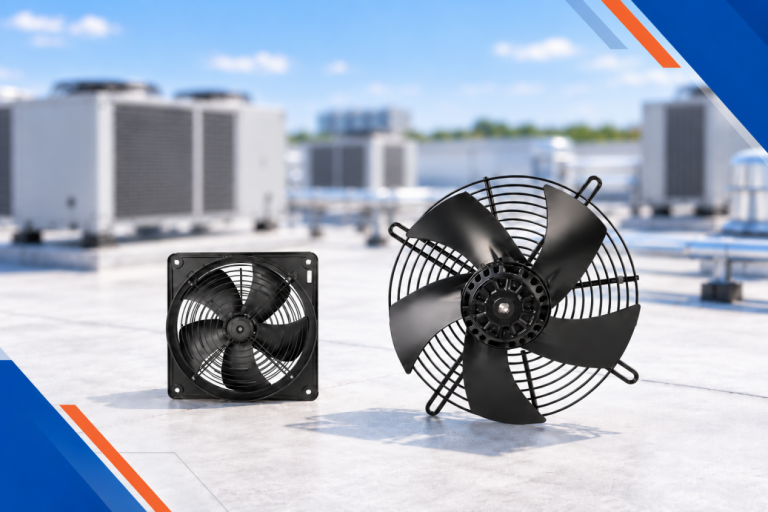
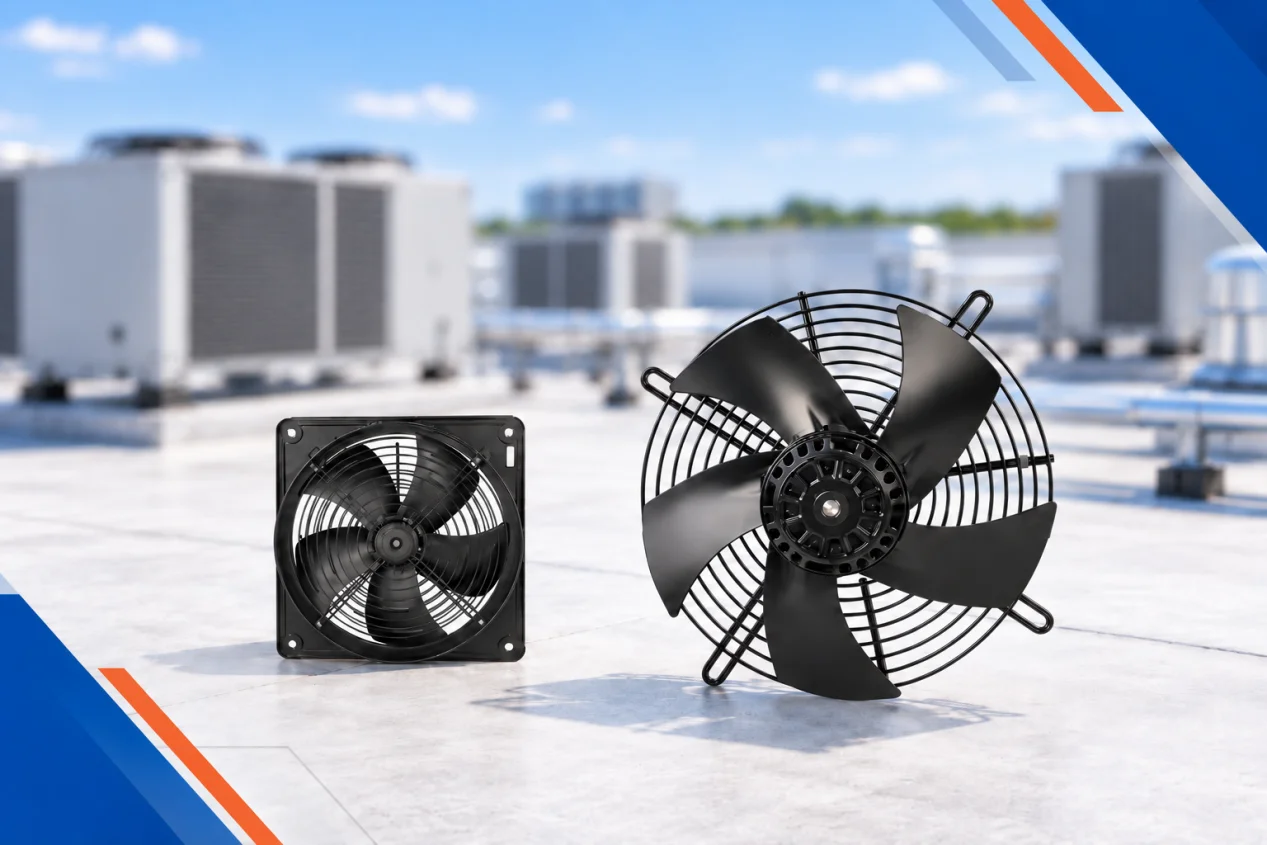
A complete HVAC system usually consists of multiple components, including compressors, evaporators, condensers, expansion devices, and air-moving equipment. Among these components, the condenser unit plays a critical role in heat dissipation. In order to achieve efficient heat transfer, the condenser rely on axial cooling fans responsible for moving air across the condenser coil to remove heat. Selecting the matched axial cooling fan for a condenser unit requires more than matching airflow capacity. This guide provide a complete guide for choosing an axial cooling fan for condenser units and help to avoid the common selection mistakes.
Why Axial Cooling Fans Are Used in Condenser Units?
Direct Airflow Path
Axial cooling fans move air parallel to the motor shaft, creating a straight airflow path. This allows the fan to push ambient air across the heat exchanger surface. The airflow path in condenser is usually simple and direct. The whole system resistance is relatively lower and enables efficient air movement within a compact condenser assembly.
Higher Airflow Capacity
During the refrigeration cycle, the condenser coil releases heat from the refrigerant, which requires continuous airflow across the coil for effective heat dissipation. This process requires a relatively straightforward airflow, and the airflow volume needs to be high. Axial cooling fans are commonly used because they provide high airflow capacity.
Compact Design
In outdoor condenser units, there are often limited space for fans. Axial fans that integrate motor and impeller with a shallow installation depth is suitable for this application. This compact structure simplifies equipment integration while helping manufacturers achieve smaller and lighter condenser designs.
Axial Cooling Fan Selection Guide
Step 1: Calculate Required Airflow
Airflow is the starting point of condenser cooling fan selection because it directly affects the heat exchange performance. The required airflow depends mainly on the condenser design and operating conditions, including heat rejection capacity, condenser coil size and structure, ambient temperature, and allowable air temperature rise.
In practice, the selected fan should provide enough airflow under the actual installation condition. During the refrigeration cycle, the condenser coil releases heat from the refrigerant to the surrounding air. The axial cooling fan generate enough airflow through the coil and remove heat. If the airflow is insufficient, heat transfer efficiency decreases, which may affect system performance.
Step 2: Determine System Static Pressure
Condenser units generally operate at relatively low static pressure, but system resistance still affects the final airflow. As air passes through the condenser coil, grille, fan guard, and surrounding structure, these may adds pressure loss.
This means the airflow shown under free-air conditions may not be the airflow available after installation. When selecting the fan, engineers should make sure the fan can still deliver enough air at the expected system resistance.
Step 3: Select Fan Diameter
The diameter and rotation speed of an axial cooling fan have a significant impact on delivering airflow. A larger diameter fan can usually move the same amount of air at a lower speed. Since the condenser units often have strict space limitation, the impeller size must be balanced with the available mounting dimensions. During this stage, engineers usually confirm the installation space with axial fan size.
Step 4: Check the P-Q Curve and Operating Point
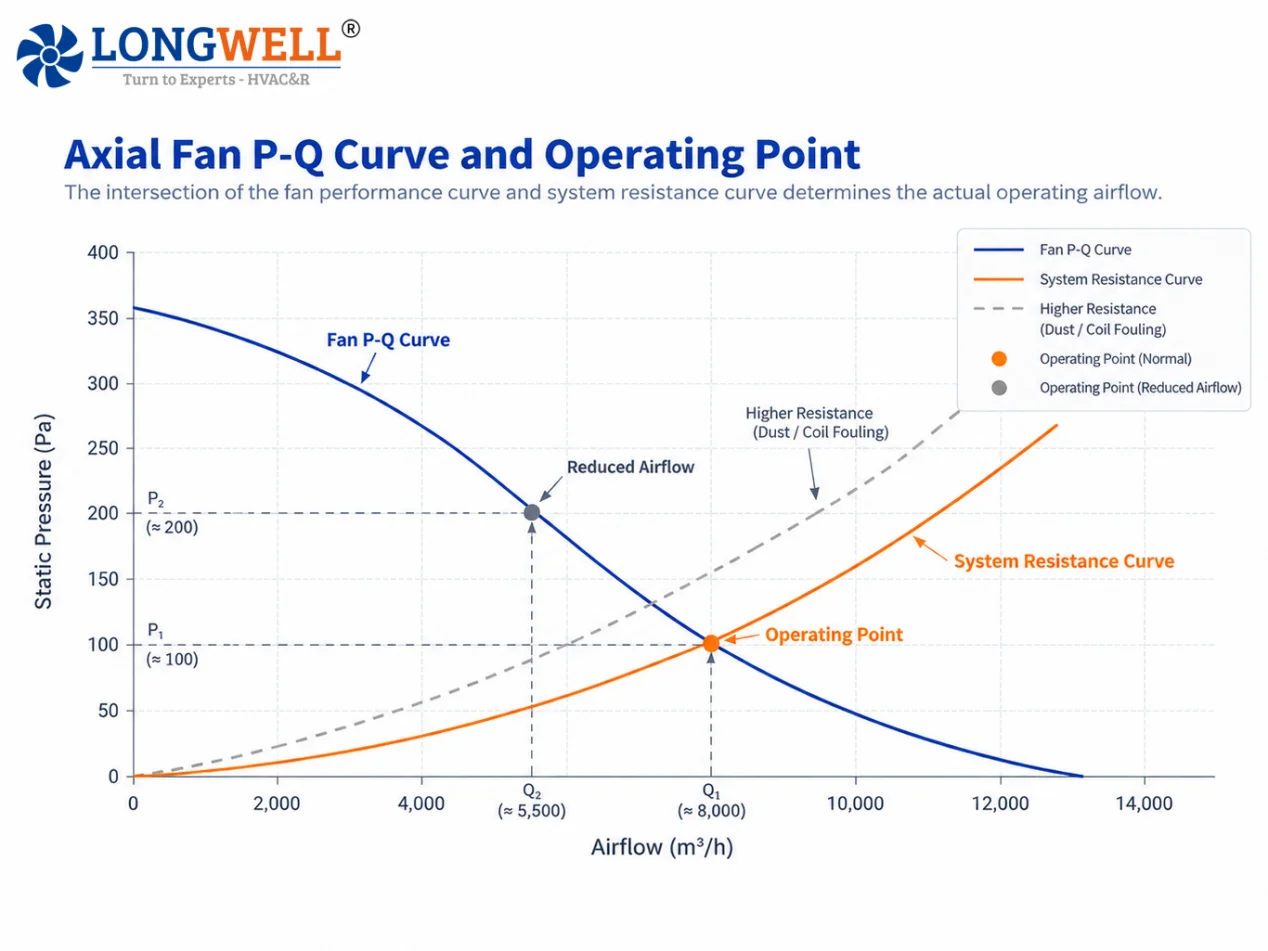
The fan’s performance curve shows how it behaves as system pressure changes. In general, airflow decreases as static pressure increases. The condenser itself has a resistance curve as well, and the intersection of these two curves becomes the actual operating point. The P-Q curve provides a more accurate way to evaluate fan performance under actual system conditions. The point should be calculated against the required airflow. The maximum airflow data from datasheet is not the actual operating airflow.
Besides, it is also worth keeping some airflow margin. Components in the condenser unit can accumulate dust and increase resistance over time and move the operating point to a lower airflow region.
Step 5: Confirm Motor and Control Requirements
Once the airflow performance is determined, the motor type and control method should be selected. Condenser units most commonly use AC or EC axial fans. DC axial fans are typically designed for lower-voltage systems such as 12V, 24V, or 48V, so they are less common in standard commercial HVAC condensers.
For applications with a relatively stable airflow demand, AC axial fans are often a practical and cost-effective choice. EC axial fans are more suitable when the system needs variable-speed control or the airflow changes with operating conditions.
Step 6: Environmental and Compliance Requirements
Outdoor operation changes what matters in fan selection. A condenser fan may see large temperature swings, moisture, dust, or corrosive air over its service life, and those conditions can affect both the motor and mechanical parts.
That is why the fan specification needs to go beyond airflow and pressure. Blade material, bearing design, motor protection, and IP rating should all match the actual installation environment, especially for units expected to run for long periods outdoors.
OEM Selection Example: 450 mm Impeller Axial Fan for a Condenser Unit
The OEM customer required an axial fan solution for existing condenser unit assembly. Their required free-air airflow is 7,000 m³/h. The installation panel size is 575 × 575 mm with maximum installation depth of 85 mm. The operating temperature should between −30°C and +60°C.
The first consideration was whether the axial fan could provide sufficient airflow for condenser heat dissipation. After evaluating the airflow requirement and available fan performance, the LWAA4D450S series was selected. The following table is part of the selected model’s specification.
|
Parameter |
Value |
|
Model Number |
LWAA4D450S-5MKB-39-00 |
|
Nominal Voltage |
380 VAC |
|
Frequency |
50 Hz |
|
Speed |
1350 RPM |
|
Input Power |
480 W |
|
Noise Level |
68 dB(A) |
|
Operating Temperature |
-30°C to +60°C |
|
Max Air Flow |
7004 m³/h / 4120 CFM |
|
Static Pressure (Max) |
~170 Pa (at 0 m³/h) |
|
Operating Temperature |
-30°C to +60°C |
|
Protection Class |
IP54 |
|
Certifications |
CE, RoHS, Reach |
Which Type of Axial Fan is Better for Your Condenser Units?
AC Axial Fan
For a condenser that runs under stable conditions, an AC axial fan is often enough. The motor connects directly to the AC supply, the electrical arrangement is relatively simple. There is no need to add speed-control functions as well. AC motor also keeps the initial fan cost lower. That is one reason fixed-speed AC external-rotor axial fans are still widely used for conventional condenser units and replacement projects.
EC Axial Fan
Some outdoor condenser units are placed in an environment with a large temperature difference between day and night. The axial cooling fan may not need to run at full speed for much of its operating time. EC motor, also regard as BLDC motor, allows the motor speed vary following the demand changes.
The motor and electronic controller are integrated into the EC drive. Depending on the fan and controller, commands can be sent through a 0–10 V signal, RS485, or Modbus. The condenser control can also be linked to pressure or temperature sensors.
Common Condenser Fan Selection Mistakes
Selecting by Free-Air Airflow Only
Free-air airflow is useful for comparing fans, but it should not be the final selection value. It represents the airflow volume under little or no resistance. However, the practical operating condition of an axial fan is different. It should generate air pass through the coil and surrounding structure.
Ignoring Condenser Coil Resistance
The condenser coil is one component in the airflow system, which contribute to pressure loss. When airflow pass through these components, pressure loss accumulated. If they are left out of the calculation, the actual operating point moves away from the original design point. Some obstructions close to the axial cooling fan can also create additional losses. They are not always included in ordinary system resistance.
Oversizing the Fan
Although suitable fan margin will make sense when system accumulate dust, select with o much margin can move the fan away from the intended duty point. The result may be unnecessary airflow or control problems.
There is an important distinction here: a larger fan is not necessarily an oversized fan. At the same airflow and pressure, a larger-diameter fan running more slowly can actually be quieter and more efficient than a smaller fan running at higher speed.
Use LONGWELL Axial Fans for Condenser Units
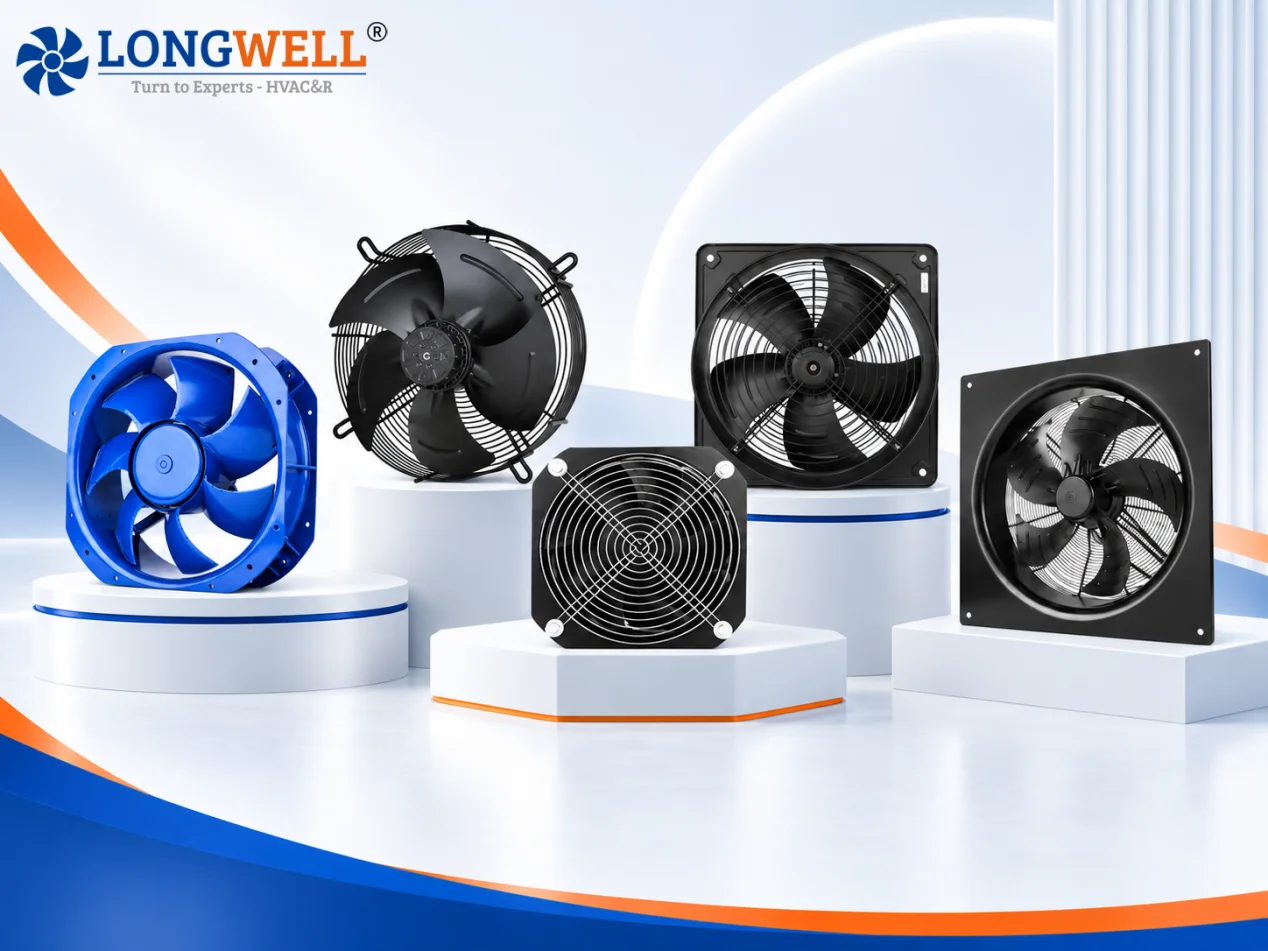
LONGWELL supplies axial fans for commercial HVAC and condenser applications, with AC/DC/EC options available for different airflow, control, and installation requirements. Fan selection can be matched to the required airflow, static pressure, mounting dimensions, voltage, operating temperature, and noise limits of the condenser unit.
For OEM projects, the fan often needs more than a standard catalogue match. LONGWELL supports adjustments to the fan structure, motor configuration, protection level, and control interface where the equipment design requires them. EC axial fans can also be used where variable-speed operation or system control is needed.
For outdoor condenser units, operating temperature, moisture protection, corrosion resistance, and long-term motor reliability should be confirmed together with aerodynamic performance. LONGWELL can support prototype evaluation and performance verification before the final fan specification moves into production.
FAQ
What is a good fan RPM speed?
A larger axial fan can often deliver the same airflow at a lower RPM, while a smaller fan may need to run faster. Whether the axial fan’s speed is good or not depend on the compatibility between the fan and the system.
Are axial fans quieter than centrifugal fans?
The noise level of fan relies on fan size, rotational speed, blade design, and installation. A poorly selected axial fan running at high RPM can still generate significant noise. So fan type does not determine noise performance.
How long do cooling fans last?
The service life of axial cooling fan varies with bearing design and environmental exposure. In commercial HVAC equipment, bearing life is often one of the main factors that determines how long the fan can operate reliably.
What are the disadvantages of axial fans?
The main limitation of an axial fan is static pressure. As system resistance increases, airflow of axial fan can fall noticeably. They can also become noisy when operated at high speed or outside their intended operating range.
Choose the right dc cooling fan
Longwell manufactures 38 dc cooling fans in-house. Send airflow, static pressure and voltage — an engineer replies with a matching model, performance curve and price within one working day.