A replacement fan needs more than a matching outside diameter. It must connect to the equipment, occupy the available space and perform the required air-moving task with the intended electrical supply and controls. Useful measurements explain those relationships, rather than producing an isolated list of dimensions.
Use the following approach to prepare a replacement enquiry for engineering review. It does not establish a universal drop-in substitute or replace the equipment manufacturer’s procedures.
Capture identity and orientation before parts move
Start with clear nameplate photographs, the complete fan and motor identification, model and serial information, and any applicable equipment drawings. Record what is legible and what remains unknown. A partial label should stay partial rather than being completed from a visually similar catalogue entry.
Photograph the installed assembly from identifiable viewpoints. Mark the inlet, outlet, mounting face and observed orientation on a sketch, and state the viewing direction used when recording rotation. This helps prevent a correct dimension being assigned to the wrong face after removal.
Establish safe access and choose rigid reference surfaces
Measurement access must follow the equipment’s hazardous-energy control procedure. Qualified personnel should isolate the relevant sources and verify the required safe state, including stored energy and possible windmilling. A stop command alone is not that verification. Do not reach into an assembly or disconnect electrical parts simply to obtain a missing dimension.
Choose rigid, identifiable reference surfaces, or datums, and show them on the sketch. Avoid measuring from flexible seals or damaged edges as though they define the intended geometry. If distortion prevents a reliable measurement, record the condition and seek the corresponding drawing instead of presenting a guess as a manufacturing dimension.
Measure the interfaces that determine assembly fit
For each dimension, retain its units, reference points and measurement method. Distinguish an observed old-part measurement from a drawing requirement; wear or damage may make them different. The table below is a record structure, not a universal acceptance specification.
For example, a note such as “depth from mounting face to rear housing” is more useful than “depth.” Pair the note with a marked view so the recipient can identify both endpoints rather than guessing which surfaces were measured.
| Item to record | Reference to make clear | Question for the candidate |
|---|---|---|
| Wheel diameter and depth | Which edges or faces define the measurement, and whether they are intact. | Does the wheel geometry correspond to the intended assembly? |
| Inlet relationship | Inlet geometry and its position relative to the wheel. | Has the intended inlet arrangement been checked, not just its opening size? |
| Shaft and hub | The connection features, engagement and axial position where applicable. | Does the proposed connection match the documented interface? |
| Mounting pattern | Hole positions and mounting faces relative to the chosen datums. | Do attachment points align without unreviewed alterations? |
| Installed envelope | Occupied space, cable exits and access needed for servicing. | Can the assembly be installed and subsequently maintained? |
| Mass and support | Documented mass, support points and the load path. | Can the intended support arrangement be retained or appropriately reviewed? |
Check the installed envelope, not only the removed part
The Longwell product image below shows a black centrifugal impeller, the motor-side housing, mounting features and cable exits. It illustrates why a replacement enquiry needs several interfaces. The image supplies no scale, exact model identification or proof that this component fits the equipment being repaired.
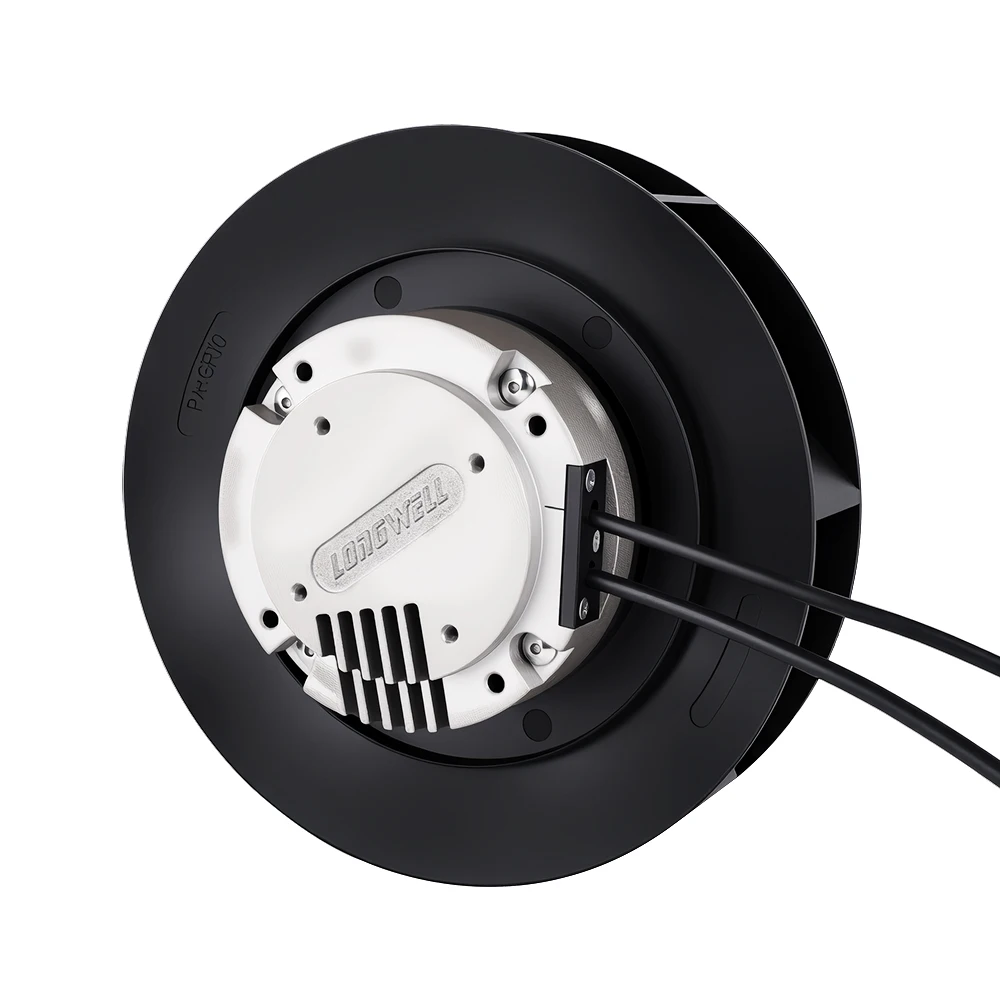
Measure available space in the equipment as well as the part itself. Include the route for installation, service access and the support arrangement. A candidate can resemble the removed fan while leaving a cable exit or maintenance point in an unsuitable position.
The EC centrifugal fan range provides family-level research options. Treat each candidate as requiring its own drawing and application review, not as an identified replacement for the pictured or existing fan.
Record electrical supply and control requirements separately
Retain the specified supply, phase, frequency, motor and drive information, current, power, speed and protection details. Identify whether a value comes from the nameplate, a drawing or a recorded operating condition. These sources answer different questions and should not be merged into an unlabeled specification.
Record control interfaces against the equipment’s wiring information. Wire colour and plug shape do not establish function or compatibility. Where the old connection is unclear, request the applicable documentation rather than trying connections. Have the responsible electrical specialist resolve an undocumented interface before a candidate is accepted.
Recover the operating duty and environmental conditions
Mechanical fit does not answer whether the fan can perform the required duty. Provide airflow and pressure together, identify the pressure and rating basis, and describe the relevant operating environment. Keep measured conditions separate from the duty the equipment is expected to achieve.
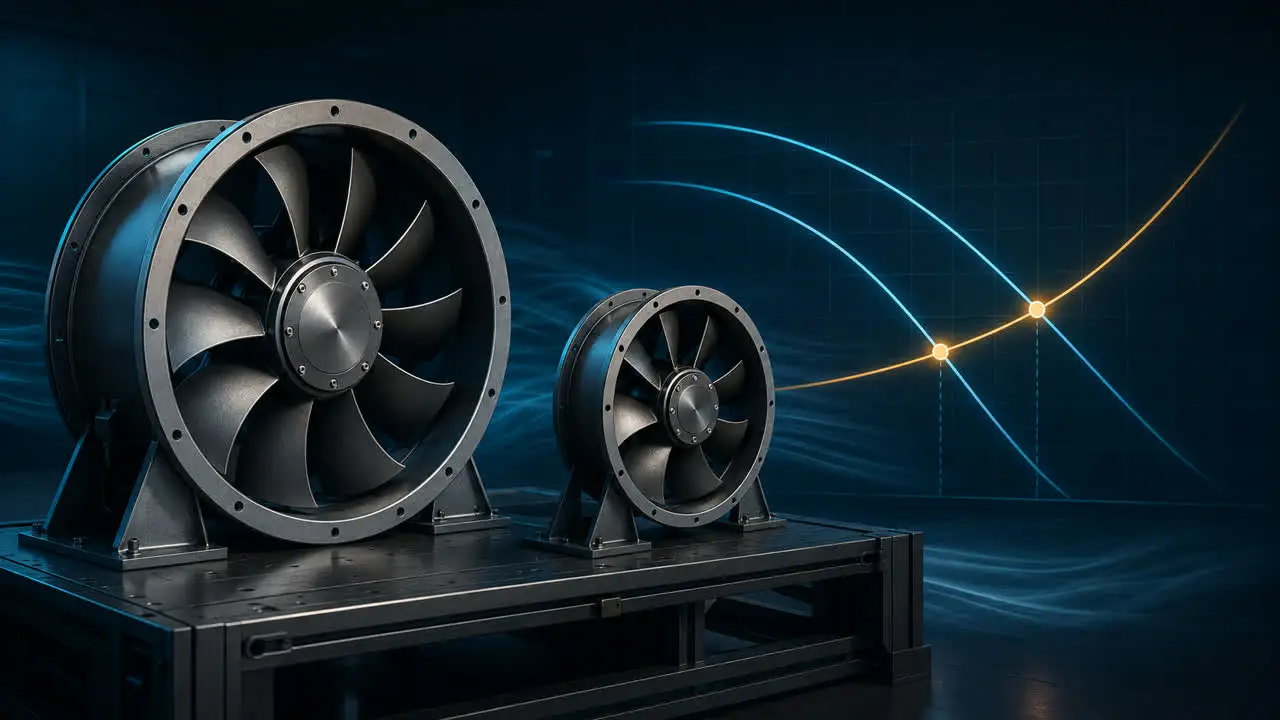
The guide to fan performance curves explains the relationship between fan performance and operating conditions. Use the candidate’s applicable data for the review; a general curve or another model’s result does not establish the performance of a replacement.
Submit deviations and failure evidence with the measurements
Investigate why the old fan is being replaced and retain relevant damage, failure symptoms and operating records. Copying the old dimensions without examining the failure leaves an important part of the decision unanswered. Mark damaged or inaccessible features so that the reviewer can distinguish uncertainty from an intentional requirement.
Bundle the annotated sketch, photographs, identity records, interface measurements, electrical requirements and duty information. List candidate deviations explicitly. Changes in mounting, envelope, load path, controls or performance need engineering review; dimensional similarity alone does not justify describing a fan as a guaranteed drop-in replacement.