A whole house fan not working — it will not start, moves too little air, or stops after a few minutes — does not point to one universal failed part. The same complaint can begin in a closed air path, a controller command, a shutter interlock, a belt or wheel problem, or an electrical fault. So a useful process splits what a homeowner can observe from what needs qualified service.
First, record the symptom exactly. What does the control show? Do the shutters move? What sound do you hear? How long does the fan run, and does airflow change when you open the intended intake path? Do not begin by buying a motor or a capacitor.
First confirm which fan system you have
A whole-house fan draws outdoor air through chosen openings in the living space and pushes it into the attic. An attic fan vents the attic itself. Meanwhile, an HVAC blower moves air through the duct system. Their controls, dampers, risks and parts all differ, even though homeowners call all three “the house fan.” That is why a whole house fan not working needs its identity settled first.
Next, photograph the nameplate, the control, the grille, the shutters, the attic-side assembly, and every readable model suffix before ordering parts. For broader system context, Longwell’s residential ventilation solution overview is a project-scoping reference, not proof that any listed product fits the installed fan.
Apply a safety stop gate before testing
Stop the fan and leave the area if a carbon-monoxide alarm sounds, you smell gas, you see soot or smoke, or a flame at fuel-burning gear behaves oddly. Those are emergencies, or work for a qualified combustion-safety check. They are never a fan-repair experiment. Above all, do not run the fan to “clear” a suspected combustion problem.
Also stop for damaged wiring, scorching, a hot electrical odor, a loose guard, severe vibration, or contact with moving parts. A wall switch set to off is not isolation. Likewise, never bypass an interlock, hold a shutter open, remove a guard for a live test, hand-spin the wheel, or keep resetting a tripping circuit.
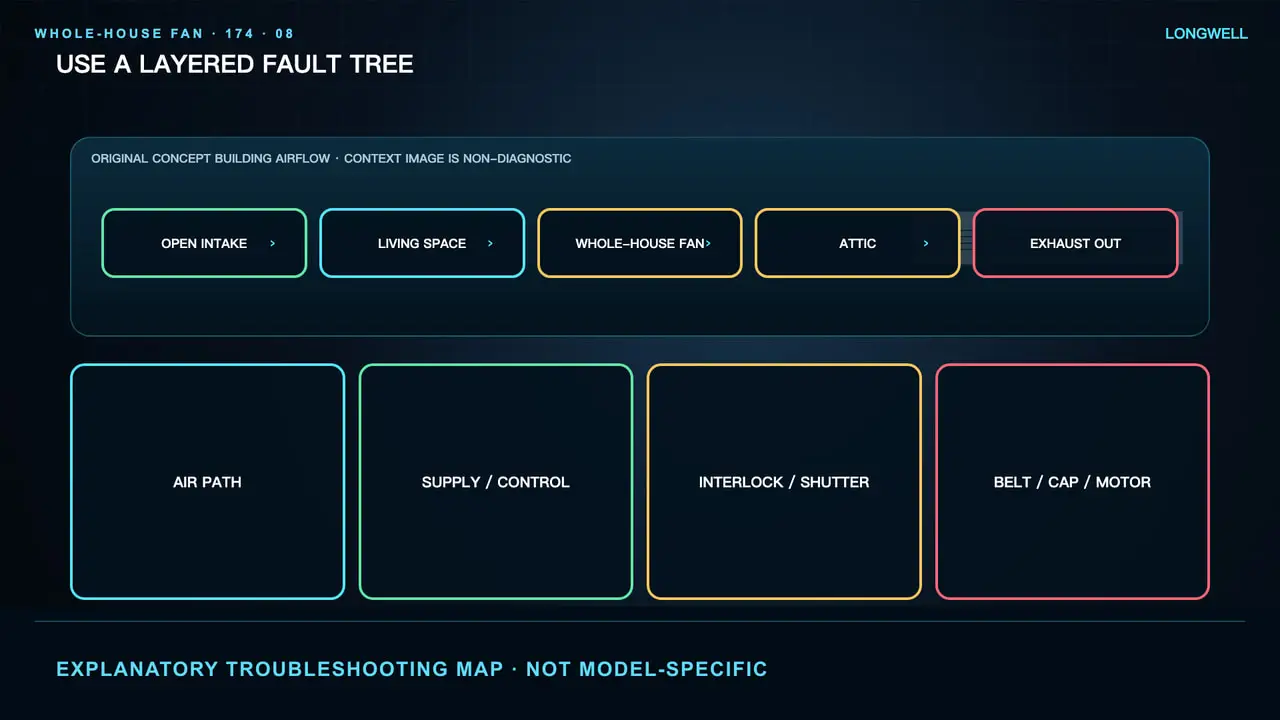
Check the air path before blaming the motor
Open the intake the instructions call for. Then follow the path from the living space, through the fan, and out of the attic. Closed windows, blocked screens, stalled shutters, stored items near the discharge, or too little attic exhaust can all cut airflow or raise load. In many cases of a whole house fan not working, the air path is the fault and the motor is fine. Do not invent a window count or vent area; those depend on the unit and the building.
Observe from outside the machine only. Do the shutters start to open? Does the sound change? Is airflow even across the chosen openings? Never reach through a grille or enter an unsafe attic. If you cannot inspect the route safely, note what you can see and hand the next step to a technician.
A whole house fan not working: five symptom branches
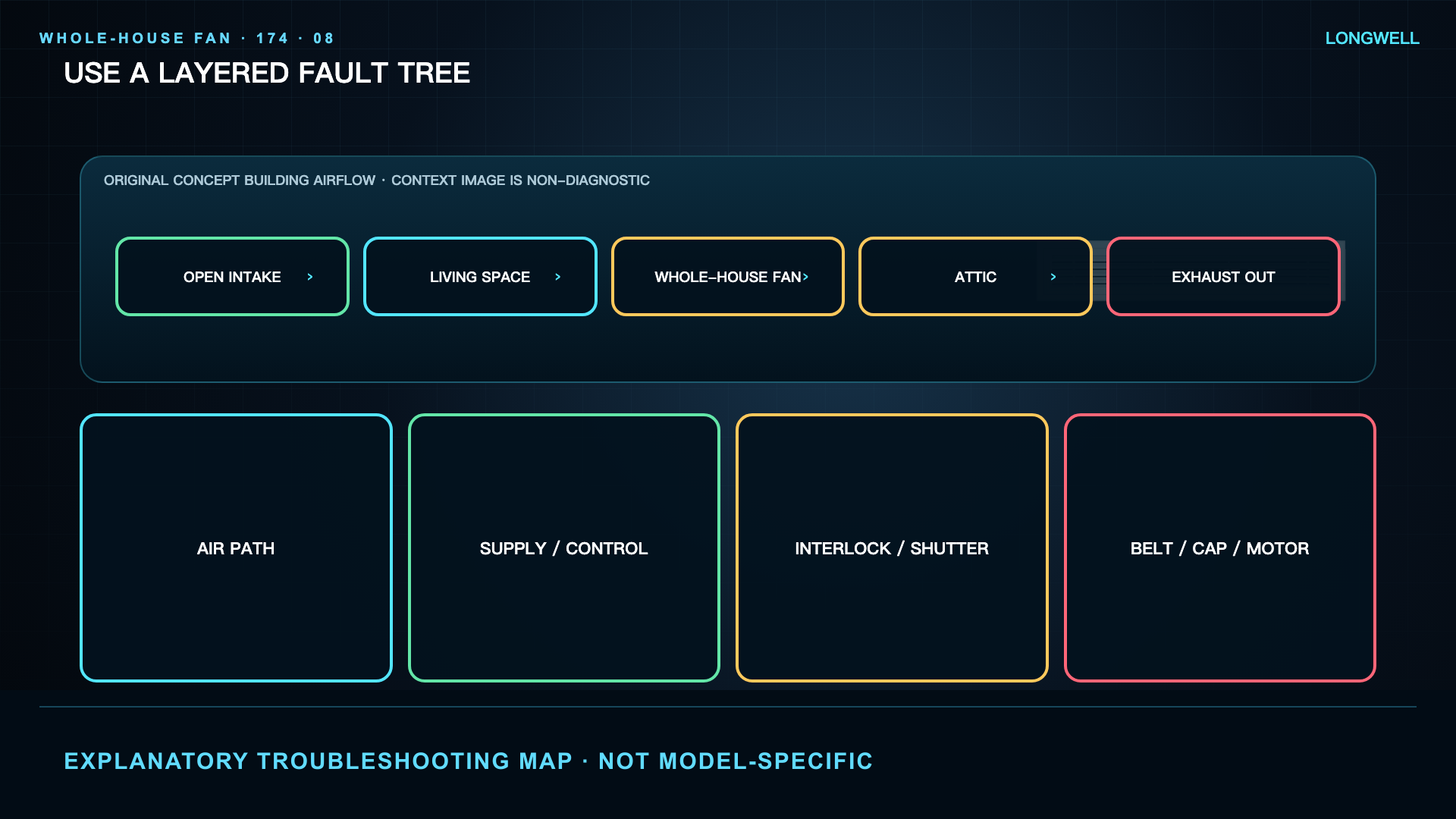
- Silent, with no shutter movement: record the controller state and any indicator or fault code. The cause may sit in the supply, the command, the interlock or the motor circuit. Silence alone does not identify it.
- Shutters move, but the fan does not: stop the attempt and report the sequence. A qualified check can then separate interlock, belt or wheel restraint, capacitor, motor and wiring causes.
- The fan hums but does not start: switch it off. Do not push-start the wheel or short a capacitor. An obstruction, a mechanical load, a starting part or the motor itself can all hum the same way. The US Department of Energy’s whole-house fan overview explains how these systems are meant to run.
- The fan runs but airflow is weak: recheck the intake and the attic exhaust path. Then note shutter position, belt sound, odd vibration, and whether the problem is uniform or tied to one room.
- The fan cycles or stops: record the run time, the control status, the conditions, and whether it restarts by itself. Restriction, overload, protection, control logic or a loose connection each need evidence before you blame a part.
Leave energized and guarded checks to qualified service
A technician should find every energy source, isolate each one by the equipment procedure, verify the safe state, and restore guards before commissioning. After that, the service sequence tests the control command, the supply, the interlocks and shutters, the belt and wheel, the capacitor where fitted, the motor, the wiring, obstructions, and the protection history against the maker’s exact information.
No single voltage, resistance, capacitance, temperature or current value is universal. Therefore, ask the technician to record the test point, the condition, the instrument, the units, and the permitted range. That turns “the motor seems bad” into a finding someone else can review.
Choose repair or replacement only after identity is settled
With a whole house fan not working, repair makes sense when you know the exact assembly and revision, the housing and wiring are still serviceable, and an approved part exists. Replacement is a different task. Opening size, mounting, supply, control method, shutters, air path, sound target, access and combustion interaction all need review. Similar dimensions, or a similar advertised airflow, do not make two fans equivalent.
Send an RFQ that can be answered without guessing
Include clear nameplate and installation photos, the model and suffix, the voltage, frequency and phase, controller and wiring references, opening and mounting dimensions, the intake and attic exhaust arrangement, the exact symptom sequence, any alarms or trips, prior service, video of the sound or shutter behavior, and whether fuel-burning gear is present. For a replacement, also give the required duty point and its pressure basis, the operating temperature, the sound target, the space limits, and any local requirements. A complete RFQ for a whole house fan not working gets a usable answer on the first pass.
Ask the supplier to say whether they propose a repair part, a complete fan, or a system redesign, and to name every assumption they made. The Longwell solutions directory can route a documented project inquiry, but it does not confirm a model match, performance, certification, or replacement compatibility.
Commission the complete guarded system
After service, confirm the guards and panels are back, the shutters work, airflow is stable, and there is no odd noise, vibration, cycling or heat. Where the fan can affect fuel-burning gear or building pressure, include a qualified combustion-safety check. Finally, keep the findings, the part identity, the settings and the closing notes with the system record.