Thermal management has become the engineering challenge in dry-type transformer design as transformer power ratings continue to increase. It is known that dry-type transformers rely entirely on air circulation to dissipate heat from the windings and core. At ultra-high-power levels, natural convection (AN) can no longer remove heat fast enough — risking localized hot spots, accelerated insulation aging, and forced capacity derating. A purpose-engineered forced-air (AF) cooling system is therefore essential to achieving rated performance and ensuring long-term reliability.
LONGWELL integrated fans provide a compact and efficient solution for forced-air cooling in high-power dry-type transformers. By generating a uniform airflow across the transformer cooling surfaces, cross-flow fan technology can help improve heat dissipation, support stable operating temperatures, and enhance overall transformer reliability.
Engineering Cases
A global transformer OEM partnered with LONGWELL for an integrated cooling solution for their ultra-high-power dry-type transformers. LONGWELL uses cross-flow (tangential) and centrifugal fan technology.
LONGWELL delivered not just the fans, but the complete package – fans, aluminum ducts, structural frame, motor drives, wiring harness, temperature-controller interface, and acoustic treatment – engineered-to-order against the transformer’s exact kVA burden. The result is one of the few complete-package fan cooling solutions for ultra-high-power dry-type transformers commercially available globally, and is directly replicable across any global project of the same class.
Why this case matters: Most cross-flow fan suppliers ship fans only — leaving ducting, controls, brackets, and acoustic treatment to the transformer OEM. LONGWELL delivered one tested, warrantied, globally-certified package. That integration is the differentiator.
LONGWELL Solution
LONGWELL delivered a fully integrated fan thermal subsystem for dry-type transformer. This is one of the rare complete dual-fan solution packages for ultra-high-power dry-type transformer cooling globally. Most competitors specialize in single-technology niche, they ship fans only, leaving ducting, controls, and acoustic integration to the customer. That integration is exactly where most projects fail.
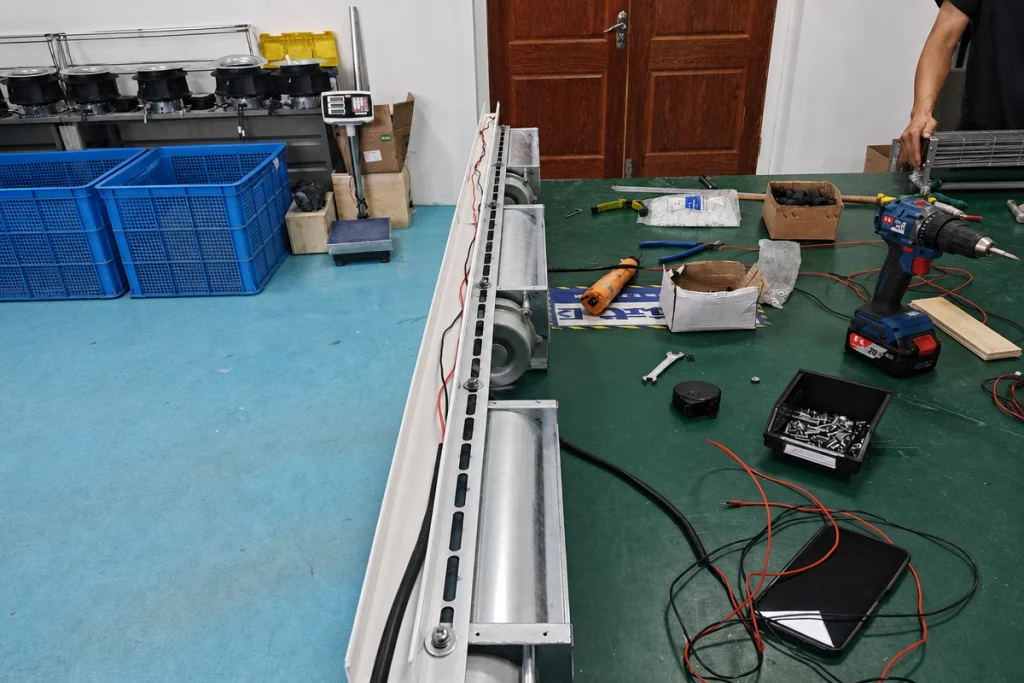
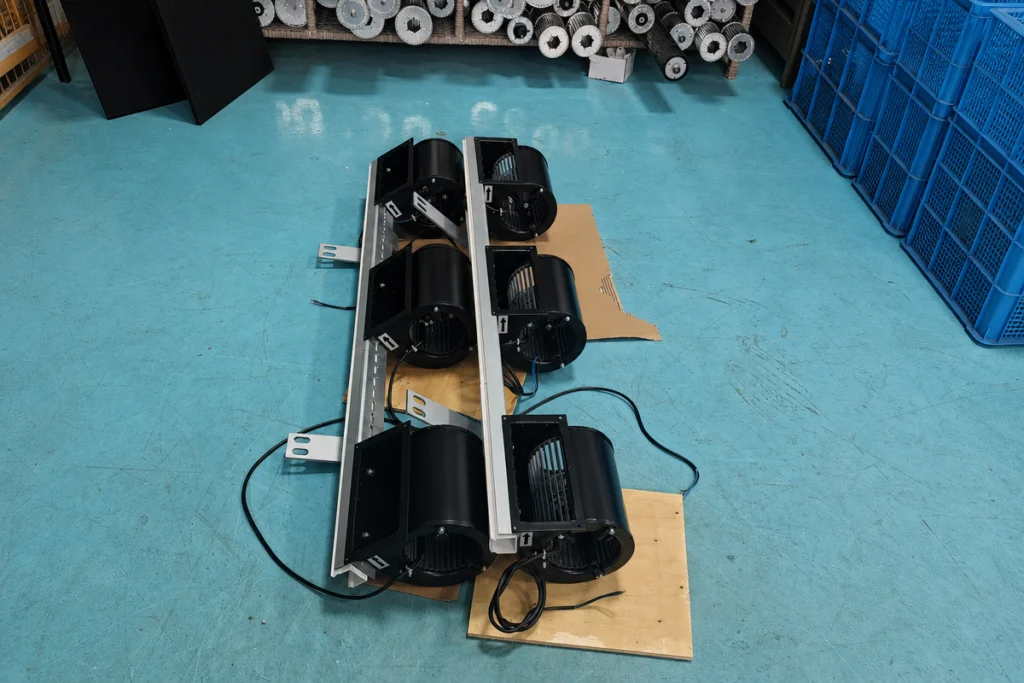
System Architecture
The fundamental requirement at 10+ MVA is not just airflow volume — it is both airflow uniformity across the winding height and sufficient total CFM to overcome system resistance and remove the elevated heat-flux load. The engineering reality is that system resistance in a UHP dry-type transformer typically reaches 150–250 Pa at the required airflow (inlet/outlet losses account for 30–40%, core-path resistance 20–30%, the remainder from ducts and fittings).
Cross-Flow (Tangential) Blower Bank
The cross-flow bank provides primary uniform sheet airflow across the entire winding height. Each long cylindrical impeller produces a rectangular, wide-amplitude airflow curtain — typically 590 mm to 2,000 mm depending on winding height — which directly blankets the LV/HV cooling ducts from edge to edge. The airflow is gentle and uniform, designed to enhance rather than disrupt the transformer’s natural convection pattern.
Cross-flow fans are specifically suited to the flat cooling surfaces of cast-resin and open-type dry-type transformers — their slim, elongated form factor allows installation along the full length or width of the cabinet, reducing the number of discrete fan units needed and improving overall system reliability through fewer components.
Centrifugal Blower Boosters
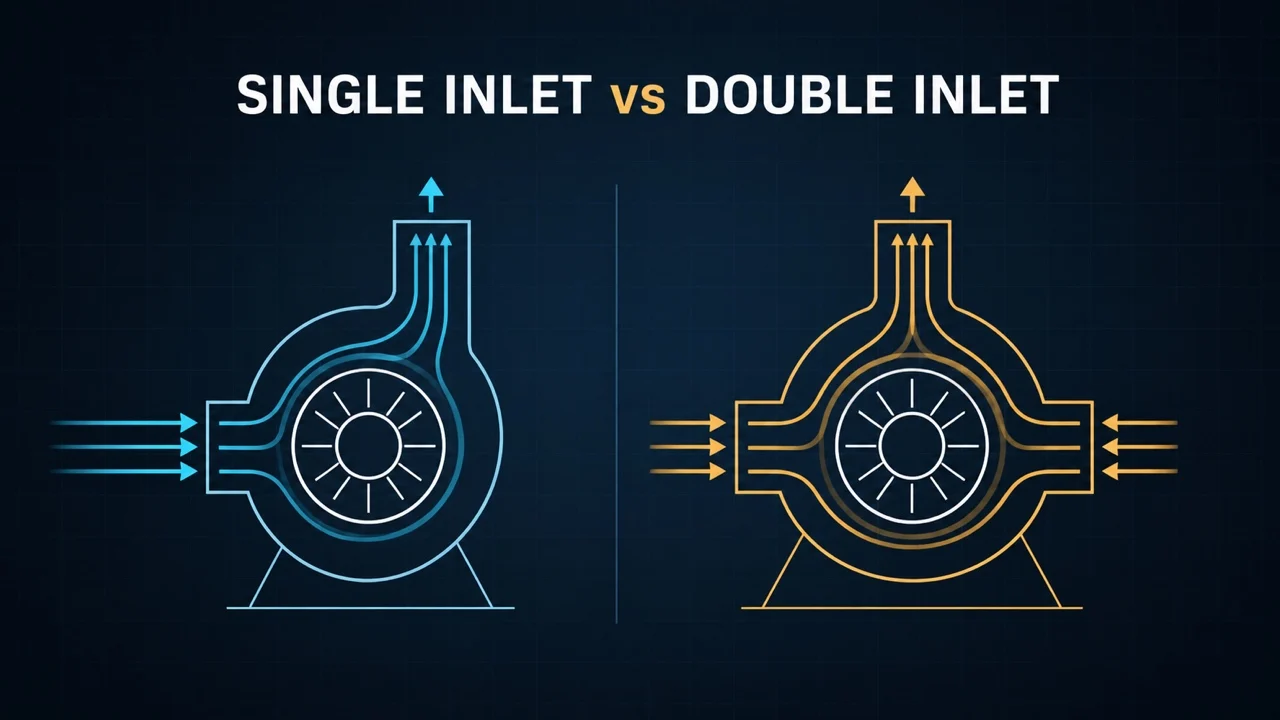
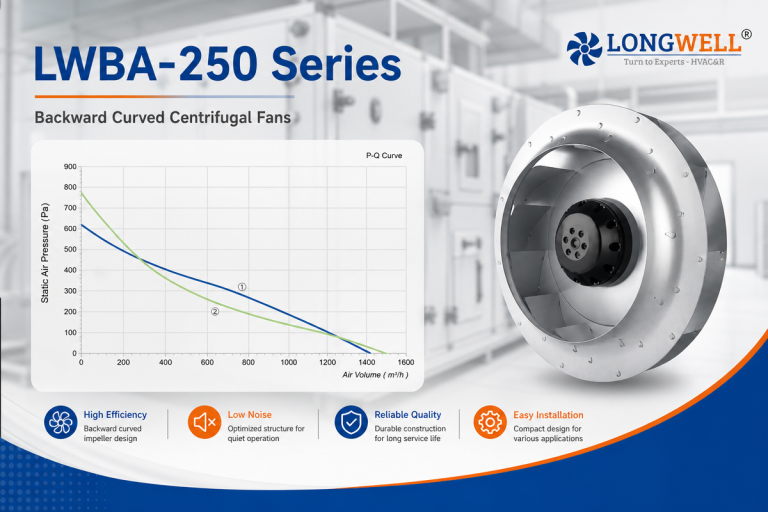
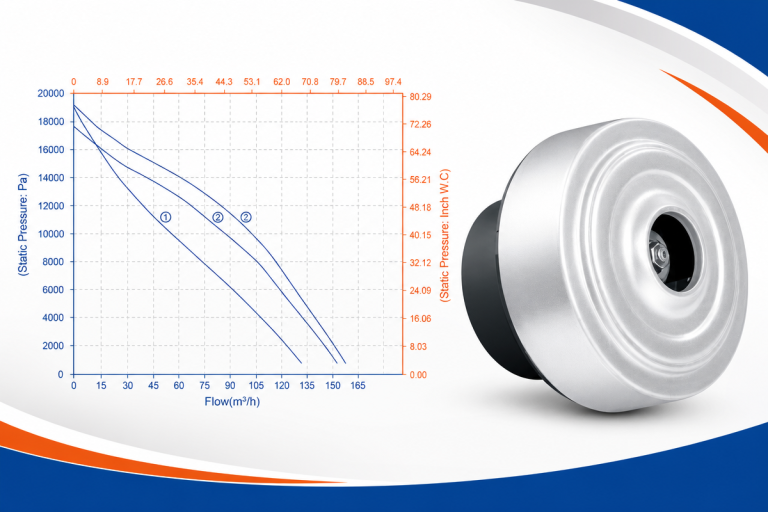
Centrifugal blowers supplement the cross-flow bank with high-static-pressure, high-CFM targeted airflow. The compact depth profile and rotatable volute housing allow the discharge direction to be oriented in any direction to match the duct layout, and the enclosed impeller design provides inherent protection against rain and debris for outdoor or semi-outdoor installations.
Sizing Methodology & Design Margins
The dual-fan system is sized using a four-step engineering process, not catalog selection:
- Thermal-load calculation: Using the heat-balance equation Q = 1.2 × V × ΔT (where Q = heat load, V = volumetric flow, ΔT = temperature rise, 1.2 = air volumetric heat capacity in kJ/(m³·°C)), the required airflow is computed from the transformer’s total losses.
- System-resistance mapping: The system-resistance curve is plotted against each fan stage’s performance curve. The intersection defines the operating point, which must fall within the middle third of the fan performance curve to avoid surge and ensure peak efficiency.
- Correction factors & safety margins: +15–25% safety margin is applied to the calculated airflow.
- Electrical & control integration: Motor electrical parameters are matched to the supply, and thermal-overload protection is configured.
Industry Implications — Globally Replicable
Across the global transformer industry, ultra-high-power dry-type units are the fastest-growing segment, but cooling has remained a bottleneck because:
- Traditional suppliers specialize in either cross-flow fans or centrifugal blowers — not both as a single integrated package.
- Transformer OEMs do not want to become airflow engineers — and even more so, they don’t want to source and integrate two separate fan suppliers into one thermal subsystem.
- Indoor, fire-safe installations (data centers, metros, renewables, public infrastructure) demand tighter acoustic, thermal, and integration control than ever before — and the dual-fan architecture is the only one that can deliver uniform coverage AND high total CFM at this power class.
About LONGWELL
LONGWELL is a specialized manufacturer of fans, including centrifugal fans, cross flow fans, axial fans, exhaust fans, and other industrial fans. It also provides solution for different airflow, ventilation, and cooling applications. Headquartered in Ningbo, China, with global distribution and engineering support, LONGWELL’s blower platform has been deployed across HVAC, data-center cooling, and industrial ventilation.
Why LONGWELL for Power-Equipment Cooling
- Cross-flow + axial + centrifugal coverage — among very few suppliers globally that can deliver all three fan types, and the only ones in the UHP dry-type transformer cooling market that integrate cross-flow AND centrifugal into one tested, warrantied subsystem.
- Vertical integration from EC motor winding to assembled blower unit
- In-house aerodynamic and acoustic test facilities
- Custom engineering support for OEM customers with thermal-manufacturing challenges
- Global compliance documentation (CE, UL, RoHS, IEC) integrated into the base platform
Contact LONGWELL
For technical discussions on similar projects — dry-type transformer cooling, integrated cross-flow + centrifugal dual-fan subsystems, or two-stage forced-air manifolds — contact LONGWELL’s power-equipment engineering team.
What to send for a fast quotation
Five items below — typical engineering reply comes back within 24 hours.
- 1 Transformer type and kVA rating Cast-resin / VPI / silicone-impregnated · single-phase or three-phase · voltage class
- 2 AN baseline vs. AF target uplift percentage Current rated kVA (ONAN) and target forced-air kVA — drives fan selection
- 3 Indoor / outdoor / offshore environment Ambient temp range, humidity, salt / corrosive atmosphere, altitude
- 4 Original cooling fan model If like-for-like replacement or retrofit — share current fan model and any photos of the installed assembly
- 5 Acoustic / IP / certification requirements Target dB(A) @ 1 m, IP54 / IP55, regional codes (IEC / UL / IEEE / JB-T)
Note: This case study is released for industry publication. For OEM-quote requests, site-survey scheduling, or customized reference design, please contact LONGWELL directly.
Contact LONGWELL →