A span no single extrusion survives
An industrial equipment maker needed a continuous 1200mm airflow curtain from an EC cross-flow fan. That dimension forced a split impeller from the start. Extrusions for cross-flow rotors stop well short of that span, because an unsupported shaft bends at speed, and the bending grows with the cube of length.
Meanwhile the order was for 408 units, so every answer had to be a production answer rather than a workshop one.
The compounding constraints
- Firstly, 1584 m3/h against 191 Pa, under 60 dB(A).
- Next, 220 V input with genuine 0-10V speed regulation.
- Meanwhile 85C constant ambient, far beyond the 60C where standard EC blowers stop.
- Finally, CE compliance with verification to AMCA 210/211 and ISO 5801 before mass production.
The customer own assembly plan
They asked for a two-section design: a 920mm base plus a structural extension, with their own technicians fitting the central shaft coupling during final integration.
Consequently, a precision operation moves onto their factory floor, and that shaped the engineering more than any airflow number did.
How a split impeller carries the span
A split impeller solves bending by dividing the span. In exchange, it creates three new problems: alignment, balance and the joint itself. The design work is those three.
Why splitting beats stiffening
The single-piece options all lose. A thicker-walled extrusion at 1200mm still whips at speed. A steel rotor gains stiffness and pays it back in weight and noise. And a mid-span support bearing steals airflow from the middle of the curtain.
By contrast, dividing the rotor halves the unsupported span, and each half then behaves like the proven shorter impellers it resembles.
The coupling the customer installs
Here the central coupling joins the sections into one stiff body, and it must do so repeatably in the customer factory, not just in ours.
So we designed the joint for assembly rather than adjustment: engagement that self-locates, torque that a fixture sets, and no step where a technician can introduce an angle. A split impeller that depends on skilled alignment fails statistically across 408 units.
Balance across a joint
Each section gets balanced on its own. Then the pair gets validated as an assembly, because two balanced halves can still meet at a heavy spot.
In short, the acceptance figure belongs to the assembled rotor. That is the number the 60 dB(A) limit rests on.
The 85 degree problem
EC electronics dislike heat, and 85C ambient is brutal territory for them. So the winding insulation moved beyond standard class, the bearing grease suits the top of the range, and the electronics sit out of the hottest zone rather than merely carrying a rating for it.
We also rejected the tempting alternative: an external AC motor on a drive belt, isolating the electronics entirely. It failed twice. The 0-10V regulation would then need a separate drive, and the belt itself is a wear item the customer maintenance plan did not want. Verification follows AMCA 210-16 methods.
Technical Specifications
The length row is the reason this product exists in two pieces. Every other row had to survive that decision.
| Parameter | Specification |
|---|---|
| Airflow | 1584 m³/h |
| Static Pressure | 191 Pa |
| Power | 68.7 W |
| Speed | 1500 RPM |
| Voltage | 220V / 230V |
| Frequency | 50/60 Hz |
| Noise | 59 dB(A) |
| Dimensions (Reference Unit) | A: 1059mm, B: 951mm, C: 930mm |
| Housing Material | Steel + Aluminum Alloy |
| Blade Material | Aluminum Alloy |
| Insulation Class | B (Base) / Upgraded for 85°C |
| Speed Control | 0-10V/PWM |
| Signal Output | FG |
| Bearing Type | Ball bearing (High-Temp Grease) |
Technical Documentation
LWCE-90520SN-10-00.pdf – Mechanical drawing and electrical schematic for the custom 520mm primary module, required by the OEM chassis integration team.
LWCE-901200SN-06-00.pdf – Dimensional specifications detailing the 1200mm dual-section shaft layout and mid-span support geometry for the final assembly.
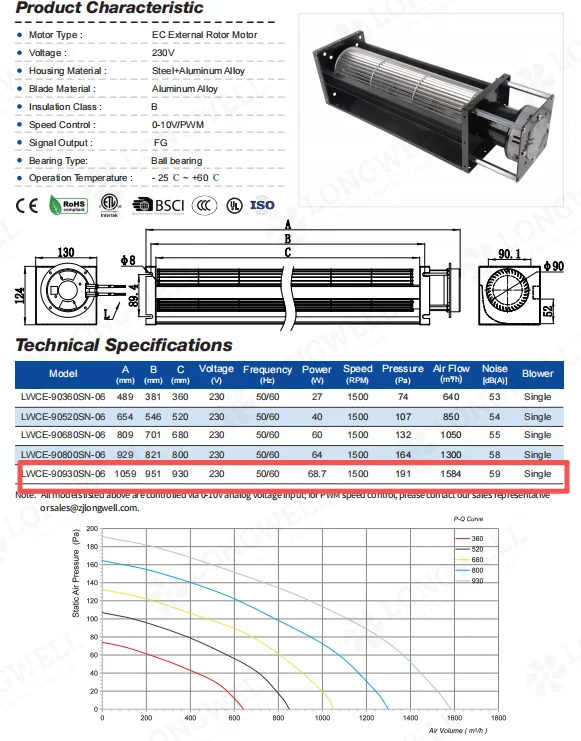 Standard performance curve and baseline characteristic data for the 90mm series EC cross-flow blowers used by the procurement manager for initial qualification.
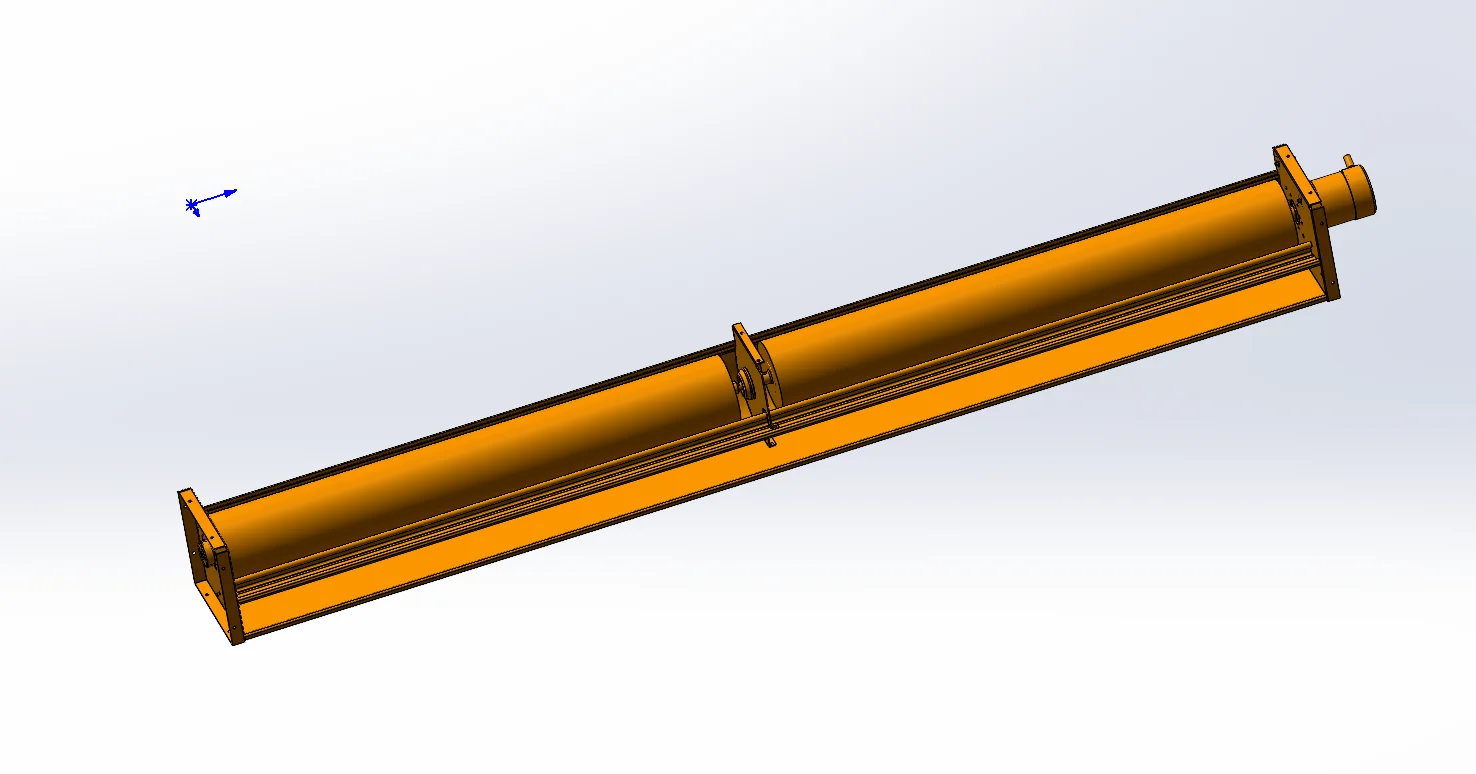 3D CAD visualization showing the tandem housing structure and central coupling access point requested by the production engineers.
Specifying a sectional rotor
A split impeller is the right answer to a narrow problem. Four checks tell you whether you have that problem.
- Confirm the span genuinely exceeds one-piece limits. After all, a split impeller adds a coupling, an assembly step and a balance validation. Therefore, below the length where extrusions run out, one piece is simpler, cheaper and quieter. Exhaust the single-piece options first.
- Decide who installs the coupling, and design for them. Specifically, a joint assembled in the fan factory can rely on fixtures and practice, while one assembled by the customer must be foolproof by geometry. State the assembly location in the enquiry, because it changes the design.
- Insist on assembled-rotor balance acceptance. Remember, two individually balanced sections do not guarantee a balanced pair. The figure that matters is measured after joining, in the configuration that will actually spin.
- Treat high ambient as an electronics placement question. Moreover, beyond insulation class and grease, ask where the drive electronics physically sit relative to the heat. A rating on a datasheet is not the same as a component kept out of the hot zone.
See our cross-flow fans range, the EC cross-flow fans section, or cross-flow impellers.
Questions about split impellers
Why not just support a long impeller in the middle?
A mid-span bearing works mechanically, but it costs airflow, because the support structure sits directly in the discharge. On an air curtain, whose whole purpose is an unbroken ribbon of air, a gap in the middle defeats the product. Splitting the rotor keeps the curtain continuous.
Does the coupling change how the fan runs?
A well-designed one does not. Instead, it joins the sections into a single stiff body, and the assembled rotor gets balanced and validated as one. What it does change is the assembly process, which is why who installs it, and with what fixture, belongs in the specification.
How does shaft deflection scale with length?
Steeply: bending under self-weight grows roughly with the cube of the unsupported span. For example, a 920mm section behaves well while the same construction at 1200mm whips. That is also why halving the span buys back far more stiffness than thickening the wall.
Is 85C ambient really that different from 60C?
For the electronics, yes. After all, component life roughly halves per 10C, so the same drive runs at a fraction of its expected life. Surviving 85C is a design exercise in insulation, lubricant and physical placement together, not a derating footnote.
Got a duty point you need matched?
Tell us the airflow, the pressure and the space you have. Then we mark your duty point on a tested curve and send the drawing back. Meanwhile samples and custom spec sheets take up to 90 days. Since 1990 we have supplied OEMs across HVAC, refrigeration and industry.
Browse Related Products:
🏆 ISO 9001 / ISO 14001 / ISO 45001 | CE (TÜV) | UL/ETL | ATEX Zone 21/22 | AMCA 210/211 / ISO 5801 tested