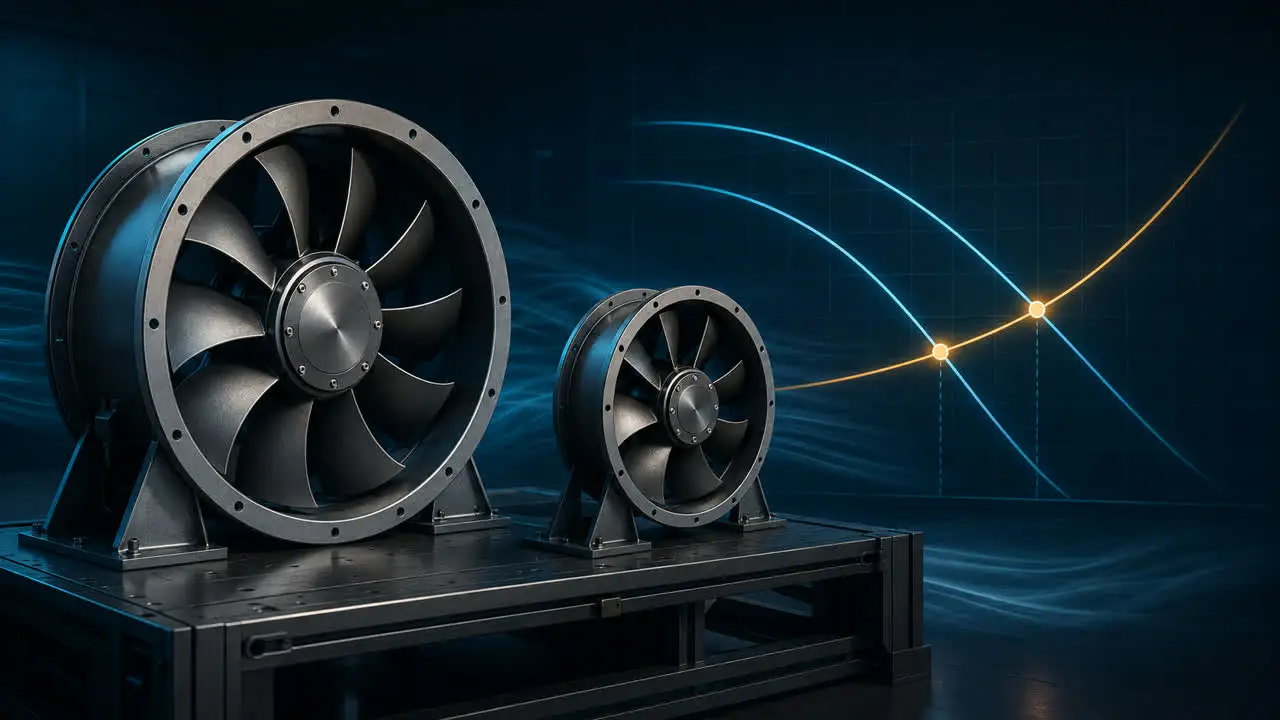
Between a fan that runs flat out and variable speed fans that modulate all day sits a middle option people often overlook.
Two-speed fans capture a large share of the energy benefit for a fraction of the cost, provided the load has two clear states.
Fixed speed suits constant duties and costs least. Two-speed fans suit loads with a clear high and low state, and running at half speed uses about an eighth of the power. Variable speed suits continuously varying loads and captures the most energy, though it costs most and adds complexity.
What the cube law gives you
| Speed | Airflow | Power |
|---|---|---|
| 100% | 100% | 100% |
| 75% | 75% | 42% |
| 67% | 67% | 30% |
| 50% | 50% | 13% |
So that table explains why two-speed is worth a look. A fan spending half its hours at 67 percent speed uses roughly 65 percent of the energy of one running flat out.
How each option is achieved
- Fixed speed needs a contactor and nothing else.
- Two-speed on an AC motor uses pole-changing or tapped windings.
- On a single-phase motor, a relay simply picks a different speed tap.
- Variable speed on AC needs a drive, along with the checks that implies.
- On EC, variable speed fans have it built in, so you send a signal.
- Finally, staging several fans gives coarse steps without any drive at all.
Staging deserves more attention than it gets. Four fans switched one at a time give five load steps, and they need no speed control hardware at all.
Comparing the three
| Fixed | Two-speed | Variable | |
|---|---|---|---|
| Capital cost | Lowest | Low | Highest |
| Energy saving | None | Moderate | Highest |
| Control complexity | Minimal | Simple | Higher |
| Noise at part load | Unchanged | Noticeably lower | Lowest |
| Maintenance | Simplest | Simple | More to go wrong |
| Best fit | Constant duty | Two clear load states | Continuously varying |
Our part-load energy guide covers the variable speed case in more detail.
Where two-speed is the right answer
The clue is a load with two obvious states rather than a smooth range. Where the demand moves continuously, variable speed fans win instead.
- Kitchen extraction, since cooking and idle periods differ sharply.
- Car park ventilation, because busy and quiet hours are distinct.
- Livestock buildings, which switch between minimum and tunnel modes.
- Cold stores, where door-open and door-closed are two clear states.
- Workshops, since occupied and empty need very different rates.
- Finally, night setback in almost any occupied building.
In each case a simple timer or sensor picks the speed, so no drive is needed at all.
Where variable speed fans earn their cost
A continuously varying load wastes the most at fixed speed, so it gains the most from variable speed fans.
Variable air volume systems, data halls and demand-controlled ventilation all sit here. Meanwhile variable speed fans also allow trimming at commissioning, which is worth having even where the load barely moves.
Variable speed lets you trim the fan to the actual system rather than to the design estimate. On a fan that turned out oversized, that alone can save more than the control hardware cost.
Practical cautions
Speed control brings a few requirements, whichever method you pick.
Set a minimum speed that keeps the motor cool and the system safe. Then look for resonance bands when sweeping variable speed fans through their range. Meanwhile respect any minimum airflow rule, because air quality and freeze protection ignore energy targets entirely.
Our VFD compatibility guide covers the drive checks, while ASHRAE guidance covers minimum ventilation rates.
One last suggestion before committing to hardware. Log the fan for a week and plot how many hours it spends at each load. If the picture shows two clusters, two-speed will do. If it shows a smear across the range, variable speed fans are worth the money.
Speed control FAQ
Are two-speed fans worth it?
Frequently yes, where the load has two clear states. They capture a large share of the variable speed saving for a fraction of the cost and complexity.
Can any AC motor run at two speeds?
No. It needs pole-changing or tapped windings, which have to be specified at purchase. A standard single-speed motor cannot be converted.
Is staging as good as speed control?
For coarse control, close. Staging fans in an array gives useful steps without any drives, though each running fan still operates at full speed.
Does two-speed operation reduce noise?
Considerably at the lower speed, since sound power falls steeply with speed. Dropping to two-thirds speed typically removes around 9 dB.
Match the control to the load. Fixed speed suits constant duties, two-speed suits two clear states, and variable speed fans earn their cost where demand genuinely moves all day.