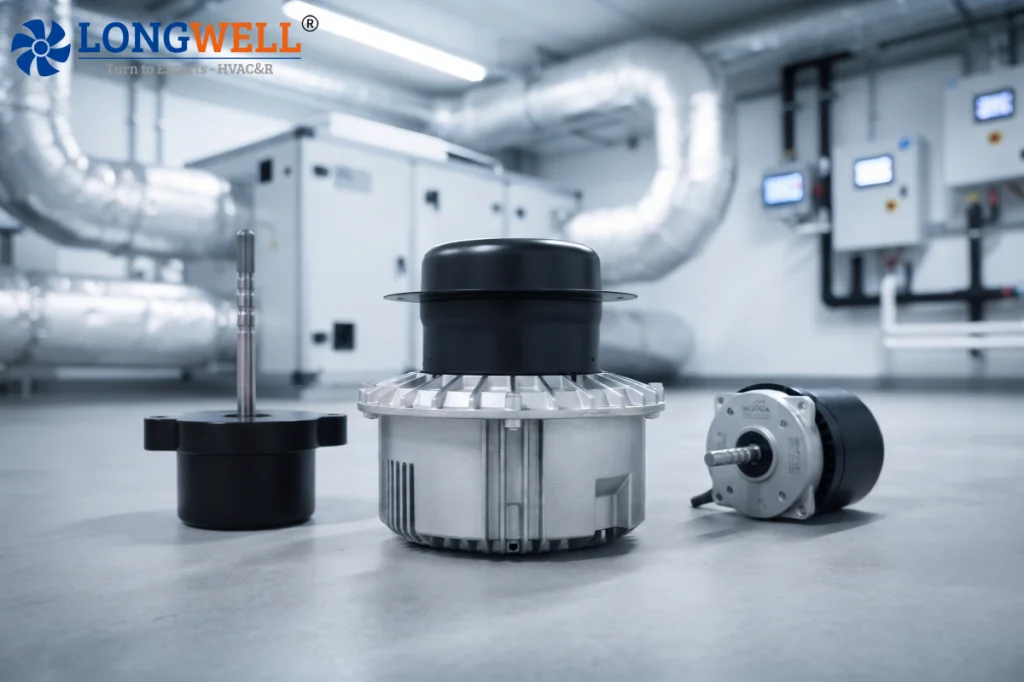
Electric motors served as the driving components of HVAC systems. Their operation directly affects energy consumption and overall system performance. Traditional HVAC applications commonly use AC motors. It is because AC motors are compatible with standard power supplies and are usually in a smaller size. As energy efficiency requirements become stricter, traditional AC motors are gradually being phased out. EC motor boasts higher efficiency and precise speed control. It is becoming more popular in HVAC systems.
In this blog, we will compare the differences between using EC motors and traditional motors in HVAC systems. We will also explore ways that can maximize EC motor efficiency in HVAC systems and introduce LONGWELL’s EC motor technology.
EC Motor vs Traditional Motor: Key Difference
AC Motor
AC motors are one of the most widely used motor types in traditional HVAC applications. They operate by using alternating current to generate a rotating magnetic field that drives the rotor. The conventional AC motors typically operate at fixed full speed, leading to more energy consumes. This limits their response to changing airflow requirements in practical HVAC systems.
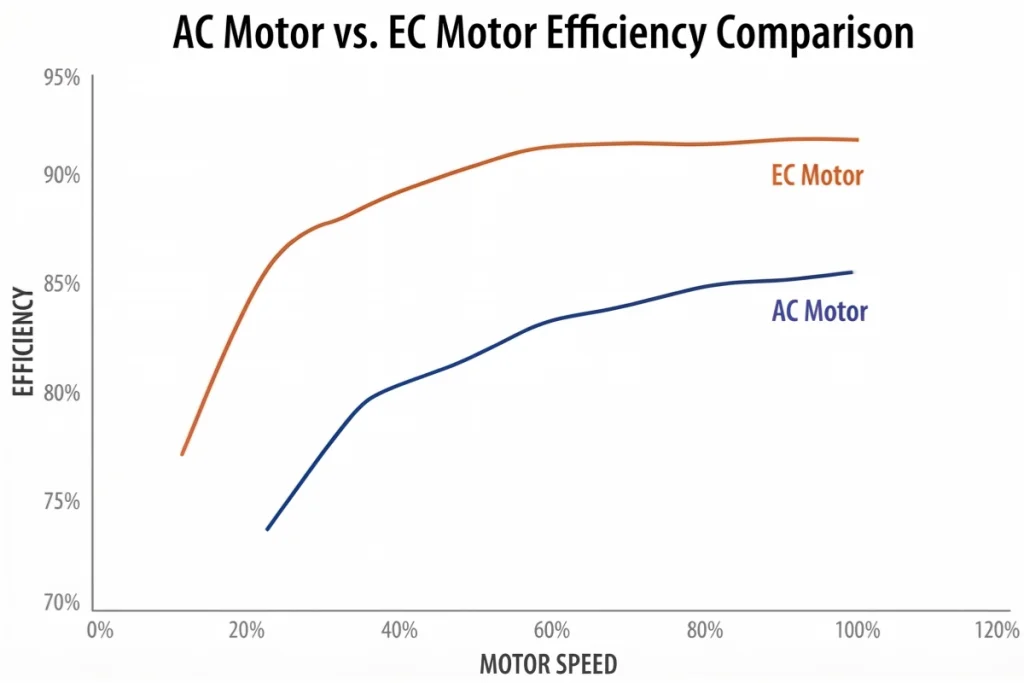
Although an AC motor can add external VFDs to adjust speed, this may increase the installation complexity and costs. Meanwhile, the efficiency of AC motors may also decrease when operating away from their optimal performance range.
DC Motor
DC motor uses direct current to generate electromagnetic force. This limits DC motors’ direct application in many HVAC systems because AC power is the standard source. Compared to an AC motor, a DC motor can provide more precise speed adjustment. A major advantage of DC motors is their permanent magnet design, which reduces energy losses. However, conventional brushed DC motors rely on mechanical brushes and commutators. These components create friction and wear over time, resulting in higher maintenance requirements.
EC Motor
EC motor combines the advantages of AC and DC motors. It uses brushless and permanent magnet technology with electronic commutation. It is different from traditional motors that rely on mechanical switching or external controllers. This design provides precise control of current flow and rotor movement. The brushless motor eliminates mechanical wear components, improving reliability and extending operating life.
One of the most significant advantages of EC motors in HVAC applications is their variable speed control capability. The intelligent control system integrated with the EC motor enables it to automatically adjust the speed and power output according to the real-time air flow requirements. This helps the HVAC system maintain the required performance while reducing unnecessary energy consumption.
| Feature | AC Motor | DC Motor | EC Motor |
| Power Source | AC | DC | AC input with electronic commutation |
| Speed Control | Limited;often requires VFD | Requires controller | Integrated variable speed control |
| Energy Efficiency | Medium | Higher | Significantly Higher |
| Maintenance Requirement | Higher | Moderate | Lower |
Why are EC Motors Used in HVAC Systems?
Lower Energy Costs
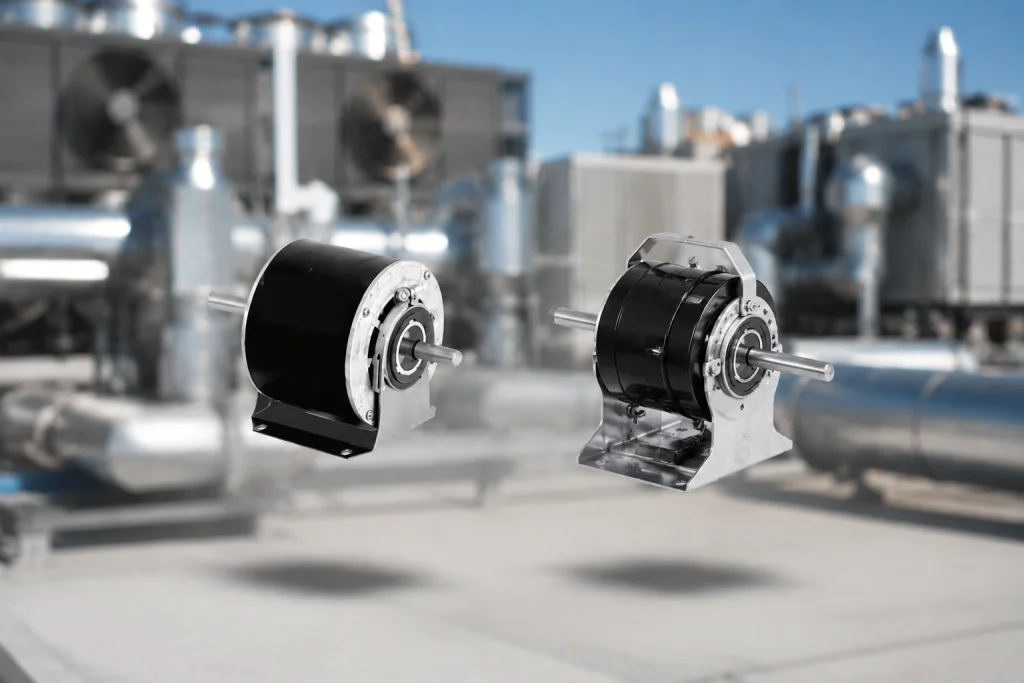
One of the main reasons that modern HVAC systems use EC motors is their lower energy consumption. A traditional motor cannot precisely control the speed. In practical HVAC applications, airflow demand often changes depending on room occupancy and outdoor temperature. Always using at full speed results in unnecessary energy consumption. EC motors can adjust their speed automatically based on the actual airflow requirements, which solves this issue. In addition, the fan power consumption follows the fan affinity law, where power is proportional to the cube of rotational speed. Reducing the fan speed when it is not necessary significantly reduces energy consumption. Facilities that switch to EC motors experience immediate and long-term savings.
Higher Reliability
EC motor also provide enhances system reliability and longer service life. The design of EC motors eliminates brushes, which are common failures in traditional motors. They avoid the gradual wear on mechanical brushes and commutators. Furthermore, the EC motor reduces friction and heat generation, resulting in improved operational stability and a longer service life. This is critical to HVAC systems that operate continuously for extended periods.
The design of EC motors integrates the motor and electronic controller into a single unit, reducing the need for additional control components and simplifying system installation. In compact HVAC systems, it can help improve system integration.
Lower Operational Noise
In offices, hospitals, hotels, and residential buildings, HVAC systems and noise level is particular sensitive. Excessive fan noise can negatively affect indoor comfort and user experience. EC motor can achieve precise speed control, which avoids sudden speed changes and repeated starting or stopping. This reduces sudden airflow changes and minimizes mechanical and aerodynamic noise generated by the fan.
Additionally, the brushless design of EC motors eliminates noise caused by brush friction and mechanical switching. Combined with optimized fan blade design and proper system configuration, EC motor-driven fans can achieve quieter operation in HVAC systems.
How to Maximize EC Motor Efficiency in HVAC systems?
In HVAC systems, only using an EC motor cannot reach high efficiency. The fan, control strategy, and operating conditions should work together to generate a high-efficiency system.
Select the Right Fan and Motor Combination
The first step is to select the fan that matches the system’s requirements. The mismatched motor and fan may consume unnecessary energy, reducing efficiency and shortening service life. The right fan should operate close to its BEP in the HVAC systems.
In addition, the motor rating should match the required airflow and pressure conditions. Selecting an EC motor based only on its maximum output may result in inefficient operation during normal working conditions.
Utilize Variable Speed Control
The airflow requirements in HVAC systems may change. The building occupancy or temperature is rarely constant. Under this condition, the constant speed motor is not the most efficient driving. Integrating EC motors with intelligent control systems, such as 0-10V analog control, PWM signals, or building management systems. It allows HVAC equipment to maintain optimal performance under different operating conditions.
Optimize HVAC System Design
Reducing unnecessary pressure losses allows the EC motor to operate at a lower speed, improving the system efficiency. In HVAC systems, ductwork plays an important role in overall efficiency. Common causes of increased system resistance include dirty filters, poorly designed duct installation, and excessive bends or restrictions in ducts. Poorly designed ducts can force fan motors to operate at higher loads and consume more energy because of increasing airflow resistance. For OEM HVAC manufacturers, optimizing the airflow path and component integration can further enhance the efficiency benefits provided by EC motors.
Maintain Proper Operating Conditions
The brushless design of EC motors leads to fewer maintenance requirements. However, EC motors also need proper operating conditions for keeping long-term efficiency. The motor performance will be influenced by accumulated dust or overheating. Regular inspection of the fan assembly and electrical connections helps ensure the motor continues operating efficiently.
For HVAC systems, preventive maintenance can also help identify issues such as reduced airflow, increased vibration, or abnormal noise. This helps prevent small problems from accumulating and eventually leading to the shutdown of the motor.
LONGWELL’s EC Motor Technology
LONGWELL has invested heavily in research and development to create EC motors that lead the industry in efficiency and reliability. The EC motor of LONGWELL is controlled by FOC vector technology to enable electronic commutation.
SmartEC™ Variable Speed Control
LONGWELL’s EC motors use advanced variable speed control to deliver matched energy efficiency in HVAC systems. These variable-speed motors adjust their output based on real-time demand. The integrated SmartEC™ platform allows the motor to operate at the exact speed needed for current conditions. When heating or cooling needs change, the motor responds instantly, which leads to significant energy conservation. In commercial HVAC systems, this dynamic operation means less wasted energy and more consistent performance.
OEM Integration and Customization
LONGWELL’s EC motors support IoT integration for smarter HVAC management. The system can use the information from real-time data sensors to customize settings. For the model differences resulting from brand changes, LONGWELL provides a model comparison table to minimize integration discrepancies.
LONGWELL supports multi-dimensional customization for OEM partners.
- Appearance Customization: Size adjustment according to installation space, custom colors, special surface treatment (anti-corrosion, rust prevention, etc.).
- Performance Customization: Optimize air volume or static pressure for specific working conditions, special low-noise design, bearing upgrade and material strengthening.
- Electrical Control Customization: Voltage adaptation to regional standards, intelligent control and sensor integration, interface design adaptation.
- Packaging Customization: Custom brand LOGO, packaging design, special labels or QR codes.
LONGWELL also provides fans specific for HVAC systems.
FAQs
Can EC motors improve reliability in HVAC systems?
Yes. EC motors integrate several components, which reduce the chance of overheating and electrical failures in HVAC systems.
What makes EC motors more efficient than traditional motors in HVAC systems?
EC motors use advanced electronics and brushless technology, which achieve speed control based on demand. This reduces wasted energy in HVAC systems.
Are EC motors suitable for all types of HVAC systems?
The EC motors are suitable for many HVAC systems. Their compact size makes them easy to install in HVAC projects. However, whether to choose EC motors depends on the condition of your HVAC systems.
How do EC motors help lower operational costs in HVAC applications?
Compared to traditional motors, EC motors use less electricity in HVAC systems. They only speed up when needed. Facilities need fewer repairs and longer equipment life, which saves money over time.
Choose the right ec axial fan
Longwell manufactures 152 ec axial fans in-house. Send airflow, static pressure and voltage — an engineer replies with a matching model, performance curve and price within one working day.