Specifying Cabin Airflow in Tight Spaces
The customer needed a reliable elevator cross flow fan to cool a passenger cabin. Space was the biggest problem here. The fan had to fit inside a shallow roof cavity. This gap measured strictly under 135 mm high.
Therefore, we kept the final profile exactly 131.2 mm high and 125 mm deep. Furthermore, the motor only adds 25 mm to the depth. Meanwhile, the total assembly width hit a strict limit of 425 mm. Standard commercial units were simply too large for these constraints.
Next, we checked the electrical limits. The control board supplies 220VAC directly to the ceiling unit. However, the frequency changes based on the region. The motor must handle both 50Hz and 60Hz inputs safely.
So, the target airflow sat at 250 m³/h at 50Hz to meet standard air exchange rates. Furthermore, the ambient temperature required a span of -20 C to +60 C. This wide thermal band handles cold shafts in winter and hot solar gain in summer. Finally, the unit needed to meet GB/T13933-2008 safety rules. The housing required a tight grill over the moving parts.
Engineering the Impeller and Motor Control
We had to balance steady airflow, low weight, and low noise. First, we tested standard aluminum for the 90.4 mm impeller. However, we rejected the heavy metal quickly. Metal impellers add a lot of mass to the shaft. Consequently, this heavy weight hurts the bearings and makes the fan louder.
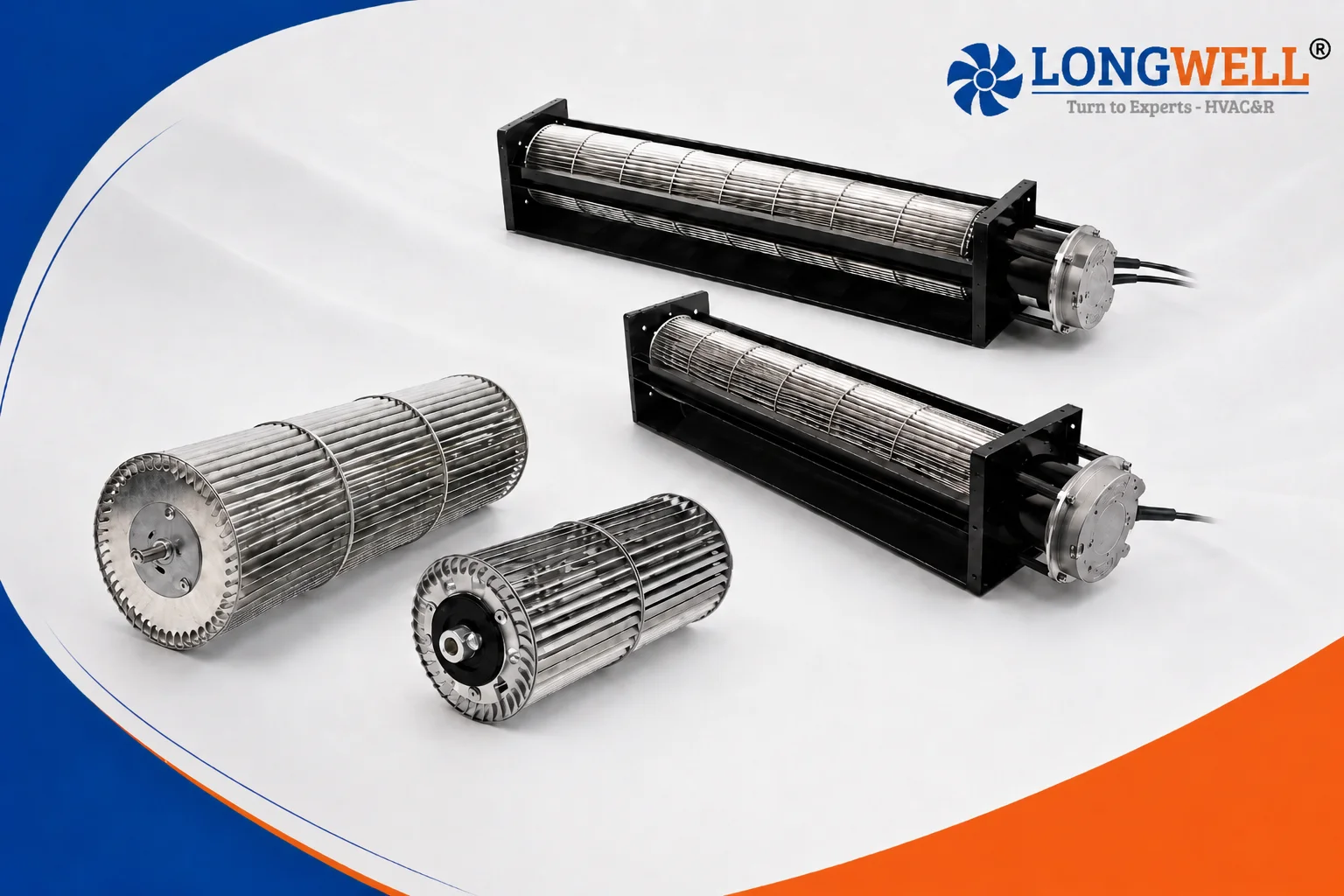
Instead, we chose a special plastic for the long blades. We selected an AS polymer blended with 30 percent glass fiber. This specific mix gives the blades high strength. Therefore, the blades stay straight even at +60 C. In short, the lighter plastic helps the ball bearings reach a 30,000-hour life. Furthermore, the drawing shows a left-rotation setup with a built-in sleeve. This matches the air inlet plate perfectly. It pushes air exactly out the 294 mm output gap.
Matching AC Motor Technology to Relays
Next, we checked the motor drive. We could use a highly efficient brushless DC motor. Even so, the existing cabin panel only had a basic 220V AC relay. Therefore, a DC motor would force the buyer to add an external power supply. This adds unnecessary cost and failure points.
Thus, we picked a tough 1-phase AC induction motor. At 50Hz, this motor uses just 22 W of power. Specifically, it draws a tiny 0.12 A running current. This low current easily passes through standard relays safely. By contrast, a DC system would have cost a materially higher amount. It would not add practical value here.
Keeping the Elevator Cross Flow Fan Quiet
Loud fans ruin the passenger ride. Therefore, our impeller size choice directly changes the cabin noise. A smaller 60 mm impeller must spin past 2000 RPM to move 250 m³/h of air. Consequently, the fast air makes a loud, annoying whine.
Instead, we used the maximum allowed depth to fit a larger 90.4 mm impeller. This larger size lets the motor spin at a slow 1250 RPM. As a result, the air flows smoothly out the exhaust port. Finally, we used galvanized iron (GI) for the housing. Bare cold-rolled steel rusts in damp air. However, the GI plates block rust completely. This keeps the fan strong for years.
Technical Specifications
| Model | LWE-91294SA-01 |
| Voltage | 220 VAC |
| Frequency | 50 / 60 Hz |
| Current | 0.12 / 0.14 A |
| Power | 22 / 26 W |
| Speed | 1250 / 1300 ±50 RPM |
| Airflow | 250 / 260 m³/h |
| Bearings | Ball bearing |
| Impeller Material | AS+GF30% |
| Housing Material | Galvanized Iron (GI) |
| Overall Width | 425±2 mm |
| Height | 131.2 mm |
| Operating Temperature | -20 C to +60 C |
| Service Life | 30,000 Hours |
| Certifications | CE |
In short, the AC voltage tolerance and strong impeller material drive this design. Therefore, the unit handles both grid frequencies well. The 407±0.8 mm mounting dimension ensures easy structural fit.
Reference: AMCA 210 covers the test method behind these figures.
Technical Documentation
First, the engineering drawing shows the exact iron panel sizes and mounting holes. Next, the 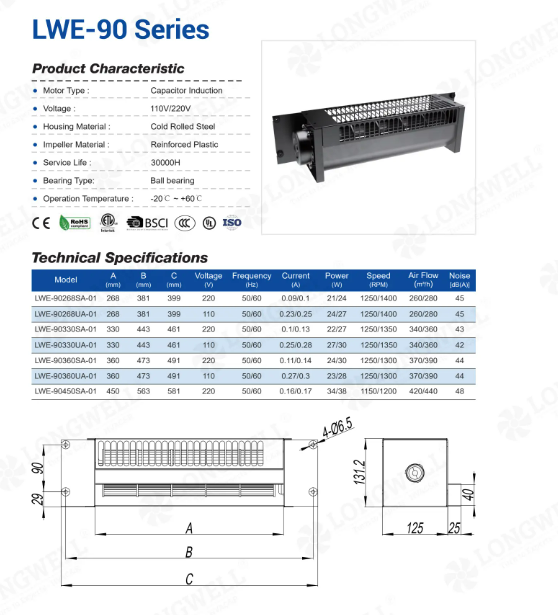 product image shows the final plastic impeller inside the protective grill.
Practical Guidance for Shaft Cooling
Engineers facing a similar cabin cooling problem should check their limits early.
- First, measure the exact height above the ceiling panels. Picking a fan taller than 135 mm will ruin your physical installation.
- Next, check the output of your existing control board. Supplying 220VAC directly to an AC motor avoids the cost of external DC power supplies.
- Furthermore, review the temperature range inside the operating shaft. Standard plastics melt near +40 C. Always specify glass-reinforced materials to survive +60 C heat.
Related: Cross Flow Fans.
Engineering Questions
Browse our cross-flow fans range, the AC cross-flow fans section, or cross-flow impellers.
Have a Similar Fan Requirement?
Longwell’s engineering team delivers custom spec sheets and samples within 90 days. Since 1990, we have supplied EC fans and blowers to OEMs across HVAC, cold chain, data center, and industrial applications worldwide.
Browse Related Products:
🏆 ISO 9001 / ISO 14001 / ISO 45001 | CE (TÜV) | UL/ETL | ATEX Zone 21/22 | AMCA 210-16 / ISO 5801 tested