Scoping the 110mm Centrifugal Fan Replacement
A customer needed a 110mm centrifugal fan replacement. They had a broken fan from an old electronics box. The old part had become hard to find, so a 110mm centrifugal fan replacement was the only route. First, they sent a sample so we could size the 110mm centrifugal fan replacement. We measured the part closely before quoting the 110mm centrifugal fan replacement. It ran on a standard 24 volts. Current draw was exactly 0.19 amps. Speed sat at 3000 RPM. Also, the physical size was very strict. The old fan measured exactly 110 mm wide. The total height was 25.8 mm. Therefore, we had to fit our new part into this exact space. The main box could not change at all. Any size change would hit the metal frame.
Next, we checked the working space around the box. These electronic boxes sit outside in the weather. So, they face hot days and cold nights. The fan must work from -10°C to 70°C. Condensation is also a big risk here. Water drops form inside the box overnight. Thus, the new fan needed better water safety. Airflow was another strict rule. The system needed 58 CFM of moving air. This cold air stops the hot boards from failing. Meanwhile, the office space near the box is very quiet. Noise had to stay under 25 dB(A). Finally, the new part needed clear safety marks. We had to meet the UL 507 safety standard. We also used ISO 5801 methods to check the air pressure. In short, we needed a small, quiet, and waterproof fan. We had 90 days to finish this custom NPI project.
Engineering the Motor and Plastic Impeller
Making a new 24V DC centrifugal fan takes careful balance. We must weigh electric power against total cost. We must also watch the final weight of the part. First, we looked at the old water rating. The old fan had a basic IP46 rating. However, we rejected this old rating. The customer’s box gets wet inside during heavy rain. Instead, we chose a higher IP65 rating. This strong choice blocks thick dust and low-pressure water streams.
Consequently, we added a tight seal inside the motor. We put a thick coat of resin on the bare stator. This sealing process added a little extra weight. The total weight reached 198 grams. Next, we needed to drop weight from other places. We rejected heavy metal blades for this job. Instead, we picked a PBT plastic impeller. This special plastic is very light but very strong. Therefore, the motor spins up quickly without wasting power. The light plastic also takes stress off the small bearings. Bearings always last longer when the moving fan is light.
Choosing the Right Motor Insulation
Next, we looked at the motor wire wrap. The old fan used Class F insulation. However, Class F costs a lot more. Engineers use it for very hot spaces. We checked the real heat limits of this project. The customer only needed safe running up to 70°C. Therefore, we rejected the Class F wrap. We chose a Class B insulation instead. Class B handles 70°C with total ease. Thus, this choice gave a materially lower cost. The finished fan works just as well.
Upgrading the SmartEC Control Board
Finally, we focused on saving electric power. The old unit used about 4.56 watts. That is too much power for a modern box. We designed a new SmartEC motor board. This new motor pulls just 0.15 amps under full load. It runs on a smooth 24 volts. Therefore, the total power dropped to just 3.6 watts. Furthermore, we bumped the top speed up to 3200 RPM. This fast speed pushes exactly 58 CFM of air. It also hits 13.0 mm-H2O of static pressure. Even so, the running noise stayed right at the 25 dB(A) limit. The new motor uses four wires. These wires give full PWM speed control. Therefore, the main board can slow the fan down when the air is cold. In short, we made a much better cooling tool. It uses less power and fits the same tight space.
Technical Specifications
| Parameter | Specification |
| Model Number | LWBD3G110-059NM-01-00 |
| Nominal Voltage | 24 VDC (Range: 16-28 VDC) |
| Airflow (Max) | 99 m3/h / 58 CFM |
| Static Pressure (Max) | 13.0 mm-H2O |
| Speed | 3200 RPM |
| Current | 0.15 A ±10% |
| Power Input | 3.6 W |
| Noise Level (LpA) | 25 dB(A) |
| Dimensions | Ø 110 mm x 25.80 mm |
| Weight | 198 g |
| Protection Type | IP65 |
| Insulation Class | Class B |
| Ambient Temperature | -10°C to 70°C |
| Impeller Material | PBT |
| Certifications | CE, ETL (UL 507, CSA C22.2#113), RoHS, REACH |
The input current and the IP class matter most for this cooling project. First, the lower 0.15A current keeps the main motor very cool. It saves power all day long. Next, the IP65 class stops heavy water drops from breaking the fan board.
Reference: IEC 60529 covers the test method behind these figures.
Technical Documentation
LWBD3G110-059NM-01-00 Specification Sheet
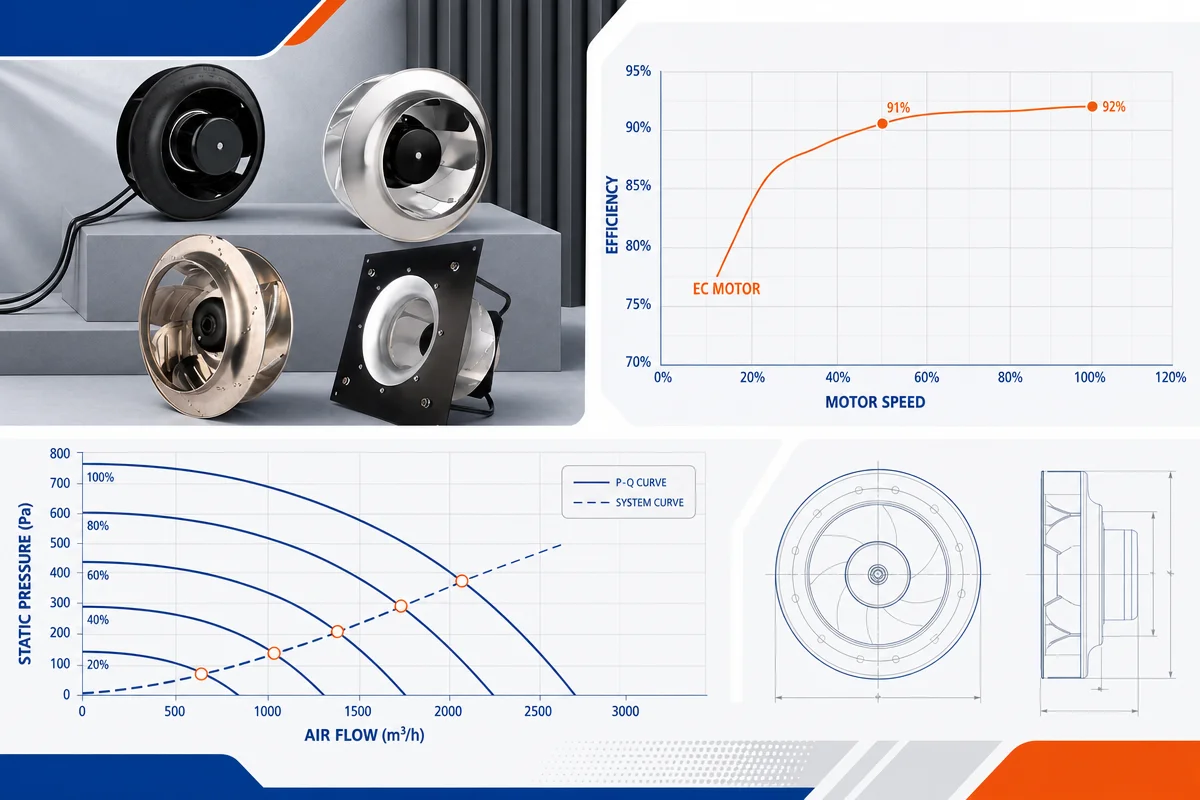
This file shows the exact outer size and the clear air curves. Any system engineer needs this file to plan the main mounting frame.
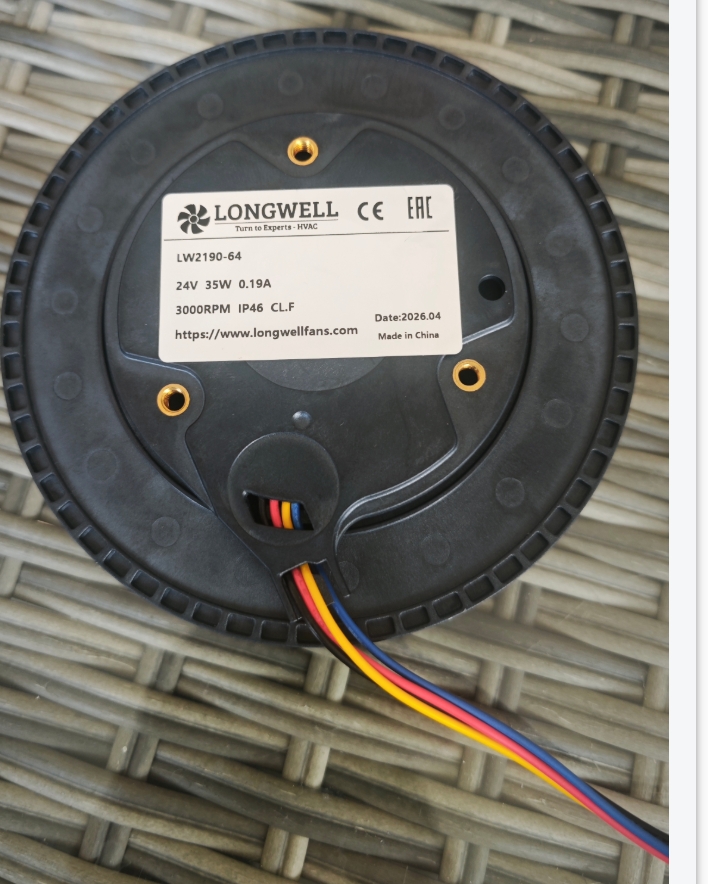
This picture shows the old 24V DC centrifugal fan label. It notes the old power draw and the starting point for our new design work.
How to Replace a Compact Blower
- Measure the real system pressure: First, measure the air pressure inside your box. Many engineers match the free-air numbers but forget the tight wires inside. Tight wires block the air and cause huge cooling drops.
- Check the real heat limits: Next, read the actual heat numbers near the fan. Do not blindly copy the old fan label. Using a Class F wire wrap for a cold box just wastes money. Instead, match the wire class to the real heat.
- Verify the control wires: Furthermore, count the wires on your control board. A basic fan might use simple voltage control. However, modern boards need clean PWM signals. Plugging a basic fan into a smart board will trigger an error light.
- Send the exact frame limits: Finally, send your supplier the exact physical limits. Since we mold our own plastic impellers, knowing your exact space helps us build a better fit.
Related: Centrifugal Fans.
Technical Documentation & Resources
A 110mm centrifugal fan replacement comes from the same range. Browse our centrifugal fans range, the backward-curved fans section, or forward-curved fans.
Have a Similar Fan Requirement?
Longwell’s engineering team delivers custom spec sheets and samples within 90 days. Since 1990, we have supplied EC fans and blowers to OEMs across HVAC, cold chain, data center, and industrial applications worldwide.
Browse Related Products:
🏆 ISO 9001 / ISO 14001 / ISO 45001 | CE (TÜV) | UL/ETL | ATEX Zone 21/22 | AMCA 210-16 / ISO 5801 tested