Planning the Three-Phase Fan Conversion
First, a customer asked us for a three-phase fan conversion on a 450mm EC axial fan. They needed the three-phase fan conversion for a heavy industrial cooling system. The original was a 230V model, so the three-phase fan conversion started there. However, the new system runs on 380V three-phase, so a three-phase fan conversion was required. Therefore, they needed a complete electrical redesign. Next, the customer asked for a blowing airflow direction. Standard models use a suction setup. This change reverses the air path. As a result, the motor receives less direct cooling. The original fan provided 6,695 m3/h of air. It ran at 1590 RPM. Its maximum static pressure was 242 Pa. Consequently, the new machinery requires much more cooling. Therefore, the airflow demands increased sharply.
The fan sits outdoors. We know this because the minimum ambient temperature is -25°C. Meanwhile, the upper limit reaches +60°C. So, the motor faces severe thermal stress. In short, managing this heat was our primary goal. Furthermore, the unit must meet IEC/EN 60335 safety standards. The customer also wanted to keep their existing 0-10V analog controllers. They did not want to rewire their electrical cabinet. This saves hundreds of hours of manual labor on the assembly line. Finally, the fan had to fit the exact 450mm footprint. Any change in size would force them to alter their sheet metal panels. This would cost too much money.
Redesigning the Motor and Impeller
Initially, we looked at the existing 420W stator. Engineers thought about simply rewinding it for 380V. We rejected this idea. The original motor core lacked the torque for higher speeds. Instead, we chose a larger 900W three-phase EC motor. This bigger stator provides the mechanical power needed. Therefore, we can spin the rotor much faster under a heavy load. Next, we reviewed the impeller material. The baseline design used cold-rolled steel blades. Driving heavy steel to high speeds is risky. It increases the moving mass. Consequently, it wears out the deep groove ball bearings faster.
Upgrading the Impeller and Insulation
So, we replaced the steel blades with a PA66+GF impeller. This glass-fiber reinforced plastic is much lighter. As a result, the total rotor weight dropped. This change also improved dynamic balance at extreme speeds. Then, we looked at the motor insulation. A blowing fan pushes air away from the motor. Therefore, the motor runs hotter. The original fan used Class B insulation. However, the new 900W load generates more heat. The +60°C ambient temperature makes this worse. Finally, we upgraded the insulation to Class F. This protects the copper windings from melting. Class F is rated to handle up to 155°C internally. Therefore, it provides a massive safety margin.
Evaluating the Trade-Offs
Every engineering choice has a cost. First, we pushed the speed from 1590 RPM to 1950 RPM. This increased the acoustic output. The peak noise climbed from 68 dB(A) to 75 dB(A). The customer accepted this penalty. Their equipment sits in a noisy industrial plant. Next, we changed the ingress protection. The old model was IP54. We dropped the new model to IP20. This strict trade-off happened for a good reason. It maximizes internal airflow directly over the stator. The copper coils need this direct air exposure to shed heat rapidly. Meanwhile, the new model uses our SmartEC control logic. It supports an RS485 Modbus RTU bus. The unit also accepts analog 0-10V and PWM signals. In short, the system now delivers 8,343 m3/h at 345 Pa. The modified fan hits all thermal targets. It achieves this at a materially lower cost than a full system redesign.
Technical Specifications
| Parameter | Value |
| Model | LWAE3G450TT-5PEW-16-00 |
| Nominal Voltage | 3~380 VAC (Range: 304~456 VAC) |
| Frequency | 50/60 Hz |
| Speed | 1950 rpm (±5%) |
| Input Power | 900 W |
| Current | 1.4 A |
| Max Airflow | 8,343 m3/h (4,908 CFM) |
| Max Static Pressure | 345 Pa |
| Noise Level | 75 dB(A) |
| Ambient Temperature | -25°C to +60°C |
| Protection Type | IP20 |
| Insulation Class | Class F |
| Impeller Material | PA66+GF |
| Control Interfaces | 0-10VDC, PWM, RS485 (Modbus RTU) |
| Certifications | CE, RoHS, Reach |
In this table, the input power and speed dictate the airflow. Therefore, the Class F insulation is strictly required. It protects the motor under the 900W continuous load.
Reference: AMCA 210 covers the test method behind these figures.
Technical Documentation
The engineering drawings below detail the final approved design.
LWAE3G450TT-5PEW-16-00 Primary Technical Specification – Contains the 380V electrical data, P-Q curve, and wiring diagram.
LWAE3G450SS-5MEW-03-00 Reference Specification – The original 230V fan data used as the baseline.
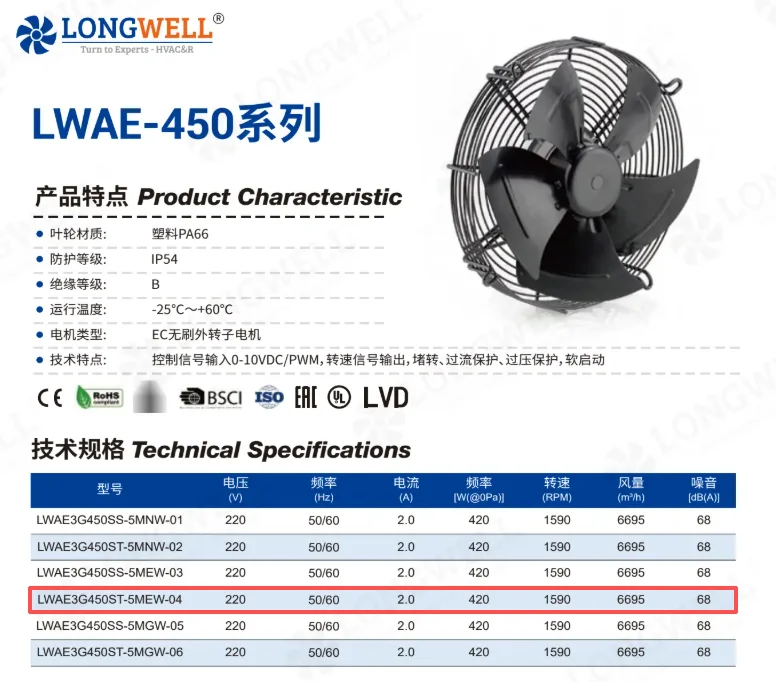
This final 380V assembly uses the lightweight PA66+GF impeller.
Specifying Three-Phase Industrial Cooling
If you face a similar problem, consider these lessons. Converting a single-phase system requires careful planning. Therefore, check these details first.
- Verify structural noise limits: Increasing RPM always raises sound pressure. Here, gaining 1,648 m3/h of air cost an extra 7 dB(A). You must confirm your enclosure can dampen this. Then, specify higher speeds safely. Ignoring this step often leads to failed acoustic inspections on the final assembly.
- Match airflow direction exactly: A blowing fan pushes air away from the motor. A suction fan pulls air over it. Consequently, this changes the internal motor cooling. So, state your exact air path in your first inquiry. This allows the factory to select the correct insulation class immediately.
- Reassess the IP rating: Many engineers default to IP54. However, dropping to IP20 allows better airflow over the stator. This lowers winding temperatures significantly. Therefore, use IP20 if your fan sits inside a protected cabinet. It extends the operational lifespan of the bearings and coils.
- Check digital control protocols: We integrate RS485 Modbus RTU directly into our motor electronics. Thus, you can wire the unit directly to your central PLC. Finally, this eliminates external speed controllers. This saves cabinet space and simplifies your wiring diagrams.
Related: Axial Fans.
Engineering Questions
Technical Documentation & Resources
A three-phase fan conversion keeps the same frame. Browse our axial fans range, the AC axial fans section, or EC axial fans.
Have a Similar Fan Requirement?
Longwell’s engineering team delivers custom spec sheets and samples within 90 days. Since 1990, we have supplied EC fans and blowers to OEMs across HVAC, cold chain, data center, and industrial applications worldwide.
Browse Related Products:
🏆 ISO 9001 / ISO 14001 / ISO 45001 | CE (TÜV) | UL/ETL | ATEX Zone 21/22 | AMCA 210-16 / ISO 5801 tested