Matching a Tight Space with High Airflow Needs
The customer needed a cold room air curtain fan for a new HVAC unit. This cold room air curtain fan holds warm outside air away from a chilled doorway. Specifically, the cold room air curtain fan had to deliver exactly 1600 m³/h. Next, the cold room air curtain fan had to overcome 80 Pa of static pressure.
Furthermore, the space around the cold room air curtain fan was very tight. The metal frame allowed only a 140×140 mm square space. Therefore, standard large blowers would not fit inside the machine. The air equipment cools an outdoor evaporator coil.
Consequently, it faces extreme weather all year. The unit must run safely from -25°C up to +60°C. Meanwhile, the local power grid provides 230V at 50/60 Hz. The customer also demanded UL 507 and CE marks.
These marks are strictly required for global export. First, the buyer wanted variable speed control. So, they specified a 0-10VDC or PWM control input. This lets the main system adjust the air flow easily.
Finally, the control board needed a speed sensor wire. This frequency generator wire sends real RPM data back to the panel. Finding an off-the-shelf fan with these traits was impossible. Most standard models lack the required 0-10V control input. Instead, our engineering team had to design a custom unit.
Why This Cold Room Air Curtain Fan Needs a Custom Shaft
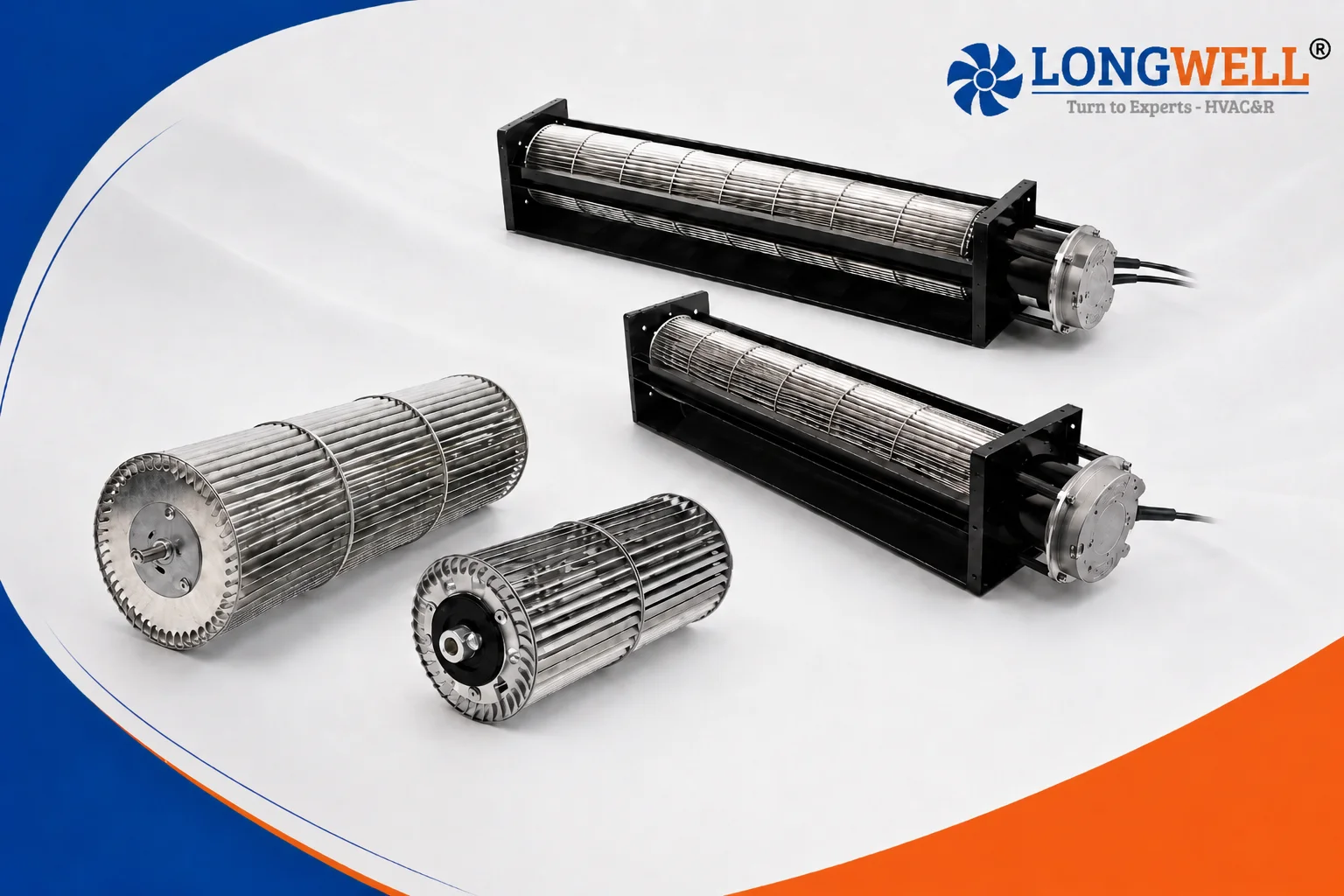
Standard blades reach up to 800 mm long. Beyond that length, the aluminum metal bends too much. The customer needed a 1000 mm long span exactly. First, we tried using two shorter 500 mm EC cross flow fan units.
We placed a bearing bracket in the center gap. However, this center bracket blocks the steady air flow. It creates a dead spot in the air curtain. So, we quickly rejected the two-part split design. Instead, we chose to build one long 1000 mm blade.
Stopping the Long Blade from Bending Mid-Span
To stop the bend, we used a heavy steel shaft. Standard fan shafts are only 6 mm thick. Instead, we pushed a solid 8 mm rod inside. Furthermore, we used 45 stiff aluminum alloy blades.
The whole rotating blade is 100 mm across. This solid design makes the moving part very stiff. However, this structural choice had a big trade-off. The thick steel rod adds a lot of heavy mass.
Therefore, the heavy part needs more electrical power to spin. We traded light weight for a strong, straight shape. Next, we had to find a motor to spin it.
Picking the Best Motor and Housing
We paired this heavy blade with an EC92/102 motor. First, this external rotor motor has high starting torque. It spins the heavy rod to 1500 RPM easily. Consequently, it delivers the needed 80 Pa system pressure.
Next, we built the outer box from thick SGCC steel. Thin sheet metal would twist from the strong motor force. Therefore, the tough SGCC steel keeps the 140×140 mm box flat. Finally, this custom design choice cost more money.
The big EC motor and thick steel cost more to buy. Even so, it fixed the air gap problem completely. We ran several tests to confirm the final output. First, we measured the air speed across the entire length.
Next, we checked the motor heat after continuous running. Therefore, we proved the LWCE-1001000SN-06-00 design hits the 1600 m³/h target.
Technical Specifications
| Model | LWCE-1001000SN-06-00 |
| Target Airflow | 1600 m³/h (941 CFM) |
| Target Static Pressure | 80 Pa |
| Voltage | 230V |
| Frequency | 50/60 Hz |
| Speed | 1500 ± 150 RPM |
| Control Method | 0-10VDC / PWM |
| Impeller Diameter | 100 mm |
| Blade Count | 45 Blades |
| Effective Length | 1000 ± 0.5 mm |
| Overall Length | 1125 ± 2 mm |
| Housing Dimensions | 140 x 140 mm |
| Bearing Type | Ball bearing |
| Insulation Class | B |
| Operation Temperature | -25°C to +60°C |
| Impeller Material | Aluminum Alloy |
| Housing Material | SGCC Steel |
These specs define the final EC cross flow fan output. The 1000 mm length and 80 Pa pressure matter most. First, pushing that high pressure requires the 1500 RPM speed. Next, that fast speed forces the use of heavy SGCC steel. Consequently, the strong metal stops all unwanted shaking. Furthermore, the Class B insulation protects the motor coils. Therefore, the fan stays safe even in 60°C hot weather. Finally, the EC motor technology keeps the power use low.
Reference: AMCA 210 covers the test method behind these figures.
Technical Documentation
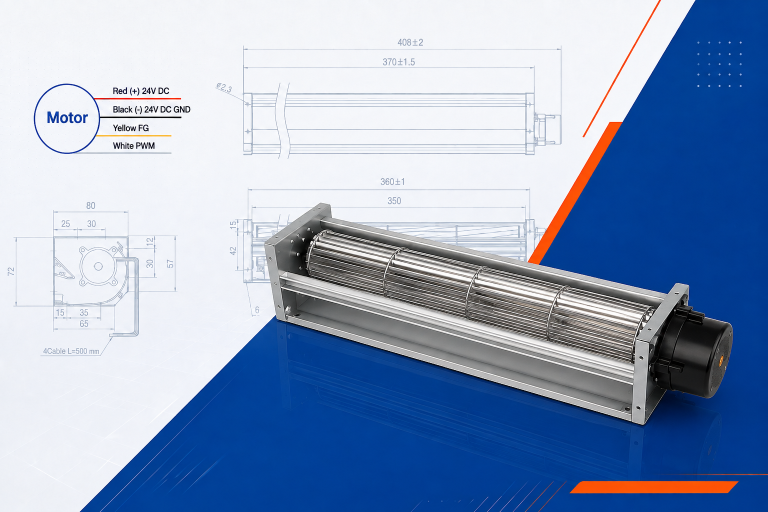
LWCE-1001000SN-06-00 Engineering Drawing
This file shows the exact 1125 mm total length. First, it gives the wiring map for the EC motor. Next, it lists the SGCC steel parts for the team.
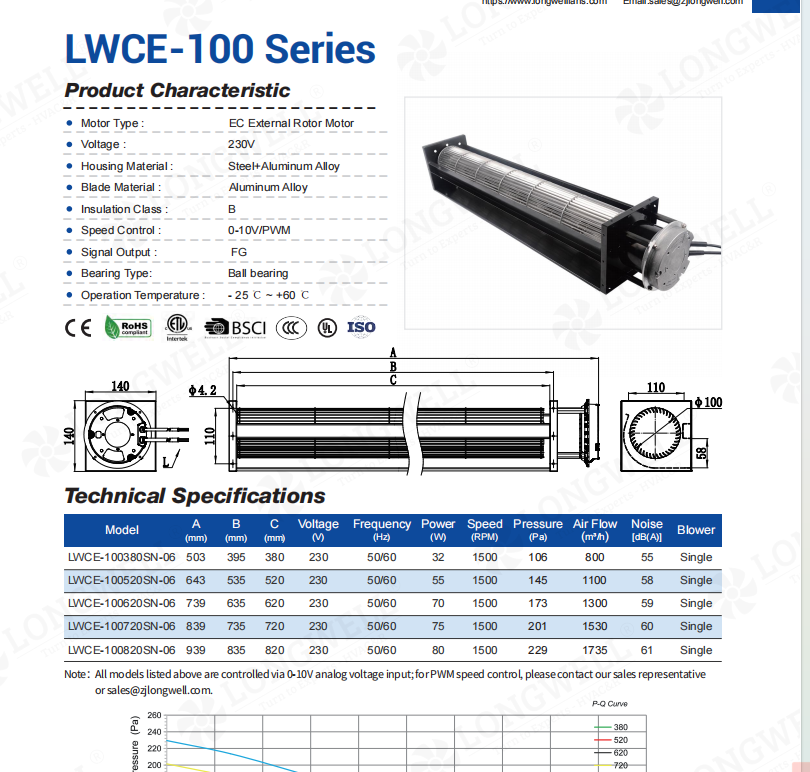
This sheet shows the 140×140 mm box size limits. Furthermore, it maps the air speed on a graph. Therefore, buyers can check the fan output data quickly.
How to Spec Long-Span Blowers
If you need a very long EC cross flow fan, check these details.
- Measure the true space. First, you must measure your real cabinet space. A 1000 mm air path needs an 1125 mm total box.
- Check the drag. Next, you must calculate the system air drag. High air flow needs strong pressure to push past tight vents.
- Verify the control signal. Furthermore, you should check your main control board. Make sure it sends a true 0-10V speed signal to the motor.
- Plan for weight. Finally, you must prepare for a heavy unit. A strong 8 mm steel rod adds weight to the fan. So, your mounts must hold this extra mass safely.
Since we test parts to AMCA 210-16 rules, we confirm air flow exactly. Therefore, the final unit will match your true system needs.
Related: Cross Flow Fans.
Questions About This Fan Design
Technical Documentation & Resources
Browse our cross-flow fans range, the AC cross-flow fans section, or cross-flow impellers.
Have a Similar Fan Requirement?
Longwell’s engineering team delivers custom spec sheets and samples within 90 days. Since 1990, we have supplied EC fans and blowers to OEMs across HVAC, cold chain, data center, and industrial applications worldwide.
Browse Related Products:
🏆 ISO 9001 / ISO 14001 / ISO 45001 | CE (TÜV) | UL/ETL | ATEX Zone 21/22 | AMCA 210-16 / ISO 5801 tested