Rethinking Ventilation: Why Engineers Are Choosing EC Duct Fans
LONGWELL EC Duct Fan Series | Efficiency · Silence · Intelligence · Global Certified | www.longwellfans.com
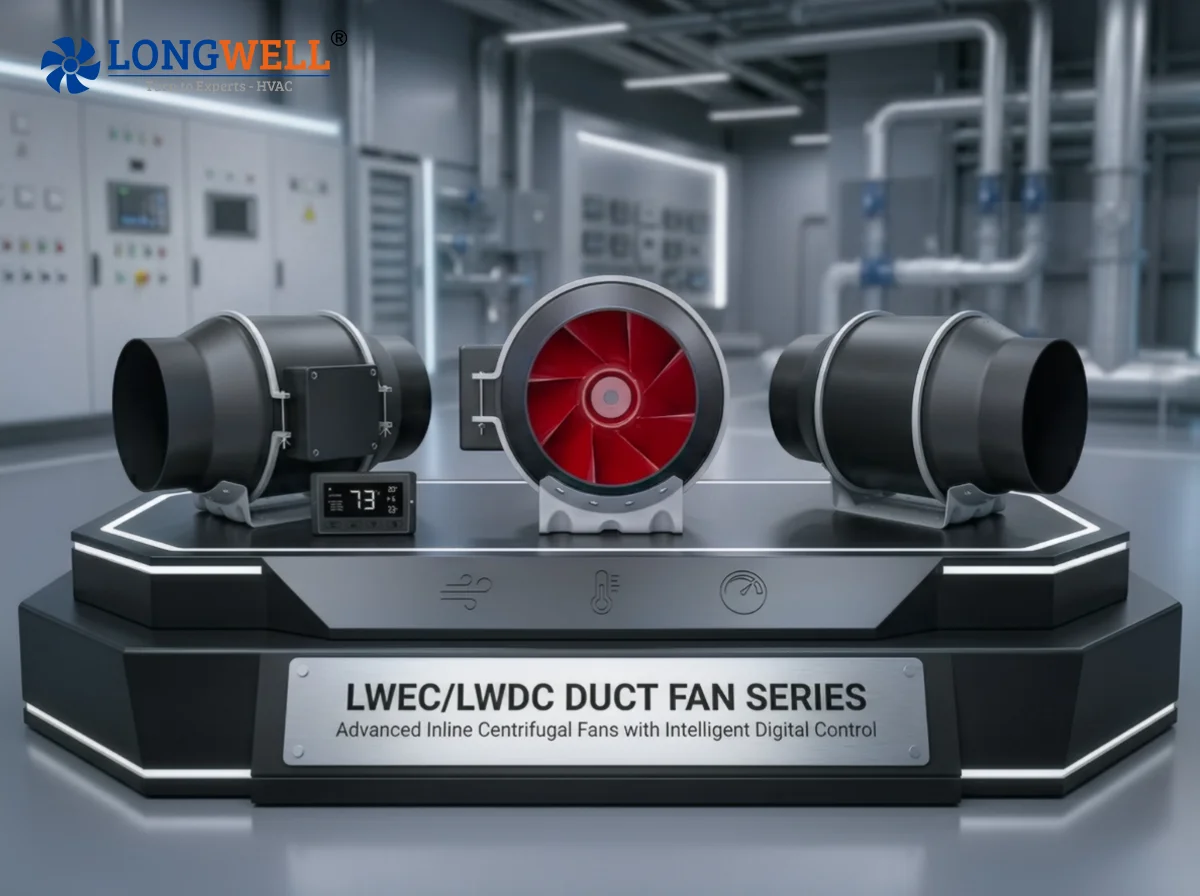
LONGWELL EC Duct Fan Series — Engineered for Superior Air Quality
Ventilation accounts for over 30% of total building energy consumption in commercial and industrial facilities. Yet in many projects, fans are selected based on catalog peak performance alone — leaving engineers to deal with the real-world consequences: oversized units running inefficiently at partial load, persistent background noise complaints, and control systems that cannot respond dynamically to changing occupancy.
Three root causes underlie most ventilation failures:
▶ Energy waste at part load: Conventional induction (AC) motors lose efficiency rapidly when speed drops below the design point — sometimes falling to 40–55% efficiency under typical duty cycles.
▶ Structural noise pollution: AC motor electromagnetic vibration at 50/60 Hz generates a persistent low-frequency hum that standard isolation mounts cannot fully suppress.
▶ Absence of intelligent control: On/off or fixed-speed operation cannot adapt to real-time air quality or occupancy demand, resulting in simultaneous over- and under-ventilation in different zones.
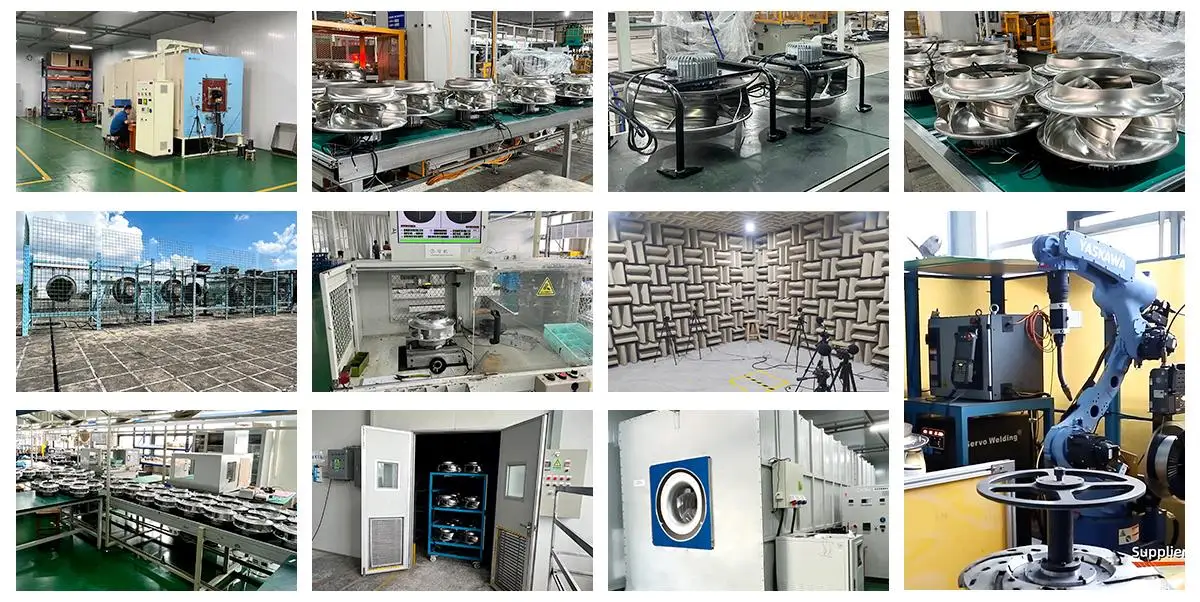
Ningbo Longwell Electric Technology Co., Ltd. — operating under the global brand LONGWELL — has spent over 25 years developing EC (Electronically Commutated) motor-driven duct fans that systematically address each of these challenges. This article examines the technology, performance benchmarks, and real-world economics behind the LONGWELL EC Duct Fan series.
I. Inside the Technology: What Makes EC Motors Different?
The fundamental difference between an EC motor and a conventional AC induction motor lies in how torque is generated. An AC induction motor relies on electromagnetic induction between the stator field and rotor conductors — a process that is inherently resistive and heat-generating, particularly at variable speeds.
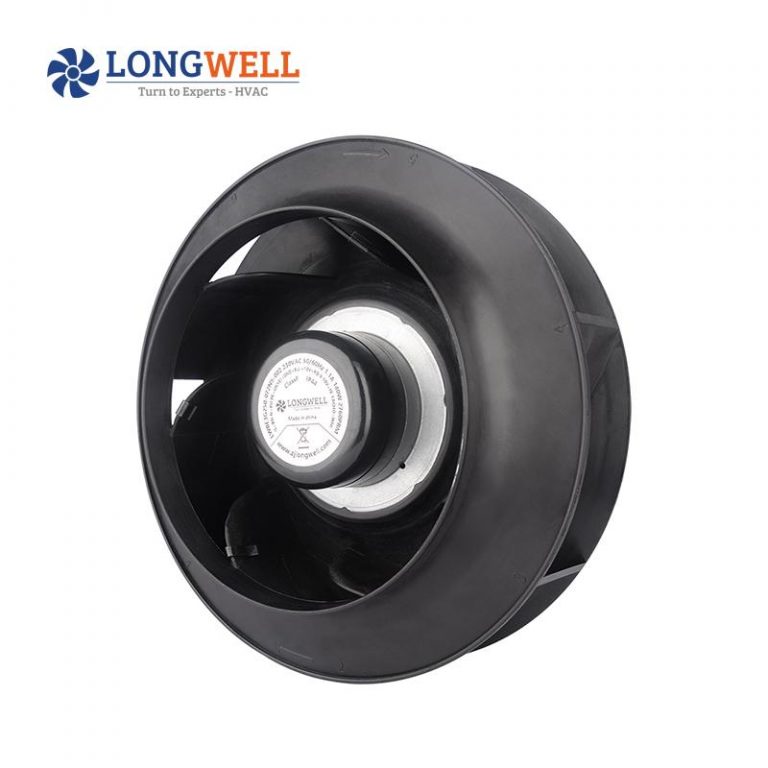
An EC motor, by contrast, integrates a permanent magnet synchronous motor (PMSM) with an embedded digital controller. A rotor position sensor provides real-time feedback, enabling the controller to commutate the drive windings electronically with precision — eliminating brush wear, commutator losses, and slip resistance in a single design decision.
EC vs. AC: A Seven-Dimension Comparison
| Parameter | LONGWELL EC Duct Fan | Conventional AC Fan |
| Rated efficiency | Up to 90%+ | Typically 55–70% |
| Part-load performance | High efficiency across full speed range | Sharp efficiency drop below rated speed |
| Speed control | Built-in digital drive, no VFD required | Requires external variable frequency drive |
| Noise level | As low as 25 dB(A) in quiet mode | 50+ dB(A) at high speed |
| Maintenance cycle | Brushless — maintenance-free bearing life 50,000+ hrs | Regular brush & bearing replacement required |
| Power factor | Near unity (≈1.0), minimal harmonic distortion | Lower PF, significant grid harmonic pollution |
| Form factor | Compact — integrates motor and drive in one unit | Larger motor body, limited installation flexibility |
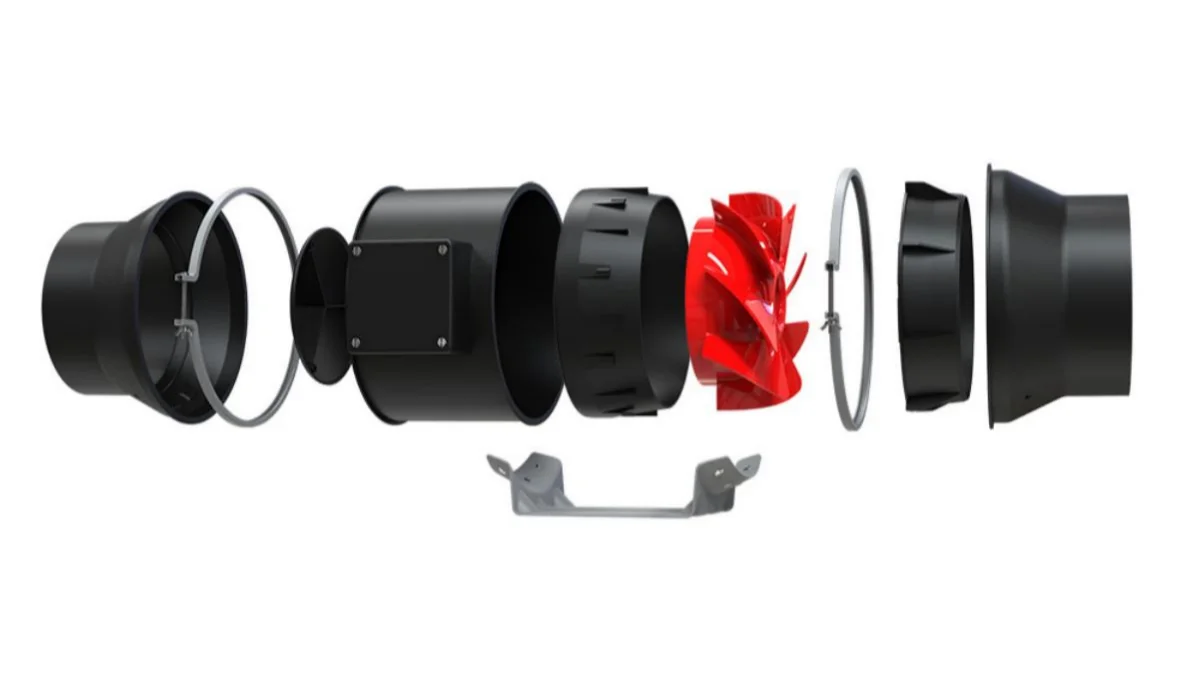
LONGWELL EC Duct Fan — Structural Disassembly Diagram
II. Performance by the Numbers: Industry Standards & Product Range
Selecting the right duct fan begins with understanding how industry standards classify performance. According to AMCA Standard 205 (Energy Efficiency Classification for Fans) and ASHRAE 62.1 (Ventilation for Acceptable Indoor Air Quality), duct fans are typically evaluated across four application tiers: residential, light commercial, commercial, and industrial.
The LONGWELL EC Duct Fan series spans 4-inch (100 mm) to 12-inch (315 mm) duct diameters, covering airflow capacities from 80 m³/h to over 2,000 m³/h — matched to the full spectrum from single-room residential extraction to large-scale mechanical ventilation in industrial facilities.
① Industry-Standard Performance Matrix
| Duct Size | Max Airflow | Static Pressure | Typical Application | Tier | AMCA FEG |
| 4″ (100mm) | ≤ 200 m³/h | 50–150 Pa | Bathroom, local extraction | Residential | FEG 67+ |
| 6″ (150mm) | 200–600 m³/h | 80–250 Pa | Apartment fresh air, restaurant | Light Commercial | FEG 67+ |
| 8″ (200mm) | 600–1,200 m³/h | 100–350 Pa | Offices, retail spaces | Commercial | FEG 71+ |
| 10″ (250mm) | 1,200–2,000 m³/h | 150–500 Pa | Commercial buildings, schools | Commercial | FEG 71+ |
| 12″ (315mm) | 2,000–3,500 m³/h | 200–700 Pa | Factories, large warehouses | Industrial | FEG 79+ |
Note: Airflow data referenced to AMCA 210 standard test conditions. FEG (Fan Efficiency Grade) per AMCA 205 — higher values indicate superior aerodynamic efficiency. Static pressure ranges reflect typical installed system resistance.
② Why EC Technology Sustains Efficiency Across All Tiers
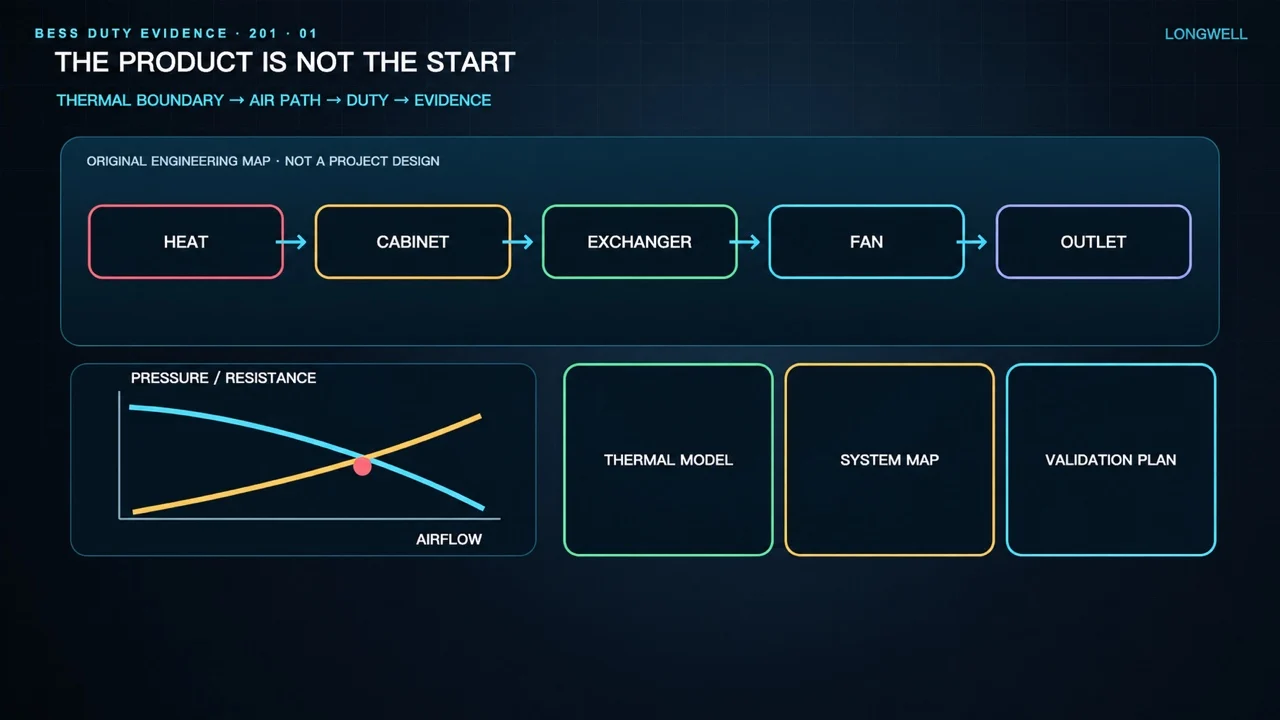
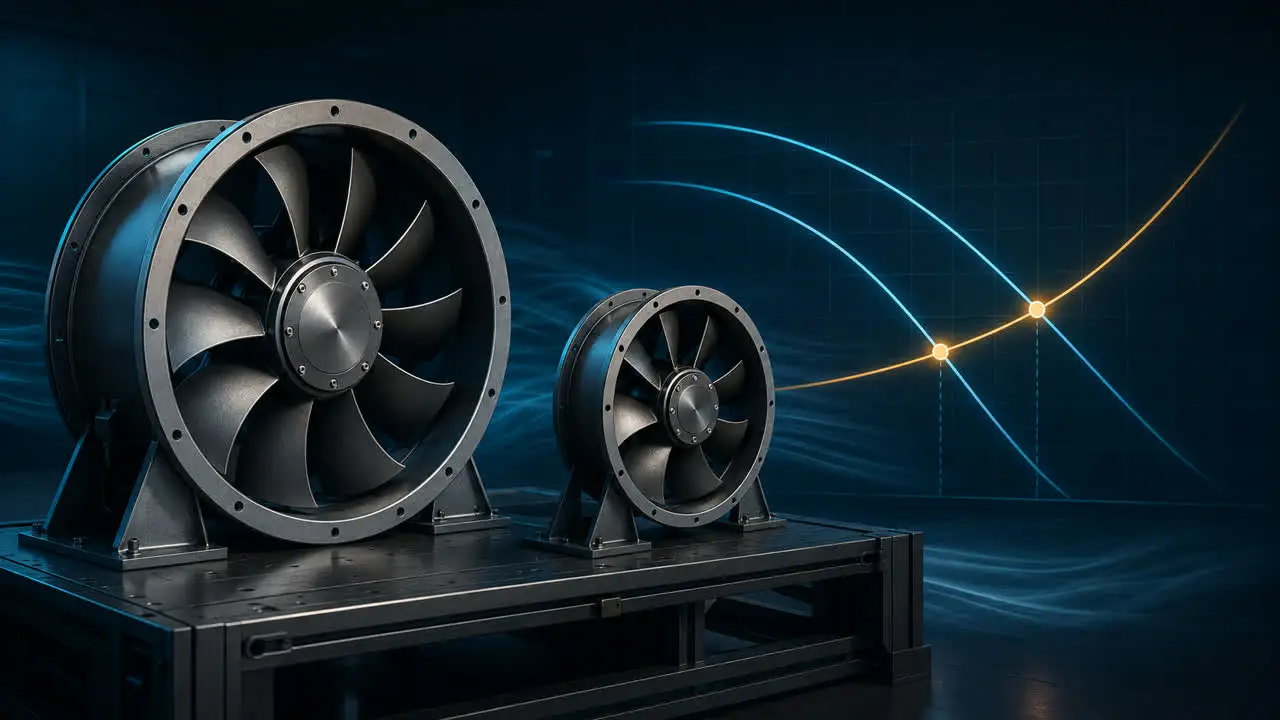
A critical insight from AMCA and ASHRAE guidelines: fans should be selected to operate within ±15% of their rated duty point to maintain both efficiency and acoustic performance. EC motor technology is purpose-built for exactly this requirement. Regardless of whether the application calls for a compact 4-inch residential unit or a heavy-duty 12-inch industrial fan, the LONGWELL EC drive maintains system efficiency above 85% across the full operating speed range — compared to 40–55% for conventional AC motors operating off their rated point.
③ Mixed-Flow Impeller: Engineering the Airflow-Pressure Balance
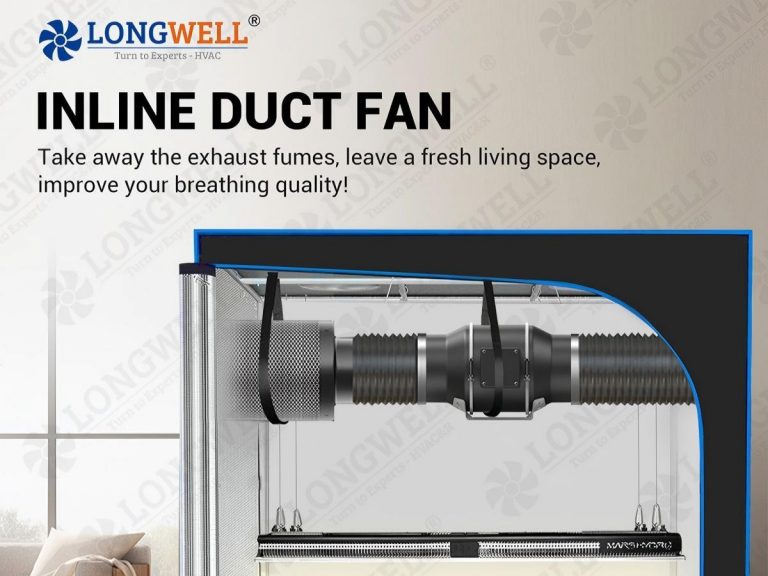
Pure axial fans deliver high airflow but struggle with duct resistance. Pure centrifugal fans provide high static pressure but restrict flow capacity. LONGWELL EC duct fans employ a mixed-flow impeller topology, where CFD-optimized three-dimensionally twisted blades guide airflow diagonally through the impeller — capturing the volume advantage of axial designs and the pressure capability of centrifugal geometry. The result: a fan that handles real-world duct systems with bends, filters, and dampers without requiring booster fans in series.
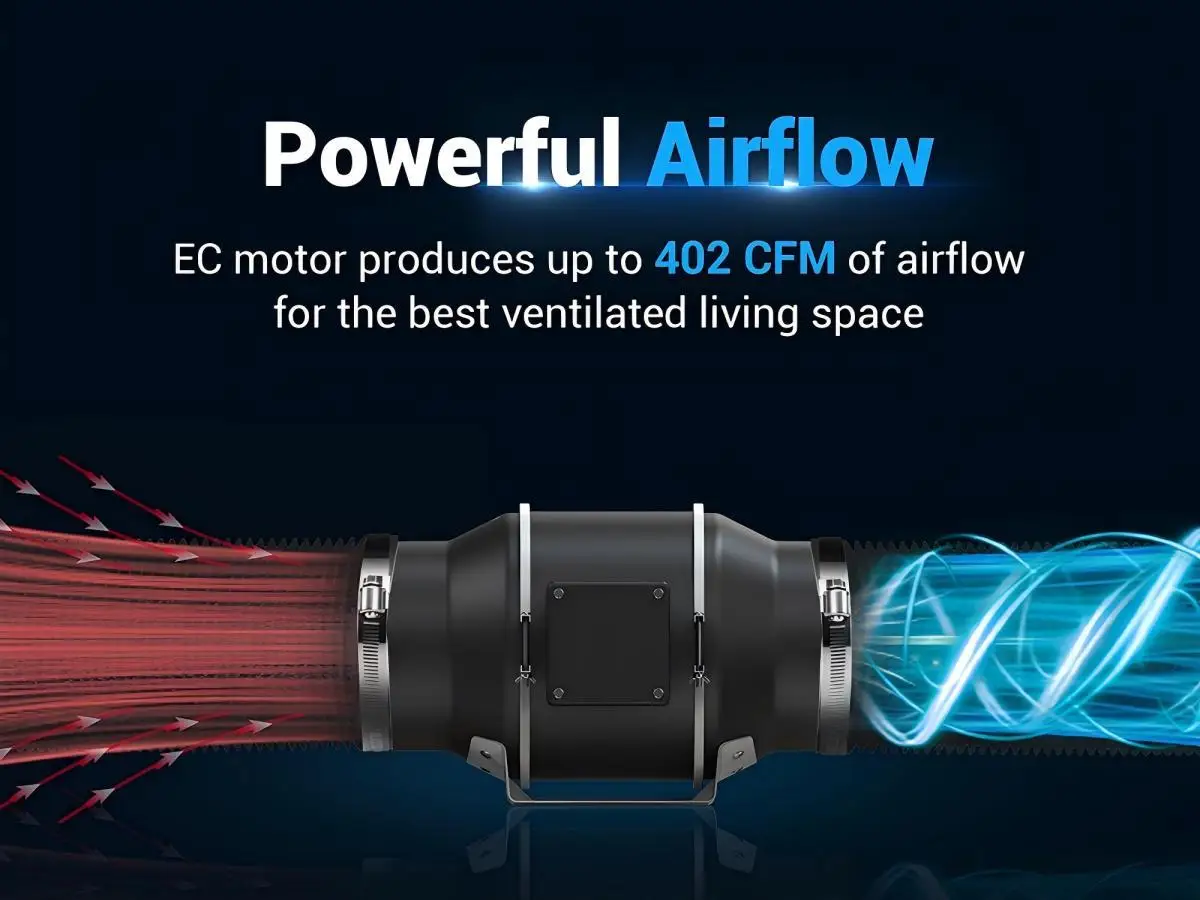
LONGWELL EC Duct Fan — Full-range diameter lineup covering residential to industrial applications
III. Acoustic Engineering: Silence by Design, Not by Coincidence
Noise from ventilation equipment remains one of the most common sources of occupant complaints in commercial buildings. LONGWELL’s acoustic engineering approach integrates noise control at four distinct layers of the product — not as an afterthought, but as a core design constraint from the first concept sketch.
Acoustic Control Pathway: Motor Layer (electromagnetic) → Impeller Layer (aerodynamic) → Housing Layer (structural damping) → Installation Layer (vibration isolation)
Electromagnetic Noise Suppression
The EC motor’s internal PWM switching frequency operates at 16–20 kHz — well above the 2–5 kHz range where human hearing is most sensitive. This design choice effectively pushes commutation noise out of the audible discomfort zone. By contrast, conventional 50 Hz AC motors produce a characteristic 100 Hz harmonic hum that penetrates walls and ceilings with ease.
Aerodynamic Noise Reduction
Blade leading edges feature a serrated bionic profile that disrupts boundary layer separation vortices, suppressing broadband turbulent noise. Trailing edge chamfering attenuates Blade Passing Frequency (BPF) tonal noise — the most perceptible component at mid-to-high speeds. Combined with speed reduction capability, the fan achieves adequate airflow at lower RPM, reducing the overall sound power level at source.
Structural Vibration Isolation
Rotor and impeller assemblies are dynamically balanced to Grade G2.5 per ISO 1940, minimizing residual vibration transmitted to the housing. The composite ABS + galvanized steel shell provides both structural rigidity and internal damping. Anti-vibration rubber gaskets are supplied at duct connection flanges as standard, breaking the vibration transmission path before it reaches the duct network.
Measured Reference: Typical operating noise at 1 m distance: 28–33 dB(A) — equivalent to a quiet library. Compliant with ASHRAE 55 acoustic comfort criteria for occupied spaces.
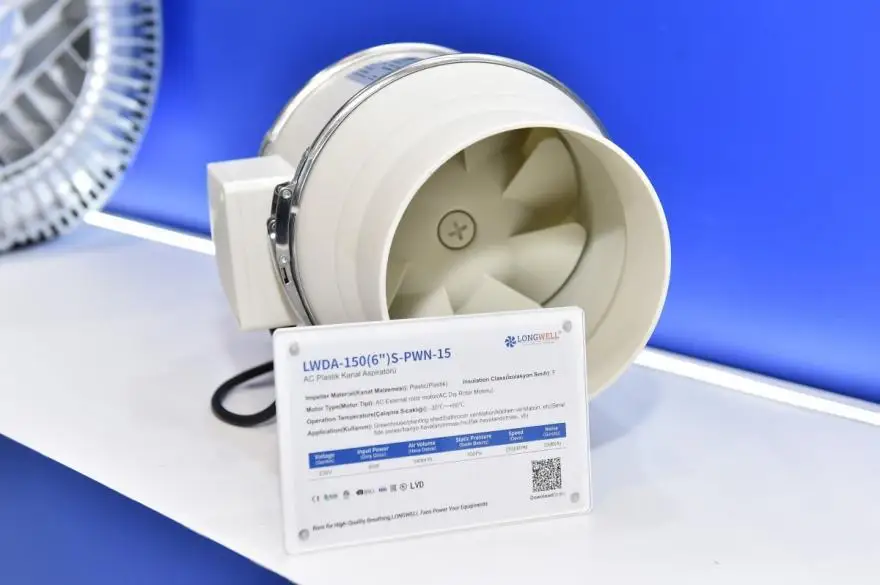
LONGWELL at international trade shows — validated low-noise performance recognized globally
IV. Smart Control Integration: Making Fans Work for the Building
The full value of an EC duct fan is realized not as a standalone product, but as an intelligent actuator node within a building automation system (BAS). LONGWELL EC fans ship with a standard control interface suite designed for seamless BAS integration:
▶ 0–10V Analog Signal: Linear speed control via BAS, PLC, or wall-mounted potentiometer. Response latency < 0.3 s. Compatible with most VAV controllers and energy management platforms.
▶ PWM Digital Input: Precision duty-cycle-based speed command, enabling direct interface with demand-controlled ventilation (DCV) algorithms.
▶ RS-485 / Modbus RTU (optional): Full bus communication for remote monitoring of speed, power draw, cumulative runtime, and fault status — ready for integration into SCADA or BMS dashboards.
▶ Hardware Protection Output: Over-temperature and over-current fault signals transmitted to the supervisory system, providing equipment and personnel safety without relying solely on firmware.
In practice, these interfaces enable:
▶ CO₂ Demand-Controlled Ventilation (DCV): Fan ramps up automatically when CO₂ thresholds are exceeded, returns to low-speed quiet mode as concentration normalizes.
▶ Occupancy-Based Scheduling: Integrated with access control or camera-based people-counting, fan speed reduces by 40% during unoccupied periods, recovering energy without manual intervention.
▶ Thermal-Humidity Coupled Control: Coordinated operation with AHUs and humidifiers to maintain ASHRAE 62.1 indoor environment standards year-round.
LONGWELL product certifications — underpinning global market confidence
V. Total Cost of Ownership: The Full Economic Picture
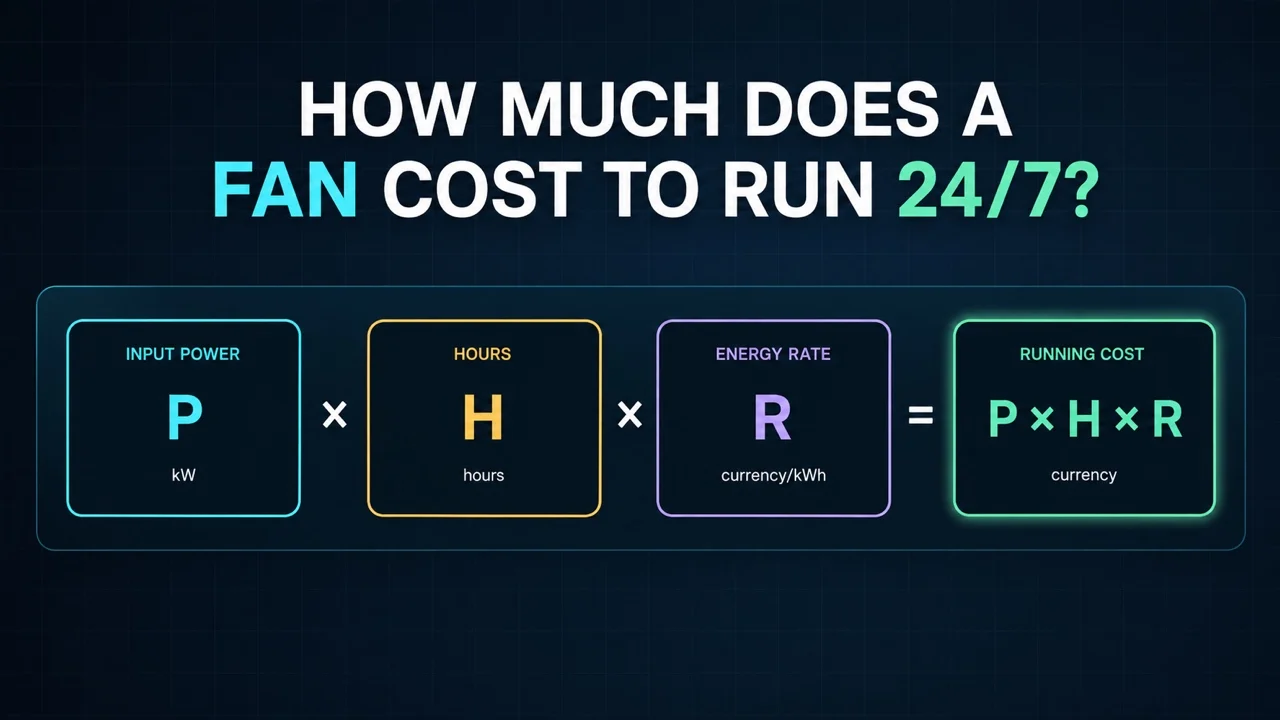
Procurement decisions based solely on purchase price systematically undervalue EC technology. The following lifecycle cost model — based on a real-world commercial installation scenario — illustrates the true financial case:
| Cost Category | AC Fan (per unit/year) | EC Fan (per unit/year) | Annual Saving |
| Annual energy cost (16 h/day, 365 days) | ≈ $330 | ≈ $182 | ≈ $148 |
| Maintenance & brush replacement | ≈ $42 | $0 (maintenance-free) | ≈ $42 |
| Filter & lubrication service | ≈ $21 | ≈ $11 | ≈ $10 |
| Unplanned downtime cost (est.) | ≈ $69 | ≈ $17 | ≈ $52 |
| Total Annual Cost | ≈ $462 | ≈ $210 | ≈ $252 |
Basis: EC fan rated 120W; AC fan rated 160W; electricity at $0.12/kWh; 16 operating hours/day. Actual savings vary by installation.
Using this model, the typical EC fan price premium over an equivalent AC unit is recovered within 12–24 months through operational savings alone. Beyond the payback period, the EC fan continues delivering savings that compound over its extended service life — a compounding return that grows with scale and operating hours.
VI. Global Certification Matrix & Market Readiness
LONGWELL (Ningbo Longwell Electric Technology Co., Ltd.), founded in 1990, has built a 25-year track record in HVAC fan design and manufacturing, exporting to over 60 countries across Europe, North America, the Middle East, and Southeast Asia. Market access is backed by a comprehensive certification portfolio:
| Certificate | Target Market | Scope |
| CE | EU / European Economic Area | LVD, EMC, ErP Ecodesign Directive compliance |
| UL / ETL | USA, Canada | North American electrical safety market access |
| FCC | United States | Electromagnetic interference (EMI) compliance |
| ISO 9001:2015 | Global | Quality management system certification |
| ISO 14001:2015 | Global | Environmental management & green manufacturing |
| ISO 45001:2018 | Global | Occupational health & safety management |
| BSCI | European buyers | Supply chain social compliance audit passed |
| Regional Trademarks | DE / RU / TR markets | Brand registration in key regional markets |
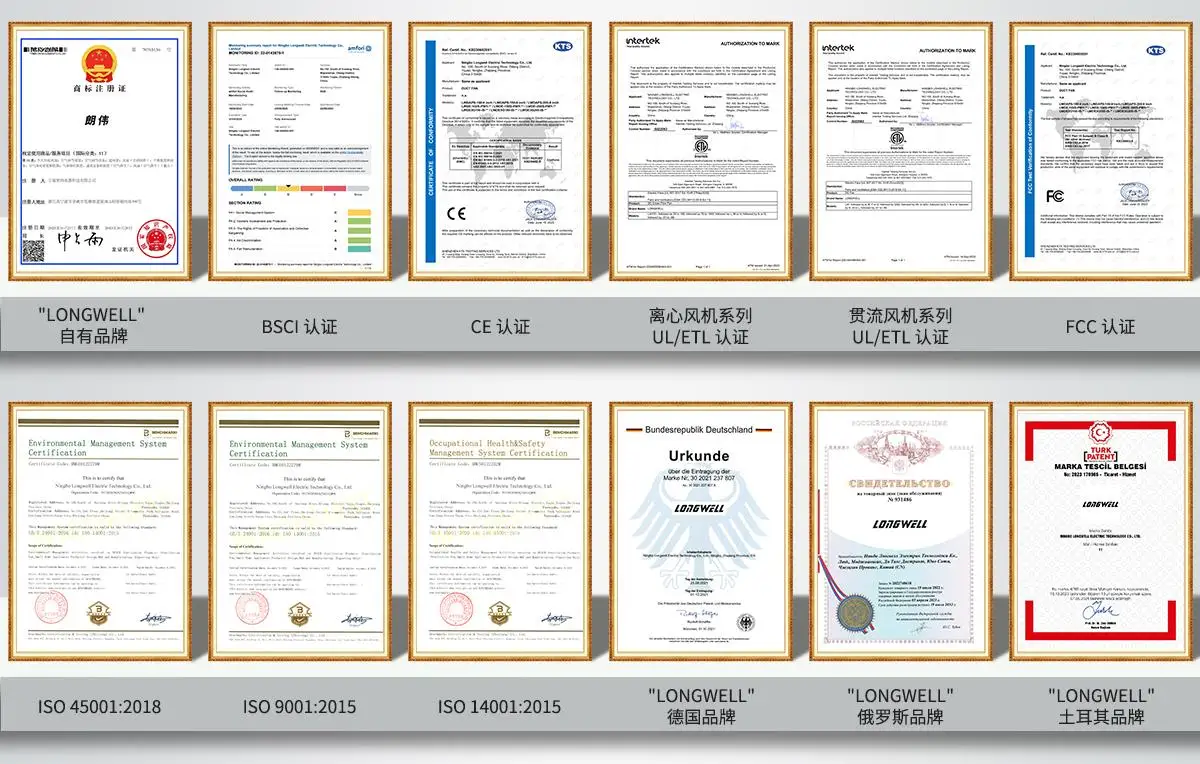
LONGWELL global certification matrix — verified compliance for 60+ country markets
VII. Specification Guide: 5 Steps to Selecting Your EC Duct Fan
With multiple diameters, speed ranges, and control configurations available, structured selection methodology ensures you capture the full performance benefit of EC technology. Here is the LONGWELL engineer-recommended selection workflow:
▶ Step 1 — Calculate Design Airflow: Determine required CFM/CMH from space volume and target air changes per hour (ACH) per ASHRAE 62.1. Add 15–20% margin for accessory pressure losses.
▶ Step 2 — Assess System Static Pressure: Tally total equivalent duct length, elbow count, filter type, and damper resistance. LONGWELL EC series covers 50–700 Pa system resistance.
▶ Step 3 — Match Duct Diameter to Model: Select from 4-inch (100mm) to 12-inch (315mm) diameter range. Airflow coverage: 80–3,500+ m³/h.
▶ Step 4 — Define Control Interface: Specify 0–10V analog, PWM digital, or RS-485 Modbus based on BAS architecture. Align with electrical design team prior to equipment schedule.
▶ Step 5 — Verify Certification Requirements: Confirm required compliance marks for the target market; LONGWELL provides full certification test reports and Declaration of Conformity documentation on request.
The LONGWELL applications engineering team offers complimentary fan selection consulting. Submit your project’s BIM model, duct schedule, or floor plan and receive a formal fan selection report within 48 business hours.
Get Your Custom Ventilation Solution from LONGWELL Today
📞 Technical Sales: +86 18358274663
✉️ Business Inquiries: sales@longwellfans.com
🌐 Official Website: www.longwellfans.com
Ningbo Longwell Electric Technology Co., Ltd. | Born for High-Quality Breathing
#ECDuctFan #HVACEfficiency #LONGWELL #SmartVentilation #ECMotorFan #GreenBuilding