Equipment Cooling with an 80mm 220v ac fan
Engineers often face tough space limits when cooling small control panels. This specific customer needed to cool a tight box. The system ran on a direct 220 VAC power rail. Therefore, they needed an 80mm 220v ac fan.
The space allowed a maximum width of 80 millimeters. Next, the depth could not exceed 25 millimeters. The cooling unit had to run all the time. Consequently, physical failure was completely unacceptable.
The system needed at least 19 CFM of airflow. This flow keeps the internal parts safe from heat. Meanwhile, the local air temperature changed widely. It dropped to -10°C in winter.
By contrast, it reached +60°C in summer. The chosen fan had to survive these big shifts. It could not jam or fail electrically. Also, the market demands strict safety rules.
For example, buyers require UL 507 compliance for safety. In short, our team had to build a very small unit. It had to run on mains voltage directly. The device also needed to stay quieter than 26 dB(A).
Even so, physical space remained the hardest limit. Every single millimeter counted. Finally, the customer wanted strong shock resistance. They asked for a 30cm drop test onto a wooden board. This test ensures the bearings stay safe during factory assembly.
Engineering Choices for the Cooling Unit
Picking the Best Motor
First, we looked at motor types for this 80mm 220v ac fan. We rejected a direct current motor. The customer did not have a low-voltage DC supply in their box. Adding a new power supply would cost extra money. It would also take up too much space. Instead, we picked a shaded pole induction motor. This design runs right off the 50/60Hz mains power. However, this choice reduced electrical efficiency. The AC motor uses up to 15 watts at 50Hz. A DC version might use much less power. Even so, saving space justified the higher power draw.
Selecting Strong Bearings
Next, we solved the life span requirement. The fan had to run for 50,000 hours at 25°C. We rejected a cheap sleeve bearing. Sleeve units cost less and run very quietly. By contrast, they wear out fast if mounted sideways. Therefore, we used two ball bearings in the motor. This upgrade raised the unit cost. It also added a tiny bit of noise. The sound level hit 26 dB(A) at 60Hz. Even so, the dual ball bearings guarantee a 50,000-hour life. They also let the user mount the fan in any direction.
Impeller Material and Safety
Finally, we met the heat and safety rules. The highest air temp reached +60°C. So, we built the impeller from strong PBT plastic. We added glass fiber for extra strength. This mix meets the UL94-V0 flame rating. Furthermore, we used impedance protection on the motor wires. Sometimes, dirt can jam the rotor. If that happens, the built-in resistance limits the current. Consequently, the motor will not catch fire. It stays safe for 72 hours at 220 VAC. This protection added a little weight to the coils. However, it completely removed the need for an extra thermal fuse. The approved fan pushes 23 CFM at 2750 RPM on 60Hz.
Technical Specifications
| Parameter | Value |
|---|---|
| Model | LWAA8025SH-10-00 |
| Dimensions | 80 x 80 x 25 mm |
| Weight | 260 g |
| Rated Voltage | 220 VAC |
| Frequency | 50 / 60 Hz |
| Input Current | 0.09 A |
| Input Power | 12 / 15 W |
| Speed | 2300 / 2750 RPM (±10%) |
| Airflow | 19 / 23 CFM |
| Max Static Pressure | 2.8 / 4.8 mm H2O |
| Acoustical Noise (Avg) | 23 / 26 dB(A) |
| Operating Temperature | -10°C to +60°C |
| Life Expectancy | 50,000 Hours at 25°C (15~65% RH) |
| Insulation Class | UL Class A |
| Impeller Material | PBT UL94-V0 |
| Frame Material | Aluminum Alloy |
| Bearing Type | Two Ball Bearings |
First, the input power and current rows matter a lot. They define the electrical load for the control box. Furthermore, the max static pressure shows how well the fan pushes air through tight spaces.
Reference: AMCA 210 covers the test method behind these figures.
Technical Documentation
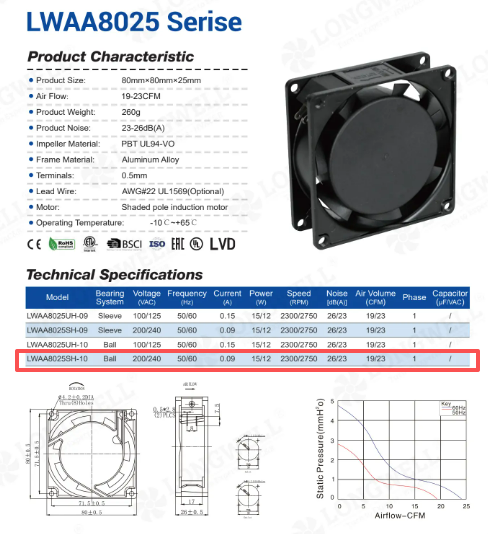
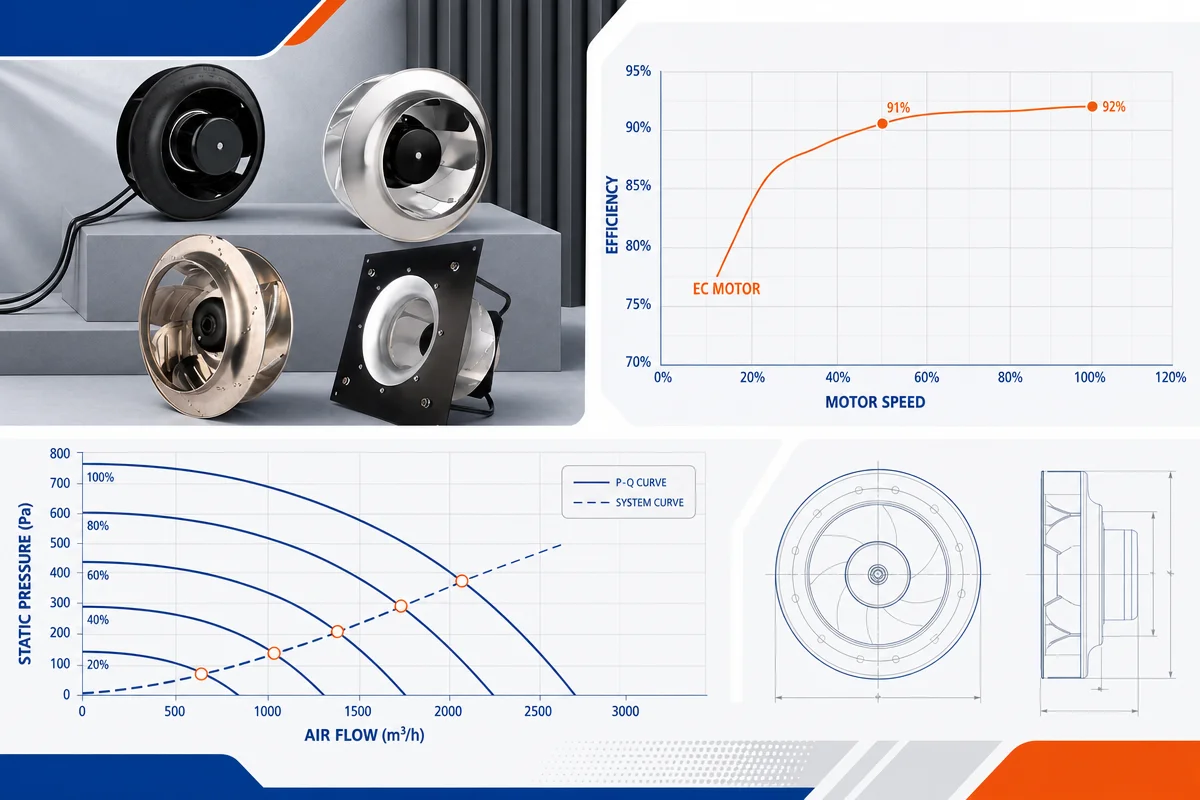
This image shows the basic shape and performance curves for mechanical designers.
LWAA8025SH-10 Technical Specification Document
The attached file gives the exact electrical, heat, and material data for final safety checks.
How to Cool Tight Spaces
First, depth is often the hardest limit when fitting an 80mm 220v ac fan into small boxes. Consequently, planners must check their power setup early to avoid bad surprises.
- Measure your true open depth. A 25mm thick frame leaves very little room for air to spread out.
- Check your available power rails. Running a cooling fan on mains power saves you from buying a separate DC power supply.
- Pick bearings based on your mounting angle. Ball bearings last much longer than sleeve types in vertical positions.
Even so, buyers often forget the difference between 50Hz and 60Hz grids. Therefore, always ask your maker for flow data at both speeds.
Related: Axial Fans.
Frequently Asked Questions
Technical Documentation & Resources
Browse our axial fans range, the AC axial fans section, or EC axial fans.
Have a Similar Fan Requirement?
Longwell’s engineering team delivers custom spec sheets and samples within 90 days. Since 1990, we have supplied EC fans and blowers to OEMs across HVAC, cold chain, data center, and industrial applications worldwide.
Browse Related Products:
🏆 ISO 9001 / ISO 14001 / ISO 45001 | CE (TÜV) | UL/ETL | ATEX Zone 21/22 | AMCA 210-16 / ISO 5801 tested