Replacing a 140mm ec forward centrifugal Fan
A customer asked us to replace a 140mm ec forward centrifugal fan. This fan goes into a commercial HVAC unit. Space inside the metal box was very tight. The customer had already built and locked the physical frame.
We could not change the chassis. First, the customer sent us a strict drawing. It showed a tight total width limit. The fan width could not exceed 73.8 ± 1 mm.
This depth spans from the mounting face to the inlet ring. If the fan was too deep, it would hit the door. Next, the system needed strong cooling power. The airflow target was at least 484 m³/h.
Also, it required a static pressure over 200 Pa. The fan must push air through dense filters. Electrical power limits were also strict. The main system provides 230 VAC nominal power.
However, the grid can fluctuate in remote areas. So, the fan must run safely on a 176-264 VAC band. It must accept both 50 Hz and 60 Hz frequencies. Meanwhile, this unit sits outdoors.
Ambient heat swings wildly during the year. The low temperature reaches -25°C in winter. High temps hit +60°C in direct summer sun. Thus, the internal motor insulation had to meet Class B limits.
This rating prevents the copper windings from melting. Finally, the end user lives in Europe. Consequently, the whole machine must pass strict safety tests. It must comply with EN 60335-1 standards.
These rules ensure basic public safety. Plus, the raw materials must pass RoHS and REACH rules.
Engineering the Fan Rotor
Meeting the 73.8 mm depth limit caused a hard geometry problem. Standard fans in this size class normally measure 80 mm or wider. Thus, a normal fan would simply not fit the hole. We had to find a creative solution.
First, we looked at redesigning the entire sheet metal housing. However, that choice was far too expensive for the customer. It would delay their production by months. Instead, we designed a custom offset for the motor hub. This change let us push the motor deeper into the metal wheel. As a result, the total depth stayed exactly under 74 mm. So, the customer got a perfect drop-in fit. They saved money on factory retooling.
Choosing the Impeller Material
Next, we evaluated the impeller blade material. We briefly considered using molded thermoplastic blades. Plastic is very light and cheap to produce. Yet, the fan runs constantly at 1910 RPM. It also faces a peak operating temperature of 60°C. Over a long 40,000-hour life, hot plastic might warp. Warped blades create loud noise and lose airflow.
Instead, we chose galvanized sheet steel for the wheel. Metal blades stay highly rigid under intense heat. Therefore, they easily maintain the required G6.3 balance grade. This precise grade meets ISO 5801-1997 test rules. It also follows JB/T 9101-1999 vibration requirements. Still, this material choice had a real cost. The metal wheel weighs much more than plastic.
Managing Power and Noise
A heavier metal rotor increases starting inertia. So, the motor must work harder to spin up. Peak input power reaches exactly 70 W. Current reaches a maximum of 0.58 A.
We paired the steel wheel with a high-efficiency EC motor. This motor includes a smart soft start feature. Consequently, the fan takes nearly 15 seconds to reach full speed. This slow delay protects the deep groove ball bearings.
They avoid sudden mechanical shocks. Finally, the customer needed precise fan speed control. So, we added a control circuit for a 0-10VDC signal. It also accepts a 1K to 10KHz PWM signal.
The fan outputs a 10VDC auxiliary power supply. It provides a tachometer signal of 5 pulses per revolution. At full speed, the noise hits 72 dB(A). Ultimately, the customer traded slightly more noise and weight for absolute physical compliance. In return, they gained a durable fan that fit their exact box.
Technical Specifications
| Parameter | Value |
|---|---|
| Model Number | LWFE3G140-072NS-01-00 |
| Nominal Voltage | 230 VAC |
| Voltage Range | 176~264 VAC |
| Frequency | 50/60 Hz |
| Speed | 1910 RPM |
| Maximum Input Current | 0.58 A |
| Maximum Input Power | 70 W |
| Air Flow (Max) | 484 m³/h / 208 CFM |
| Static Pressure (Max) | 216 Pa |
| Noise Level | 72 dB(A) |
| Ambient Temperature | -25°C to +60°C |
| Insulation Class | Class B |
| Protection Type | IP44 |
| Impeller Material | Galvanized sheet steel |
| Bearings | Maintenance-free deep groove ball bearings |
| Life Expectancy | 40,000 Hours (L10) at 40°C |
| Balancing Grade | G6.3 |
| Work System | S1 |
| VSP Control | 1-9.5 VDC |
| PWM Control | 1K-10KHz, 10V amplitude |
| Signal Output | 5 Pulses/Revolution |
| Auxiliary Power | 10VDC, Max 10mA |
The total depth of 73.8 ± 1 mm is the most critical constraint here. It allows the new fan to drop directly into the old chassis. The customer does not need to cut new metal. Furthermore, the wide voltage tolerance matters deeply. It ensures stable 1910 RPM fan operation. Even on weak utility grids, the airflow remains strong. Finally, the IP44 protection rating keeps out splashing water and dust. This is vital for outdoor HVAC systems.
Reference: AMCA 210 covers the test method behind these figures.
Technical Documentation
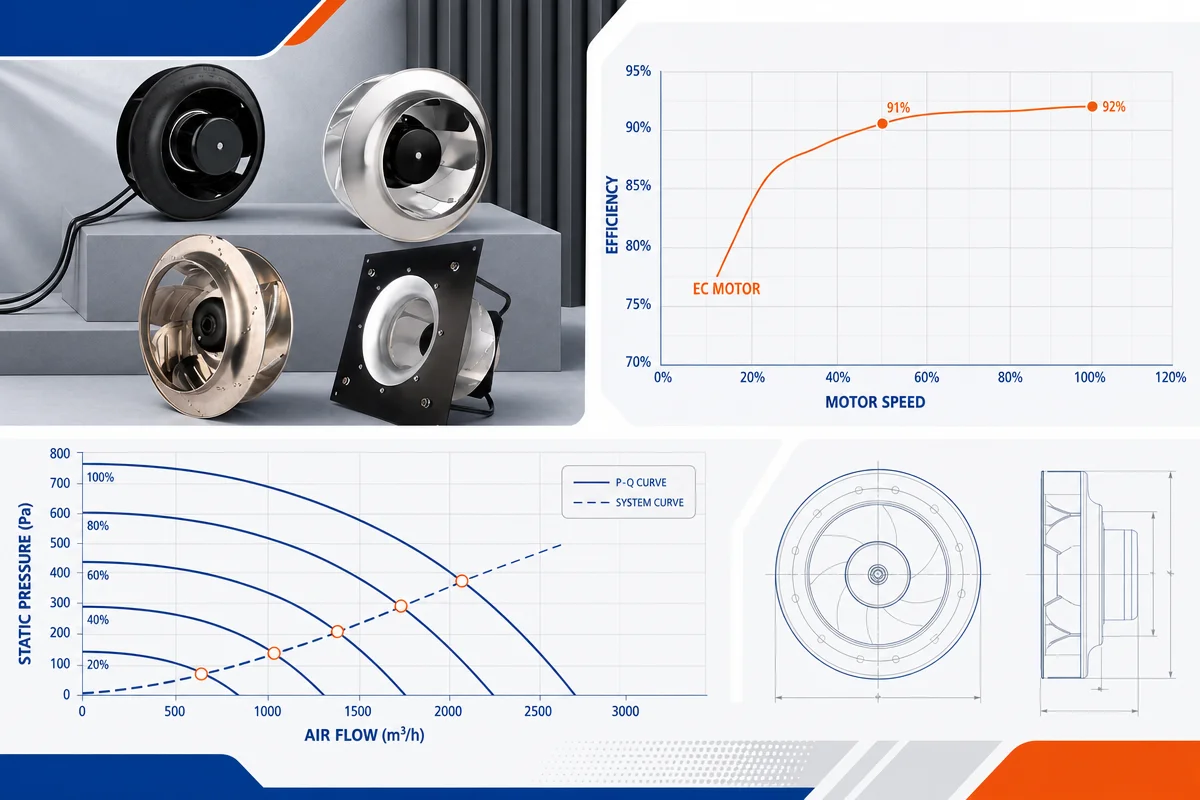
Technical Specification for LWFE3G140-072NS-01-00.
This file details the complete aerodynamic performance curves, wiring diagram, and physical dimensions for the engineering team.
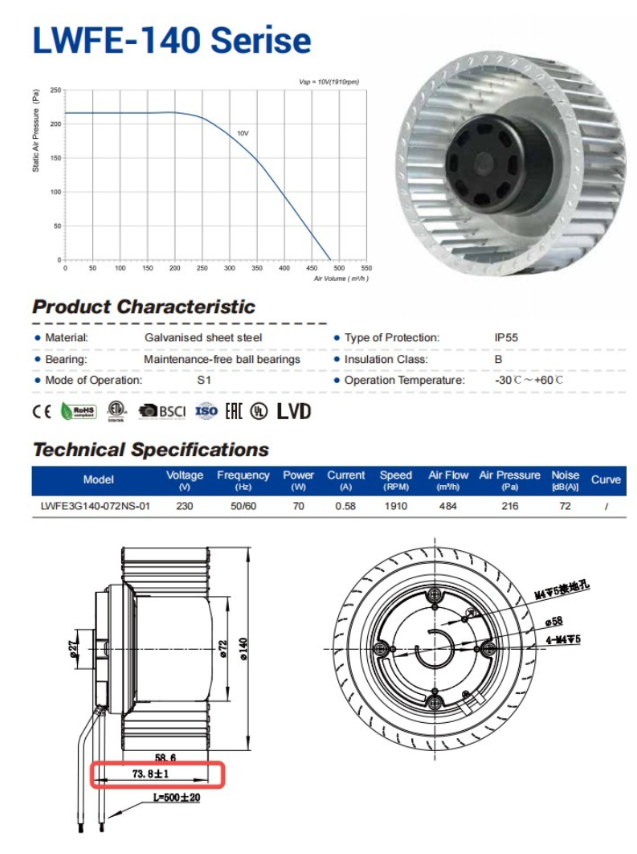
This exact customer drawing highlights the strict 73.8 ± 1 mm depth limit that drove our entire design process.
Specifying Fans for Confined Enclosures
Replacing a blower inside a tight commercial unit requires careful planning. If you face a strictly locked space, check these key details first:
- First, measure the absolute maximum depth from the mounting plate to the inlet ring. This strict number often forces your supplier to customize the hub offset.
- Next, check the maximum ambient heat for your specific application. Sustained air heat above 50°C usually means you must abandon plastic blades entirely. You will need to switch to galvanized steel.
- Finally, send your fan supplier a detailed drawing. Clearly mark the one physical dimension you cannot compromise on. This helps the factory provide an accurate first quote.
Finding these strict limits early stops expensive redesigns later in the project. Related: centrifugal fans.
Frequently Asked Questions
Technical Documentation & Resources
Browse our centrifugal fans range, the backward-curved fans section, or forward-curved fans.
Have a Similar Fan Requirement?
Longwell’s engineering team delivers custom spec sheets and samples within 90 days. Since 1990, we have supplied EC fans and blowers to OEMs across HVAC, cold chain, data center, and industrial applications worldwide.
Browse Related Products:
🏆 ISO 9001 / ISO 14001 / ISO 45001 | CE (TÜV) | UL/ETL | ATEX Zone 21/22 | AMCA 210-16 / ISO 5801 tested