Converting the 230V AC Blower
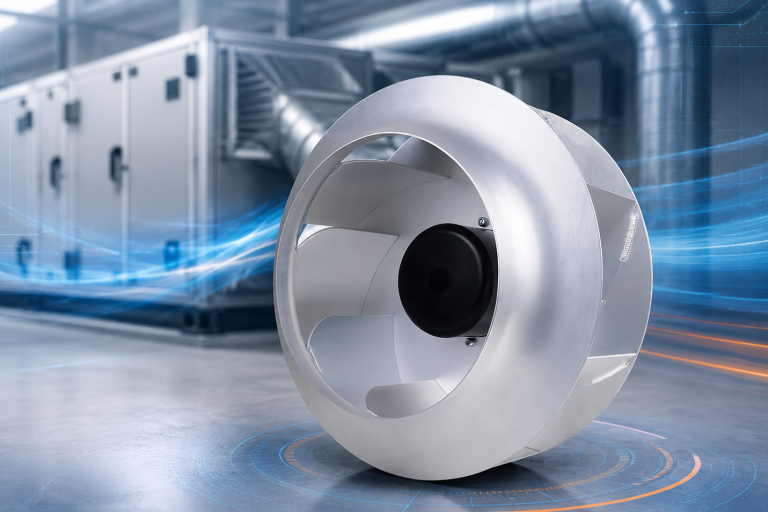
A customer builds equipment for the North American market. So, they needed a 115v backward centrifugal fan. We received an order to convert two 230V AC units. Specifically, they wanted 110V versions of their 190mm and 225mm impellers.
However, the physical space for the fan was strictly fixed. First, we checked the strict performance targets. The larger unit required up to 1287 m3/h of airflow. Furthermore, it had to reach 695 Pa of static pressure.
The system operates in temperatures from -30 °C to +60 °C. Therefore, this -30 °C lower limit means the gear lives outdoors. It likely goes into a telecom cabinet facing harsh winters. Next, the customer had a strict component rule.
They wanted a round motor capacitor instead of a square one. Consequently, we had to fit a larger part into the same tight space. The final design had to meet EN 60335-1 safety rules. Also, it had to work safely at altitudes up to 1000 meters.
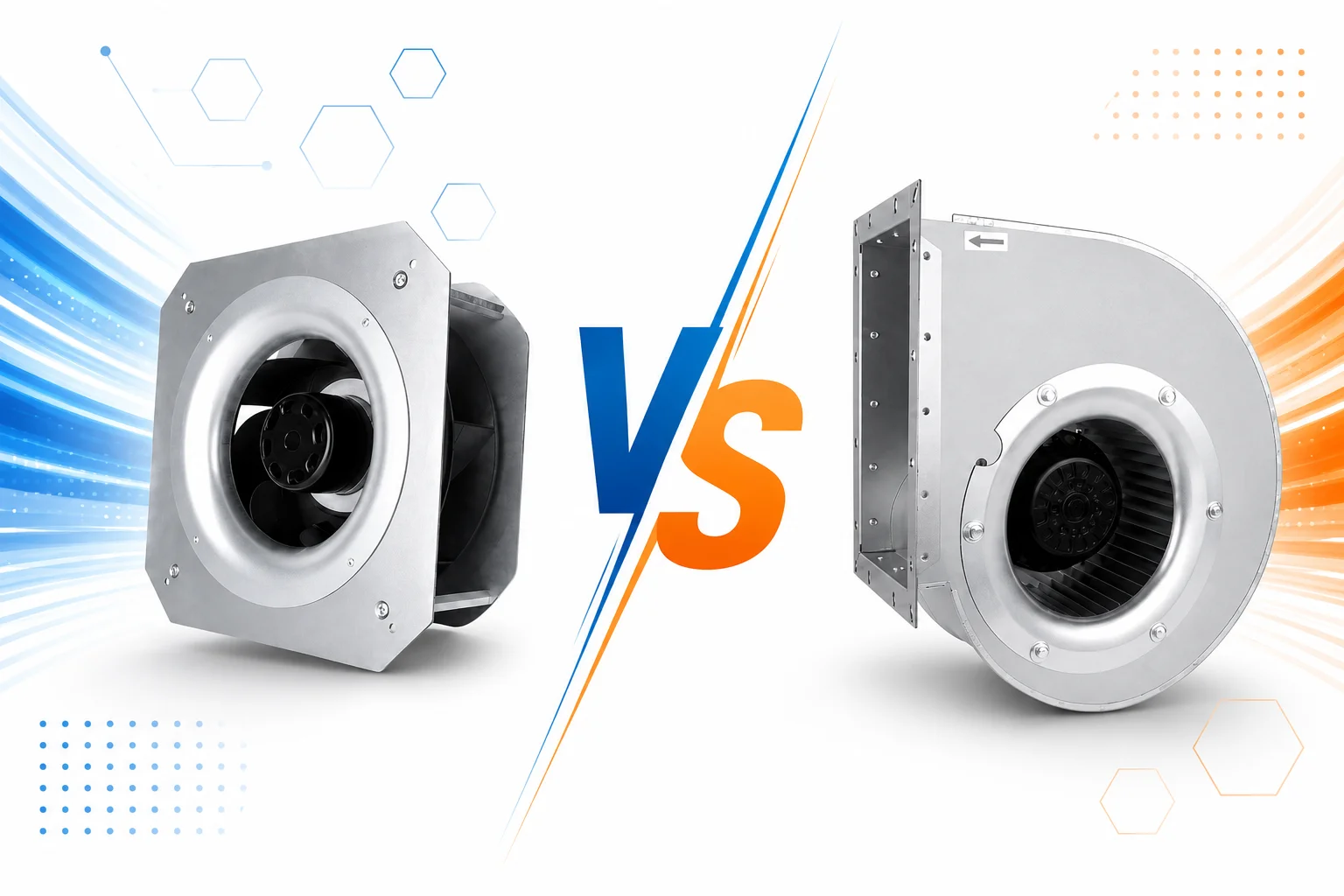
Backward centrifugal fans are great for pushing air through thick filters. In short, we had to keep the exact blade shape intact.
Engineering the 110V AC Fan Motor Conversion
This project brought two main hurdles. First, we had to handle a higher current draw. Finally, we had to mount the large round capacitor safely.
Handling the Higher Current
Cutting the supply voltage in half changes how the motor works. Meanwhile, a motor drawing 0.9 A at 230V will pull about 1.5 A at 110V. This keeps the mechanical power exactly the same. We could not keep the original stator winding. If we kept the old wire size, the higher current would cause too much heat. That heat would ruin the Class F insulation quickly.
Instead, we chose a thicker copper wire for the winding. This lowered the electrical resistance. So, the motor can handle 165 W of input power safely. It stays well within its strict thermal limits. We also added a thermal switch that opens at 150 °C. This design cost a bit more in raw copper material. Even so, it stops early failures under heavy loads.
Fitting the Round Run Capacitor
The customer asked for a round motor run capacitor. Most fan makers use standard square film capacitors. Square ones easily slide into very tight gaps. By contrast, round capacitors use thick aluminum cases. They handle heat stress very well. For the 190mm model, we used an 8 μF part rated for 500V.
We decided not to mount the capacitor on the outside. An outside mount would break the strict size limits. Instead, we changed the internal wiring layout. We locked the round capacitor safely inside the standard housing. This choice added some assembly time to each unit. However, the final 115v backward centrifugal fan met the exact request. It did so without harming the IP44 or IP54 ratings.
Final 115V Backward Centrifugal Fan Specs
In the end, the new fans hit every airflow target. The 190mm fan moves 597.4 m3/h at 2800 RPM. Next, the 225mm model pushes 1287 m3/h at 2900 RPM. Both models use sealed deep groove ball bearings. These bearings last for 30,000 hours at 40 °C. Finally, noise levels remain completely under 72 dB(A).
Technical Specifications
| Parameter | LWBA2E190-092NU-10-00 | LWBA2E225-092NU-22-00 |
|---|---|---|
| Nominal Voltage | 110 VAC | 110 VAC |
| Voltage Range | 99-121 VAC | 98-121 VAC |
| Frequency | 50/60 Hz | 50/60 Hz |
| Input Power | 60 W | 125/165 W |
| Current | 0.27 A | 1.2/1.5 A |
| Speed | 2500/2800 RPM | 2600/2900 RPM |
| Airflow | 556.2/597.4 m3/h (326.5/351 CFM) | 1133/1287 m3/h (666/757 CFM) |
| Static Pressure | 361 Pa | 546/695 Pa |
| Noise | 65 dB(A) | 70/72 dB(A) |
| Capacitor | 8 μF / 500V | 16 μF |
| Operating Temperature | -30 °C to +60 °C | -30 °C to +60 °C |
| Insulation Class | F | F |
| IP Rating | IP44 | IP54 |
The current and input power rows matter the most here. Therefore, the buyer’s control board must safely handle continuous 1.5 A loads.
Reference: IEC 60529 covers the test method behind these figures.
Technical Documentation
190mm Technical Document. This PDF has the physical sizes and electrical data for the 190mm AC model.
225mm Specification Sheet. Engineers need this file to check the IP54 rating and 695 Pa pressure limit.
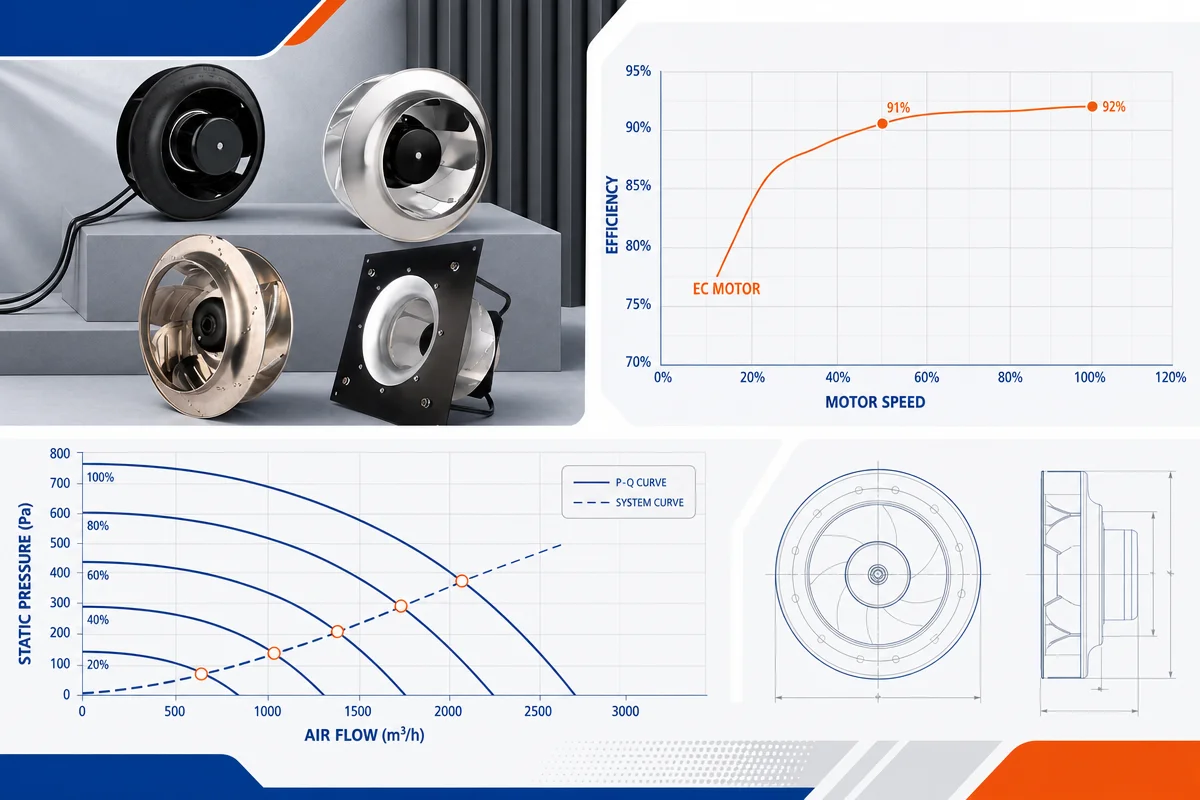
 This chart plots the airflow curve tested to AMCA 210-16 rules.
 Finally, this drawing proves the total diameter stays under 225mm.
Specifying a Voltage Conversion
If you are changing a European design for North America, remember these engineering points.
- First, check the exact sizes of the new capacitor. Round capacitors take up much more space than square ones. They can easily ruin a tight blower layout.
- Next, check the current limits of your control relays. Cutting the voltage in half will double the motor current. This often melts small relay contacts during start-up.
- Finally, tell your fan supplier the exact highest ambient temperature. Extreme heat changes the required wire insulation and bearing grease type.
Related: Centrifugal Fans.
Engineering FAQs
Q: Why does dropping the voltage increase the motor current? A: Electrical power equals voltage times current. So, an AC motor needs the same power to move a set amount of air. Dropping the supply to 110V forces the winding to pull twice the current.
This lets the motor sustain 165 W without losing speed. Q: What separates the IP44 and IP54 ratings on these fans? A: The 190mm fan has an IP44 rating. This rating blocks solid objects larger than 1mm.
By contrast, the 225mm fan earns a tougher IP54 rating. It uses tighter internal seals that block fine dust. Therefore, this makes the larger unit safer for dirty air. Q: Why use a PA66 plastic impeller instead of metal?
A: PA66 plastic offers a great strength-to-weight ratio for fans under 300mm. We inject the plastic in a single piece. This process yields a very even mass spread. Consequently, the fan easily meets the JB/T 9101-1999 G6.3 balance grade. Less imbalance means far less vibration at 2900 RPM.
Technical Documentation & Resources
Browse our centrifugal fans range, the backward-curved fans section, or forward-curved fans.
Have a Similar Fan Requirement?
Longwell’s engineering team delivers custom spec sheets and samples within 90 days. Since 1990, we have supplied EC fans and blowers to OEMs across HVAC, cold chain, data center, and industrial applications worldwide.
Browse Related Products:
🏆 ISO 9001 / ISO 14001 / ISO 45001 | CE (TÜV) | UL/ETL | ATEX Zone 21/22 | AMCA 210-16 / ISO 5801 tested