Defining the Application for a 310V DC Cooling Fan
This project required a specific 310V DC cooling fan for an industrial control cabinet. The customer came to us with strict rules. Their equipment housing gave us very little room to work. We had to move exactly 510 m3/h of air.
This equals about 300 CFM. Also, we had to push this air against a high system resistance. The static pressure limit was exactly 50 Pa. Furthermore, the electrical system was already set.
The main power rail provided exactly 310 VDC. We could not use standard AC power. Therefore, we needed a dedicated direct current motor. Next, we looked at the physical space.
The cabinet offered a tight 200 mm by 200 mm slot. The maximum depth was only 60 mm. These hard limits shaped every step of the design. The cabinet runs indoors.
However, the ambient air gets warm. The required operating temperature range is -10°C to +60°C. Consequently, the fan materials needed to handle this heat safely. The customer asked for a UL Class A insulation rating.
They needed 1,000 units quickly. As a result, we had to use an existing frame mold to save time. Finally, the customer wanted proof of performance. We had to test the airflow to standard AMCA 210-16 methods.
Engineering the 200mm Axial Impeller System
Designing a 310V DC cooling fan within a 60 mm depth is hard. We looked at three different motor types. First, we thought about a standard AC motor. However, AC motors need an extra inverter to control the speed. Adding that part would make the fan deeper than 60 mm. Therefore, we rejected the AC option. Next, we considered a lower voltage motor. But the cabinet only supplied 310 VDC. We did not want to add step-down transformers.
Consequently, we chose a dedicated DC motor. We set the speed to exactly 2000 RPM. This specific speed gives us the 300 CFM airflow. It also pushes past the 50 Pa static pressure wall.
Trading Acoustic Noise for High Static Pressure
Every fan design forces you to choose between airflow and noise. Hitting 50 Pa in a thin frame is tough. The blades must grab the air aggressively. Furthermore, the motor must spin very fast. As a result, the fan makes more noise. The average acoustic output reached 56 dB(A).
We could have slowed the motor down. This action would lower the noise level. However, a slower fan would fail to hit 50 Pa. The cabinet would then overheat. So, the customer accepted the 56 dB(A) noise level. It was the necessary cost to keep the electronics cool in a small space.
Choosing Bearings for a Long Life
Next, we focused on how long the fan would last. The customer wanted a life expectancy of 50,000 hours at 25°C. First, we looked at simple sleeve bearings. However, sleeve bearings wear out too fast. Instead, we chose two ball bearings for the motor shaft.
This choice increased the unit cost. Even so, ball bearings keep the rotor stable for years. Furthermore, we made the frame and impeller from strong plastic. The material meets the UL 94V-0 fire safety rating. Finally, we added locked rotor protection. If the blades get stuck, the motor will not catch fire. In short, the LWAD20060ZL-01-00 model meets all safety rules.
Technical Specifications
| Model | LWAD20060ZL-01-00 |
| Rated Voltage | 310 VDC |
| Speed | 2000 RPM (±10%) |
| Max Airflow | 300 CFM (at 50 Pa Static Pressure) |
| Acoustical Noise | 56 dBA |
| Insulation Type | UL: CLASS A |
| Life Expectancy | 50,000 Hours (at 25°C) |
| Operating Temperature | -10°C to +60°C |
| Dimensions | 200 x 200 x 60 mm |
| Weight | 1050 g |
| Bearing Type | Two Ball Bearings |
These specifications show the limits of this particular 310V DC cooling fan design. The 1050-gram weight mostly comes from the heavy dual ball bearing motor block.
Reference: AMCA 210 covers the test method behind these figures.
Technical Documentation
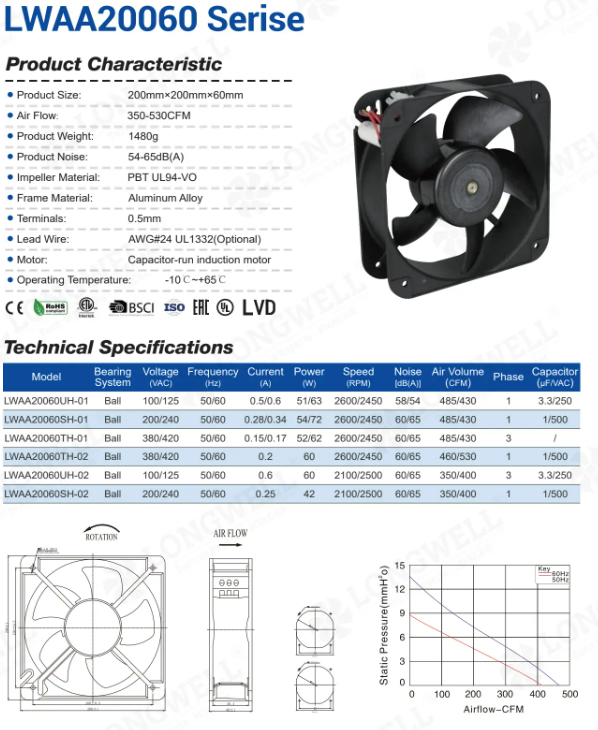
First, this reference drawing shows the basic frame size and the 200 mm mounting holes for the cabinet layout.
Download LWAD20060ZL-01-00 Specification PDF
Next, this approved data sheet gives engineers the exact wiring steps and current limits for the final production unit.
How to Specify an Axial Blower for Tight Spaces
Fitting a high-pressure 310V DC cooling fan into a small cabinet requires careful planning. Do not guess the system resistance before you start.
- First, measure the exact pressure drop inside your cabinet. A simple guess of 50 Pa often leads to buying a fan that is much too weak.
- Next, verify your main power supply early in the project. Sending the wrong voltage to a 310V component will destroy the motor very quickly.
- Furthermore, do not ignore the frame depth limit. A deeper housing makes it much easier to move air quietly.
- Finally, check if you have room for a larger diameter fan. Adding just 50 mm to the width can drop the noise level greatly.
In short, measure the physical space before you pick a motor. Related: Axial Fans.
Common Engineering Questions
Technical Documentation & Resources
Browse our axial fans range, the AC axial fans section, or EC axial fans.
Have a Similar Fan Requirement?
Longwell’s engineering team delivers custom spec sheets and samples within 90 days. Since 1990, we have supplied EC fans and blowers to OEMs across HVAC, cold chain, data center, and industrial applications worldwide.
Browse Related Products:
🏆 ISO 9001 / ISO 14001 / ISO 45001 | CE (TÜV) | UL/ETL | ATEX Zone 21/22 | AMCA 210-16 / ISO 5801 tested